‘Fairly early innings’ of AI
Maybe because it's been a busy week of Halftime with "anniversary" tributes by most of the current panelists, Friday's (10/9) show was flat as a pancake.
Judge opened mentioning the "OpenAI revenue report."
Steve Weiss said what's "worrisome" is the "circular funding" in the AI space.
Jason Snipe mentioned the "vulnerability of concentration risk."
Permabull Stephanie Link, who might possibly have been on every Halftime Report episode this week, said, "There's no indication whatsoever that these companies are going to reduce spend," but if they do, there's risk. Even so, Stephanie asserted, "We are still in the fairly early innings with regards to AI."
Rob Sechan, who had an extremely quiet show remotely, said there's a risk of "one of these financings not working."
Weiss pointed out that defense stocks are trading at 52-week lows.
Weiss is called an ‘influencer’
Judge and Steve Liesman on Friday's (10/9) Halftime Report took up the new White House inquiry of Lisa Cook.
Steve said, "We haven't seen anything like this since we believe the time of uh, of President Hoover maybe." Steve said Liz Warren called it a "kangaroo court."
Meanwhile, MacKenzie Sigalos tackled reports of purportedly slowing iPhone demand.
Judge said maybe people fed up with gas prices just want to wait on their next phone. Judge said the panel wasn't going to go "overboard" (snicker) on a report that's only prompted a great stock to give back 2%. But Steve Weiss said, "The camera's deficient ... goes backwards." Rob Sechan said, "Steve as an influencer might not like the new camera, however, there are a lot of people that will."
Beware the stuck gauge that makes it look like the water level is rising when it’s actually sinking
Stephanie Link on Friday's (10/9) Halftime Report said she bought some stock ticker MIR to get some exposure to nuclear.
(These are obviously different times than 1979.)
Judge said he wondered why Stephanie didn't just buy OKLO, but he saw it's "down 52% year to date," so there seems to be a "disconnect somewhere" in investor interest in the nuclear chain. Stephanie didn't answer the question but shrugged that "we don't have enough power."
Meanwhile, CNBC's Contessa Brewer was in Macau to report on how strong gambling is there, or at least, how strong casino execs say it is. Judge said, "The stocks don't lie." Contessa didn't want to go there, stating that the casino CEOs say investors are "just ignoring how much cash is actually being thrown off by these big casino companies."
Oliver said there was "wild trading in Micron"; someone made a complicated "synthetic short." Stephanie said there's no reason "fundamentally" to short the stock.
Annika Kim Constantino explained why HUM was such a big winner Friday. Steve Weiss said the star ratings are a big deal but that he's "missed this stock."
Stephanie's Final Trade was WFC, Rob Sechan said HPE, Jason Snipe said ANET and Weiss said UNH without mentioning "Hemsley."
We heard early from Carl Quintanilla's crew that Sara Eisen was going to be on Bill Maher's show Friday.
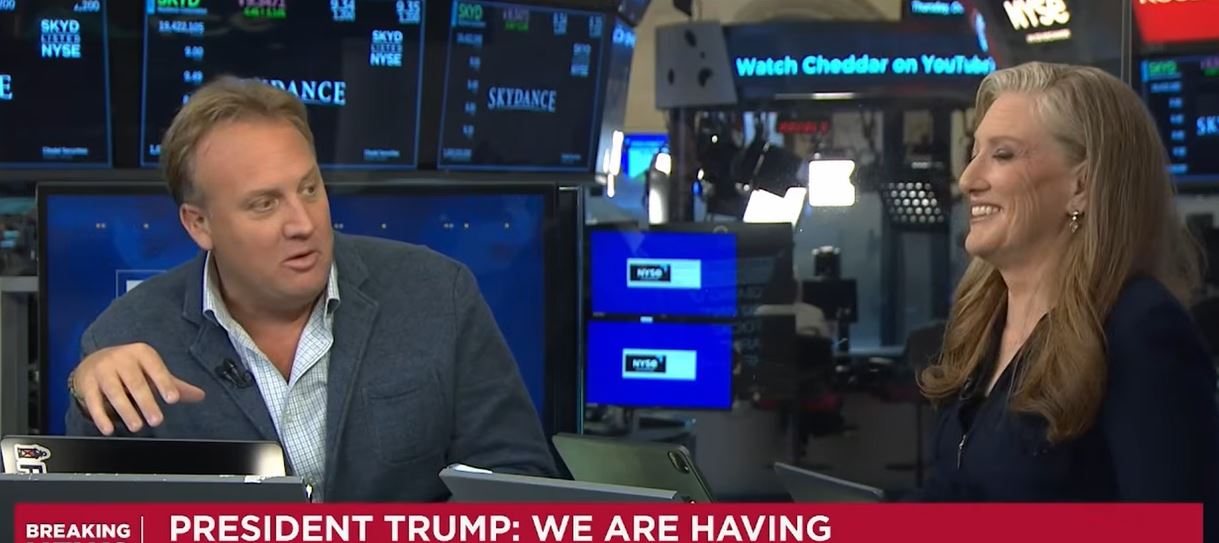
Jenny claims XLE is driven by AI
Megan Cassella reported on Thursday's (10/8) Halftime that Donald Trump says he won't be attacking Iran before the midterm elections.
Josh Brown said he doesn't think the XLE rally is over and called it "a non-AI-related sector."
Hoo boy.
Jenny Harrington, who was celebrated a day ago on this page (see below) and had a great encore Thursday (the bar keeps rising for Jessica Chastain), then cut in and insisted, "The huge winners in that sector are directly because of AI."
Josh said "no" and "can we do facts" and rattled off the refiners leading the XLE.
But Jenny countered, "Almost everything is because there's so much demand for energy of every kind."
Josh said AI is "powered by natural gas" and nat gas prices are "lower today than they were 15 years ago."
Jenny, who got so exasperated, she leaned back so far in her chair as to practically leave the tight screen frame, said CVX is up because of the demand for all kinds of energy.
Jenny told Josh, "You can't disintegrate (sic meant 'disintermediate') energy from AI right now."
Josh said "electricity," not oil, is driving AI.
Josh has the stronger argument, but this is actually one of those debates where both are at least somewhat right; Jenny made some constructive points. (The conference angle wasn't great, but the overriding point was fine.) And, to be honest, no way we're siding against a CNBC superfox (see below) in a debate like this.
Moments later, Josh tred to explain why WSM is on the Best Stocks list while someone, maybe Shannon Saccocia, kept laughing. Then Jenny burst out laughing saying she likes BBY better.
Josh, Jenny again draw battle lines over DIS-vs.NFLX
The Story of the Day on CNBC on Thursday (10/8) was the SBUX-CMG chatter, and the Halftime Report crew didn't seem to think it's a very good idea.
Josh Brown said both SBUX and CMG would "lose another 20%" if they combine. Josh said he "can't imagine" that SBUX shareholders would embrace picking up a different turnaround story.
Judge said Stephanie Link, who wasn't on Thursday's show somehow, was "on a plane" but gave a "quick response" to the SBUX story, which is that she'd be "shocked" if this happens, when they haven't (according to Judge) "fixed Starbucks yet."
But Malcolm Ethridge said the "lack of an overlap between their core customers could actually lead to an opportunity here that maybe we just don't see."
Meanwhile, Josh suggested great earnings won't be enough for the highly rate-sensitive stocks.
Jenny Harrington said the everyman is aware of market headlines; "Even my least-sophisticated clients are like, 'Oh but bonds have been down.'"
Oliver said the options bias in DAL was bearish. Oliver said JBLU is in "free fall." Josh pointed out Ed Bastian is "always on" CNBC around earnings time.
CNBC issued its FA firm rankings, courtesy of Robert Frank, and it's Howland Capital that's No. 1. Howland chief Peter Dixon talked up his "fantastic team" with Judge. "We've been using AI for a long time now," Dixon said.
Very late in the show, Judge revealed the "significant headline" that OpenAI anuualized revenue is $20 billion less than signaled. Santoli said the info "creates a market-wide question in terms of where leadership might come from."
Shannon Saccocia's Final Trade was IYJ, Malcom said V, Jenny said DIS and Josh said NFLX.
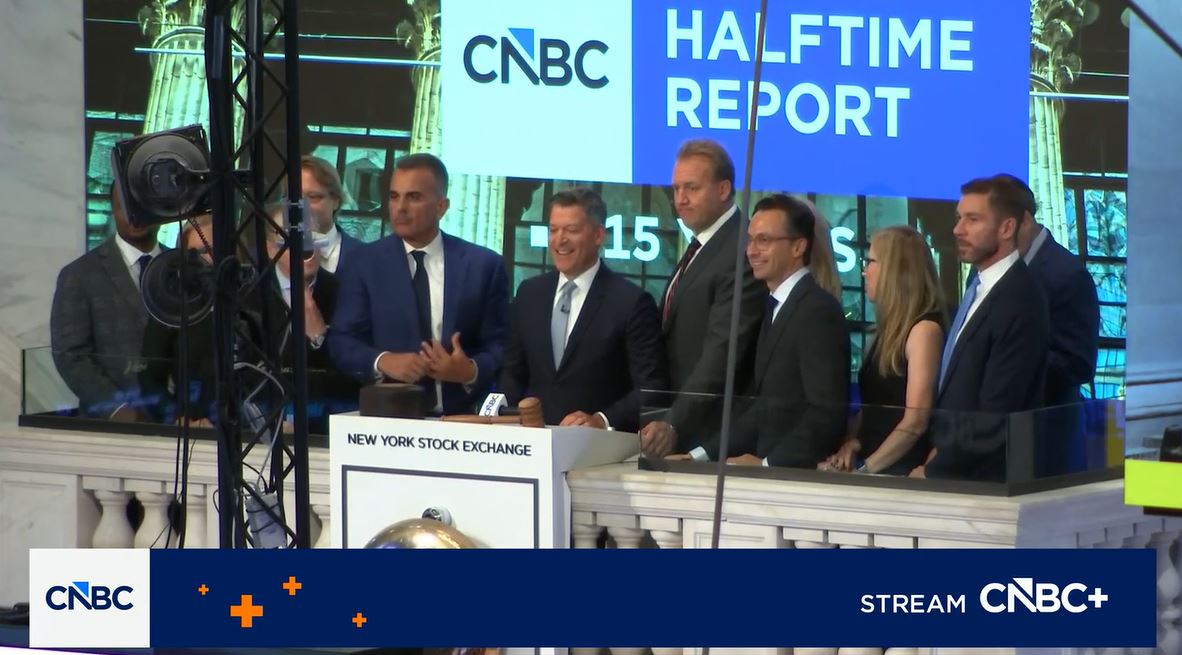
Actually it’s the 17½th-year anniversary, but who (else) is counting
The Halftime Report's purported "15-year anniversary" was celebrated not only by CNBC, but actually by the NYSE, where Judge rang the Opening Bell on Wednesday (10/7).
On Wednesday's Halftime Report, Judge said it was "surreal this morning."
The last thing this page wants to be is Debbie Downer (that was a common Fast Money term around 15 years ago, by the way), but, um, we do sort of believe in the concept of fact-checking ...
First, the notion of Oct. 7, 2026, being the 15-year "anniversary" of the Halftime Report makes no sense. (You can check out yesterday's report below.)
On Oct. 7, 2011, the Halftime Report was a half-hour show, airing at 12:30 p.m. Eastern after a half-hour of The Strategy Session.
In terms of "anniversary," what Judge is actually talking about is Oct. 17, 2011, which is still more than a week away, because that's when the Halftime Report expanded to 1 hour and got the previous Strategy Session time.
Why are they celebrating an "anniversary" 10 days early? Beats us. Chances are 1) The NYSE has other Bell-ringers planned through 10/17 and 10/7 was the only day that worked, and 2) Everybody figures viewers don't know the difference anyway and that nobody fact-checks this stuff. #sorry
Oct. 17 may be the anniversary of the Halftime Report's expansion to 1 hour. But the Halftime Report actually debuted on Monday, April 13, 2009 (a great time to buy stocks, by the way).
It was hosted by Melissa Lee, who wasn't mentioned during Wednesday's anniversary recollections.
The official account of this page noted that the original "Fast Money Halftime Report" was a "nine-minute show at 12:45 p.m." It aired during "Power Lunch." On that first day, the panel consisted of Fast Money regulars who agreed to do this short hit around lunchtime. On April 13, 2009, Guy Adami, Dennis Gartman, Carter Worth and Jon Najarian were on the show. Guy Adami joked, "I feel like Don Shula" (referring to a famous football coach, as the segment was called "Halftime Report").
Back to the present. On Wednesday's show, Josh Brown boasted, "I was on the pilot episode of this show."
Absolutely not true.
This page, not Brown, was here for the "pilot."
Records on this site indicate Brown first appeared on Fast Money (not Halftime) on Dec. 28, 2010.
The first time Brown is documented on this site as being on the Halftime Report was June 2, 2011.
He was not on the Oct. 7, 2011, panel. On the real 1-hour anniversary date of Oct. 17, 2011, panelists/guests included Steve Grasso, Steve Weiss, Pete Najarian, Jon Najarian, Patty Edwards, Mike Khouw, Dennis Gartman, Herb Greenberg and Amelia Bourdeau.
Halftime basically never had a "pilot," unless you count its 9-minute debut on Power Lunch on April 13, 2009, a full year and a half before Brown was making any kind of Fast Money-related appearances.
All "Halftime" was was the regular Fast Money with the same panelists, moved up 5 hours to air during market hours. It wasn't exactly a groundbreaking idea.
For a little while, the Fast Money gang would sometimes joke on Fast Money about things they had said earlier in the day on the Fast Money Halftime Report.
Gradually — and this took literally years — regular Fast Money panelists stopped showing up on Halftime, and Halftime developed its own crew, to the point that for many years now, the shows really no longer have any connection to each other, which is obviously why the Fast Money crew wasn't present for Wednesday's Halftime to offer congrats.
Mel was the early host, until Halftime got handed off to Judge in early 2011 and expanded from 15 minutes to a half-hour. This page reported back at the time that Mel is a fan of "The Hangover."
Back again to the present. Viewers heard about Carl vs. Ackman at the 30-minute mark of Wednesday's (Halftime).
Judge gave a "shout to Max Meyers by the way." Judge recalled that the conversation went "22 minutes straight, no commercials," and it was "the last Friday of Davos."
Judge said the Icahn-Ackman argument served to "put the show, in some respects, on the map," and it's an example of what the show aims to do, "real money, real debate." Pointing to the relevance, Steve Weiss said those kinds of debates happen at investment shops "all the time."
Not surprisingly, Ackman-Icahn got mentioned again at the end of the show.
Around that time, Judge said, "There are several committee members who couldn't be here today due to scheduling issues or, or what have you, thank you to all of you too." OK, from what we can tell, that includes Kari Firestone, Jason Snipe, Amy Raskin, Malcolm Ethridge, though Malcolm was on Closing Bell later in the day.
Judge added, "Let me also say this, um, it's a day also to celebrate and, and say thank-you to the people you don't see. Who truly make this show go. This show is nothing without our incredible production staff. Judge mentioned Executive Producer Kevin Flynn and "super EP" Todd Bonin.
In the morning, while ringing the NYSE Bell, Judge credited Cramer for coining the term "Investment Committee."
Someone unloads the JOET during the Halftime Report 15th ‘anniversary’ broadcast
In an extremely classy comment Wednesday (10/7) about the (purported) 15-year anniversary of CNBC's Halftime Report, Joe Terranova stated, "Every day, over the last 15 years, I'm pinching myself and, and wondering when I'm gonna wake up from the dream that I'm living."
Joe added that "it's a blessing to have this platform; it's a blessing to have an ETF, there's also stuff that comes with it on the other side."
Judge said there's "incredible responsibility" with helming an ETF.
Joe said, "As we're sitting here right now, someone's betting against JOET. Someone just sold a HUGE block of JOET ETF, as we're sitting here on the show. I watched the print go up. ... That's the rawness; that's the realness."
‘This market has no fear’
Panelists on Wednesday's (10/7) celebratory Halftime Report got to discuss the stock market of the last 15 years, as well as Wednesday's market.
Josh Brown said, "I think this market has no fear in it whatsoever." Josh called the 15 VIX "unbelievable."
But Josh said, in place of fear, there is "tons of doubt."
Permabull Stephanie Link suggested the 5.3% 10-year hasn't hurt the market but actually said if we get to 6%, "we'd have to talk about it." (And then when it gets to 6%, it'll be, "if it gets to 7, we'll have to talk about it.")
In a show heavy on research of past moments, Judge admitted, "I don't know what the Nasdaq was trading at 15 years ago."
Steve Weiss said this is a "very interesting period" and that the market "cohort" has changed since 2008; it's index-driven "and they're used to these V-shaped recoveries," whereas at the beginning of the century, the downdraft "lasted for a decade."
Judge asked about the RSP's slump in the last month. Bryn Talkington said, "There is interest-rate sensitivity" and pointed out that we've come from zero rates over the last 15 years, whereas, in the 2000s, it wasn't like the market was weaning itself off ZIRP from the '90s.
Jenny buckles knees during anniversary edition of Halftime
The biggest highlight from Wednesday's (10/7) Halftime Report was not the Bill Ackman-Carl debate.
Rather, it was the black/gray ensemble worn by CNBC superfox Jenny Harrington that had viewership crowds buzzing.
If we do succeed in getting Jessica Chastain to actually portray Jenny in the movie, Jessica's got a lot to live up to.
Joe is the only one thanking the viewers
Josh Brown on Wednesday's (10/7) Halftime Report said he doesn't get why SPOT isn't more well-liked; he thinks it's been caught in a "vortex with other media stocks."
Kevin Simpson said he bought more SPCX. (This writer is long SPCX.) That's curious, because months ago, as SPCX began to slide below $200, Kevin made a point of saying he'd easily buy more if it got close to $100, but then we never heard him indicate he had actually bought more.
Evidently, he did.
He said Wednesday he previously bought at "120, 121" and apparently also bought on the Wednesday pullback. He suggested it could be a "big winner" 15 years from now.
Sarat Sethi bought more RACE, citing limited supply of the product, and also bought DIS, citing "global brand" and earnings, "great products, new management, balance sheet's much better." (Which doesn't sound like the greatest endorsement of Iger.) (And how does "new" management necessarily mean "good.")
Bill Baruch trimmed BRK-B, calling it a "low-beta name at the end of the day" while the market is "breaking out," so he cut in half and bought MS. Josh said homebuilder stocks have "all been thrown in the garbage," but "maybe Berkshire knows something the rest of the market doesn't." Josh said he's "never sold" BRK.
Josh's Final Trade was TTAN; Stephanie Link said META, Joe Terranova said ABNB and in an extremely classy moment said he wanted to "thank the viewers ... we're nothing without you." Steve Weiss' Final Trade was SKHY.
Judge apparently getting head start on 15-year anniversary festivities
Late on Tuesday's (10/6) Halftime Report, Judge said that on Wednesday, Halftime will celebrate 15 years.
"Talk about how we got here and what we think we're gonna do next. Can't wait," Judge said.
15 years on television is an impressive run.
We have no doubt Wednesday's show will provide some great highlights and relive some great memories.
But we do have to note a few things.
Exactly when the "anniversary" of the Halftime Report occurs is a matter of debate. The show began as a less-than-15-minute insert into the lunchtime hours to allow traders from Fast Money to make real-time calls rather than being limited to aftermarket calls.
It quickly outgrew that limited amount of time and took up the 12:30 Eastern half hour after The Strategy Session, which aired at noon Eastern.
The Oct. 7, 2011, Halftime, which was a Friday, was still a half-hour show and was hosted by Judge, whose panelists were Mike Murphy, Steve Grasso, Patty Edwards, and some guy named Jon Najarian.
As you may have noticed, 3 of those 4 people have not been on CNBC for a long time.
Which is too bad. We get that TV shows, like any business, have to make tough decisions about personnel. But a lot of good people have graced the Halftime Report and aren't heard from anymore.
The "real" 15-year anniversary that Judge plans to observe (more than a week early) is actually Oct. 17, 2011. That was a Monday. According to this site's archive, that was the first day the Halftime Report went to 1 hour. It was given the half-hour slot occupied by The Strategy Session, which signed off Oct. 14.
On that Oct. 17, 2011, according to this site's archive, "Steve Grasso and Stephen Weiss butted heads over GMCR."
It appears Pete Najarian, Jon Najarian and Patty Edwards were all panelists, and that Herb Greenberg and Dennis Gartman appeared on that episode.
We think ... THINK ... that Judge was doing guest-hosting around CNBC in spring 2011, then started taking over Halftime duties permanently around May 2011. So while Oct. 17, 2011, marked a significant expansion for the show, it wasn't the beginning of the Judge Era.
As for the memories, we get that the all-time Halftime Report highlight is Bill vs. Carl. But that was 13 years ago. At some point, it would be great to create some new memorable moments in television.
Kevin: Might be 1-and-done
Judge on Tuesday's (10/6) Halftime Report said Wolfe has an 8,000 target, calling that number "intact" (snicker).
Kevin Simpson thinks the Fed hiking cycle could be one and done. Bryn Talkington said it might be "one more and done." Bryn said if the market really was projecting out multiple hikes, "that broadening story would be dead in the water."
Bryn predicted earnings season will be "all about tech and energy."
Jenny Harrington bought GOOGN, which is some kind of convertible preferred of the Alphabet stock everyone otherwise owns, and said of Big Tech, "Everyone thinks I don't like them just because I don't own them, but that's not the case, it's because I haven't been able to buy them."
Permabull Stephanie Link said she sold "a good chunk" of MRVL "a while back" because she "was up 150% (chuckles) in 3 months time." Stephanie said, "Their total addressable market is so underappreciated (snicker)."
Kevin said it' "hard to argue" against Citi's 800 target for AMD.
Kevin said he feels good about moving from IBM into NVDA. Kevin bought more UNH. Jenny tried to argue why dividend stocks won't get crushed by rising rates.
Santoli pointed out, "The market's being very discerning within semis right now."
The daily panelist commentary on NFLX (cont’d)
Judge on Tuesday's (10/6) Halftime Report announced that "Elon's a trillionaire again," and that Goldman raised its SPCX target to 230 from 220. (This writer is long SPCX.)
Stephanie Link for the 2nd straight day (see below) got to comment on how great the SPCX outlook is; she bought it when it was down 40%, 30%, 25%, always Halftime panelists' favorite metric.
Jenny Harrington, who has never NOT defended DIS, said there are 4 reasons to like the stock: "There's double-digit underlying EPS growth, the reacceleration of theme parks is strong, there is the multi-year sports drivers, and the new reenergized senior management team."
Whoa whoa whoa ... that last one is kind of interesting. How is the management team "reenergized" when it's new people (not the guy who hung on for 20 years and ousted someone so he could come back because he was bored). The management team has less stature at DIS than David Muir.
But Jenny admitted she bought DIS 6 years ago around 118, and "we're still down." Judge wondered, "Why are you still there?" Jenny said "it's pumping out free cash flow" and "it's cheap" and there have been other stocks where she realized if she held on just a little longer, she would've made money.
On NFLX, Kevin Simpson admitted he's "down about $10 on this in a very short period of time, like 6 weeks. ... Content's the problem." He mentioned "sports" and "live entertainment," which is what people always say about NFLX (and sometimes people mention "ad tier" too).
Oliver said PEP has had a "rough year" but that call-buying was outpacing put-buying Tuesday. However, the only big trade was someone buying 130 puts expiring September 2027.
Bryn Talkington's Final Trade was GPIQ. Kevin said UNH, Jenny said CWEN and Stephanie Link said EQT.
Judge somehow didn’t entertain a debate about NFLX on this episode
Judge opened Monday's (10/5) Halftime asking the panel "how long stocks and bonds can coexist at their respective levels."
Which is a question you're probably going to be hearing for weeks.
Joe Terranova said there are "2 things" that suggest "this can continue," apparently "this" meaning stocks and 10-year yields keep going up. Joe said there was a "clearing event last week" at the White House with the tech CEOs that "comforted" the market about data centers meriting debt spending; also MU earnings "validated" the AI demand.
Permabull Stephanie Link of course thinks "we're gonna continue to see a rally in equities," because the economy's so great.
Josh Brown said the S&P 500 has been "lying to you" this year, showing positive returns, but "we just do not have the majority of stocks in a bull market right now" as managers are finding the Mag 7 to be "the Easy Button."
Joe said the "cyclical component" of the market has "clearly" lost momentum.
Stephanie noted how much certain industrials are down, "but the backlogs are only accelerating." (Imagine all of that Total. Addressable. Market.)
Jimmy Lebenthal touted the "uptrend" in energy stocks and suggested it'll take a while to refill oil inventories.
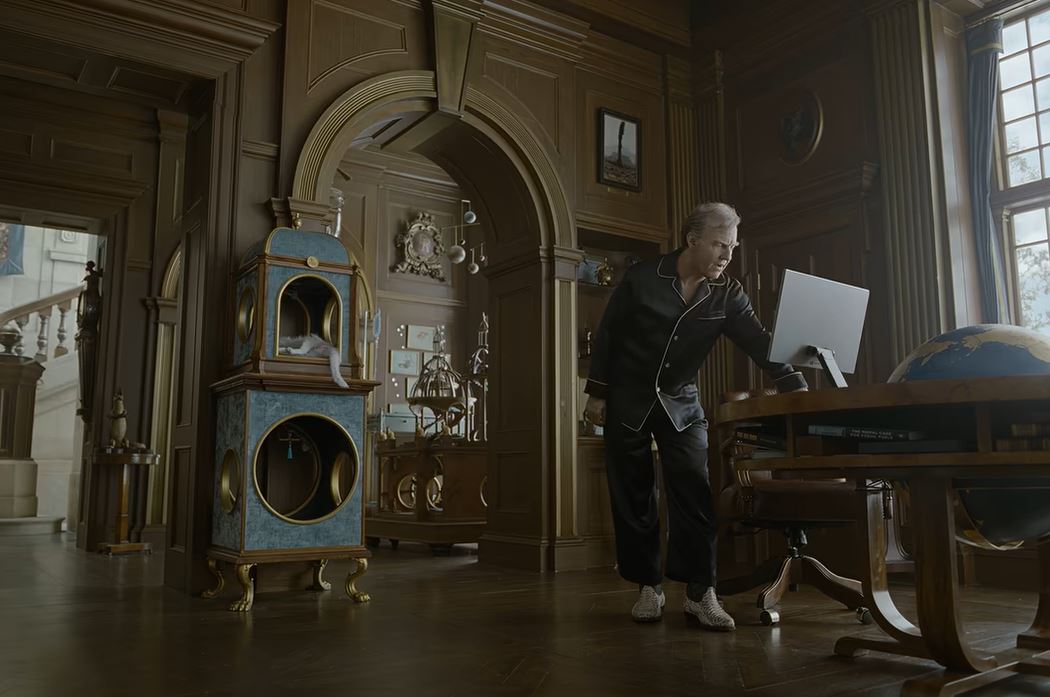
What in the world was Tom Cruise, 64, thinking?
Judge on Monday's (10/5) Halftime Report at one point mentioned "Brady Bunch" to Josh Brown, as a jab at Josh's shirt.
As far as media conversations go, Judge could've instead asked the panel if anyone 1) actually bought a ticket to "Digger" and 2) if so, actually found the movie watchable.
Because we'd like to know.
Anyway. Judge said Adam Jonas is pinning a $300 target on SPCX. (This writer is long SPCX.) Stephanie Link, who's long SPCX, noted Halftime panelists' favorite metric, that the stock is "still down 17% from the highs."
Stephanie keeps talking about EL (this writer is actually long EL); we have no idea why. Stephanie says that one is "down 74% from January 2022 highs."
Stephanie expressed enthusiasm for buying WFC (Zzzzzzzzzz).
CBOE got an upgrade from TD Cowen; Joe Terranova bought personally in June at 266; "I was ready to time-stop myself out of it at the end of September."
"Technically, this thing is in no-man's land."
The Best Stocks thing was mostly a recap; Josh Brown mentioned INTC and VLO. He also mentioned CRH getting knocked out, for those keeping score. CRH fan Jimmy Lebenthal said he understands why CRH would get knocked off the list, but it's because of interest rates, and Jimmy isn't selling, the stock is still a "good long-term compounder."
Oliver said bearish options traders "were getting waxed" by the EWZ. Oliver mentioned the great year of the EWZ. Stephanie said, "I've never seen an ETF up this much."
Josh's Final Trade was NVDA. Jimmy said LNG, Stephanie said ANTO-GB, and Joe said STLD.
Judge said Al Michaels, who was in Cleveland last week for that dreadful Pittsburgh Steelers game, sent Judge a picture of Cleveland-Cliffs.
Frank takes a page from Judge’s playbook, asks everyone why they don’t own META
Frank Holland guest-hosted Friday's (10/2) Halftime Report with Amy Raskin, Jimmy Lebenthal, Malcolm Ethridge and Bryn Talkington, but PermaBull Stephanie Link was available to join in to discuss buying META.
"I think this story is totally changing," Stephanie said, adding, with a straight face, "The TAM is in the trillions in my mind."
Somehow retrying Judge's excruciating go-round a week ago, Frank asked Bryn, then others, why she doesn't own META. Bryn said she owns the QQQ and "I'm so overweight technology."
Amy said she hasn't used Muse yet, and "they're not gonna own this market ... it's still unclear to me how they're really gonna monetize it, um, in a trillions way."
Also, Amy said she can't get past "the issues around what they do to children," adding, "I've never had a client push back on me for when I say that."
Malcolm said Muse is popular but his issue is "the monetization of it," and the reason it's popular now is that you don't have to pay for it.
While we cringed when Frank went down this path, it was actually a fine discussion this time.
Bad news for the 490
Bryn Talkington on Friday's (10/2) Halftime Report claimed the Fed is not "looking to be political" and therefore will be "on hold through at least December."
That would be at odds with Jeffrey Gundlach's comments to Judge a few weeks ago about how most people don't know about the Fed and therefore there's no reason to avoid October moves; "What percentage of Americans know that there is a Fed funds rate?"
Jimmy Lebenthal on Friday opined, "I think the 2-year is way ahead of itself."
Amy Raskin said, "I think it's gonna be hard to get rates down sustainably without a slowdown in economic growth." Which we agree with. But it is kind of at odds with the panel's discussion about the consumer and NKE in the latter half of the program.
Guest host Frank Holland said Scott Rubner is "more constructive" on equities in Q4.
Jimmy claimed the oil world is figuring out alternate options; "There have been a number of workarounds around the Strait of Hormuz already."
Malcolm Ethridge predicted of the stock market, "It's going to be a playing of the old hits. That means the S&P 39-, uh, 490, probably not going to matter all that much toward the end of the year."
Late in the show, Santoli said "still some questions going into the weekend."
Frank should’ve led a discussion on whether ‘Digger’ is watchable
Friday's (10/2) Halftime crew, with guest host Frank Holland, took up NKE and athletic apparel.
Bryn Talkington said it's too hard for these stocks because "there's just too many choices" for athletic footwear/clothing.
Amy Raskin agreed and said even selling NKE "years ago" was "too late."
Jimmy Lebenthal owns ONON and said, "I think the problem here is China" for all of these stocks. Frank indicated he wears "size 14s."
On Fast Money, Karen Finerman said of NKE, "I would much rather buy it at 40."
Meanwhile, Bryn said rather than AI, "This whole market's been about energy this year."
Amy trimmed ILMN, NTRA and CRWD because they've done so well.
Amy bought more BRK and VRTX and MDI-CA, a stock probably never mentioned on the show.
Jimmy bought more ORCL (which he always seems to be buying) and MU.
Malcolm Ethridge bought more GS and MS.
Bryn said 370 is important for TSLA, and if 370 proves support, it can move higher this quarter. (On Fast Money, Karen Finerman said TSLA "is like a tracking stock for SpaceX at this point.")
Jimmy likes CRH, he says any pullback over the last 10 years is a buying opportunity. But he said it's not a trade, it's something you should plan to hold 2-3 years.
Amy said she trimmed SNOW "too early." Bryn said CBRE is a "wonderful company and good stock."
Oliver said IBIT calls were popular. But someone made a big bet that MSTR will stay under 162.5 by the end of the day. Bryn thinks the downtrend in bitcoin is "somewhat over" and "better days are ahead."
Bryn's Final Trade was NVDA, Malcolm said OKTA, Amy said CGNX and Jimmy said DAL.
How many days in a row are we going to discuss NFLX
In a very sleepy edition of the Halftime Report on Thursday (10/1), what better to try than another discussion of NFLX.
Josh Brown admits NFLX is the stock he's been "the most wrong about this year," but he's not a "prisoner" to it, he could sell it any time. He's in it higher but figures it eventually will make money. Josh said, "They figured it out ... They are now actively deemphasizing this stupid metric of time spent."
Malcolm Ethridge indicated it's a perception issue, stating, "Investors are misunderstanding how they should think about the company now." Sarat Sethi said everyone likes to "watch" Netflix, but the battleground is the multiple. Sarat correctly noted media companies don't trade well nowadays.
Still wondering why Alex thinks Eamon thinks Alex might be the ‘village idiot’
Mel (called "M-Lee" by Carl in the lead-in) was the guest host on Thursday's (10/1) Halftime, a show that could've used one of those Guy Admi-Tim Seymour '70s rock music arguments. (Actually they don't really argue.)
Sarat Sethi opened Halftime saying the markets are "really focused on" rates.
Bill Baruch suggested there's a "bottom" building in bonds; he said there's "definitely some window-dressing" in people selling bonds, and also the "carry trade" (Zzzzzzzzzz) is a factor.
Josh Brown said "The Mag 7 is back to Mag 7'ing."
Malcolm Ethridge bought more RKT. Bill bought MHVIY.
Josh Brown bought more SNOW, he said he "added again yesterday." It was also his Final Trade.
Josh said WST is on the Best Stocks list.
Santoli said in Mike's Market Memo that the market was "taking a breather" on some entrenched trends.
Touting the WNBA playoffs, Elle Duncan gave a shout-out to VSNT Sports.
Mel said investors in NKE have gotten "fooled" maybe "one too many times."
Bill's Final Trade was MU. Sarat said MS, and Malcolm said CB.
Jon Fortt asks the
‘Marathon Man’ question
On Wednesday's (9/30) Halftime Report, Oliver said CBOE and HOOD were popular in the options market. Guest host Jon Fortt asked the group about "tokenized trading" and said, "I think a lot of the people using it, especially on Robinhood, haven't experienced a good sustained downturn, probably ever. Is it safe?"
Joe Terranova gave a bureaucratic response, "Market structure has changed dramatically ... I don't know if I like the word 'safe.'" Joe said "without question," there's the possibility of a significant correction.
Jon referred to the housing crisis and said, "I worry about people buying stocks they can't afford." Jenny Harrington said it's a "tale as old as time."
On Fast Money, Guy Adami and Dan Nathan were at some HOOD event.
Jenny says Meg Whitman, 70, is old enough to avoid gigs that may have a negative outcome
On Wednesday's (9/30) Halftime Report, Jenny Harrington said she sold WHR; "if you followed me into it; I truly apologize."
Jenny bought ACI and said it "sounds boring" but is kind of "interesting," has a "huge 5.8% dividend yield."
Jenny concedes you can "poke fun" at grocery stores but asserted a fact we weren't aware of; "people don't want to go more than 3 miles."
Jenny then said "What I like most" is that the CEO is great and Meg Whitman is taking over as chairman, and "Meg's at the point in her life where she's not going to get involved in something unless she is quite positive that she can make a positive impact."
Guest host Jon Fortt correctly cracked, "Unless it's politics."
Joe Terranova told Jenny, "I'm very proud of you for getting rid of Whirlpool," but he questioned why ACI is down so much in 4 years. Jenny blamed the failed KR merger.
Liz says Fed hike wasn’t actually ‘needed’
Liz Thomas said at the top of Wednesday's (9/30) Halftime Report, guest-hosted by Jon Fortt, "I don't think the Fed needed to hike rates. Totally understand why they did."
Liz predicted a "relaxation in inflation," and if that happens, "the rate-hiking cycle all but disappears."
Steve Weiss said rates "show no signs of going lower" but "every sign of going toward 6%." But, "it's too dangerous to be short."
Weiss attributed CAT's "good month" to the "AI trade," not the "real economy." Jenny Harrington said her portfolio is the "real economy," including CAG and KMB and CLX and CMCSA; she thinks now is "probably a buying opportunity."
Joe Terranova said the Q3 market "bent, but it didn't break."
As to the stock of the day that would report earnings later, Weiss said MU has "traded forever" at its 6½ P.E. Weiss said he apparently unloaded a stake in MU when it was "up over 300%" in less than a year. Still, he's been "trading it"; which he doesn't "talk about on the show because it gets confusing for viewers."
Weiss curiously said, "I think most investors are better in the indices than in individual stocks."
Weiss remains on MRNA bandwagon
On Wednesday's (9/30) Halftime, Steve Weiss lamented Citi's downgrade of MRNA; "I don't know why they're downgrading it," the future is "extremely bright."
Sara Eisen mentioned Ken Griffin's beef with Harvard.
Joe Terranova's Final Trade was CBOE; Liz Thomas said the 10-year (Zzzzzzz), Jenny Harrington said MRP and Weiss said META.
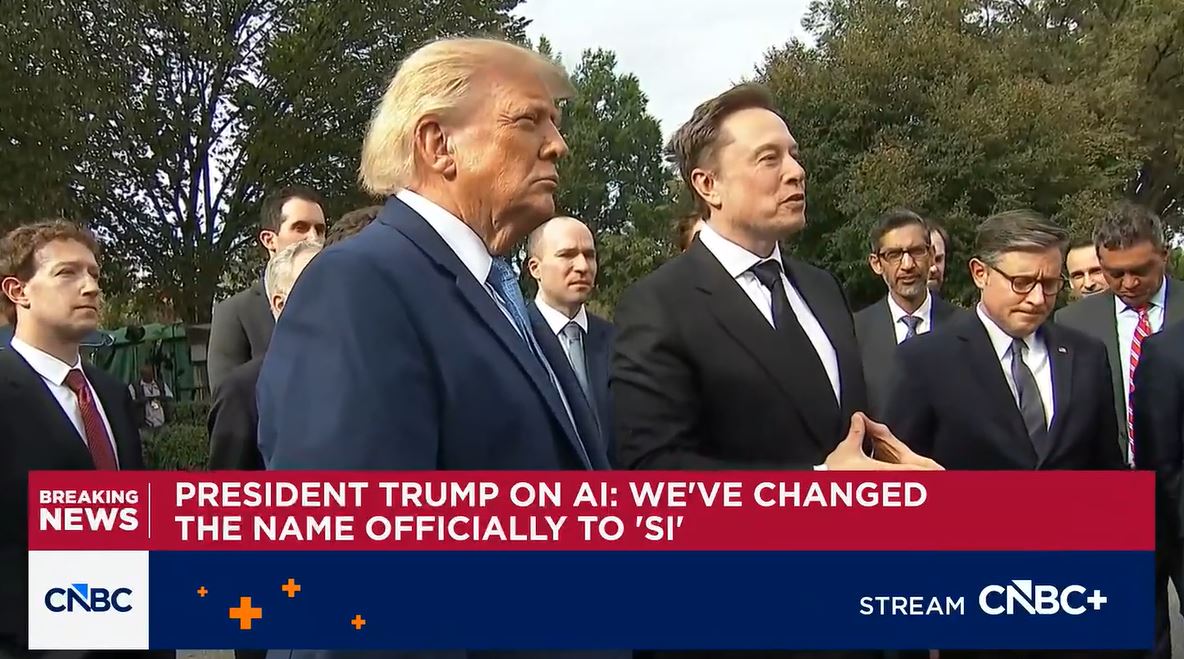
Finest moment of Donald Trump’s second term — impromptu press conference with tech giants
It was so good, we even watched it twice.
Judge's Closing Bell on Tuesday (9/29) got an unexpected treat when Donald Trump put together an impromptu press conference outside the White House — surrounded by most of the biggest names in tech.
Jensen. Elon. Zuck. Sundar. Dario. And others we didn’t recognize but must be bigwigs.
They were casually taking part in a very important American event — a press conference. Freedom of the press. Business leaders — many of whom are almost never available — engaging. And seemingly happy to do so. A win-win.
Donald Trump entertained a remarkable amount of questions rarely granted by presidents. Most were intended for him, but several times, he deferred to others.
The media questioners were great. There wasn't wasted time (and the time allotted was very generous), and there were hardly any fawning questions; there was a pointed question about Republican candidates spurning Trump. There were moments of chest-thumping, but in a more impressive way this time.
Much has been made of Silicon Valley's lack of effective messaging about data centers. Tuesday's press conference was the best response, probably ever.
Jensen, Zuck, Dario, Sundar, Elon, all making very eloquent remarks across the board.
We do wish Tim Cook had been there, but can't have everything. (Maybe he was, but he wasn't on camera.)
Later on CNBC's Fast Money, Karen Finerman and Steve Grasso called the White House tech summit a "win."
Pretty much all of the press conference questions were good, and the entire discussion was crisp and topical and relaxed. This page is not implying or suggesting that the tech leaders — or this page — agree with Trump's responses to the questions. Rather, this theme was clear — that these business titans are willing to work for the greater good, that they're taking the concerns seriously, that they're going to make it work, and America is going to lead.
Kate has better luck with Sam than Julia did with Elon at Sun Valley
The star guest of Tuesday's (9/29) Halftime Report was Sam Altman, who was not actually at Post 9 (too bad, that would've been awesome; Boy George did it this year) but in San Francisco for an interview with CNBC's Kate Rooney at an OpenAI event.
And, after Judge touted the interview from the beginning of the program, he didn't cancel. #whew #seebelow #SunValley
Kate did cover a lot of ground, but we didn't hear a whole lot of headline statements. She started by asking Sam about abandoning some new AI model; Sam said it falls under the "abundance of caution category."
Kate asked about Muse. Sam said, "I've tried it; it seems like a nice product." Kate asked if Sam is "threatened by Zuckerberg at all." Sam said "no."
Sam said of the possible IPO, "I don't have a particular timeline in mind," which Judge decided was the headline from the interview.
Judge noted that Sam said something about "liability framework" (Zzzzzzzzzzzzzzzz).
Joe Terranova discussed AI innovation and declared, "Cybersecurity is the No. 1 investment off of it."
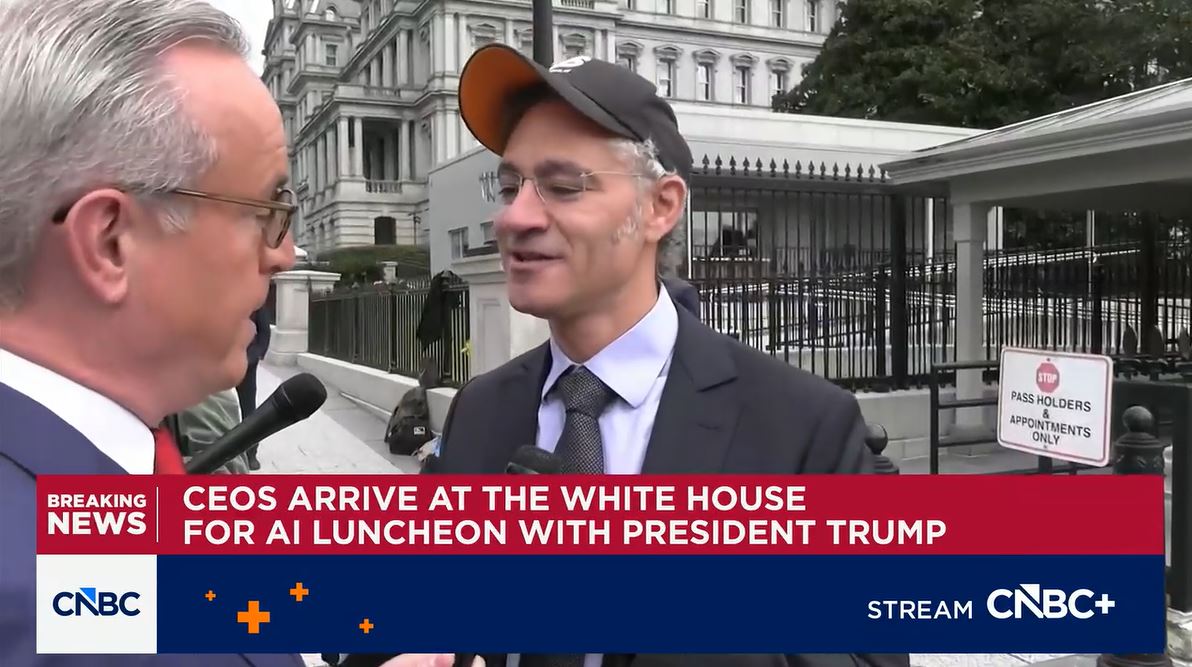
Alex Karp asks if Eamon thinks Alex is the ‘village idiot’
CNBC's Eamon Javers on Tuesday (9/29) was stationed at the White House (where apparently TV cameras still operate) and, during the Halftime Report, mentioned briefly interviewing Alex Karp, who "was kind of aggressive" and "got kinda nose to nose with me ... inches from my nose."
The clip showed Karp asking Eamon, "Do you think I'm the village idiot?" Eamon responded, "I'm asking you the question."
But exactly what the question was that prompted Karp's reaction wasn't shown.
Stephanie Link said she doesn't know if she wants part of the Anthropic IPO. Josh Brown suggested NVDA shares might take off and said it would make people's "heads spin" if it does so.
Grasso says data center opposition has ‘jumped the shark’
Joe Terranova on Tuesday's (9/29) Halftime Report predicted "historic" revenue from MU's report, though he's "not as confident" about the market reax.
Permabull Stephanie Link of course expects a "great report" but noted how much the stock is up since early in the year.
Joe made the argument that MU's having a "secular shift" rather than just being "cyclical."
Jason Snipe said a lot has been "going on with yields over the last 30 days or so; I mean the 10-year is up 50 basis points, in the last 30 years (sic)." Still, it's a "solid" setup, and "I am bullish going into this quarter."
Judge said Deutsche Bank gave NFLX a 95 (snicker) target. Remember when Josh Brown months ago was gushing about how it would get to 120, no problem? Josh said Tuesday he doubts it'll see 100, "that's a stretch," but he thinks it's "way too cheap."
But Josh admits "it seems like dead money" and said he'd rather buy if it breaks out over 80.
(Karen Finerman on Fast Money said NFLX is "paying a lot for content" but still, "I like it here." Steve Grasso said "we're back to the same level 2 years ago, where the stock actually took off." He said you could "take a stab at it here," and if you own it, don't sell it now.)
Joe gloated that DIS was doing a "3rd round of job cuts," which Joe asserted is "cost-cutting, that's financial engineering," a term Jimmy Lebenthal (who wasn't on Tuesday's show) was disputing a day ago. (But how is cost-cutting "financial engineering"?) Jason Snipe always likes NFLX and mentioned "deployment of their AI strategy" and "targeting for ads."
Joe's Final Trade was ETN. Stephanie said SPCX (this writer is long SPCX). Jason said ABBV (probably the 30th time someone has Final Traded it this year), and Josh said AMD.
On Fast Money, Elizabeth Burton said the AI White House event was either a "pep rally" or a "quarterback draw." Steve Grasso said, "I think we've jumped the shark on the data center, you know- uh, push- pushback against."
Joe left out the part about the only thing that moves DIS share price is activism
On Monday's (9/28) Halftime Report, Steve Weiss had to defend his recent NFLX re-buy (which came after he sold it a few months ago asserting it's dead money for at least the rest of the year).
Weiss admitted "it's not looking particularly good right now." But Weiss shrugged at those who think Netflix doesn't have hit shows and asserted, "I can't imagine they're gonna miss for a 3rd quarter."
"I don't want any of the streamers," Joe Terranova bluntly and correctly stated, one of Joe's best stock observations of the year. (Streaming is no longer a "special" thing anymore and eventually, NFLX is just gonna be like any other studio that David Ellison decides to scoop up with his free pass from the DoJ.)
Judge said there were people who used to view NFLX as a "sure bet." Joe said he's not sure the "profitability" is there for NFLX from its live sports spending, and it has a "very clear margin challenge."
Weiss said streamers keep hiking prices and suggested people will "cut other streaming services and go to Netflix." That's a fair point. We think, while true, that argument just doesn't have the juice it used to have; they might just go to YouTube or not anywhere else. PermaDIS Jimmy Lebenthal protested Joe's comment that "a lot of what's going on Disney right now is financial engineering," insisting DIS isn't doing "financial engineeering."
‘It’s a cutthroat business, Hollywood’
After the A Block on Monday's (9/28) Halftime Report, Judge took up Chapek's interview on Squawk and played the clip of Chapek mentioning the stock price (which means Judge thinks he's got a valid point).
PermaDIS Jimmy Lebenthal said "a nice little rise" took place under Chapek, but "we had a lot of giveback under Mr. Chapek as well," though Jimmy acknowledged he's "relatively certain that he was undermined."
Really. Where did he ever get that idea. #BobNeverWantedToGo
Jimmy explained, "It's a cutthroat business, Hollywood."
But of course Jimmy likes the stock (he's never not liked it); "this is an opportunity to get a great company at a great price."
Jimmy risked a Bust Call in stating, "I think Josh D'Amaro is the leader for the next 10 years." (It's fine that Jimmy believes that; David Muir actually has more clout.)
Been a long time since we’ve heard an inverted yield curve warning (or Greece austerity measures warning)
Steve Weiss said at the top of Monday's (9/28) Halftime Report that he sold some CSCO and META as he's apparently getting "cautious."
Weiss said "There is no reason for the 10-year yield to come down," and that it's in Iran's "every interest" to keep oil going up, and it looks like we could return to "really aggressive military action."
OK. We get that. However, Weiss sounds like Iran's goal is simply to antagonize U.S. consumers. He's ignoring the fact that life in that country this year must be somewhat miserable and there might actually be pressure on whoever the leaders are to start reopening their oil markets and economy.
Weiss said he bought CSCO after the last quarter hoping for a bounce, it "didn't happen." Weiss said his META stake was "much too big," so he trimmed.
Jimmy Lebenthal admitted "I have no idea" how high the 10-year yield goes and indicated Weiss doesn't know either. Jimmy said he thinks strong profits and labor market are enough to carry the market higher.
"I do believe the rally's gonna broaden," Jimmy asserted. Judge said "that's a pretty bold statement" to suggest an "equal weight S&P moment." (Note: Stephanie Link wasn't on Halftime but got her daily chance to make the Permabull case on Closing Bell.)
Joe Terranova said there's a "clear significant downtrend in place for real estate, for utilities, for consumer discretionary, for financials."
Jimmy insisted to Weiss that the 2-year is "overshooting" and pricing in 4 rate hikes, which is "too many."
Weiss said the yield curve is flattening and may go inverted, and while it's famously not perfect, "Since 1960, all 8 recessions were preceded by a yield curve."
Show had so little news, Judge was watching NFL waiver wire
Judge on Monday's (9/28) Halftime Report said NVDA "out-Apple'd Apple" with its buyback. Steve Weiss says he much prefers buybacks to dividends, a common refrain on this program.
Weiss said he's surprised that META is down on the hiring of the MongoDB guy, which Weiss said means META is charting a clear course.
Jimmy Lebenthal said he's "in the green" in his MU position that was pieced together from different buys (we think starting around 1,200, based upon when he first announced it). (Because it's not going to be cyclical anymore, apparently.)
Judge said BRK keeps loading up on LEN. Joe Terranova said that in the long run, "they're gonna be right."
In the 26th minute, Judge cut in to Joe's commentary with news of the Minnesota Vikings trading JJ McCarthy (Zzzzzzzzzzz) to the New York Giants.
Oliver said someone was selling GLD puts. Joe said he thinks "gold and silver are a little washed out," and he wouldn't be long, but it's "wait and see" as he doesn't think the downtrend continues.
Apparently a racehorse was named after Jimmy and is called Farmer Jim.
Weiss' Final Trade was UNH, which has probably been his Final Trade a dozen times this year. Jimmy said ABBV, which has probably been named this year 2 dozen times by the panel as a whole, and Joe said OKTA.
Coulda just said it’s like Lucy pulling away the football
Steve Weiss opened Friday's (9/25) Halftime Report, guest-hosted by Frank Holland, saying the market is more focused on oil than rates, which Weiss calls a "mistake," because "rates are gonna continue to go higher."
Weiss says a deal with Iran is "highly, highly unlikely."
Kevin Simpson doesn't want to be "overly bearish" but says the bar gets higher with every hike in yields.
Rob Sechan said "every time" it sounds like we're near a deal with Iran, it doesn't happen, which has to be a "persistent worry."
Kevin indicated we should be concerned about market narrowness, but Rob said no, "what's happening should be happening," it's "incredibly rational behavior" in that small caps and others with rising-rate issues aren't performing as well.
Weiss said if earnings don't deliver, there could be a "sustained selloff in the market." Who knew.
Weiss at one point said, "I don't think it's in his interest (snicker) at this point, uh, meaning Trump, to continue to raise tariffs."
Late in the show, in Mike's Market Memo, Santoli likened the market reaction to supposed Iran negotiations to the "defensive back" who keeps falling for the "pump fake." Santoli said oil wouldn't go back to 68 "right away."
‘I am more bullish on ethereum than perhaps anything’
Steve Weiss on Friday's (9/25) Halftime Report said airfare prices are "absolutely insane."
Oliver Renick said options traders were buying the crypto dip.
Kevin Simpson said bitcoin was just around $59,000, "seems like a day or 2 ago." Rob Sechan's assessment of what Oliver reported prompted Weiss to correctly ask, "Could you translate what you said the first part" (it's not really worth it for this page to try typing it alll in).
Rob chuckled but said, "I am more bullish on ethereum than perhaps anything because it provides the base infrastructure layer for all financial transactions that are being done by some of the biggest investment houses."
Rob said of META, it's "really tough to bet against them." Kevin gloated about selling 770 META calls that were actually in the money early in the morning.
Kevin said he actually bought S, acknowledging Josh Brown joking about it this week having the old Sears ticker symbol. Kevin said he'd buy it in "tranches." Rob said of cybersecurity stocks, "I believe in them."
Kevin bought NTRA, which later was his Final Trade.
Weiss mentioned "Hemsley" in the 31st minute; UNH became his Final Trade.
Kevin said the "under-40" membership at COST is up 60% since COVID.
Weiss said the athletic apparel space is challenged but DKS, a recent buy he's been defending repeatedly, is a "destination store."
Kevin said his portfolio tooks its MCD position down from 5% to 2½%. He wouldn't be "rushing in" to the name.
Diana Olick reported on the big jump in mortgage rates. Guest host Frank Holland said Scott Bessent won't be AI czar. Rob's Final Trade was HPE.
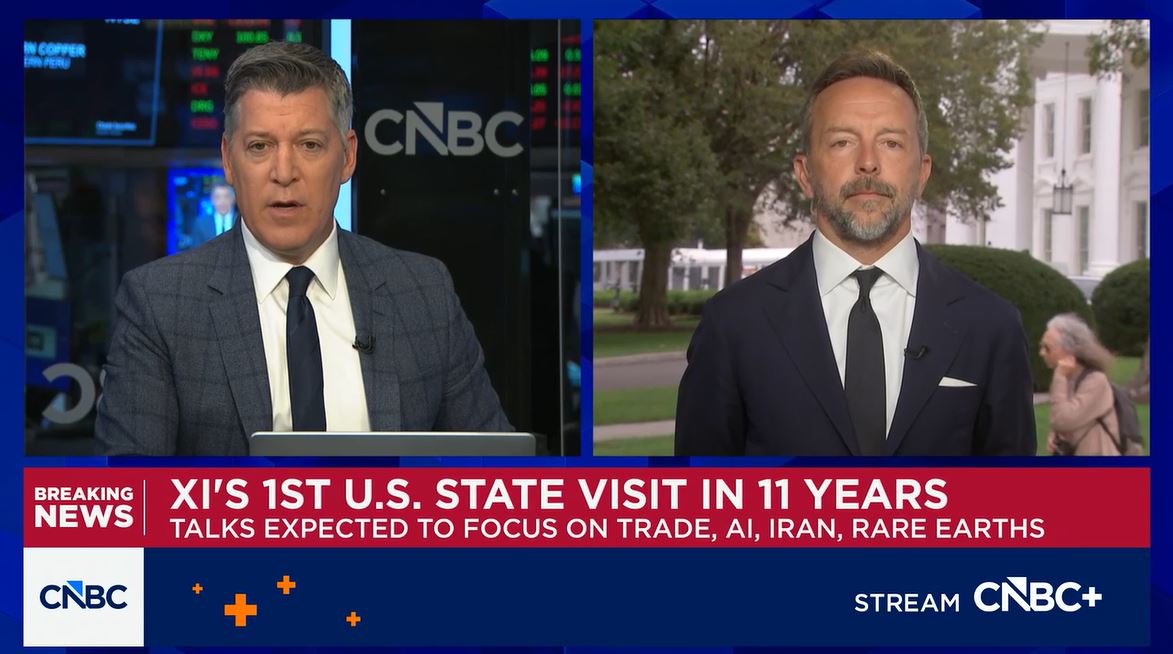
Evidently, Brad thinks there’s already enough AI regulation
Judge told Brad Gerstner, the star guest of Thursday's (9/24) Halftime Report who was on location on the White House grounds (where TV productions sorta are/sorta aren't doing broadcasting these days), that Donald Trump had commented on AI regulation on Truth Social, saying (according to Judge), "I wanna leave it exactly where it is."
Judge asked Brad if Brad thinks we "need a greater platform for AI regulations and for safety."
Brad said "we're here to talk about super intelligence" (he said "super intelligence" twice) and pointed out how the U.S. actually has acted on some guardrails for "frontier" models. Brad asserted that the course we're on is already "safe and fast."
Judge then asked about Elon's quote about how it would be great for the U.S. and China to come up with a "platform for AI regulation."
Brad said he's "not gonna front-run the, the White House in terms of the things that are being discussed" but that the president isn't "ceding" any control to a "U.N. for AI."
Judge said Brad doesn't have to front-run anything but emphasized Elon's comment and demanded, "Are you in favor of that or not?"
Brad responded with a question, does the U.S. already have a "regulatory framework"? Brad indicated yes, so, "I don't know that there's a lot of daylight between Elon and the White House that you're suggesting."
Brad said everyone at the table has "good will" and there's "nobody who wants to YOLO (snicker)."
Judge protested, "I wasn't suggesting, I mean, I was merely reading the statements word for word of what was said by President Trump and Elon Musk in the last, um, 24 hours."
Judge asked Brad about META. Brad called Muse "incredible" and claimed, "This is the next 10x moment."
Judge told Brad that Reuters reported that the U.S. and Iran had discussed a "phased deal" to reopen the Strait, a headline we've literally heard about a half-dozen times in the last 6 months.
Judge closed mentioning Brad's generous gift to Indiana kids via the Trump Accounts.
Guy Adami suggests on Fast Money that Big Tech may be the new Too Big To Fail companies
Permabull Stephanie Link opened Thursday's (9/24) Halftime Report saying "there's a lot going on" with the Xi visit, but Thursday is "all about AI."
Shannon Saccocia said the 10-year's been moving in "lockstep" with oil.
Josh Brown, who was remote, gave a lengthy speech about how great the stock market has been since the 2008 financial crisis and a lot of formerly 60/40 portfolios (Zzzzzzzzzz) are more like 80/20 or even 90/10.
Stephanie bought more COIN.
Judge said OKTA got a price target hike from B of A to 220. Malcolm Ethridge said that kind of price upgrade with the stock already at 211 "doesn't mean a whole lot." Josh said the market on cyber stocks has gotten "completely insane" and noted the wild swings in sentiment just this year. He suggested the "smart thing is to be more discerning (snicker)" and "focus on the larger players" such as CRWD.
Josh said LITE is on the Best Stocks list.
Josh's Final Trade was UTWO, Shannon said IYM (Zzzzzzzz) (at least it wasn't the XLF), Malcolm said NOW and Stephanie said PWR.
Weiss’ rationale for buying NFLX sounds weak
Judge on Wednesday's (9/23) Halftime asked Steve Weiss why he rebought NFLX; Weiss claimed it's a "small position" and tried to explain that it was a move on negative sentiment when in fact he probably only bought because it had gone up since recently bottoming in the mid-60s (but now seems heading back there again).
Jason Snipe likes NFLX but admits "YouTube TV's absolutely, um, biting into their, to their apple."
Joe Terranova sold NFLX in June, it's down 17% since. Joe said "I'm not feeling particularly good about any of the streamers," which was the best observation of the discussion. Joe said streamers are "challenged on margins." Joe said Disney+ hiked its price 13%, and there could be a point where consumers stop paying the increases.
Weiss said consumers will "pick and choose" which streamers they watch and will "narrow" it down.
This time, it didn’t go up supposedly because of a Brad Gerstner letter
Judge on Wednesday's (9/23) Halftime Report again went back to META and recapped Tuesday's dreadfully elongated conversation. Steve Weiss said he's got an "overposition" in META and he's not sure he wants to sell it.
Weiss correctly said, "The AI lead changes repeatedly."
Weiss again talked about the "caretakers" or "business people" running the rest of the Mag 7 while founder Zuck still runs META.
Rob Sechan urged Weiss to "let it ride" with META. Weiss said, "No you don't let it ride ... you have to have risk management."
Joe Terranova has been "somewhat frustrated" by the performance of insurance companies, which he's recently touted.
Uh oh, it’s December 1999
Joe Terranova on Wednesday's (9/23) Halftime asserted, "I think we're pulling forward a lot of potential return," but it's the "5.08" that's weighing on the market.
Steve Weiss, who basically got drowned out by applause from the NYSE floor, said he's "keyed" on Donald Trump's "admission" that there won't be a "cessation" of hostilities with Iran until after midterms.
Weiss said it's "problematic" that 5% appears to have gone from resistance to support on the 10-year.
But Weiss said there can be a "pause" for stocks, but the longer-term trend is higher.
Jason Snipe, who had a quiet show, had any pullback before earnings season is an "opportunity" to buy some stocks.
Rob Sechan said it's "no surprise" to him that equal weight has weakened; he's not going to chase it.
Judge was filling time with stats from Krinsky, who made some comparison to December 1999 based on this week's advance/decline, though Judge admitted that some people's reax was to "scoff at it like it means nothing."
"I do believe there's headwinds for the consumer," Rob said.
Weiss said, "This is an AI-driven economy" but that it's "leaving the consumer behind."
Rob said the "sole mission for the Fed was to get control of the long end. And they did it through a rate hike and strong rhetoric."
Rob said "re-rating," like he always does.
Late in the show, Santoli in Mike's Market Memo said the 10-year is the market's focus now. Rob explained, "The markets are trying to push the Fed around."
Hedge funds accused of making up ‘b.s. stories’ about shorted stocks
On Wednesday's (9/23) Halftime Report, Steve Weiss said he sold VLO; "I was up 35% in a month," but for a commodity stock, you "can't stay there too long."
Joe Terranova said he's been long VLO since 144 and "probably" should sell some of it.
Joe and Rob Sechan backed DVN, but Weiss said it's been a terrible stock since 2006.
Oliver said USO calls were popular, but gold, bonds and bitcoin were a little dicey.
Joe pointed out precious metals have changed their traditional "correlation" with rising yields and actually have been doing better when yields go down. Joe crowed a bit about saying recently that he didn't trust the rebound in gold, which has been a good call.
Weiss bought more DKS. Weiss correctly recalled making it his "disastrous Final Trade" before earnings and traced what it's done since; he thinks it still owns the space and is a "great long-term play."
Weiss also bought more FTAI but admits it's a "battleground for hedge funds" who like to short it and make up "b.s. stories." Weiss also bought more MRNA; he's back on that bandwagon.
Rob's Final Trade was HWM, Weiss said FTAI, Jason Snipe said MSFT (Zzzzzzz) and Joe said LNG.
Belski predicts NFLX, GOOGL, AAPL and AMZN will ‘own all sports’ in 5 years
Tuesday's (9/22) Halftime Report included a frankly insufferable conversation initiated by Judge about why panelists don't own META #whocares (see below).
But the NFLX conversation was actually quite good. (This writer has no position in NFLX; unloaded earlier this year.)
Judge said HSBC cut NFLX, as Wells did Friday, but BMO gave it a 135 (that's correct, 135) (snicker) target. Judge admitted, "That's an outlier."
Brian Belski said he bought NFLX in 2022 when sentiment was "even worse than it is now."
Then, this was the Big Comment: Belski thinks "5 years from now," NFLX, GOOGL, AAPL and AMZN will "own all sports."
We totally doubt that. Will the "landscape" get closer to that scenario? Probably. But we're not going to see "all sports" on only those platforms. (This writer is long GOOGL.)
Jimmy Lebenthal said he's not trying to trash a stock that Belski or anyone else likes, but he wondered about the issue of "competition" for NFLX with the PSKY settlement. Josh Brown, who was on the show but not at Post 9, cut in that the competition is YouTube.
Belski said the competition will be consolidated.
Jimmy said that kind of argument is like backing GM on getting into EVs. Judge hectored Jimmy, saying that in fact was a "big part of your bullish thesis on GM at the time before you got out ... you were all in on the EV thing for a while."
Back to NFLX, Josh said the Wells argument against NFLX is that it doesn't have the "hits," which Josh basically agreed with. He said Wells' target is 57. But Josh said YouTube "is the real bear story." Josh said he's long NFLX in the low 80s and thinks it will eventually make money, but it's in a "very bad place right now."
Jimmy sees another crescendo
Joe Terranova at the top of Tuesday's (9/22) Halftime Report said investors are "remaining anchored" to the Mag 7, though some people are concerned about the "concentrated nature."
Brian Belski said this is a "rent-to-own situation within the big-cap areas."
Jimmy Lebenthal said the market is "setting up for a nice crescendo (pronounced 'cre-SHEN-doe,' which is correct, according to Google's pronunciation guide) into year-end," and if we had a dollar for every time Jimmy has said "crescendo" around end-of-the-year stock trading, we'd be rich.
Zuck is ‘excessively volatile in terms of how he’s running his operations’
On Tuesday's (9/22) Halftime Report, Josh Brown said NVDA, META and AAPL have had a "narrative shift."
That led to an excruciating passage in which Judge noted how great META has done in the last 2 weeks and demanded to know why no one on the panel owns it.
Joe Terranova said it had "clearly lost its momentum." But Joe said META's gain has been a "valid move" with "more to come higher."
Brian Belski said Zuck is "excessively volatile in terms of how he's running his operations." Belski a couple times insisted he won't buy a stock for "2 weeks." Jimmy Lebenthal said he agrees with Belski and that the numbers people are citing may not equate to monetization. "I'm not hating on Meta," Jimmy protested.
Judge scoffed that everyone had a "convenient answer" about not owning META.
Judge carped for seemingly forever about "trying to go deeper" than Belski's assertion about "can't own everything."
Josh Brown said of META, "I have not owned it over the last year. I also didn't ride it down 30% from its high, and I didn't get trapped in it. I've been trapped in other things like Netflix." However, Josh said, "I might buy this," because after huge gains in 3 weeks, it's got a 24 forward P.E. (oh joy).
AAPL as Final Trade, oh joy
Josh Brown's Best Stocks segment on Tuesday's (9/22) Halftime Report was just another go-round on cybersecurity stocks. Joe Terranova asked for a chart on OKTA. He said it's in a "massive recovery" from where it was over the last 5 years.
Oliver said puts in SCHW were popular. Joe said it's "not good right now" for SCHW. Belski indicated he's not worried. (Later on a very humdrum Fast Money, someone (maybe Guy Adami) suggested pressure on the banks is coming from Brian Moynihan's recent comments.)
Josh's Final Trade was AMZN. Belski said CHKP, Jimmy said MU and Joe said AAPL.
‘2 words: Risk on’
At the top of Monday's (9/21) Halftime Report, Joe Terranova, quite frankly in Santoli Jr. Mode, said, "2 words: Risk on. That's exactly what we are seeing right now."
Joe added, "In the near term, the market has just established some really bullish momentum."
Jimmy Lebenthal suggested the broadening is gaining steam.
Permabull Stephanie Link a couple times talked about how great October and November are historically. Bryn Talkington suggested after the midterms (she first called it "midtimes" (snicker)), stocks do great from November to February, and if we do get a "drawdown," which she said we really haven't yet, it would be a great time to buy.
Bryn cautioned that oil could still weigh on markets.
The Dominator, Dom Chu, was guest hosting on Monday. Late in the show, Santoli acknowledged Santoli Jr.'s assertion about risk-on, but Santoli Sr. said he's not sure Monday's market-leading stocks represent "genuine risk." (Horse-racing fans will appreciate that term.)
Adam Parker sneaked in that compliment for Bryn (see below); this page is working on an even better one
The Dominator, Dom Chu, guest hosting Monday's (9/21) Halftime Report, said Jensen is saying there's a "0%" chance of AI ending the world.
Bryn Talkington said, "I would trust Jensen by the way."
Bryn said NVDA will be "range-round (sic) (snicker), range-bound" from 210-230, but it's had trouble with 230-236, so she'd keep selling calls.
Jimmy Lebenthal said he "doubled my position" in QCOM. He admitted he could've bought at 160, but now it's got "momentum."
Bryn said bitcoin and ethereum are up for the quarter but down for the year. She predicted they'll "continue to slowly move higher."
Stephanie Link owns COIN for the crypto exposure. (What's the multiple on crypto exposure.) Oliver said bitcoin-related options were popular.
The Dominator being the guest host, he went ahead and conducted ETF Edge with Brendan Ahern at Post 9.
Jimmy says he based his Final Trade on Santoli’s Market Memo
On Monday's (9/21) Halftime Report, CNBC's Annika Kim Constantino was in Houston for an "exclusive" with LLY's Dave Ricks. Joe Terranova hailed how LLY is diversifying its revenue. Jimmy Lebenthal said LLY's valuation "has come down quite a bit, and is becoming quite attractive."
Bryn Talkington's Final Trade was UBER, suggesting a 70-78 range for that stock, and it's near the lower end. Jimmy actually said, "I delayed my Final, uh, Trade until I heard what Mike Santoli had to say," so Jimmy's picking MU. Stephanie Link said NTRA, and Joe said DDOG.
We wanted to give Fast Money a long listen, but it was Too Much Tim Seymour Too Early, so we tuned it out.
Jimmy suggests Greg will do a better job if Warren stays out of it
On Friday's (9/18) Halftime Report, the subject of BRK chairmanship came up.
Amy Raskin suggested, "This is just not Berkshire's market," evidently because Goldman Sachs and GE aren't looking for payday loans. She said BRK had a "tough couple of months" in the spring, but "we like it here" because the multiple isn't bad.
Jimmy Lebenthal said Warren Buffett is big on "proper corporate governance," then Jimmy curiously said such governance is difficult "when you've got the former CEO as the chairman," that may be why Warren is stepping aside. Jimmy suggested that if Greg Abel wanted to do a dividend while Warren is chair, that might be awkward. Guest host Leslie Picker pointed out Warren is still a "big shareholder."
Weiss said just on Monday he was buying more NFLX and it looks ‘safe’ now; it was 80 on Monday and 71 at week’s end
It seems nothing will stop Halftime Report panelists from endorsing NFLX.
Jason Snipe on Friday (9/18) said "engagement is a real story" for NFLX, which was slumping amid a downgrade. Jason conceded sports licensing is "very expensive," but he thinks they'll "double their ad revenue."
Rob Sechan said "it's a matter of what content comes out." But Rob said "the beauty of right now" is that buying NFLX "after it's re-rated" has been a moneymaker; he also said "a nice hedge" is owning YouTube, which basically must mean Alphabet. (This writer is long GOOGL.)
Another panelist indicates wonderment about why Task Force Kevin (or Jay) didn’t do this a while ago
Amy Raskin on Friday's (9/18) Halftime Report said, "It does feel like we're going to be in a churn for a while."
Amy is "sorta sympathetic" to the notion that the Fed could've done "more earlier," then we could've just "put the Fed behind us for a little while" (while we instead wait for 25-basis-point mission creep into 2027). (Maybe in the meantime, they can figure out how to lower the price of diesel.)
Jimmy Lebenthal opined that "There's rotation going on" and it's "healthy."
Rob Sechan said the market "backed the Fed into the corner (snicker)," and "Chair Warsh had to talk tough," but "this is the best (snicker) outcome we could've had."
Rob gushed about how the market generally does OK after hikes and said "Fixed income is finally a hedge to all this," and "We have been buying bonds like maniacs."
Maniacs.
Hmmmmm.
Jimmy then indicated a lot of people may just be worrywarts for one reason or another, stating, "People are talking about the end of the world," but speaking "clinically (snicker)," he's heard many "multiple" times from clients calling and claiming "oh my God, the world is ending," including during Russia's Ukraine invasion.
Amy however cautioned that AI spending is in a "financially unsustainable arms race ... that is not going to end well." Rob conceded, "We will overbuild," but it's not "today's problem."
Santoli suggested bulls on Friday were just trying to "escape the week without further damage."
Task Force Kevin says ‘7 weeks is a good investment’
MacKenzie Sigalos reported on Friday's (9/18) Halftime about the iPhone sales schedule; the 18 Pro was hitting shelves Friday. MacKenzie tried out a Duo, "and it was incredible ... it's very impressive."
Amy Raskin is holding AAPL though she's "not sure" she'd be adding now.
Rob Sechan asserted, "You can't be underweight AAPL" even though the valuation would suggest as much. Jimmy Lebenthal and Amy both protested that they're underweight the name.
Bill Baruch dialed in to say he trimmed AAPL because it's at the "upper band of historical valuation," after he "leaned into it in May and June." Instead he's buying more NVDA, AVGO and AMZN.
CNBC's Julia Boorstin reported that D'Amaro, whose previous biggest move as CEO was hosting a Legends ceremony for Iger, hired Karandeep Anand as Disney's first Chief Technology Officer. Jimmy said it's "still a very cheap stock" and "worth hanging onto," like he always does.
Jason Snipe predicted GS will "get through" any softness. He also spoke favorably of APO.
Jimmy hasn't seen enough to get back into ONON. He said it's a "no touch" until earnings estimates start rising. Amy claimed "the consumer is getting stretched." Rob Sechan asserted, "The lower end of the K is very stretched."
In a curious segment at the end, Sharon Epperson pointed out that a lot of the biggest stocks are AI plays, so you might have a lot of exposure to AI in your 401(k). Jimmy suggested just buy the QQQ looking at ways to "broaden" your holdings.
Rob's Final Trade was AVGO, Jason said ANET, Jimmy said CSCO and Amy said ITUB.
Stocks have best day in weeks despite bond market being in ‘disarray’
Judge was evidently taking a travel day on Thursday (9/17); hence, Santoli guest-hosted the Halftime Report.
Joe Terranova said everyone's "glad we're past the moment" of the 20-minute-short Fed meeting (snicker) and that we've got a "degree of clarity" (snicker) (which is ... what?).
Malcolm Ethridge said this all could've happened a while ago. "I wish that we had gotten the moment past us earlier in the year ... the bond market now is in disarray," Malcolm observed.
Santoli said he doesn't think 50 was ever "in the cards" despite Jeffrey Gundlach's comment to Judge a day earlier (see below). Kevin Simpson said the market could've handled it, though. Santoli said that back in 2022, "The initial one was 25" and the larger ones came later.
Santoli said we all know the "paramount rule" about "don't fight the Fed," but right now, "It's a little bit ambiguous."
If people aren’t sure about Task Force Kevin’s messaging, they should take a crack at Austan’s purported Edmund Burke quote about the twilight
Joe Terranova on Thursday's (9/17) Halftime Report said the stock market has been trading "very defensively" since the end of June and apparent trends haven't been happening.
Malcolm Ethridge suggested the Mag 7 could keep leading for weeks, in contrast with semis; "It's really the Mags that are carrying us."
Joe said there's been a "revival" in insurance stocks and a "building trend" there.
In the middle of the show, Leslie Picker spoke with Bruce Flatt, CEO of BN, who said of the rate hike, "it just doesn't matter."
Flatt said the Fed is "trying to cool a little bit of inflation ... mostly oil prices are high." Flatt noted "we're not even close" to the hikes of 2022.
Flatt stressed the importance of nuclear power, which his company apparently finances in some way, and how it's not going away and said they're "having trouble keeping up" with the amount of buildable power/data center capacity. He even said "if there's a slowdown, that's really good."
Joe called Santoli, who was guest-hosting, an "encyclopedia of market knowledge."
Joe still wants to bookmark the JBHT diesel announcement
On Thursday's (9/17) Halftime Report, CNBC's Tanaya Macheel reported on "tokenized stock trading" that has something to do with blockchain. Kevin Simpson used the opportunity to tout HOOD. Guest host Santoli mentioned "sports bets" and said "they do it all."
JBHT, a stock Joe Terranova kind of spoke warily about a day ago (see below), got an upgrade from Citizens; Joe reaffirmed Thursday that he'd wait on this one; "there's a story here that we need to bookmark," which is the impact of "rising refined products" (basically diesel and gasoline) and how it could affect earnings.
Kevin said $6 diesel "percolates through the entire system." Joe said this is why there is some "objection" to the rate hike, that the Fed can't produce more diesel and thus the hike doesn't actually address the problem that everyone hates.
Oliver said CRWD options activity was "quite positive"; poeople were buying the 250 strike "expiring tomorrow." Malcolm Ethridge said the market's been "ignoring" the importance of cybersecurity for a few years amid AI excitement, so even though CRWD might be kind of extended, it can still "grow into that valuation."
Kevin's Final Trade was UNH, Malcolm said GS and Joe said TER, stressing it's a "trade."
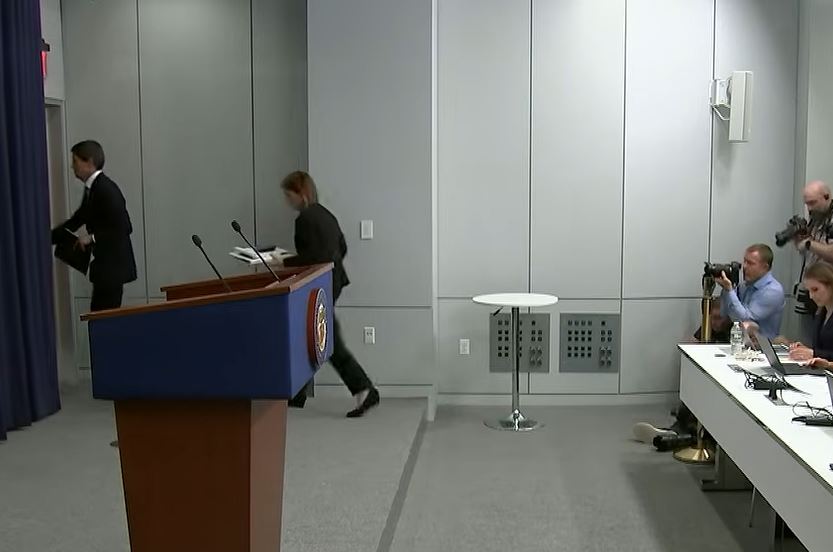
Where did Kevin have to be on Wednesday afternoon?
On Wednesday's (9/16) post-Fed episode of Closing Bell, Judge reported, "I should note for our viewers that this news conference was 15, 20 minutes shorter than we've become accustomed to."
Judge's guest, Jeffrey Gundlach, said, "I almost didn't make it into the chair on time," explaining he's normally ready around 3:10 Eastern time.
Judge said, "That- that makes 2 of us; uh, my- my dancing shoes were gonna be tested for, for a moment."
In his press conference, Kevin Warsh claimed to one questioner that he's trying to get to "more people," and because of that goal, he can "cherry pick" the questions he answers. If he's sincerely trying to hear from "more people, why did he end the press conference 20 minutes earlier than usual?
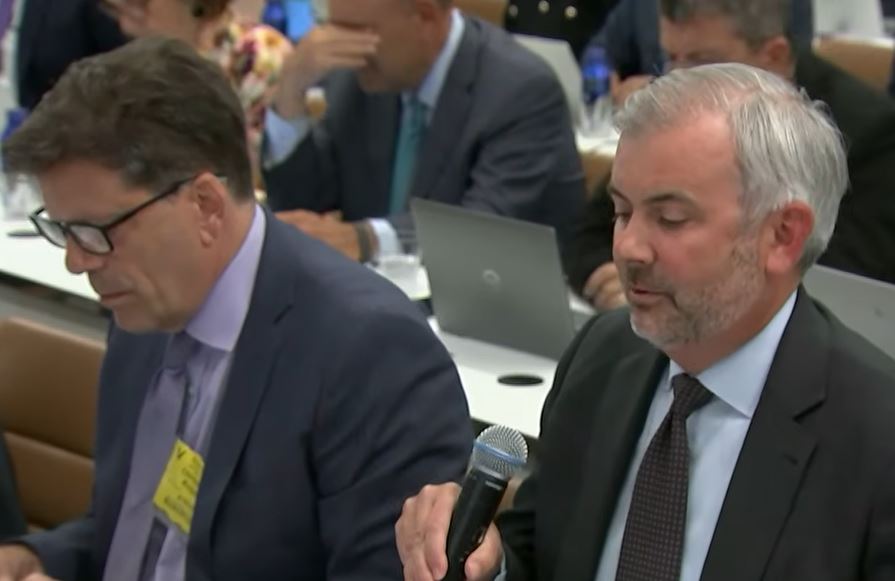
Steve rubs his eyes while another questioner tries to get Hassett Lite to provide an answer
This page merely reviews CNBC programming; it's not our job to defend CNBC personalities.
(Of course, if we happened to be in Englewood Cliffs and we happened to notice a buncha goons circulating around Judge's car or Joe's car, we're gonna be there.) (If we ever noticed someone messing with Karen's car, they're gonna be in big trouble ...)
But when Steve Liesman can barely ask a question — let alone get an answer — someone needs to stand up for something.
The occasion was the Federal Reserve chairman's (it recently was known as "chair," but they apparently changed it back to "chairman") "press conference" on Wednesday (9/16) in the wake of the central bank's interest rate decision.
Normally ... in a normal, regular world ... these press conferences are a decent — not perfect, but decent — way for the general public to get some real-world answers from folks who tend to operate in an ivory tower, AND a way for those said folks to engage in some way with the everyman they're sworn to be serving.
It seems that for the foreseeable future, these press conferences are instead going to be more like when Bobby Brady got to be safety monitor.
Steve Liesman, who had tried to ask a very important question of the Fed chairman and was essentially rebuffed, joined Judge's Closing Bell and admitted, "I'm disappointed in that the, um, removal of the follow-up question makes it very difficult to actually get some answers from a person who doesn't wanna really give any answers," though Steve is "thankful" he still gets a chance to ask a question.
Steve had actually asked God's Gift to Banking, "Thank you Mr. Chairman, Steve Liesman, CNBC. I want to follow up on that question. Um, previously, most Fed officials have described the rate as modestly restrictive. And if you removed accommodation, could you give us your sense of where the Fed funds rate is relative to neutral (note: Steve should've stopped there), and some detail, if you wouldn't mind, on your sense of, is there a short-term rate you're aiming for, and a longer-term neutral rate, do you think in terms of those?"
Kevin chose only to address the 2nd question, which was far less important: "Uh, in a word, no," but in a "few words," he's interested in the neutral rate only "as an academic matter ... it's useful academically ... Do I think it has any operational effect on decisions that we make today? No I don't."
On Closing Bell, Steve affirmed that he asked "where the Fed funds rate is relative to neutral." That question was completely ignored.
Steve then aired a clip of Kevin saying in his opening statement, "We removed a dose of accommodation," which means, according to Steve, that the Fed rate "is at best neutral," because the Fed can't exert "downward pressure" on inflation without going "above neutral."
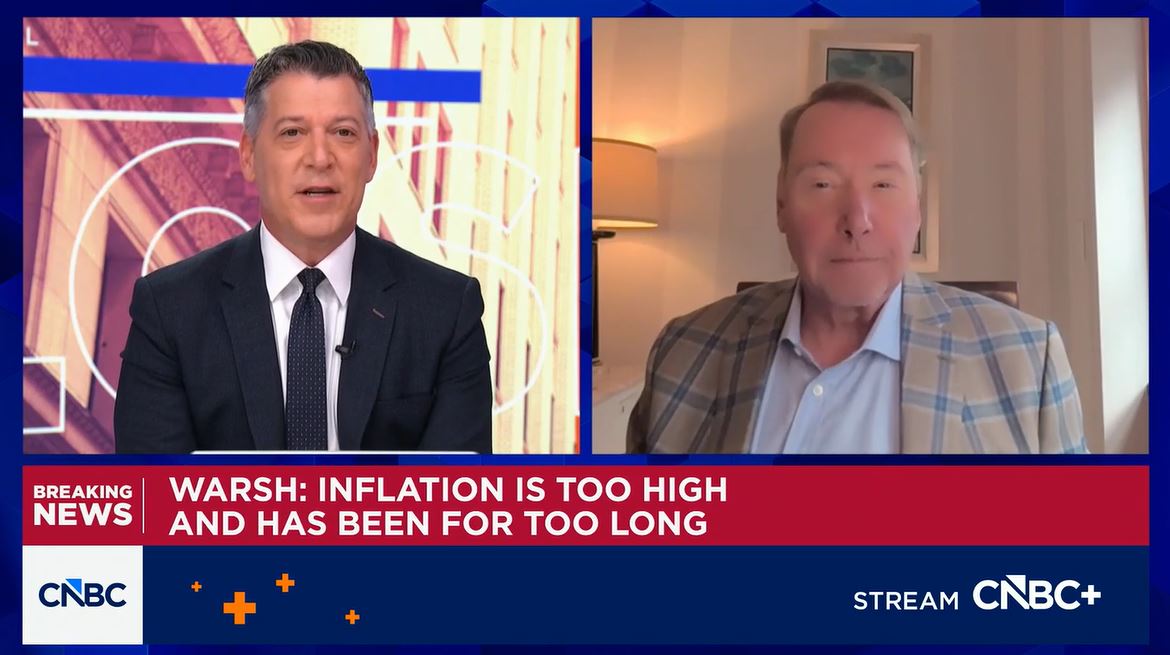
‘Devoid of content’
Jeffrey Gundlach, star guest of Wednesday's (9/16) Closing Bell, was not exactly impressed by the intellectual heft of Kevin Warsh's press conference.
Jeffrey said it "was kind of devoid of content" and, in the understatement of the 2nd half of this year, noted there were "a lot of questions that were asked and not a lot of answers given."
Jeffrey concluded, "I thought that the content was pretty thin."
Jeffrey said Kevin was "opaque" on Wednesday. "I don't like this task force thing. It's- it's like a company that's having trouble that wants to hire consultants, and the consultants always wanna figure out what the- what the people at the company really wanna hear, and then they tell 'em what they wanna hear."
Judge, who fell for the statements Wednesday as though what Kevin Warsh said on 9/16/26 is going to be relevant at all the next time there's a rate hike to consider, said that based on what he heard, the Fed seems "far from done." Jeffrey agreed that the chance of a 1-and-done is "extraordinarily low." Yeah. See if you still think that in a month or so.
Jeffrey suggested the popular notion (expressed by people on the Halftime Report) that the Fed won't hike in October before an election may not have any credence, as he wondered, "What percentage of Americans know that there is a Fed funds rate? Let alone what the Fed funds level is. It's probably a smaller percentage even than those that are supportive of Congress, which polls down at about 14% or something."
Jeffrey said he doesn't think the Warsh Fed is going far enough. Jeffrey said he had watched Halftime, as he told Judge, "There were a lot of people playing word games." Jeffrey said he would've done a 50-point hike and called it "stun and done."
Referring to motor oil prices at Costco going up, Jeffrey suggested there's a "psychology that inflation is now trending higher," it prompts people to perhaps stock up on things because they think prices will soon be even higher.
Jeffrey said California gas stations are charging only $9.99 for diesel because the pumps only have room for 3 numbers. (That falls under the category of "Things AI can't fix.")
Jeffrey says AI sentiment went from retiring to ‘Tahiti’ to all gonna die by end of decade in a matter of weeks
Jeffrey Gundlach on Wednesday's (9/16) Closing Bell opined a little bit on the AI scene.
Jeffrey told Judge: "In June or July of this year, I feel like AI was at peak embracement in terms of enthusiasm. It was kind of ... enthusiasm mania, almost. ... 'AI's gonna let us all retire and live on Tahiti, life of luxury,' uh, and then people started to worry about job losses, but that didn't scare people enough. Now we have to go into it, we're all gonna be dead by the end of the decade if we don't do something about this rogue AI thing. Which to me sounds a lot like the COVID vaccine scare back in- in 2020. Like we're all gonna die if we don't take 7 or 8 booster shots. ... This on the face of it to me is an attempt to get the government involved in picking winners and losing- losers, and actually maybe helping out with aiding and abetting financing."
‘7 weeks is a good investment’
(a/k/a there is no neutral rate)
Viewers of the Federal Reserve press conference actually learned something Wednesday (9/16).
Kevin Warsh actually sorta explained why there was no hike at the Fed's last meeting.
Kevin said that back then, a "good majority" found that "7 weeks is a good investment" as a way to "buy time" for making a "wise decision."
He said later that the idea was to "buy a little time."
Translation: They only wasted 7 weeks of time in fighting a problem that Kevin claimed was a menace months ago.
If inflation is such a problem, why in the world is the Federal Reserve attempting to "buy time"?
Kevin told Nick Timiraos that the committee on Wednesday decided to "take an action to ensure a timelier return to our price stability objective."
OK. So higher inflation was OK in July. But on Sept. 16, it has to go.
Kevin a couple times told reporters, "I've got nothing for you" on discussions with Donald Trump. Does anyone believe that's a true statement?
On Closing Bell, Tom Lee said even 50 basis points higher wouldn't "topple the economy," and "I would be buying this dip," as the market was doing an "overreaction" to Kevin Warsh's comments. Greenhaus said "they could've waited"; Greenhaus is getting tired of hearing how "resilient" the consumer is.
Weiss says if there hadn’t been a hike, the market perhaps ‘rips’
In the quickly out-of-date, generally tiresome pre-Fed meeting commentary on Wednesday's (9/16) Halftime Report, Joe Terranova said the market is "clearly positioned" for a hike. (This review was posted overnight Wednesday-Thursday.)
Joe said consumer discretionary is "really trading awful."
Steve Weiss suggested if there's no hike, then the market "rips." He said the argument for not cutting would be that inflation is just a "supply shock." Weiss said "cut" when he meant "hike," which happens to many people on Halftime; he thanked Joe for correcting him.
Jimmy Lebenthal said, "I do think they're going to hike," based on Task Force Kevin's "very distinct logic" from Jackson Hole. Jimmy said if there is a hike, he expects "downward pressure on 10-year yields."
Jenny Harrington said if there is no hike, she "would not take it as a positive."
Jenny suggested that hiking or not hiking won't have much impact on the important rates, but there's a "credibility thing."
Steve Liesman suggested "one and mum."
Jenny suggested it could be "yawn and wander," but the latter term sounded kind of like "wonder."
Santoli was back for "Market Memo" that used to be called a "Midday Word." Santoli said a 25-point hike still only takes us to "50 basis points lower than we were a year ago." Santoli said if they don't hike, it's "mass confusion." Santoli even said if there's no hike, it would be viewed as "an act of hostility by the chairman on the markets" given that they priced in a hike at 90%.
If only Al Michaels could be the Fed chair ...
After the A Block, Judge on Wednesday's (9/16) Halftime Report brought in Al Michaels to preview the Thursday Night Football opener, an interview that's become a regular feature.
Al said, referring to Thursday Night Football on Amazon, "I can't believe it's been 5 years now since we started this package."
On Bills-Lions, this week, Al advised, "Bet the over."
Judge explained that "somebody got the message" to improve the caliber of the Thursday games, "it's like every game is good."
Al said "the league did us a solid" after the first year. (Translation: No more Cardinals vs. Browns.)
Al twice called Jimmy Lebenthal "Farmer John (sic) (snicker)" before heckling Jimmy over CLF.
Jimmy said, "I do think they're turning it around here." Steve Weiss joined in, cracking that CLF had been on the 1-yard line with 99 yards to go but now is up to the 10 "with 90 to go."
Al told Jimmy, "You have convinced me not to short it." Jimmy in defiance made CLF his Final Trade.
Yardeni’s down to 7,900
In case you've wondered whether market "strategists" are simply chasing what the S&P 500 is currently doing, Judge, who was in L.A. after his day off at Future Proof, in the 14th minute of Wednesday's (9/16) Halftime Report said Yardeni cut his target from 8,400 to 7,900.
(Judge had a lot of trouble enunciating Yardeni's targets a few weeks ago (see below); that was during the summer rally when Judge was trumpeting how Ed was hiking targets every few weeks.)
(Yardeni a couple hours later Wednesday on Power Lunch said it looks like "the beginning of a rate-hiking cycle.")
Julia Boorstin was at the L.A. set with Judge, and they talked about Zuck's opinion on AI. Jenny Harrington said, "We're in this wild period in time, where everything's unprecedented (snicker)."
Steve Weiss again credited Zuck for having a "founder's mentality" while other Mag 7 leaders are just the "2nd generation" managers. That's been a fair point, except we don't see evidence this decade that there's any predictability that betting on Zuck instead of the "2nd generation" managers will get you better stock performance.
Joe wants to ‘bookmark today’
Joe Terranova on Wednesday's (9/16) Halftime Report said he bought more AAPL; it's his "6th consecutive purchase since late March." He said it's been having "higher lows."
Judge asked Steve Weiss about crypto and the failed Senate vote. Weiss said it's a space for "true believers" and "there's no there there" and no "business use case" and "there's no utility to it," but even so, it'll "remain a trading vehicle," and he thinks "the bias is lower."
Judge said AZN got reiterated buy by UBS; Jimmy Lebenthal agrees with the call.
Oliver said options traders are fading XLE.
Joe mentioned "$6 diesel" and said "we need to bookmark today and revisit it," apparently because Joe thinks JBHT's profit warning related to diesel could be a canary in the coal mine.
Joe cautioned, "Do not dismiss this."
Jimmy predicted, "I think energy stocks are gonna make a lot of money for the rest of this year."
Jenny Harrington's Final Trade was SCHW. Weiss said UNH (without mentioning Hemsley) and added FTAI, and Joe said INCY.

Time magazine comes up with a way to get mentioned on national TV
Judge on Tuesday's (9/15) Halftime Report took the day off, er, was at Future Proof in Huntington Beach. (At least they didn't fly him out to Cupertino to sit outside the Apple HQ.)
Stephanie Link predicted a "dovish hike" Wednesday and said it's not a "foregone conclusion" that the Fed hikes in December. Of course, "The economy can handle it."
Shannon Saccocia indicated a hike is coming and then actually predicted "1 or 2 days" of a "relief rally," those last 2 words piquing Judge's interest. But Shannon shrugged that after the relief rally, the market goes back to a "challenging continuum" (snicker).
Josh Brown, the host of this event (Future Proof, not the Fed meeting), suggested the market might go up "either way," hike or no hike, because the market just wants this news event "out of the way."
Josh emphasized how you can never get rid of your energy stocks no matter how much peace is in the Middle East; it's your "only hedge" for times like we're having now. Stephanie said energy is "only 3% of the S&P 500."
A portion of the show involved Kate Rooney and a recap of the latest anti-AI headlines. (Who's monitoring Dario and Elon and Sam to make sure they're not plunging ahead into advancing AI?)
Josh trumpeted how "we know" that cybersecurity names are obvious tech winners.
Star guest Rick Rieder, who must've said "listen" about 15 times, is expecting a hike on Wednesday. (This review was posted overnight Tuesday-Wednesday.) Rick didn't really answer Judge's question about whether it could be "one and done."
Stephanie bought WFC (Zzzzzzzzzz). Josh bought more NFLX and more DAL. He said "Netflix is 38% below its 52-week, uh, its all-time highs," always a favorite Halftime "buy" metric.
Josh's Final Trade was TGT. Stephanie said TFC and Shannon said IYH.
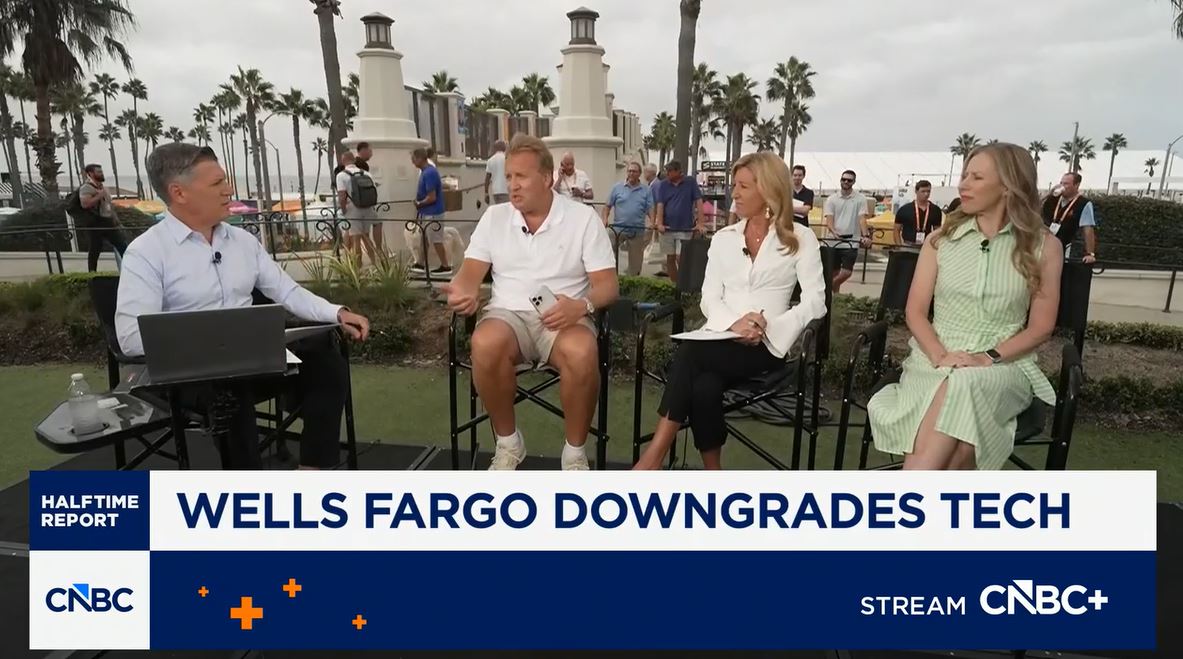
Weiss on July 17 said of NFLX, ‘I think this is dead money for at least the rest of the year and maybe longer’
Guest host Santoli on Monday's (9/14) Halftime Report said "Rothchild" (sic pronunciation) cut its DIS target from 160 to 125; the screen text said "Redburn."
Jimmy Lebenthal of course is going to "stick with" DIS.
Steve Weiss said, "I'm glad Scott's not here," because Weiss hadn't previously announced he bought back NFLX after trumpeting a sale a while back (he's used the term "dead money"); Weiss bought back NFLX "not far from here."
He said he now finds it's a "safe one" because "the downside's been taken out." (Translation: For all of his supposed "bottoms up" analysis, the stock simply started going up again; that's why he likes it.) He thinks it's "OK" but not sure it gets to 100.
‘Trading range favoring the lower end’
"It's kind of a mixed market," said Steve Weiss on Monday's (9/14) Halftime Report, and he doesn't see how you put "new money" in.
Weiss said oil's in a "supply shock" that will affect margins. Weiss questioned how much a Fed hike can actually lower inflation; "tightening to reel in a supply shock doesn't work."
Weiss said the president for maybe the "50th time" said that "Iran's looking for a quick deal. That's just an asinine statement as we've heard so many other times, and the market, they're stupid enough to believe it. On the 51st time, let him do it. In my view, we're gonna go through 5% ... the market's gonna be in a trading range favoring the lower end."
Weiss complained that AVGO hasn't done anything.
Joe Terranova said "the market just wants to rotate," which is what he says all the time. "I still think it's this game of rotation."
Veering into Santoli Jr. Mode (while Santoli Sr. was guest-hosting the program), Joe said that at 10:26 a.m., the "10-year touched 5%" but noted it was back down to 4.949% in the last 90 minutes.
Jimmy Lebenthal said the market's only down about 3% and predicted the market "will crescendo into year-end." Weiss said, "Midterms always unsettle the market."
Liz Thomas suggested there will always be demand for cybersecurity.
Santoli doesn’t take suggestions of ‘stagflation’ seriously anymore
During the A Block of Monday's (9/14) Halftime Report, Joe Terranova ushered in a curious conversation.
Joe said the market can go "anywhere," and then he started trying to explain "the biggest risk in the market." But he threw in the word "not" while saying "people believe 60 to 90 days from now, this all resolves itself," and we think he means that the "biggest risk" is that people believe it but it doesn't happen. On the other hand, he could've meant that people simply stop believing it, and that's the risk. (That "not" kinda threw us off.) (Guest host Santoli didn't clarify.)
Liz Thomas offered, "I think the biggest risk is that the Fed puts the, the dampen (sic) on this economy in places that it can't hold up."
Jimmy Lebenthal opined, "They are probably backed into raising rates, more than once." Steve Weiss predicted we'll be hearing "stagflation" more often. Santoli shrugged about "the number of times we've heard that word in the last 6 years, honestly."
It may have seemed like Santoli was showing off, but actually, it was an informative summary
Guest host Santoli on Monday's (9/14) Halftime Report correctly noted that Mike Mayo "always loves the bigs (sic) banks."
Steve Weiss said, "I think the banks look great here." Weiss owns GS and is "looking at Wells Fargo." Santoli said, "I'm not worried about Goldman Sachs ... at this point."
Liz Thomas made a reference to this being more like the Fed path of 1999. Santoli explained, "June of '99, they start to hike again," and in February 2000, Greenspan says "I thought it would have more of an effect; it didn't work."
Joe said, "I think we all appreciate that encyclopedia of knowledge."
Joe said "the game we're gonna play" is the market pricing in the next rate cut after the hike is done. Santoli countered, "One and done is exceedingly rare."
Jimmy Lebenthal said "Chairman Warsh (otherwise known as Task Force Kevin) painted himself in a corner."
Jimmy said only if the Fed is "incredibly stupid" would it hike a week before the midterm elections.
Weiss said giving the market the perception that the next move will be a cut "would destroy all credibility the Fed has." (Wait'll the Fed starts naming buildings and monuments after somebody.)
Joe seems to think Liz’s gold bullishness might be a mistake
Liz Thomas on Monday's (9/14) Halftime Report said IAU was her Final Trade in her last 2 appearances, and "I think it's more attractive now" and she'd keep buying.
"4,300 is a good place to be" in spot gold, Liz said.
Guest host Santoli told Joe that gold became kind of a "retail" play. Joe said gold's summer bounce has occurred within a "larger downslope," and, "I don't trust the rebound that we had recently; I think you could fall back towards the lows that we made in June and July."
Joe doesn't want to buy APP as it's near a 52-week low. "Let it prove itself first," Joe said.
The Dominator, Dom Chu, did ETF Edge with Justin Schack of Rosenblatt to discuss how retail traders are using ETFs. Schack said some people are turning to "high risk, high reward" ETF products, apparently in order to get ahead in life as things cost so much. We didn't exactly get what the point of this segment was (other than somebody sponsored it).
Oliver said there's options interest in bonds and the VIX. Later on another show, he said CRWD options were popular.
Jimmy Lebenthal was asked to opine on DAL, one of about a half-dozen stocks that he always likes no matter what; he said higher oil is offsetting ticket demand. He said oil will be a headwind for the "foreseeable future." Joe likes DAL more than UAL.
Jimmy's Final Trade was AZN, Weiss said LDOS, Liz said the 10-year (Zzzzzzzzz) and Joe said EXPD.
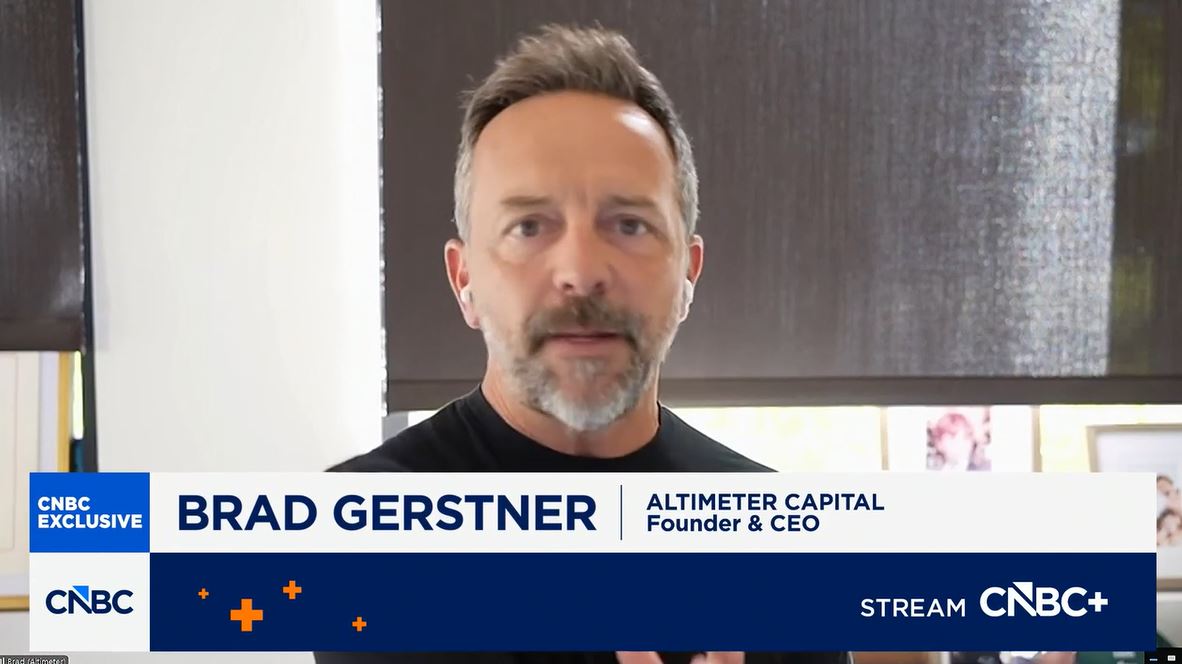
Brad says ‘horses---’ on live TV
Brad Gerstner, the star guest of Friday's (9/11) Halftime Report, made a nice statement about 9/11.
But Brad was actually on hand to discuss Jacob Coxon's statement about AI.
Judge listed Brad's X statement in reaction to Coxon's statement in which Brad called it "ridiculous hyperbole from an ex-junior employee who worked a total of 6 weeks at Anthropic, now cause for regulatory intervention? No thx." Judge said there were "a couple of emojis after that."
Judge told Brad that Coxon is "not the only one" expressing such concerns. Judge also mentioned Paul Tudor Jones' WSJ op-ed (NOT Paul's years-ago comments about female traders).
Brad said, "This discussion's been going on for a decade. There was nothing new this week." What Brad doesn't like "hyperbolic scare tactics" that are "hiding behind a political agenda."
Brad emphasized how the industry is "taking a lot of time" to get the models right.
But Judge said Dario "himself" was posting about "warnings of AI" in January and Sam Altman apparently has raised safety issues (when not arranging some circular financing thing with NVDA). Brad interrupted, "Scott doesn't that make you feel great?" and "did you ever hear that out of Mark Zuckerberg about social media?"
Brad returned the focus to Coxon, stating, "To go on national television in a highly coordinated way ... single researcher ... tell the moms and dads of America that this can kill all of humanity in the next 3 years without any countervailing, you know, conversation, is deeply irresponsible."
Brad said "Jensen Huang yesterday called it deeply untrue. Andrew Feldman, the founder, uh, of Cerebras who spent decades studying this, called it 'utter horses---.'" Brad said "Elon himself" called it a "coordinated psy-op."
Brad said, "I would ask ... these folks who are causing this alarm: What would they like us to do?"
Brad then dug into the past. "Remember all the claims around nuclear? That it was gonna kill all the kids, that it- Ralph Nader, that it would wipe out the city of Cleveland. Not a single person in this country died or was injured by nuclear energy. But we shut down 67 nuclear reactors. We unilaterally ... disarmed, while China's building a hundred fission reactors. Why did we do that? Because of alarmists, activists, that went uncountered."
All Brad is asking for is a "balanced conversation."
Judge then returned to his favorite topic of last week, stating "polling" shows "one after another" that a "growing number of Americans don't want data centers in their backyard. ... Certainly they're not all fools. ... They see an industry that's racing ahead, they hear us talk about IPOs, they see people getting rich, they worry about this technology that's coming into their backyards and they think, causing their water bills, their electricity bills to go up, and God forbid, take my job. And that's why there's this growing level of distrust."
Brad said, "Correct, correct," and "we need to do a much better job ... of explaining what in fact is happening. ... In fact, AI has created a million new jobs in America. Right? We learn, that all of this catastrophizing about data centers may in fact have had support from the CCP, right? So I want a little investigation, who is behind all of this activity."
Brad said he "totally" agrees with Scott Bessent's carping about the data center messaging (when Scott isn't minting new currency featuring the current president). Brad wonders who is pushing back against claims like Coxon's; "explain how that is going happen."
Judge said some "group in Yemen" was using Claude to develop missiles; Judge said it sounds like "Holy you know what (snicker)."
Brad said "our adversaries" have been trying to "Google" how to build weapons for "25 years."
Brad mentioned "6 weeks" probably 4-5 times.
Kevin says it would be ‘terrific’ for Task Force Kevin to signal (in some way) to markets that this is ‘one and done’
Judge opened Friday's (9/11) Halftime Report saying rate hike odds have soared from 71% to 86%; "Dare I say, it's almost as if the market wants a hike. Thinks it's getting a hike. And is actually fine if it does get a hike."
(Which is different than what some Halftime panelists were saying in the last couple weeks. But what a difference the data makes!)
Jimmy Lebenthal said one effect of a hike would be that Austan Goolsbee straightens out his Edmund Burke quotes "long rates come down." Jimmy said the stock market usually doesn't melt down over the first hike, a point heard in at least one other CNBC show Friday.
Jenny Harrington said it's "OK" to be raising rates for the "right reasons," which in this case is a strong economy; Jenny predicted we'll "roll with it" (snicker) (that's Steve Winwood).
Shannon Saccocia said there's already been "positioning this week" on rate expectations. Shannon asserted, "If they don't go in September, they're likely not gonna go in October, right, ahead of the election."
Kevin Simpson said it would be "terrific" if the Fed telegraphed next week that "this is one and done." Kevin said we don't need a "dovish" Fed, we need a "credible" Fed.
Jimmy thinks he might get AAPL under 300
Jenny Harrington in the 10th minute of Friday's (9/11) Halftime Report was back to making references to her awesome late 2022 META buy when she knew it was so undervalued (though she didn't go into the specifics this time; she has previously).
Jimmy Lebenthal said he's "considering" buying a Duo. Jimmy said he sold AAPL "at 330" just before the last earnings report; he'd look to get back in at "something below 300" ... and this is the key part that always gets our Spider-Sense going ... that "makes up for the taxes that my taxable clients will have to pay on the shares that I sold."
Exactly what does Jimmy mean, "makes up for" ... He's apparently saying that whatever amount it will fall, it's definitely going to bounce back, so in order to sell now and take tax hits, he has to be convinced that it's going to fall really far so that he can buy it back and recoup the obvious bounce back that's going to happen which will apparently make up for the taxes paid (which are an accrued liability that presumably can't be magic-wanded away no matter whether Jimmy sells or not).
There's nothing about, "Gee, maybe I SHOULD sell this stock and take a tax hit because there's ANOTHER stock that might actually do BETTER."
Anyway, Jimmy said he can't "justify" buying AAPL now as a "fundamental value-based investor," meaning Judge's scare tactics about the multiple are working.
Jimmy said ORCL's free cash flow was "a lot better than expected" (snicker) it was expected negative 10 billion but was only negative 5 billion (double snicker). Jimmy suggested ORCL was down because interest rates were up. Jimmy called ORCL a "buying opportunity" and said you can buy "right now."
Jenny said there's "fluff" and "froth" in some AI-related stocks. Jimmy protested of ORCL, "This is not a frothy stock."
Kevin Simpson said the PLTR multiple is "stretched." But Kevin said "they are the place to go, especially for AI sovereigntry (sic pronunciation) uh- soven- sovereigntry (sic basically same as first time) and deployment."
Kevin bought UNH. He retraced the stock's path and said earnings are "closer to a trough than a peak."
Judge said healthcare's having "its worst week since March." Jenny said healthcare is "only helped by AI."
Kevin's Final Trade was FCX. Shannon Saccocia said IYE, Jimmy said DAL and Jenny said KMB.
Judge had Liesman on Closing Bell, but they didn't take up Austan's purported Edmund Burke quote that some of us are still scratching our heads about. (Something about there's a difference between day and night even if there's also twilight ...)
Friday Morning Football, oh joy
Judge on Thursday's (9/10) Halftime Report said JPMorgan upgraded META from 640 to 820.
Bill Baruch said META is building enough compute that it can sell if it doesn't use it itself.
Josh Brown talked up QSR for his Best Stocks list. He said Ackman's in the stock.
Josh claimed, "Burger King fixed its nuggets," which he joked is "like China revenue for Nvidia."
Stephanie Link talked up SBUX.
CNBC's Alex Sherman was in Melbourne (pronouncing it "Melbin," saying that's how the "locals" pronounce it) to give us the latest CNBC NFL team valuations for the big football game that was an absolute dud. (This review was posted overnight Thursday-Friday). Judge asked Malcolm Ethridge about NFLX. Malcolm said NFLX isn't getting credit for sports/live events from Wall Street, but he still thinks investors should want the company to take "big swings" to gain/keep viewers.
Ternus had ‘guns blazing’
Malcolm Ethridge on Thursday's (9/10) Halftime Report said AAPL has an "obvious" opportunity for gains, he thinks the iPhone, though expensive, will spur a "supercycle."
Malcolm added, "Oh by the way — there's no AI story to it."
Josh Brown said AAPL gave "way more" than the expectations; Ternus "came out guns blazing." Josh said, "I think the foldable's gonna be a hit. They will not be able to make enough in order for this to move the needle in Q4," but it could be a "blockbuster" next year.
But Josh said Malcolm's statement that there's no AI is "not quite true," though Josh acknowledged AAPL doesn't have its own LLM.
Josh predicted "waiting lists" for the Duo as he said techies were expecting a $2,500 price, but it's actually under $2,000. Judge agreed, noting "B of A had the pricing a little higher as well going in." Malcolm said AAPL will get a "bulk discount" for the parts, which will boost the margins.
Bill Baruch talked about how 25 years ago, he had a Nextel phone, then a BlackBerry, and now, "I couldn't imagine life without the iPhone." Malcolm compared the Duo to "like the next pair of Jordans coming out 30 years ago."
Judge mentioned the 33 multiple to Stephanie Link.
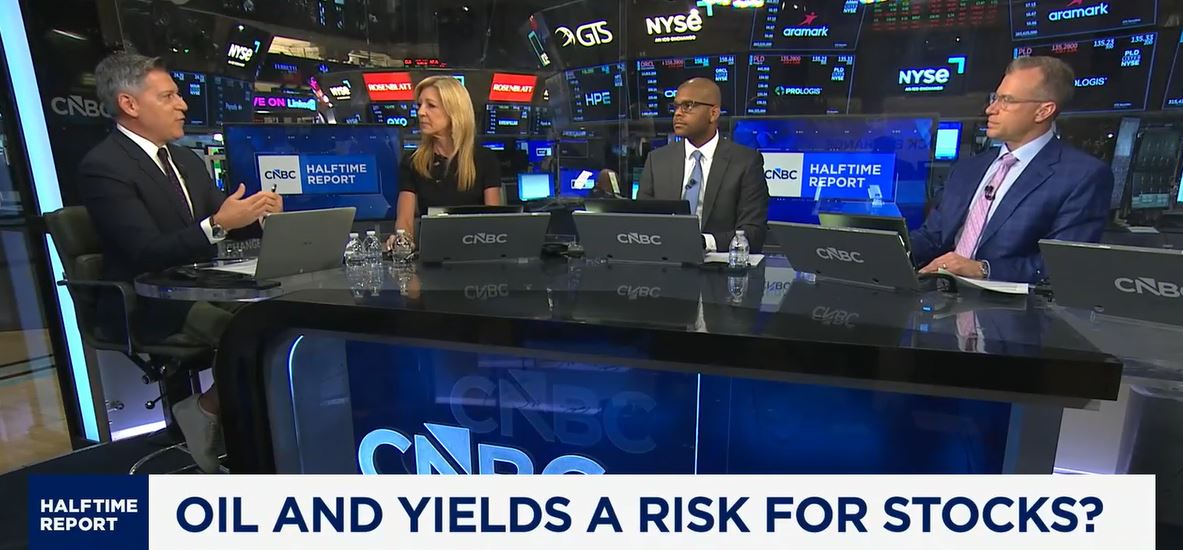
Judge wears that 3rd pair of sneakers that have no logo
Permabull Stephanie Link actually started off Thursday's (9/10) Halftime Report claiming "we're all watching" yields, oil, inflation data (as if any of those would change her outlook, as if even $375 a barrel for oil will change Stephanie's bull case).
Stephanie shrugged that September is typically weak but said "Before you get too negative" (no chance of Stephanie ever doing that), October and November tend to be good.
Judge was so devoid of topics, he restated Rubner's call that he trumpeted just a day ago.
Malcolm Ethridge is on board with the "September seasonality." He said there are "opportunities being created."
Bill Baruch said the PPI report has things "for both sides." Bill said a 70% hike probability "is too high."
Late in the show, For Mike's Market Memo, Santoli said it's "same story, only moreso."
Shouldn’t Dara have bought AAPL?
Josh Brown has often mentioned TTAN on the Halftime Report, so it was a little embarrassing to this page to realize Thursday (9/10) that we had no clue that the stock apparently had cratered this week.
And so we gotta give Judge credit for demanding Josh explain "what's the story here."
Josh said revenue growth was 21% (they always start with the positives), "but they missed on EBITDA." Josh outlined strengths and strategies but thinks it may be in the "penalty box for a quarter or 2."
Josh sold MAR, he said it "worked," but it was only a trade, not an investment. He also sold CFG, he said that's the "same story," it was a trade that he didn't want to let become a loser; "I may be back."
Judge said Dara has bought 141,000 UBER shares. Josh for the umpteenth time mentioned how great the UBER platform is going to be, and he thinks eventually the stock will "get its groove back," but he doesn't know when.
Josh's Final Trade was SNOW. Bill Baruch said TEM, Malcolm Ethridge said CB and Stephanie Link said NVDA.
Joe says the JOET sold COST at $1,014 in both April and July
Joe Terranova occasionally likes to talk about stocks having a "time correction," meaning, they don't go anywhere for a while, so even though they're not down hugely, you should sell.
On Wednesday's (9/9) Halftime Report, Joe didn't use that term, but that's basically how he judged COST, which he said he sold; "I time-stopped myself out."
That was fine. Then came the gaffe. (Which Judge didn't correct.)
Joe explained the JOET bought COST in July 2021 at "429" and "sold the stock in April (sic) of '26 at a thousand and 14." Then Joe decided he'd buy it personally. But, "I should've listened to the old- my own rules, which exited in July (sic) at a thousand and 14."
Joe indicated valuations for COST and WMT, or at least COST, got high, but they're unique companies. Steve Weiss said the multiples are kinda high for those "pretty narrow" margins. Weiss said, "Subscription models always give you a premium valuation."
At least Judge didn’t go to Cupertino for the event like he did for WWDC (Zzzzzzzzzzzz)
Joe Terranova on Wednesday's (9/9) Halftime Report said AAPL only has 58% buy recommendations from the analyst community while other Mag 7s are over 90%.
Judge and Joe haggled over AAPL's multiple and revenue growth, Judge saying analysts "can't get their arms around" a 33.8. Joe said he doesn't look at valuation as an "indicator" of when to get in. (Comments like those usually prompt Weiss to demand, "So valuation doesn't matter???!!!!!")
Joe said it's not an "extreme valuation." Joe asserted that revenue growth is "coming back again."
Steve Weiss said iPhone launch hype "always dissipates" afterwards and said the iPhone X launch "was a dud," but for this one, "there is no expectation." Judge protested that there's "huge expectations."
Bryn Talkington called AAPL and/or its event a "nothing burger."
Oliver said AAPL options were pricing in "more than 3 times the typical move."
Meanwhile, "I think Meta was a buy," said Kari Firestone, citing low multiple and growing earnings.
Weiss hailed Zuck for having a "startup mentality" while other Mag 7 chiefs are "more focused on, 'Let's run the business as we inherited.'"
Weiss shows up in 9th minute
Judge started Wednesday's (9/9) Halftime Report with Scott Rubner's latest note; apparently, Rubner thinks, "The highs are in for the month."
Joe Terranova said, "Scott (Rubner, not Wapner) has the hot hand."
Joe said he understands all the "headwinds" right now, but once again says it's not enough to make him bearish. Joe indicated people don't really think oil and bond yields are going to be elevated by the time of midterms, but if they are, then everyone's "offsides."
Kari Firestone said summer was "quite blissful."
Judge said Barclays went to 7,950 (a major jump from 7,800).
Bryn Talkington said since 1962, the market typically has a "peak to trough decline" of 7 to even "like 28%" between this time of year and the midterms. But then "95% of the time" afterwards from November to February, the market's positive.
After a fair amount of commentary, Judge welcomed Steve Weiss to Post 9 somewhat mockingly (we're guessing Weiss got stuck in traffic). Weiss said "the risk/reward has changed," but that doesn't mean sell "long-standing positions and, and pay taxes on them, even capital gains as opposed to ordinary tax."
(Translation: Weiss doesn't expect a huge V-shaped drop that, if you sold now and somehow caught the bottom, would offset your agony at paying gobs in taxes that you'll eventually have to pay someday anyway.)
Weiss said over the weekend, he studied the "correlation" of high gas prices with "low approval ratings" of the presidential administration "and really didn't find much."
Weiss said if the AI trade goes away, "then the bottom falls out. But that's not going away." Weiss said there's a risk to shorting, as the president could announce any time, "We're close to a deal," and the market for whatever reason will react to it. Still, on the Middle East conflict, Weiss said, "There's no off-ramp right now."
Weiss buys more DKS but is done doing that for now
Judge on Wednesday's (9/9) Halftime Report asked Steve Weiss about DKS, which Weiss made his Final Trade right before the ghastly earnings report (see below).
Weiss explained he called it a "high-risk" trade at the time, which was true.
But a couple days after earnings, "I bought a lot more of the stock in the 20s (sic, 120s, which Judge clarified with Weiss)," Weiss added.
Weiss said retail stocks are "problematic." Weiss insisted the DKS stores are "destination locations." We don't disagree with that at all; DKS may be a tough stock, but it's a great place to buy stuff. (This writer has no position in DKS.)
However, Weiss said, "I'm not buying more at these levels definitely." Joe Terranova said rubber is at an all-time high.
In the show’s 37th minute, we heard ‘Cambridge Analytica.’ (But what about the Russia election interference?)
Santoli said on Wednesday's (9/9) Halftime Report, "Bonds keep getting cheaper, and nobody wants to buy 'em."
Steve Weiss said FTAI is "pretty broken."
Bryn Talkington's Final Trade was INFL. Weiss said WFC; he doesn't own it, a remark that confused Judge and brought clarification in the final seconds. Kari Firestone said TMO, and Joe Terranova said NTR. Judge said, "Good stuff."
Santoli’s Market Memo
On Tuesday's (9/8) Halftime Report, Santoli announced he's launching a "Market Memo."
The screen text called it "Insights for Investors Who Want More." Santoli said it'll be coming out Tuesday mornings. It's "free to subscribe."
Meanwhile, Santoli said "it's a little staticky" as to whether there's a "new mode of things" in the stock market. He's watching the QTOP, and it's "still 4% below its record high."
Yardeni might be up to 8,595 by now
Joe Terranova announced at the top of Tuesday's (9/8) Halftime Report, "I feel pretty good today," not because of seeing Judge in a tie, but because the momentum factor was "actually rebounding."
Joe chalked up the drop in market indexes to AMGN.
Brian Belski said we're in a "vacuum" of no news and asserted the Fed isn't going to hike (after first saying it's "not gonna cut").
Joe said a 25-point rate hike "will literally do nothing as it relates to inflation" but "further freeze this residential housing recession that we're in."
Jimmy Lebenthal said "diesel factors into everything."
Judge again showed his chart purporting to show the Mag 7 catching up with the S&P 500. Jimmy said he thinks those stocks are just in a "consolidation phase."
Belski predicted financials will "kill it" in earnings. Judge pointed out, "They haven't traded very well lately."
"Nobody believes this rally," Belski asserted, saying there's "still a fair amount of money" on the "sidelines" (snicker).
Joe, though, disagreed, stating, "I don't think the skepticism's out there," but "a lot of people" are "incredibly bullish." Joe suggested rising yields will weigh on stocks, "the biggest risk" to the market. Judge said Yardeni sees a Fed hike "in play."
Judge back in tie, NKE sneakers
Joe Terranova on Tuesday's (9/8) Halftime Report said it's possible a foldable new AAPL phone "gets some traction."
Jimmy Lebenthal explained that "Tim Cook is still hangin' around in the chairman's position, so it's not like he's, uh, gone to Tahiti (snicker)."
Joe said a new phone only adds "incrementally" another reason to own the stock. But Joe assured that the stock "hasn't broken down," it's not far from its "334" all-time high.
Jimmy said anyone can interpret the AAPL chart how they want, it's "almost a Rorschach test."
Judge at one point flagged Belski for apparently fiddling with his phone, which viewers couldn't see.
This time, it’s not Josh who’s defending SHAK
Judge on Tuesday's (9/8) Halftime Report said SHAK got an outperform from RBC with an 89 target.
Brian Belski claimed SHAK is a "thematic (snicker) play on Gen Z."
Belski said, "I think the bottom is in place with respect to Shake Shack."
(That's fine, what Brian didn't say is that SHAK is expensive in a very competitive space, the novelty wears off fairly quickly, and many of the people who enter its restaurants simply want to know the bathroom code.)
Belski said MCD is a "steady Eddie value play" and "comfort food," but Judge said the SHAK and MCD charts "look pretty similar."
Belski called SBUX a "long-term winner."
Joe Terranova, though, said nobody's talking about how GLP-1 may be causing headwinds for the "quick serve restaurant" space.
Belski said it's a "tough business" in general, but he's "never thought about the GLP-1 side of things."
Judge asked for 2-year charts for the spotlighted quick-serve restaurants and got a few. Joe said, "It's universal across the board," the declines in CMG and even DPZ.
Belski suggested DPZ and CMG have had idiosyncratic issues. Judge asked if GLP-1 could be having an impact. Belski said if so, you can throw in MDLZ and KO and GIS, which Belski said would be "more of a risk."
Judge noted the LLY chart is going the opposite direction; Belski said maybe he'll start thinking about GLP-1.
It’s a ‘heavy month’
Jimmy Lebenthal on Tuesday's (9/8) Halftime Report said he's "tempted to buy" more QCOM, but he's going to wait, because September is a "heavy month."
Jimmy insisted the QCOM chart has "one heckuva base forming."
Brian Belski said ORCL got "thrown out with the SAAS" and has "already bottomed" and even provides tech "value." Jimmy doesn't want to see a hike in ORCL's capex.
CNBC's Annika Kim Constantino reported on Novartis having "another trial setback." Belski said it's "not surprising" that AMGN was sliding on "GLP stuff." Joe Terranova said medical devices are "trading awful" because they don't have the revenue growth; Joe's advice is, "make sure you have the growth" if you're investing in health care stocks. Jimmy talked up ABBV and its "diverse pipeline."
When is Judge and/or Liesman going to clarify for viewers Austan’s purported quote from Edmund Burke (that seems more and more like it might be something Judge Smails wrote for the sailboat christening)
Judge on Tuesday's (9/8) Halftime Report started to bring up ABNB but derailed it by talking about Belski's travel habits.
Joe Terranova said ABNB is about the "very resilient" traveler and again mentioned World Cup; we'll probably be hearing about the World Cup until Q2 2027.
Oliver said XOM had "distinctly bullish" options trading, and so did BE (which never gets mentioned on the show); "options there are booming" in favor of calls.
Joe said he would expect "hedging" against oil prices at 93-94. Brian Belski said "refiners are a great business." Jimmy Lebenthal said for the umpteenth time that XOM does a lot of refining as well as other things. Jimmy said in oil, "there's a lot of money to be made all along the product pipeline above $70."
Belski's Final Trade was PNFP, Jimmy said LNG and Joe said FCX to the "80s."
Judge, Jimmy and Weiss debate what ‘financial engineering’ means
Judge on Friday's (9/4) Halftime Report noted ADBE's slide.
Jimmy Lebenthal explained, "The market wanted an outsider ... I wanted an outsider too. ... That doesn't mean that it's a sell." (It's never a sell, according to Jimmy.)
Jimmy mentioned ADBE buying back shares. Judge called that a "financial engineering move largely."
Jimmy quibbled with that terminology, he said "financial engineering to me is a negative statement."
JImmy said the buybacks come from free cash flow. Jimmy said "financial engineering" refers to "juicing the earnings per share at the expense of some other intrinsically, fundamental valuable part of the business."
Weiss said, "That's not true. ... That's not accurate." Weiss explained, "Financial engineering is not necessarily negative but just shrinking the stock- the share base. ... So the question is, what is the growth without that."
Weiss also said ADBE "cast a very wide net looking for a CEO, so was there nobody out there who thought it was a great opportunity."
Jimmy insisted on making a "distinction" in that "financial engineering" is a "negative," but what ADBE is doing isn't "negative."
If META has to pay, why don’t YouTube and TikTok ...
Judge (citing Santoli, who wasn't on the show yet) on Friday's (9/4) Halftime Report tried to claim the chart shows the Mag 7 starting to outperform again.
Jimmy Lebenthal called NVDA the "clearing event" for the Mag 7. Kevin Simpson said it's good to be "isolating" Mag 7 stocks and not talking about the whole collection like a group. (He didn't say "monolithic," but ...)
Rob Sechan said you can "continue to be patient" with META and even mentioned "late '22" (the time when EVERYBODY apparently was hoarding gobs of META stock).
Jimmy said what is "actually worrying" him, "I do think the Fed is gonna raise rates," this month, though it's not the official Cerity view.
"I don't think the market ie priced for it," Jimmy added.
Santoli said the market's been "oscillating" in a range; he noted the "VIX below 14."
Haven’t heard any more about that Cupertino invite Judge got
Judge on Friday's (9/4) Halftime Report announced that the "South China Morning Post" is reporting AAPL is about to "unveil their most expensive iPhone ever ... 1,319 dollars for the 18 Pro."
Judge suggested inflation may be "the greatest test that this company has ever faced in terms of the pricing power that it thinks it has."
Weiss said "For sure" but said the reason the stock was down Friday was the B of A report that mentioned "negative revenue growth in the app store."
Weiss came through though in mentioning, yet again, literally for about the 15th year running, the telcos being willing to "subsidize" whatever the price of the phone is.
Kevin buys FCX, AEM
Kevin Simpson on Friday's (9/4) Halftime Report called TSLA's Cybercab event on Thursday a "big fizzle."
Kevin bought more FCX and AEM. (He should've been buying FCX in March and AEM in July, but whatever.) But he said if there's a Fed hike, "Forget the gold trade."
Kevin said he'd be "careful chasing" HOOD even though it's "well beyond" the crypto trade, which Judge questioned given the chart's "reasonably tight correlation."
Jimmy Lebenthal touted XOM because "it does everything" and yet again touted its 6-year return and how it's beat the S&P. Kevin likes XOM but likes CVX "a little bit better." Rob Sechan touted SU but he said it's "run quite a bit."
Judge wasn’t wearing NKE shoes Friday
Bill Baruch on Friday's (9/4) Halftime Report said he sold AS; he said "this stock took off," and he was "long at $19," but it's "really started to break down."
Judge persisted that AS seems to serve the upper end of the consumer, so why isn't it OK. Bill said other sports names have struggled, and it's a great portfolio of brands but "may not be the right time" to own the stock.
Bill bought WMT because he sees a "trade down" in the consumer. Bill said, "If you like Walmart, this is the time to be a buyer."
Kevin Simpson would "definitely" pick WMT over COST at the moment. Judge wondered where the buyers of LULU are, "crickets." Mentioning ONON, Jimmy Lebenthal said what's been a strong business has gotten "very fickle" and even is in a "secular decline." Kevin Simpson trimmed TJX.
Kevin failed to admit that as SPCX slid from $225, he announced he’d surely buy more if it got close to $100, then didn’t when it was $104
CNBC's Oliver, who basically talks about SPCX options every day now (this writer is long SPCX), said on Friday's (9/4) Halftime Report that it "looks a bit like a caged animal."
Oliver said when SPCX breaks out of its range, "it will likely do so with noise."
Kevin Simpson, long SPCX, claimed he's not day-trading this name; "we're looking years into the future, not weeks or hours."
Rob Sechan said, "I still think the stock's going through price discovery, but let's remember, there's an evangelical level of support for this stock."
Jimmy "Adobe (Gillis)" Lebenthal said "evangelical support at times withers, and look at Tesla over the last week or so." (OK. One week of TSLA trading is proof of some kind of proof of evangelical stocks. Got it.)
Judge thanked Jimmy for that comment, prompting laughs from Rob.
Steve Weiss' Final Trade was FTAI. Rob said KLAC, Kevin said NVDA and Jimmy said ORCL.
Jimmy apparently has inside knowledge on things Judge might say
Josh Brown on Thursday's (9/3) Halftime Report said DE is on the Best Stocks list again/still, its gains this summer fueled by commodity prices and AI.
Judge said Jimmy Lebenthal owns a "Japanese tractor." Jimmy said he "should've gone on Kalshi" to wager on whether Judge would mention "Japanese tractor."
Josh said of DE, "It's basically become a technology company."
Josh held a picture of Jimmy's tractor on Josh's phone. "That's a serious tractor," Judge said to chuckles as Santoli prepared to deliver the Midday Word.
Let’s all cheer software stocks
Panelists on Thursday's (9/3) Halftime Report were cheering their new flavor of the month, software stocks. (Basically it means wait for the market to do something, then backfill the narrative and explain how everyone else misunderstood these stocks.)
Judge said UBS put a 500 on SNOW, "the highest one that we saw."
Josh Brown said the path SNOW is taking is "exactly what we laid out" in the Best Stocks column at CNBC Pro (which doesn't get that many on-air pitches anymore). Josh said it's "the data governance layer" of agentic AI.
Jason Snipe said SNOW had a "humongous number" in product revenue growth. Jason said it's up 70% YTD.
Bryn Talkington said concerns about software's demise have "somewhat died" as the stocks have had "V-shaped" recoveries. Judge said, "What SAASpocalypse?" Jimmy Lebenthal said fundamentals are proving there's "a lot of reasons" to be in these stocks.
Judge said "the IGV year to date is now positive."
Josh crowed about "the disconnect between Silicon Valley and actual businesses ... and the hedge funds bought into the Silicon Valley story," which is that they'll "obviate the need for all these quote-unquote middle men." Josh said SAAS gives you someone to "yell at" and "potentially to sue" when something goes wrong. All of which prompted Josh to tout TOST and TTAN.
Jimmy said "we should debunk the SAASpocalypse, uh, narrative" but there's another narrative that goes with it, the private credit narrative; Jimmy said Blow Owl and Apollo are also up like software stocks.
Seema Mody bolstered everyone's case that SAAS is alive and well.
Josh pointed out that software stocks have had higher multiples than semiconductor stocks, and then it "flipped" this year.
Jason Snipe rattled off a bunch of strong metrics for MSFT; "I really continue to like this stock." Jimmy touted Azure margins.
Bryn said with ORCL, "The jury's still out."
Josh touted CRWD, as he does at least once a week, and suggested Claude is even working with it.
Judge said Barclays is giving ADBE a 295 target. Jimmy said you don't need "high hopes" for this stock; all you need are "medium hopes," whatever that means.
Jimmy reiterated, "My company just re-upped with Adobe" and that "medium to low hopes" are all you need with this stock. Bryn called ADBE a "battleground stock" and pointed out how AAPL is goosing EPS by buying back so many shares.
Is Yardeni up to 8,575 ...
On Thursday's (9/3) Halftime Report, Josh Brown said, "I really never thought there was a heavy appetite for a rate hike from anyone at the Fed."
Santoli said the revelation is that the Fed swing vote is "at least a little bit agnostic." Josh suggested that just getting some Fed direction over with might be enough to get the market going, regardless of what the Fed actually does.
Bryn Talkington said the "skepticism" about AI "actually prolongs the cycle." Bryn admitted she sold half of her DELL stake "like in the 170s" to buy CRM.
Jason Snipe said COST is "somewhat of a mixed bag," he'd prefer they focus a bit on the "younger consumer," but he still likes it.
Josh called UBER the "cheapest growth stock in the market." It's a stock he mentions probably once a week. Josh conceded the "sentiment cloud" over the stock, also something he mentions about once a week.
Oliver said TSLA and SPCX, the "Musk stocks," were high up the options volume chart, "and the flows are notably bullish." (This writer is long SPCX.) Bryn suggested 400 is a key level for TSLA.
Bryn's Final Trade was COF, saying, "next stop, 227." Jason Snipe said NOW, Jimmy Lebenthal said NVDA and Josh said SPOT, he said it's about to have a "golden cross."
Adam Parker says data-center pushback is ‘mostly stupid and baseless’
Judge spent a lot of time on Wednesday's (9/2) Halftime Report talking about data center pushback (see below), but viewers actually got the good stuff later on Closing Bell when Adam Parker opined on the politically charged subject.
Adam said he thinks data center pushback is "mostly stupid and baseless. I mean, Google it, uh, you use about the same amount of water for a data center as 2 golf courses. Are we gonna cancel all the golf courses to save data centers?"
Permabull Stephanie Link was on the panel with Adam and told Judge that pushback only creates a "longer cycle" for data centers that'll last a couple decades ... "the pushback only makes me more confident in that thinking," Stephanie said.
Liz says we’ll have to get used to hearing data center complaints into late 2028
After the A Block on Wednesday's (9/2) Halftime Report, Judge rattled off the latest political headwinds against data centers.
Liz Thomas said data center buildout is "such a political topic" and predicted it will remain so "into the 2028 presidential election."
Liz said there's a risk the government "oversteps."
Judge declared, "This is an administration that has had an extraordinarily cozy relationship with much of Big Tech," but Scott Bessent took an "absolute direct shot at that industry."
Jimmy Lebenthal said the companies need to do a "better job" of explaining costs and benefits of data centers. Jimmy said there's a "similarity" to fracking opposition, but "now we look at fracking as a strategic imperative for this country."
Jimmy said with elections looming, we're "politicking."
Judge suggested the issue may only grow "louder" after midterms.
Jimmy suggested newly elected politicians are "gonna do what Willie Sutton did" (at least Jimmy wasn't trying to quote Edmund Burke) (#austan) (see below) and look at taxing data centers because that's "where the money is."
Judge suggested the data center issue has "filtered its way into the stock market" and will affect earnings outlooks.
Steve Weiss said Sam Altman doesn't want more compute going up because "he's already locked in what he needs."
What did Willie Sutton think about the market seasonality factor?
Joe Terranova on Wednesday's (9/2) Halftime Report said "Tim Stook" (snicker) you have to be "selective" this month and warned against being too cautious, which Joe said leads to bearishness.
Joe suggested the slide in the momentum factor is "washed out."
Judge said "yada yada yada" while reading apparently a bunch of analyst notes about turning cautious. Liz Thomas said "This happens every year," when people talk about a "rough" September, but there's "mixed messages" from the Treasury and Fed, and also, the AI narrative is into Year 3.
But Liz said any pullback will just "elongate" how long this cycle goes.
Jimmy Lebenthal said he's not going to try to time a correction and is "certainly not selling stocks wholesale here."
Steve Weiss suggested it would be a "major mistake" to unload stocks now.
Judge rattled off stats about how bad momentum's been doing. Joe reiterated he thinks the downtrend is washed out, but "I don't think you step in here" until the trade "proves itself." Joe said you need a "degree of apathy" toward the trade.
Joe said of AVGO, "Sometimes there's no trade."
Judge rushes to Weiss’ defense, hectors Jimmy over misstating Weiss’ commentary
Jimmy Lebenthal on Wednesday's (9/2) Halftime Report made a speech about whether there's supply constraints (NVDA) or competition (AVGO) or both in the semiconductor space.
Steve Weiss again hailed TSM, "This is the must-own in the sector," even moreso than NVDA. Weiss said it's probably his largest position, though he did "cut it back a little bit" because the position got so big.
Jimmy Lebenthal said, "I heard Steve, and I'm thinking about, should, uh, Nvidia be replaced with Taiwan Semi. If anything, you own both of them," but Judge said, "I don't think he's saying that." Weiss said, "I didn't say that at all."
Jimmy said, "I'm paraphrasing a little bit."
Judge said, "Well it's a lot a bit."
Jimmy said, "Lemme continue though, I don't want to get stuck on that."
Judge said, "No no, I do ... he's not suggesting that you should trade one for the other, if you're in Nvidia, sell it and buy Taiwan Semi ... I just wanna make sure people are clear on that."
(OK ... Jimmy did sorta imply that Weiss was drawing a comparison. But Jimmy also indicated that what Weiss was saying is what prompted the question in Jimmy's mind, which is different from saying that "Weiss says this." So Judge was right to clarify, except, it wasn't that big of a lapse.)
Jimmy said Weiss is saying that TSM "might be a better stock than Nvidia," an observation no one disagreed with. Jimmy said TSM is "awesome" and he really likes NVDA and he won't get "caught up" in picking which one's better.
Judge demands to know if ADBE being sold is Jimmy’s bull case
Judge on Wednesday's (9/2) Halftime Report suggested Jimmy Lebenthal trade ADBE for DELL.
Jimmy said he should be "flattered" that people were talking about that a day earlier. (There was a mention Tuesday of ADBE by Jenny, but we skipped it.) Jimmy said ADBE is "showing some signs of strength here."
Jimmy suggested naming a CEO could be a "catalyst" for ADBE, including if the new CEO "clearly has a design to selling this at 10 times earnings to another company."
Judge said, "You're gonna own it now for an event ... for the company to be sold. That's your bull case now?" Jim said Cerity Partners has re-upped its contract with ADBE.
Jimmy said looking at DELL makes him think ORCL will be "OK." But Jimmy always thinks ORCL will be OK, so nothing new there.
Joe Terranova said every cyber stock is down despite great PANW earnings because "positioning is full."
Steve Weiss said, "These stocks are very expensive" and "it's smelling a little bit like we saw with software."
Jimmy said Google needs its new AI model to "do well in the marketplace," which seems fairly obvious. (This writer is long GOOGL.)
Joe wrongly says ‘inferring’
Jimmy Lebenthal on Wednesday's (9/2) Halftime Report admitted that WYNN has been a dog, "what an awful chart," though "I did trim it by half about a year ago at 130. My mistake so far has been to buy back in at 106."
Jimmy said WYNN is somehow "still planning to open" the resort in the UAE on the Strait of Hormuz next year. Judge said the chart was "breaking down before the war even happened."
Joe Terranova told Jimmy, "you're inferring (sic meant 'implying') (that still isn't really the correct word, but it's more correct than 'inferring') that this is, to use your word, 'idiosyncratic' to Wynn ... it seems to me the casinos are just trading awful."
Jimmy talked up VRTX, as he always seems to do.
Joe talked up LLY, as he often does.
Oliver said there were actually a bunch of options volume in EWZ (Zzzzzzzz).
Jimmy sold PCG; it's become a "pinata in California politics."
Steve Weiss' Final Trade was GOOGL. (This writer is long GOOGL.) Jimmy said ORCL, Liz Thomas said IAU and Joe said VLO.
Stephanie said she ‘kinda’ takes Elon at his word; look what that did for Julia
We noticed something interesting on Tuesday's (9/1) Halftime Report.
Stephanie Link stated, "Elon Musk today said that AI and robotics could double the economy in the next 5 to 7 years."
We all know that such a flowery statement might be more pie in the sky than anything else.
But then Stephanie got people's attention by adding, "I kinda take him for his word."
That's interesting. Because on the Halftime Report episode of Friday, July 10 (see below), Judge spent the top part of the show touting a pending Musk interview with Julia Boorstin in Sun Valley that was due to happen any moment and could've resulted in some panelist's commentary being cut off.
It turns out that only Julia was cut off, as Judge announced in that show's 12th minute that the Elon interview was "apparently no longer happening."
Julia then went on air and explained, "We just got word that he has to postpone."
Neither Judge nor anyone else on Tuesday offered a position on 1) whether we really are going to "double the economy in the next 5 to 7 years" or 2) whether everyone should "kinda" take Elon "for his word."
All kids did was compare Pac-Man scores with other kids. They were encouraged to keep pumping quarters into the machines and improve their score, and there was nothing preventing people under 18 from playing this game for as long as they want. When is Pac-Man going to settle over addicting kids to its product ...
Judge, again without tie, on Tuesday's (9/1) Halftime Report quoted Pimco (in general, apparently) saying, "You know you have a problem when conservative Texas Governor Greg Abbott and socialist Senator Bernie Sanders agree on the same issue."
Stephanie Link proclaimed, "Elon Musk today said that AI and robotics could double the economy in the next 5 to 7 years. ... I kinda take him for his word."
"Double the economy" ... Hmmmmmmmm ...
Stephanie mentioned data center "backlogs."
Josh Brown said the AI people are "the smartest people in the world," but, "They have a PR problem," in that the "figures" put forth as the "face of AI" are Elon and Sam Altman, "and that's just not gonna work."
Jason Snipe said "the communication has not been good" about explaining the benefits of the AI buildout.
Joe’s on fire
When someone mispronounces something on TV, it's funny. It just is. That's why this page flags it. We don't flag it to harp on anyone. We flag it because it's amusing.
But, we gotta say, we were practically cringing during Final Trades of Tuesday's (9/1) Halftime Report.
Josh Brown's Final Trade was AAPL; it was also Joe Terranova's. Joe called the stock's gain a "validation of John Ternus." Joe then started to say something about "Tim Stook (sic) (snicker), uh, Kim (sic) Cook, rather, steps away-"
Judge cut in, "Tim Cook. Tim Cook."
Joe explained, "I'm from Long Island."
(Good thing Joe didn't take a stab at explaining Austan Goolsbee's purported Edmund Burke quote from Jackson Hole on Friday.) (See below.)
Jason Snipe's Final Trade was GS. Stephanie said SLB, a stock she's often recommended over the last 10 years or so.
‘Astrology for middle-age men’
Judge opened Tuesday's (9/1) Halftime Report saying the Dow has been up "15 of the past 16 months," and it's only happened "one other time," in 1935-36.
Interesting stat, though we're not really sure what it means for September 2026.
Joe Terranova again mentioned the "shot of adrenaline" that momentum names did NOT get from NVDA; Joe said there's a "significant amount of bearishniss (sic pronunciation) (this page wouldn't have flagged it, but he corrected himself), bearishness rather, as it relates to sentiment. I think the sentiment is beginning to turn. And I actually believe that's the first thing that you want to see if in fact you are going to reach a bottom for a factor." (Translation: Joe's pumping up his own mindset here.)
Joe added, "When sentiment finally turns, that actually is the moment where you don't wanna get too bearish."
Judge said of Scott Rubner; "I follow what he says, and when he says it, and so do a lot of other people on the Street."
Judge tried telling Permabull Stephanie Link that Rubner says risk/reward has changed, and Rubner is looking for a "tactical reset." Stephanie said, for anyone who wants to be tactical, "That's fine by me."
Jason Snipe said you can be "cute" and try to trade volatility; "I don't have anything against that," but maybe this is just a "soft patch" and actually a place to add exposure.
Josh Brown said, "A lot of this, uh, seasonality stuff is helpful context" ... but a lot of it is sorta "astrology for middle-age men."
Judge pushed back that it doesn't seem so much like a "calendar issue" but a "calculation."
Santoli said later in the show, "I hate to defer to seasonal stuff, but, you have to acknowledge it."
Josh said momentum peaked on June 22; we're actually "51 days past the peak of momentum's outperformance."
Joe said when sentiment goes against momentum, "Don't join that party."
Seems more and more likely that the Strait of Hormuz is going to be the Time magazine Thing of the Year
Joe Terranova on Tuesday's (9/1) Halftime Report said he bought NTR to get exposure to potash and take advantage of the "spike" in commodities. Joe cautioned that in the near term, NTR is "extended."
Judge said Krinsky is also talking up "the ag commodities."
Joe said he didn't buy CF because there's a "strong correlation" between that stock and the state of the Strait.
Judge said Aug. 19 was a ‘very, very important day for the fight against cancer,’ but he’s hardly mentioned it since
Joe Terranova on Tuesday's (9/1) Halftime Report said HOOD got a bitcoin spike after the JOET unloaded it in July. Joe said the ETF did a "bad job" on this trade, which got Judge's attention.
Judge questioned, "How could it do a bad job if it's a rules-based thing."
Joe chuckled, "It is what it is. ... You're gonna make mistakes. That's this business." (That's curious, because we don't know if Joe means that the rules was supposed to back HOOD but didn't, or whether the rules isn't constructed as well as it should be.)
Josh Brown said he never would've thought ABNB a great stock, but it's breaking out, and that's how a rules-based strategy works well.
Josh says APH and DELL are on the Best Stocks list; "both of these are data center plays."
Joe said the JOET bought APH on Nov. 17, 2020, at $31.75, for those making cost-basis trades. Joe said "it still has a reasonable valuation."
Oliver said one MSFT megabull appears to be getting "cold feet" based on closing out some options trades. Jason Snipe still likes the stock.
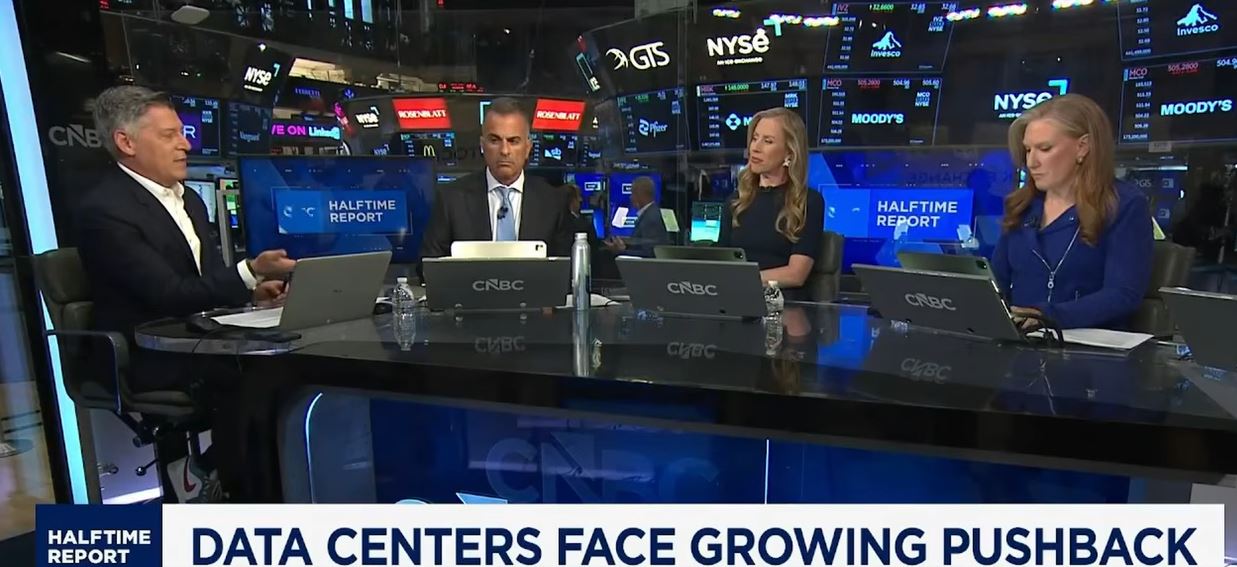
Judge evidently plans to go indefinitely without a tie (even though the Halftime male panelists are still wearing them)
Judge on Monday's (8/31) Halftime Report said the IGV is "not that far away from its highs" of 118. Joe Terranova asserted, "The signature of that move is Palantir." Bryn Talkington said "a lot of people mistakenly shorted the stock."
Joe expects PANW to deliver; if it doesn't, "I think the buyers show up aggressively on any correction."
Jenny Harrington said DOCU has "totally de-risked." She said she can't re-create it with ChatGPT.
Joe said APP is at a 52-week low. Joe again touted ZM for its Anthropic stake.
Judge hasn’t said what he’s going to do about that Cupertino invite
MacKenzie Sigalos on Monday's (8/31) Halftime reported that Phil Schiller was stepping down from AAPL's app store as Judge noted the stock was down.
Judge insisted, "This is a big deal. Uh, there's no 2 ways about it." Judge repeated, "This is a big deal."
Joe Terranova said the question is whether AAPL "has a strong succession planning (sic grammar) in place." He thinks the answer is yes. Judge said it "hardly feels like a coincidence" that this move was being announced on the eve of the Ternus era.
We woulda thought momentum would do well in April 2009, but who knows
Joe Terranova on Monday's (8/31) Halftime Report said the momentum trade was "stumbling" entering September. He was hoping for a "shot of adrenaline" from the NVDA call, but it didn't happen. Joe said agriculture prices are "on fire."
Judge said the WSJ found that the "momentum index" is down 9% since July 1; in fact, the index had its 2nd-worst month in about 40 years, other than April 2009.
Shannon Saccocia said we need a "new narrative."
Judge said the "narrative" on data centers (Zzzzzzzzz) has gotten "decidedly negative."
Bryn Talkington said we have to "ask the hard questions" about why AI stocks aren't rallying.
Judge could've made it a lot simpler by asking whether data-center stocks are on hold until after the election.
Wonder if Yardeni is up to 8,525 this week
Judge on Monday's (8/31) Halftime Report said Savita has "the lowest target on the Street for a major strategist." (We kinda think that's typical, but we're not about to research a history of Savita's calls.)
Joe Terranova challenged panelists/viewers as to, if you think market leadership is changing, whether you can be confident in the next 4 quarters of earnings of non-Big Tech stocks. "Because if you rely on history, you're going to be disappointed," Joe said.
Jenny Harrington shrugged at Judge's suggestion that AVGO could be a "catalyst."
Judge doesn’t address the purported Edmund Burke quote that Austan claimed to be making on Friday
Oliver on Monday's (8/31) Halftime Report said TSLA options were popular and someone made a big bet on volatility in either direction. Bryn Talkington said she added TSLA at 360. "The robotaxis are everywhere in Dallas," Bryn said.
Bryn said, "I haven't touched my steering wheel in like weeks," meaning "FSD is getting better and better."
Judge said it's "merger Monday" (snicker). Joe Terranova said KKR in selling USI is doing the more promising transaction than AON.
Bryn's Final Trade was GPIQ. Jenny Harrington said GXO, Shannon Saccocia said IYF (Zzzzzzzzz) (if we were to research, we'd have to think this has been Shannon's Final Trade at least a dozen times). Joe said NTR and said "I will personally buy this on the close."
We were wondering if Judge was going to decode for viewers the curious Edmund Burke quote unleashed by Austan Goolsbee on Friday's Halftime (see below), but Judge said nothing about it at all, making us wonder if this is actually some profound pearl of wisdom from centuries ago ... or something more like Judge Smails’ poem (photo above).
‘There is a difference between day and night’ — Austan Goolsbee comes up with an Edmund Burke quote that ... apparently no one else has heard of
On Friday's (8/28) Jackson-Hole-special Halftime Report, Steve Liesman got a chance with Austan Goolsbee in Jackson Hole.
First, Austan protested, "It's not my place to evaluate, the ... what the chairman says." Really? Don't they have to negotiate interest rates together?
Austan indicated rate policy is a matter of whether elevated inflation is "temporary" or "persistent." (He indicated he doesn't know.)
Austan kinda stammered around what he thinks about having fewer Fed meetings, though he said he's offered "closet support" of the idea to "scale back the use of explicit forward guidance."
Finally, Austan told Steve this:
"Like the twilight, there- there's an Edmund Burke quote, 'though twilight may be long, there is a difference between day and night.'"
We weren't familiar with that one, so we turned to the Google machine.
We typed in something like "Edmund Burke though twilight ..." and got some AI gibberish.
Then we typed in just the quote as relayed by Goolsbee, and got no takers, actually.
Then we looked up various lists of Burke's most famous quotes, and nothing like the quote relayed by Goolsbee is listed.
Make of that what you will.
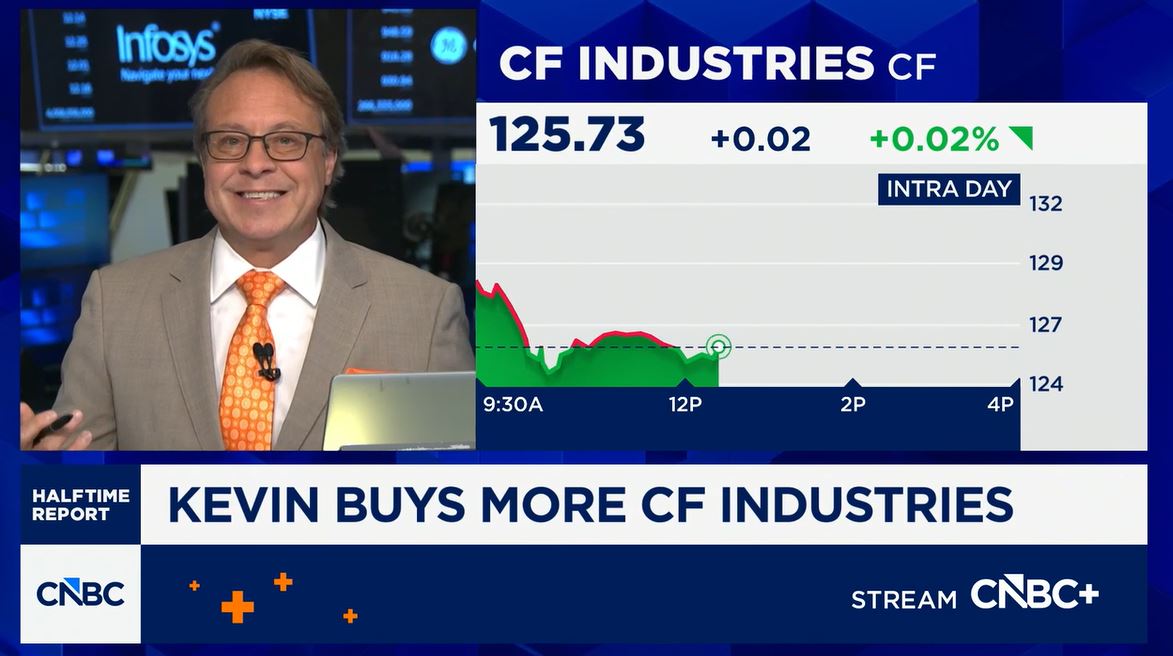
Baby boomer Kevin is a CNBC contributor
Judge wasn't present for Friday's (8/28) Halftime Report, which means he went 4-for-4 this week in skipping the tie.
The Dominator, Dom Chu, stepped in as guest host and announced that Kevin Simpson is a "newly minted CNBC contributor."
Jimmy Lebenthal joked that CNBC has a "long and lagging response time" if Kevin wasn't already a contributor. Dom said "He's been acting like one," and there was even a "ceremony," which Jenny Harrington questioned.
Later in the show, Kevin noted MDT's gains and actually mentioned "as we baby boomers age," an investment thesis heard on CNBC since at least the late '90s.
Jimmy said he's trying to "process" that Kevin is a "baby boomer." (Jimmy likes pharmaceuticals, specifically ABBV, AZN and VRTX.)
Was there anything in the speech about naming a building or coin after the president?
Jenny Harrington opened Friday's (8/28) Judge-less Halftime Report saying the 10-year entered the year at 4.2% and now it's 4.7% and the market has gone up, so maybe what happens at Jackson Hole isn't that important.
Jimmy Lebenthal said, "I thought it was a very good speech." Jimmy added, "We should expect a rate hike ... I also think that it doesn't matter."
Bill Baruch gave a "hat tip" to Kevin Warsh, explaining that the comment "hike in the woods" apparently "got the algos goin' a little crazy."
Bill said Task Force Kevin "came off more hawkish."
Bill said the 55% hike probability is "offsides."
Santoli said there was "tension release" after Task Force Kevin's remarks.
Bill: NVDA a ‘gift’
The Dominator, guest host Dom Chu, said on Friday's (8/28) Halftime Report that Hartnett thinks stock positioning is in "extreme bull territory."
Dom pronounced the Goldman guy whom Judge always quotes/interviews as what sounded like "Tony Pasquarivielo" (sic).
Bill says he really likes MRVL, though he maybe would've liked a "bigger beat" in revenue.
Bill talked up his mining portfolio, which as he noted has had a remarkable move since July (after, what he didn't mention, a disaster of a spring). He likes gold miners.
Bill Baruch said he took down exposure to industrials in the last month and a half.
Kevin Simpson bought more CF, actually Friday morning. "The fundamentals are unbelievable," Kevin said.
Dom said Goldman Sachs reiterated Sell in BBY, while Truist reiterates Buy. Jenny Harrington said she "added this back in March at $65 a share," and the investment thesis remains: "insatiable" demand for technology. Jenny said Goldman's call is "bitter grapes" (sic) or "sour grapes" because "they totally missed it."
Kevin Simpson's Final Trade was TTWO. Bill said NVDA, calling Friday's selloff a "gift." Jimmy Lebenthal said LNG and Jenny said PFE (oh no, not that one again).
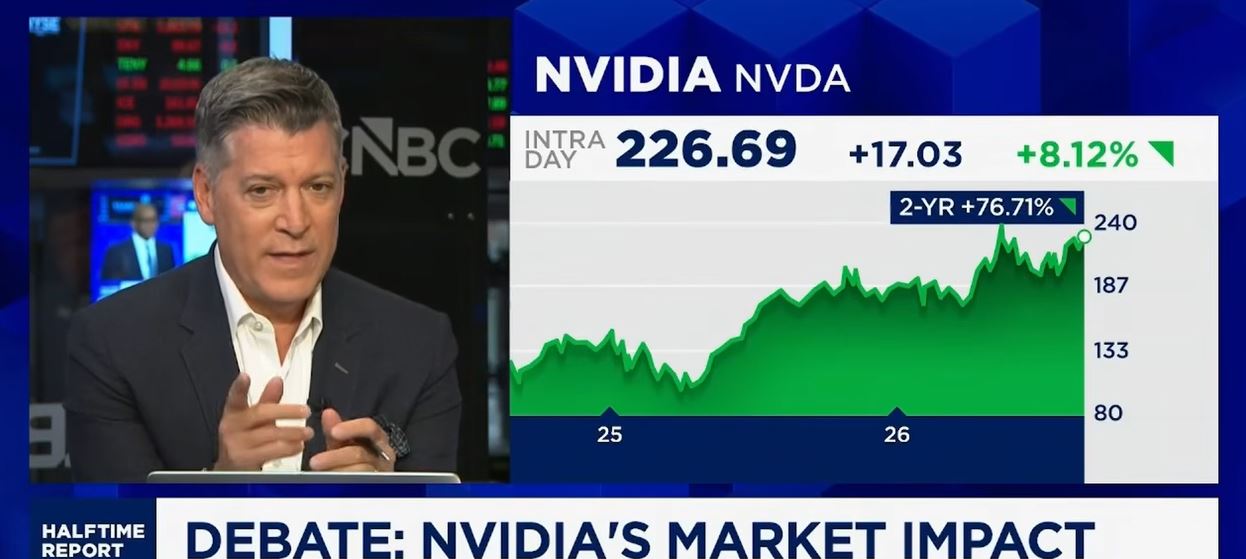
One more button, and Judge gets into what Josh calls ‘Magic Mike’ territory
Josh Brown on Thursday's (8/27) Halftime Report said the market was marveling at Jensen having "more visibility." (Nobody said anything about Jensen comforting the anti-data-center crowd or whether just 1 analyst would ask a question about it.)
The other key term Josh heard was "fungibility" (snicker).
Malcolm Ethridge said NVDA is "all sold out for the next 12 months."
Brian Belski said NVDA, like AAPL, has "created the annuity." Also, NVDA's "consistency" is "amazing."
Josh touted the NVDA buyback; Malcolm said that's not why he wants to own the stock.
Judge asked about the rally throughout tech and even software. Jason Snipe said the NVDA report will "continue to be digested."
Josh said, "CRM checked every box." Jason touted how well SNOW is doing.
Malcolm predicted more acquisitions in cybersecurity; "identity is everything."
Santoli said MU "continues not to know, like, which way is up."
Judge in the 17th minute brings up data center pushback; what happened to fracking pushback, what happened to Keystone Pipeline pushback ...
Judge on Thursday's (8/27) Halftime Report asked Josh Brown if data center pushback is an "existential threat" (snicker) to the data center trade/industry.
Josh shrugged no, saying "midterms will come and go," then people will move on to something else.
Josh said he's not "minimizing" people's concerns about where the water's going or living next door to things that are "humming" or "glowing," but, "These things will get built."
Judge said, "It could be slower." Josh said, "Isn't that bullish," as it would "lengthen the cycle."
Brian Belski said "at the end of the day."
Haven’t heard ‘Blue Owl’ in a while
Judge on Thursday's (8/27) Halftime Report said Oppenheimer raised its BX (Zzzzzzzzz) target.
Judge said it's "worthwhile" to have a private credit/private equity conversation.
Jason Snipe agreed the trade is looking a lot better in the last 3 months, largely because of gains in software stocks. Jason called the space "very investable."
Josh Brown owns "some Carlyle," CG. Josh said the space is "highly pro-cyclical."
Belski touted RF (Zzzzzzzz).
Josh pins a $200 on ABNB
Judge on Thursday's (8/27) Halftime Report said NKE is down for "5 straight years; that's. Incredible. To me."
Josh Brown said he was in the stock "for like, 10 days." Brian Belski said NKE is a "broken growth stock."
As for other retailers, Belski faulted DKS margins and also "how they talked about their guidance." He said it's "clearly" now a "broken growth story."
Josh recapped his history of having an opinion about ABNB the product and noted the stock had done little since its IPO, until recently. He said it's hit a "huge inflection point," it's become "an AI beneficiary stock." Josh predicted it "gets above 200."
Oliver said volatility in SPCX has collapsed, especially over the past month, if you had told him that then, "I probably wouldn't believe you." He said it's "never been cheaper to make a directional bet on SpaceX with options, and today, traders are betting on upside."
But a couple hours later on Closing Bell, he said the options bets were actually leaning bearish.
Belski's Final Trade was MAR. Jason Snipe said AXP, Malcolm Ethridge said BUG and Josh said CRWD.
Judge evidently is going without a tie all week
Judge on Wednesday's (8/26) Halftime Report said he got an invite "for a special event at Apple Park" on Sept. 9 at 10 a.m. Pacific time.
Hopefully Dan Ives can make it. We'll pencil in on the calendar Judge taking a travel day on Sept. 8.
Grasso: Expect NVDA to go higher on Thursday
Finally, it's over.
The monumental (according to CNBC) NVDA earnings report.
On Wednesday's (8/26) Fast Money, Guy Adami expressed skepticism, wondering why NVDA trades at a "trough multiple."
Tim Seymour called the NVDA report and reaction a "huge relief" and predicts the stock will "find buyers."
Steve Grasso said NVDA is in a "no-win situation" with its earnings reports, but it had a "good setup" for this one with expectations for a post-earnings pullback. Steve said, "It'll probably extend gains tomorrow."
Rob says Anthropic will allow him to ... not have to hire so many people
Wednesday's (8/26) Halftime Report panelists basically guessed about what NVDA needs to do or was going to do, Zzzzzzzzzzz. (This review was posted overnight Wednesday-Thursday.)
Rob Sechan admitted, "I get a lot of investors that say 'This is just like Cisco in 2000.'"
Rob suggested spending on Anthropic, "at the margin, it's likely reducing the number of employees that I'm gonna need to have," though he doesn't want to "scare everybody, like we're gonna start cuttin' jobs."
Bill Baruch was thinking competition will inspire a "more zesty (snicker) Jensen."
Bill said of ORCL, "You have to like it down here," he's been "digging in" for a couple months.
Rob admitted his Final Trade call of INTU on Friday was "poor timing." (But not nearly as bad as Weiss saying DKS on Monday.) Rob called software "a really effective hedge against the AI momentum unwind."
Joe Terranova — who did NOT, on this particular program, keep saying that Jensen needs to "comfort" people opposed to data centers — called OKTA "clearly an AI security takeover candidate."
RJF actually went up
Judge on Wednesday's (8/26) Halftime Report said Vanguard is buying Altruist, which prompted a call from Josh Brown, who said Altruist has an "AI solution" called "Hazel."
Josh called the deal "an earthquake" (snicker).
Judge said SCHW and RJF are red "because of this deal, more than likely." Kari Firestone shrugged that SCHW and Fidelity are the "2 competitors" and they're not "unexperienced" (sic "un" not "in") and "ineffective" in fending off competition.
SCHW has been "gaining market share," Kari said.
Kari said Vanguard "sells index funds" and will have to "change their image" and "spend a lot of time to integrate this."
Wonder if Oliver has read It’s NOT an Option!!!!!!!!!
Santoli on Wednesday's (8/26) Halftime Report said the market's had a "very low intensity drip of a pullback" in August.
Joe "Jensen, Comfort Us All About Data Centers" Terranova indicated TJX is at or near a 52-week low and complained again about how hard it is to find momentum in discretionary.
Rob Sechan said "there's a lot of room" in utilities. Bill Baruch, who had a quiet show, likes VST and is "kicking around" the idea of adding to it.
Oliver said NVDA options activity was leaning bullish.
Rob's Final Trade was HWM. Bill said MU, Kari Firestone said FLS and Joe said VLO.
Weiss’ Final Trade Monday was buying DKS into earnings
Talk about buying the lede. (No, not Judge skipping a tie again.)
Judge on Tuesday's (8/25) Halftime Report waited until about the last 5 minutes to even mention the stock of the day, DKS. (This writer has no position in DKS.) (But it's a great place to buy stuff.) (Despite the results reported Tuesday.)
Stephanie Link owns DKS and was forced to address the carnage. Stephanie explained, "Foot Locker was a disaster." Judge noted headwinds for NKE and ONON. Stephanie said the DKS selloff is "way overdone," but recovery will "take a long time."
Judge didn't mention that Steve Weiss just a day earlier had made DKS his "high-risk call" Final Trade ahead of earnings.
We'll look forward to Weiss' reax presumably later this week.
Kari predicts rate hike
in a few months
We wuz scratchin' our heads Tuesday (8/25) when Kari Firestone actually claimed on the Halftime Report, "It would be a relief to, uh, Broadcom if the Fed actually raised rates, which seems likely."
So a hike is "likely" ... and it helps AVGO.
Judge questioned Kari, "What do you mean, it seems likely ... 'cause it seems unlikely."
Kari said "Not right now, but I think, if you go out a few months, I think they will."
Judge said, "I think that's well far out on the- on the curve of what we think is legitimately gonna happen here."
Joe’s obsessed with Jensen comforting people about data centers
Josh Brown opened Tuesday's (8/25) Halftime Report with the breaking news that ... NVDA generally doesn't surge after its earnings report.
Then Joe Terranova got started on what, oddly enough, proved Joe's Topic Of The Day.
Joe stated that the Wednesday NVDA call will be "critical" for Jensen "to be the voice that pushes against the data center pushback that we are seeing around the country" that will "intensify as you move into the fall."
Well, first of all, we gotta ask the question that Joe never bothered to entertain ... 1) Is the "pushback" against data centers justified, and/or 2) is there some reason they have to be built everywhere anyway?
Is it important to build data centers to boost the economy on some level ... or boost some tech-stock prices?
Moments later, Joe stressed that resistance to data centers is going to "intensify dramatically" over the "next couple of months."
Stephanie Link though shrugged that the data centers will just "get built elsewhere" and that only "11 states have restrictions."
But Judge said "it is growing," some states "now opposing" data centers aren't the ones you would've thought would be against data centers.
Stephanie said, as Weiss said a day ago, that it'll prevent overbuilding.
Then Joe said that Jensen can "offer a degree of comfort (snicker)" to people who are having data centers built in their backyard.
But Joe indicated he isn't calling for a Jensen whistlestop tour.
"I'm not saying he's going out around the country, no, that's crazy," Joe conceded.
Judge told Joe, "I know you're not saying that, but I'm suggesting that that's far different from talking to a bunch of analysts ... that's talking your own book; what do you think he's gonna say."
Joe said he just wants "1 analyst" on the call to ask about data center pushback, and he wants Jensen to give a "very conferting (sic pronunciation) (apparently mangled "comforting" and "confident" together) and comforting answer" to maybe offer "some relief" to the debate.
What exactly would that "relief" be — "Hey residents, your MU stock will go up!!!!!"
Josh said "cellphone towers" used to face the same kind of resistance, and it got straightened out.
Josh said buybacks are far better than dividends for NVDA because of the "absurd" taxation.
This way, when it falls, you can brag about selling it, and when it rises, you can brag about owning it
Stephanie Link on Tuesday's (8/25) Halftime Report talked of selling "a lot" of MRVL; as always, "I made a lot of money in it."
But then Judge had to clarify that Stephanie said on Closing Bell the day before that she owned "both" MRVL and NVDA, while the Halftime audience "knows of you as having sold Marvell in your main, in your main fund, but you still have it."
Stephanie insisted "It's small though."
Judge said, "I just wanna make sure we're all on the same page here. So you still own it, albeit in a smaller fund, a smaller size than what you originally did when you sold it either in June or July."
Stephanie said, "Yeah."
Mention of EQT gives Joe another chance to mention data centers (the Virginia buildout)
On Tuesday's (8/25) Halftime Report, Santoli said the market's "trying to do as little as possible" until we get PCE and NVDA's report.
Judge wondered if there needs to be a focus on the AVGO CDS, because the ORCL CDS "became a story in and of itself (sic last 4 words redundant)."
Joe "Data Center Comfort" Terranova acknowledged that hyperscaler debt is "becoming more and more a real issue."
Kari Firestone bought VRTX. Stephanie Link trimmed PANW and bought EQT, which is "super duper cheap."
MRK and AMGN are on Josh Brown's Best Stocks list.
Oliver said options buyers were loading up on TLT calls. And, IBIT and GLD calls were outpacing puts.
Josh's Final Trade was DAL. Kari said TMO, Stephanie said TGT, Joe said data center pushback comfort, er, IBKR.
Greenhaus congratulates Judge
for ‘Zero Dark Thirty Year’
On Monday's (8/24) Closing Bell, where Stephanie Link made her daily CNBC appearance, Dan Greenhaus saluted Judge for "Zero Dark Thirty Year," stating, "You deserve credit for that."
(Actually, while a clever spinning of words, we're not quite sure what "Zero Dark Thirty Year" means or implies, but we don't want to rain on this particular parade.)

What about ‘10 (Year)’?
Judge on Monday's (8/24) Halftime Report said Wolfe is talking about apparent issues if the 10-year hits 5%.
Steve Weiss said the bond market is "just another wall of worry to climb." Weiss observed, "You could have Wa- Warsh at odds with Bessent in terms of what they're trying to do with monetary policy."
Joe Terranova said bonds are at an "unprecedented" moment because debt is being used on data centers after free cash flow.
Late in the show, Santoli suggested, "Maybe last week's bond market chatter just got a little bit too loud and overheated."
Remember when Jimmy insisted numerous times that as long as the Iran war was over in March, markets would get past it?
At the start of Monday's (8/24) Halftime Report, Judge, who skipped a tie (it's Monday, not Friday, but whatever), aired a clip of Donald Trump speaking Friday about getting bond yields down.
Donald Trump says in the clip, "The ultimate intervention is our military. And, uh, if we have to use that, we will."
Judge said, "Social media had a field day, obviously, on that," and turned to Navy veteran Jimmy Lebenthal.
Jimmy said, regarding bond yields, "I don't know who the enemy is. I mean, Operation Anti-Bond Vigilante?"
Judge suggested "Vigilante Fury."
Jimmy's advice, apparently for the White House, was, "I think this is a time to actually focus on getting the job done and talking a lot less, doing a lot less bluster." (Sure, that's gonna happen.)
Jimmy said the Iran blockade is "very successful."
Judge actually thinks Sanjay’s semantical games are ‘profound’
Joe Terranova offered on Monday's (8/24) Halftime Report, "I believe that the momentum quote-unquote AI trade needs a shot of adrenaline." (Actually, to be grammatically accurate, we think it's supposed to be "quote momentum AI trade unquote.")
Joe acknowledged, as did basically everyone else, that the "pattern" of NVDA trading is that it tends to run up into the numbers, and then stall on the report.
Judge asked Steve Weiss if data-center pushback is an "existential issue" for the AI trade. Weiss said "I think it is, clearly." Weiss said he thinks the pushback is a "good thing" longer term because they're "overbuilding" data centers right now.
Weiss said the biggest issue for NVDA is "all their commitments" as well as "double and triple ordering."
Judge claimed the MU CEO's statement a week ago that memory isn't a "commodity" anymore is "as important (snicker) a comment" as we've heard recently, a "pretty profound (double snicker) statement."
Jimmy Lebenthal said he thinks it's an "incredibly elongated cycle" of AI spend and of course, MU, which Jimmy first started buying when it was near $1,200 based on multiple, is "way too cheap."
Jimmy said for long-term investors, MU and NVDA are "buys right here."
Iran, Ukraine, Cuba, Greenland, Canada, Panama, Gaza ...
Jimmy Lebenthal on Monday's (8/24) Halftime Report said the AAPL chart since Tim Cook took over is a "helluva chart."
Jimmy stated that in the last couple years, Tim has been able to impressively "manage politics."
Now that's an interesting assessment. Who in Silicon Valley, exactly, has not been able to "manage politics" these last couple of years?
Larry and David Ellison keep getting everything they want. Jensen seems to also. So does Hock. Jeff B paid for a first lady movie. Neither Satya nor Sundai nor Zuck seems to be in any kind of penalty box.
Now, if Jimmy's suggesting that some personalities in other sectors (namely Jimmy Kimmel and the whole "60 Minutes" gang) haven't managed politics well, that's fine.
But let's not anoint Tim the next Henry Kissinger just yet.
Steve Weiss said the "hallmark" of Tim Cook's leadership is "doing things quietly" (including that free U2 song download that invaded everyone's iTunes account whether they wanted the album or not). Weiss said of AAPL, "At the end of the day (snicker), I think people find safety in it."
No use, Joe — he’s never gonna sell it
Joe Terranova on Monday's (8/24) Halftime Report said it looks like NEM is prepared to break out.
"I actually like the miners here a little bit better than I actually do the ... gold commodity," which is "rare" for Joe, he said.
Jimmy Lebenthal suggested gold's gains — which, quite frankly, have totally caught this page off guard; gold was a disaster in the spring — reflects a "reflation trade."
Then Jimmy had to do it.
Jimmy stated, "Cleveland Cliffs I think is coming out of the penalty box. It was deservedly in the penalty box."
Joe tried to interest Jimmy in STLD and stressed it's higher "quality" than CLF. But Jimmy talked about being "comfortable" with CLF (translation: he gets dinners with the CEO of CLF but wouldn't get dinner with whoever the CEO of STLD is).
He said it years ago, with the price even in the $400s; certainly wasn’t saying it recently before the big pop
Steve Weiss on Monday's (8/24) Halftime Report suggested crypto legislation's "gonna be reality" before midterms, so bitcoin could have legs. But, "There's no intrinsic value to it whatsoever."
Joe Terranova and Jimmy Lebenthal kinda touted biopharma, "catching a bid."
Judge mentioned MRNA in the 33rd minute, asking Weiss for a position update. Weiss said he bought shares on the headline last week and it actually kept going higher. Weiss said, "I said years ago ... gonna be one of the best drug companies of all time." But until now, he hasn't said that in literally years.
Joe disagrees with Wolfe's PHM upgrade.
Joe attributed ABNB's rise to the World Cup and complained about how tough it is to play momentum in the consumer discretionary sector; "I've talked about this."
Jimmy shrugged off DAL price target cuts; he said Cowen's 105 is still a nice gain.
Oliver said there was a big spread sale in the GLD, "technically a bearish trade." We tried doing the math that was explained by Oliver, but we couldn't figure out how it makes money.
Weiss "pared back" his DKS position but made it his Final Trade, it's a "high-risk call" because they are to report Tuesday morning (this review was posted late Monday). Jimmy said BLK, Shannon Saccocia said IYJ and Joe said SCHW.
Drinking, and investing, with Tom Lehman and his accredited investors only
This page has mentioned recently that we're not sure how much more of CNBC's commercial barrage we can take. (No, we don't have a problem with the Najarii.) (Notice that those ridiculous Marc Chaikin-big-market-call ads are now gone?)
Of course, there's no issue with running commercials in general. It's just that some of them tend to appear so often ... months or literally years at a time ... that there comes a point where viewers have to say, "I don't care how great Kevin Simpson's out-of-the-money-call-selling advice is, I can't take it anymore."
This page had sort of hit that threshold a while back with that company that buys your life insurance policy. That company has a series of ads, most of which are benign, except for the one where the jackass is allowed to shout a stupid sales pitch from underground, and the FCC allows the volume up.
That one's merely obnoxious. In the Incredibly Dubious category, we have "golf legend" (snicker) Tom Lehman apparently trying to sell you either Jim Beam or Jack Daniels, or some kind of supposedly guaranteed 10% investment. This page won't bother to mention the company and is cropping out its stupid qrcodes shown in the ads; it doesn't need additional publicity.
What's currently airing on CBNC sometimes as often as a couple times an hour is an update from a previous Lehman ad introducing the investment while on the golf course. So first, they warm us up with a golf outing, then it's a trip to the bar to close the sale. Just what everyone should be doing — making investment decisions while hard drinking.
Were the ad merely showing Lehman holding a glass (above), it wouldn't really be on our radar.
But it oddly keeps going back and back to the liquor.
We found that the parent company is actually a company that buys/restructures student loan debt (always an exciting business), and the ads in question refer to a subsidiary that sells notes.
Last year, the state of Massachusetts had some kind of issues with this marketing that resulted in a consent order. Apparently, the state's beef is that the ad implies a 10.25% return, but that return only comes with the longest-duration investments, not the shorter stuff.
The consent order claims “31. CEO and CIO, on behalf of Yrefy, created a one-minute script for promoters to use
in connection with radio and television advertising (the 'Script'). 32. The Script contained a detailed description of Yrefy's business, the investment opportunity and principal protection features, and included detailed instructions on how to communicate the marketing (e.g. smile at specific times). 33. The Script failed to disclose that Yrefy did not always pay a 10.25% fixed return, but rather up to 10.25% depending on the term of the promissory note selected by the investor."
"Smile at specific times."
Tom's playin' us like the 18th green.
To make this investment, are you supposed to call your broker ... or your bartender?
What better combination than student loans and hard drinks at a bar.



Does Rob actually think opening the Strait is more important than Kevin’s task forces?
Rob Sechan on Friday's (8/21) Halftime Report claimed of the Fed, "They can engage in QE" to "control" the "long end."
Judge protested, "'They aren't doing any- there's no Fed meeting next week."
Rob said, "The thing that would save everything is opening the Strait."
Judge said, "Good luck with that."
Amy Raskin thinks NVDA will "have great numbers." But Amy said Kevin Warsh is in a "hard position" in which he "has to be hawkish ... but then, the question is, does he deliver."
Judge asserted that Kevin "sort of gets off the hook" from recent econ data. But Amy said the market thinks inflation is still a problem, and the market wants to know, "when are you going to do something about that."
Santoli said, "The market's not across-the-board ready to really back away."
Rob buttons up after Josh’s dig
At one point in Friday's (8/21) Halftime Report, Josh Brown said, "One more button down in Sechan's shirt, and this show goes from Halftime Report to 'Magic Mike.'"
Judge explained, "He did email the executive producer of the program today, included me and others, asking if it was no-tie Friday, apparently he got a little overexcited at the answer."
Jenny’s ‘bizarro’ suggestion
Judge on Friday's (8/21) Halftime Report asked Jenny Harrington if next week is the "key" to the market perhaps reaching 8,400 this year.
Jenny announced, "I don't think next week even matters."
Judge said, "That is a bizarro suggestion so please, explain yourself." Jenny said, "I think Warsh is off the hook because earnings are doing all the work."
Jenny said nothing NVDA says "is going to matter to Nvidia," though it might matter to CRWV or MSFT or OpenAI. "All that matters between now and the next 4 months is earnings on Q3 earnings reports that we'll start to get in November," Jenny said.
Jenny suggested the only reason people are speculating about what Warsh will say is because there's "nothing else to talk about." (Evidently, the market needs more news events.)
Josh Brown said, "Jenny, I hate to say this, I'm on the complete and total other side." Josh said "Jensen Huang is the AI Fed chair," which is a good term.
Of course, Jenny kept cutting in several times to protest before Josh had finished his point, which is that "dozens and dozens" of large stocks will hinge on what Jensen says.
$2,000 in MNST in 2001 is worth $23 million today
In a remarkable revelation, Josh Brown on Friday's (8/21) Halftime Report said, "Over the last 25 years, Monster Beverage is the single best performing stock in the entire S&P 500," saying $2,000 in the stock in 2001 would be worth "about $23 million today."
That stock and KO are on the Best Stocks list. Josh suggested "hundred bucks" for KO.
Amy Raskin talked up ILMN and said it "has a lot to go" in "personalized medicine" given its market cap.
Judge said Krinsky wouldn't chase energy. Josh said it's a "fair point" about how much those stocks have run, but the IEO's move is "not bearish."
Josh said CRWD hired a guy who's an "absolute beast" (snicker).
In the 47th minute, Jenny said, "If you do worry about the K-shaped consumer ..." Who is worrying about the K-shaped consumer? Which part of the K are we worrying about?
Oliver spoke about popularity of perpetual futures. Oliver said exchanges took a hit this week but have rebounded because they're now seen as being in the "join them phase rather than the fight them phase." Josh predicted the "fear will remain" over the exchanges regarding the impact of prediction markets.
Jenny Harrington's Final Trade was MCHPP. Amy said CGNX, Rob Sechan said INTU and Josh said TOST.
On Fast Money, Steve Grasso said he took a Waymo, and "it was just more, more relaxing than I thought it would be."
Jimmy’s basically been making the multiple argument for MU (without showing us any proof of how the multiple is an indicator of stock direction)
Judge on Thursday's (8/20) Halftime Report played a clip of Sanjay Mehrotra on Squawk on the Street saying memory is no longer a "commodity."
Judge wondered if MU is now a "secular" trade rather than cyclical.
MU long Jimmy Lebenthal said he "would add to it here," but he still thinks it's "cyclical," though it's in a "very drawn-out" cycle.
Josh Brown said of Sanjay, "I can't believe he said that," and Jimmy agreed, "Exactly," though Sanjay is "not being disingenuous." (So, we'd probably call it "a little over his skis then.")
Rob Sechan marveled that data centers are "12 times as big" as they used to be. Rob was "shocked to hear" that some data center builders are saying "first inning." (Like nobody who's touting a stock sector ever says "first inning.")
Josh indicated the momentum trade is basically all AI; he said that buying MTUM, "you're making a de facto memory chip bet." Josh pointed to JBHT and MPC and a few others outside of AI that are working.
Josh explained, "The bears want to say "It's 1999." But the forward average P.E. for the MTUM is 19.9, Josh said. Jimmy stressed that 2 things were different in 1999, that the spending stopped after Y2K and the "speculative" fiber optic spending was getting "no revenue."
No, the wild card is going to be the earnings call, when either there’s a Brazil tax thing, a Reed departure, a terrible free cash flow ...
Josh Brown on Thursday's (8/20) Halftime Report called SPOT "maybe the best media business on the planet."
God bless Josh. (This writer has no position in SPOT but owned it early this year.) He said SPOT is by far the best business in the music business.
We're not experts, but we don't disagree. We wish the stock did great. The problem is, the stock doesn't care how good the business is, or hasn't for the past year, and it became a massive value trap.
Just like the other stock Josh touted midway through the show.
Josh talked up NFLX and its earnings growth and said the multiple "was cheap at 90." Judge said NFLX has been up "5 weeks in a row." Josh noted there's "Bill Ackman in it." Then Josh made the mistake so many of us have, noticing, "This was a hundred and forty-dollar stock not that long ago." (This writer has no position in NFLX but had a long position for a long time into this year.)
We think it's a great product and a great business.
It's just a ghastly stock. We wish we could be convinced otherwise. We've fallen for that Lucy-Charlie Brown football too many times. We'd be shocked if it sees 140 anytime in a long time.
Josh said, "The wild card is if they make a run at Universal."
Rob’s advice: ‘Trim’ SPCX
Rob Sechan, who on Thursday's (8/20) Halftime Report acknowledged again that his shop got SPCX, announced, "Our recommendation has been to trim ... we are mostly selling." (This writer is long SPCX.)
Josh Brown asked if Rob is recommending, "Trim at 131." Rob offered up what sounded like cost-basis mumbo jumbo, saying something about how his shop got "6% of their total exposure out" but is "keeping much because you have to," and finally, Rob said, "We're recommending trimming the balance."
‘Long end’ is the term of the week, then Judge and CNBC will move on to something else
Josh Brown on Thursday's (8/20) Halftime Report said what's happening at the long end of the bond market is happening all around the world.
Rob Sechan said sentiment has "gotten a little lopsided," and we're entering a "seasonally weak stretch."
Santoli said late in the show that yields are "nagging" at the market, but there isn't a "hard trigger threshold" that's been met.
Josh shrugged at CRWD's departure of the CTO.
Jimmy Lebenthal said WMT was "priced for perfection." Josh said the WMT selloff "seems like an overreaction" and "it's just slower growth than what they had been doing in previous quarters."
Rob said BABA remains a "pretty attractive bet." Judge said UBS trimmed its MAR target, but Josh still likes the stock. Jimmy brought up DIS and the comparison with MAR at a recent show. Jimmy noted that DIS has gotten "a little bit of a bid here" without offering a reason for why it's happened (and, honestly, we can't really think of one; maybe it was Iger getting the Disney Legend certification).
Rob said he doesn't think LOW and HD will move "anytime soon."
SN, not a stock that gets mentioned often, is on Josh's Best Stocks list.
Oliver said something about options interest in some bitcoin thing called PURR (Zzzzzzzzzz). Josh said for bitcoin to rip, "there doesn't actually have to be a reason."
Rob's Final Trade was NOW. Jimmy said VRTX. Josh said UBER.
It’s such a ‘huge story’ and ‘huge day’ that Judge waited 15 minutes to bring it up, talked first about the 30-year yield and Kevin’s IBM stake
A quarter of the way into Wednesday's (8/19) Halftime Report, Judge brought up the MRK-MRNA "huge story today."
Judge explained, "It is a very, very big deal. It is a very, very important day for the fight against cancer."
Kevin Simpson called it a "huge day for society."
Joe Terranova said MRK's valuation is "rich"; it apparently fell out of the JOET recently.
The vast majority of the 6-minute conversation spurred by the "huge story" was actually about MRK and the performance of biotech stocks.

General Tom Lee.
Judge on Wednesday's (8/19) Halftime Report said Tom Lee calls HOOD a "stock to avoid." But Tom likes JPM and ANET.
Kevin Simpson called JPM "100% deserving" of Tom's recommendation.
But on HOOD, Kevin "couldn't disagree more." Kevin believes in "Vlad" and the company. Kevin said the market "absolutely" correlates HOOD with bitcoin but "incorrectly" so.
Bryn Talkington though said she got "called away at 110" from HOOD in June, "I think that it is definitely gonna be driven by crypto."
Judge said of Tom Lee, "Guy walks around wearin' pins on his jacket." Kevin claimed, "Looks like a general."
Judge’s welcome to Kevin sounds a lot like what you hear from amateur-hour podcasters/Youtubers that prompt you to play the thing at 2x speed (a/k/a Kevin listens to Tay-Tay, who knew)
Shortly into Wednesday's (8/19) Halftime Report, Judge gave a "time machine" welcome to Kevin Simpson and Kevin's "new lid, new suit, lookin' great."
Kevin said, "I left the '80s."
Judge said, "You took Steely Dan off the turntable, you put Taylor Swift on, and here you are, my friend."
Kevin said he "just got a CD player" and "some Air Jordans."
That's just what viewers want, TV personalities talking about their personal lives before actually taking up the program's purported topics.
Remember when Weiss was recommending MRNA in the 400s?
Judge opened Wednesday's (8/19) Halftime Report telling Joe Terranova, "The market was starting to get to a point where it was a little nervous I think and certainly paying more attention, to the backup in the long end."
Joe only wanted to talk about the "internal rotation in the market" (Zzzzzzzz) (until the internal rotation is done in a day or 2).
Joe said cash is leaving momentum and chips and "excitingly (snicker) going into health care and continuing to go into energy."
Kevin Simpson stressed that the Fed "can't control the long end of the yield curve."
Liz Thomas stressed that the bond concerns were more with the 30-year, which doesn't affect the market like the 10-year. Liz said 2011's Operation Twist "effectively put a floor in for the S&P 500."
Liz said a current flatter yield curve "is even bullish for financials" because of everything else going on.
After a lengthy windup and giving the equivalent of a speech, Judge asked Bryn Talkington about earnings growth, only to get dead air. Judge cracked, "Bryn's like, 'I totally agree with- with what you just said.'"
Judge promised to "figure out the audio."
Joe said "the message is simple," although his description wasn't simple, apparently it has something to do with the administration in an election year being focused on yields and oil. Once connected, Bryn stressed again that bond yields (Zzzzzzzz) have had all kinds of swings in the last couple years.
‘Everyone’s there already’ in the refiner trade
Kevin Simpson on Wednesday's (8/19) Halftime said he bought more GOOGL, a "really long-term hold" that basically according to Kevin is just where his former IBM money went. (This writer is long GOOGL.)
Kevin admitted the IBM earnings warning prompted that sale.
Kevin sold a 152½ covered call in TJX, saying the Street probably didn't like the "3rd quarter guide."
Kate Rooney did another update on Anthropic/OpenAI (Zzzzzzz) (usually the updates are about Anthropic these days).
Eamon Javers reported on the trade talks with Canada and discussed with Judge whether Mark Carney's victory lap might affect the negotiations (Judge indicated yes).
Joe Terranova suggested refiners "almost are beginning to look like the Micron type of memory trade at the end of June ... everyone's there already."
Bryn said energy has "a lot to offer" as the SPR is basically at an all-time low.
Oliver said GLD 420 calls expiring Oct. 16 were popular. Oliver said the IBIT options action is "arguably the most bullish in a long time." Kevin mentioned owning AEM and pointed out it's up "almost 50% over the past month." (This writer has no position in AEM but sadly owned it early this summer.)
Wonder if Yardeni’s up to 8,530 yet
On Wednesday's (8/19) Halftime Report, Santoli said the market's been saying "semis have really nothing to do with rates."
Kevin Simpson said LOW and HD have to be considered longer-term plays and implied they're dead money for now.
Oliver said WMT (Zzzzzzz) options action was "slightly bearish." Joe Terranova said WMT is "gonna benefit from tariff refunds in this quarter and next quarter."
Kevin's Final Trade was AMZN. Bryn Talkington said IBIT, Liz Thomas said "gold" and IAU was shown on the screen. Joe Terranova said TGT, predicting higher price targets.
Guy Adami said "ass" on Wednesday's Fast Money.
Oh my — Judge tries telling Stephanie that this may not be the Greatest Economy That Ever Existed
Judge on Tuesday's (8/18) Halftime tried wading into the deep end of the argument pool (hence photo above and below) when he had the audacity to tell Permabull Stephanie Link, "There has to be a price at some point for a swift backup in yields, correct?"
Stephane at first said "Yeah" but then qualified, "it's gotta stay there for a while."
Then Judge brought up 1.5 GDP. And found himself in an argument with Stephanie over all kinds of economic data (translation: the ones supporting the Permabull case are "real-time" and matter, and all the others that don't are bogus and don't matter).
Stephanie claimed, apparently in complete seriousness, "Better growth by the way, will help debts and deficits."
Judge persisted that he rattled off areas of concern. Stephanie said, "It's not just 1 thing!!!" Judge said, "No, I listed 3 things." Stephanie said, "Well I just listed 4 things!!!!"
Joe Terranova offered, "I think the algorithms are in charge."
God help us if Yardeni raises his target again (oh, check that — one day, it’s 10,000; another day, it’s bond vigilantes)
Judge opened Tuesday's (8/18) Halftime Report mentioning ... yep ... him again ... Yardeni's note saying the "bond vigilantes are stirring."
(He actually must've said "Yardeni" 3 or 4 times in the A block.)
Jason Snipe said the market is a "real-rate story."
Joe Terranova said there's a changing "investor base" that has grown up on stocks and is "less inclined to purchase bonds." Joe described this week's market as merely a "basket rotation" that "broke the fever" in momentum.
A little later, Judge indicated he can't even remember when Yardeni did whatever he's been doing, telling Bryn Talkington, "Yardeni goes to 8,400 this (sic) week (it was last week) (see below)."
Don’t homebuilders have an enormous Total Addressable Market?
Stephanie Link on Tuesday's (8/18) Halftime Report claimed she made "15%" on housing stocks apparently over the last couple years; now she's sold DHI and TOL.
Jason Snipe said DHI is a "hard trade" though he's going to hang on for now.
Bryn Talkington kept stressing how the 10-year has fluctuated in a range over the last several years.
Joe Terranova said, "On a day like today in the market ... I want to own the exchanges." Judge called that an "extremely tactical move." Judge is right. And then the VIX recedes, and people who own CME or CBOE want MU instead.
Sure: Create a division, hand it properties from another division that already paid for the properties (sometimes decades ago), and see how hard it is to make a profit
On Tuesday's (8/18) Closing Bell, still chasing the Lakers sale story, Ozanian told Judge that NBA Finals games were televised on tape delay in the '70s; that's partly true, weeknight games were tape delayed in parts of the country and probably depending on the market, but weekend games were basically live. However, Judge didn't question Ozanian's comment.
DIS got mentioned on Closing Bell Overtime. Mel told Santoli, "We've heard about making, you know, Disney+ sort of the hub for all things Disney ... and nothing, nothing is waking that stock up." Santoli mentioned the analyst who said "maybe they should get out of streaming," though Santoli claimed it's "profitable as a streaming stand-alone."
Everyone who has a kid who ever used Facebook or Instagram will get $738
After Judge brought up the new META trial, Stephanie Link on Tuesday's (8/18) Halftime Report said, "I sold it because they're spending like drunken sailors."
Stephanie offered, "I suspect they're gonna settle on this."
Judge said there's another SPCX lockup undoing this week. (This writer is long SPCX.) Stephanie said she'll continue to add to the name. "I'm averaging down," Stephanie explained, adding, "The stock's down 28% from its highs."
Jason Snipe backed SNOW. Stephanie said NOW is "really pretty attractive here."
Joe Terranova said there are "really high expectations" for CRWD's report.
Stephanie said TGT is still a long way from the 2021 high and she'd buy more if it pulls back.
Santoli noted "the average stock (whatever that is) is doing fine" on Tuesday.
Oliver said the options market tends to price in too much move on NVDA earnings. Jason Snipe likes NVDA, but Bryn Talkington said, "I still think 228's gonna be tough to get through."
Bryn's Final Trade was INFL. Stephanie said ELAN, Joe said LLY and Jason said NFLX.
David Muir says ‘tonight’ 42 times in what is basically a 20-minute program
This page appreciates and respects the history of television news and the standards long established by broadcast journalism.
Viewers understand that there will be cliché, there will be endless pre-commercial teasers to "news" stories that may take a mere 7 seconds to rattle off at the end of the program, that "Finally tonight" will be heard in the 28th minute, that there will be some promotional segment on something the parent company is doing.
But "ABC World News Tonight with David Muir" is such a cartoonish exploitation of language, viewers/listeners have to wonder whether they're being put on by an AI factory.
We started getting suspicious when we noticed David refering to basically all of his top stories as "breaking" (it's usually within the first 3 words he says) — even though 1) the news event clearly happened early in the day and 2) his correspondents had clearly been stationed in place for hours and 3) despite David claiming it's "breaking," there is never a follow-up later in the broadcast to this supposed "breaking" news.
Then we noticed that, even worse than "BREAKING," David can't say "Tonight" often enough.
Even when it's not exactly accurate.
On Monday, Aug. 17, 2026, he actually said "tonight" 42 times.
We counted.
It was 12 times in the all-important intro.
30 times over the rest of the show.
Think about that for a moment — why in the world would grownups need to be told 42 times in a half hour that this broadcast is taking place "tonight"?
David will say "tonight" to begin not all, but almost every, news headline he reads. He will also say "tonight" regarding news events — statements, court testimony, press conferences — that obviously happened in the daytime.
The ABC correspondents will say "tonight" a few times (we counted 3 Monday); they're more likely actually to say "today," but they've obviously been trained for years to say "David" as often as possible.
We get that there are certain words viewers respond to, that news organizations are trying to highlight their coverage, that certain terms such as "exclusive" or "rare" or "behind the scenes" might get stretched a little.
National news should be relayed by talented writers who are telling us the simple, eloquent truth about what happened — not fibbing grownups, who don't need to be told it's "tonight" 42 times in a half-hour, with Reddit-scraped AI-style gibberish that even Minions could create.
Another regular element of the broadcast is Muir saying, "To the index of other news tonight." What exactly is an "index of other news"?
Honestly, Muir's obviously strategic wording makes the collection of voices heard on the program sound like a buncha carnival barkers.
According to the broadcast itself, it has somehow won the Emmy for the Best Live News Program for the 4th year in a row.
Some viewers would just appreciate the truth.
The closing part of Monday's "World News Tonight" probably normally would've been a "Finally tonight" obituary tribute to "On Golden Pond" director Mark Rydell or rock critic Dave Marsh. But there was a big Disney event (that's ABC's parent), so David gushed about how Iger is now officially a Disney legend.
Tonight.
Except actually, it wasn't Monday night ... but Sunday afternoon. And an in-house corporate celebration hardly seems like breaking national news more than 24 hours later.
Bob is an elite figure to David. The funny thing is, though, that David's actually got more clout than Bob's successor, D'Amaro.
Now, you might be saying, isn't CNBC also prone to some of this news puffery and cliché. Sure. But actually, the updates CNBC provides really are "breaking," and CNBC does return for follow-ups to news it labels "breaking." And that anchors and reporters, despite a few mild clichés, keep it real and aren't spouting inaccurate AI-generated prompter jingles ... and are doing it for FAR more than 20 minutes. God bless Judge and Mel.
Ed’s probably up to 8,490 by day’s end
He just can't get enough of it.
For about the 5th-6th time in the last week, Judge on Monday's (8/17) Halftime Report was opening with none other than ... Yardeni's target, a subject that tripped up Judge just last week on Closing Bell.
"Ed Yardeni had already taken his target to 8,400 for 2026, says, we're going to 10,000 or beyond by the end of the decade," Judge explained.
Oh joy.
Joe Terranova shrugged, "I think you can get to 10,000 in the next 18 months."
Steve Weiss said "I'm bullish as well, and I try to think of what can derail the bullishness." Weiss offered some tired excuses, "if rates go up measurably," or the old standby, the consumer "starts to weaken further." He thinks the market's moving higher, that something might "derail" it a bit, but "I don't really see any disaster."
Jimmy Lebenthal predicted a good year will "continue through year-end" but said the bar gets "much higher in 2027."
Weiss, who tends to repeat certain observations, stated, "I've been talking about this for years now, is that it's a completely different investing cohort that's driving it ... they are used to V-shaped recoveries."
Judge claimed "the momentum rollover recently" was "arguably the best thing that's happened to this market in a while ... because it cleaned up positioning."
Jimmy said Chris Verrone says "Narrative follows price," which Jimmy finds "very accurate."
Late in the show, Santoli said "there's a chance that earnings are almost too good" and get "overplayed on some level."
Weiss and Joe are on the same show; no need to call each other for a VLO recommendation
Judge on Monday's (8/17) Halftime Report wondered why GOOGL wasn't up on the Berkshire news. (This writer is long GOOGL.)
Jimmy Lebenthal said "the market doesn't quite know" whether it's Greg Abel or Warren Buffett making these calls and that other stocks wouldn't get the "premium" for Greg Abel choosing it vs. Warren.
Jimmy said there's been a "diaspora" of Google AI talent and the stock has been "heavy" since. Jimmy said he thought at the time that the Google AI shake-up was announced that the stock was doing an "overreaction," but maybe it's not.
Joe Terranova said he thought the same way, but that Judge was "100% correct" (which Judge asked Joe to repeat) that the Google AI exit was a bigger deal than Joe and Jimmy indicated.
Then, actually, an excellent counterpoint from, of all people, Steve Weiss.
Weiss told the others that "you're overreacting to people leaving," pointing out, "Jim Chanos used to keep a list of all the employees, senior employees that left Tesla ... look what happened to the stock. ... We heard the same thing with Goldman all the time. ... These companies have deep benches."
Judge insisted Google's AI division isn't like the whole of Goldman Sachs, "there is brain-drain concern."
But Weiss said, "When Jony Ives (sic plural) left Apple, we thought, 'Oh, the stock is dead, never gonna- never gonna create a new, a new great design on its devices ... it happens."
Honestly, that is a tremendous debate, and we wish it had lasted longer. We'd have to think Google/Alphabet, as Weiss indicated, has a very deep bench.
Steve Jobs passed away, and AAPL has done OK.
On the other hand, CMG has been a disaster since Brian Niccol, who's not even a tech engineer, bolted for SBUX.
The best guess here is that Alphabet remains stung for a quarter, then maybe fresh headlines will get the stock moving again.
Adam was asked about his MU call last week but actually talked about how Bryn can’t possibly be that old (see below)
Joe Terranova on Monday's (8/17) Halftime Report said investors got "troubled" when WMT execs mentioned "effects of inflation." Joe said, "I also think valuation got the best of both Walmart and Costco."
Joe wants to see WMT "deliver on e-commerce growth" and said he thinks the stock's in a "pause that ultimately refreshes."
Joe said TGT had an "idiosyncratic recovery." Joe backed TJX and ROST and says WMT and COST are "fine" long term, but there's a "valuation obstacle" near term.
Judge said Leerink had a REGN target of 641; "they're now coming up to, the, this universe ... 824 is their new target." Joe said REGN has the chance to "really rebuild" and pointed out it was 1,200 in 2024.
Oliver Renick said there was bullish "big action" in semiconductor stock options. But somebody also bought 20,100 SMH 630 puts "expiring November 20th." (Oliver on Closing Bell was also questioning why bullish activity in SPCX options wasn't stronger.) (This writer is long SPCX.)
Jimmy Lebenthal got a chance to talk about his MU buy that started when it was around 1,200 and only went down because of "deleveraging."
Judge mentioned Adam Parker has "talked about this stock doubling."
Steve Weiss said of MU, "it's finally above where I sold it," but he has "no regrets," the money is "doing well" elsewhere.
Jimmy said, "He did it his way, no regrets."
Judge said, "Regrets he's got a few."
Jimmy admitted he kind of "mashed it up there."
Joe said, "Jimmy, don't do Sinatra, come on."
Weiss' Final Trade was CSCO. Jimmy praised Weiss buying it. Jimmy said LNG, Shannon Saccocia said IDU (Zzzzzzz). Joe Terranova said MRK. Judge said "Great stuff."
Josh Brown was somehow available for Closing Bell duties.
Suddenly, Halftime Report is making a movie reference a day; wonder why
On Friday's (8/14) Halftime Report, CNBC's Julia Boorstin recapped her interview with Josh D'Amaro, who, no surprise, thinks Iger left a "strong business" (Julia's words).
Jon Fortt, the guest host of Friday's Halftime, marveled at the DIS stock chart since about 2015, it's been in "a little hundred-plus territory; that seems wild to me."
Jon bluntly asserted what Judge wouldn't, that DIS "sorta missed the boat on streaming."
Julia claimed, "The question is driving profitability around streaming." (Editor's note: If that's the "question" around DIS, they're in big trouble.) Julia claimed D'Amaro's goals are "creating a bundled content" with, of course, Hulu (Zzzzzzz), live TV and ESPN, and ... this is a biggie ... "making it kinda the destination for all things Disney." (Hasn't that sorta been the idea for Disney+ since the Chapek days?)
Jon cracked, "See if this is a case of Better Luck, D'Amaro ... that's a little movie reference."
Jimmy Lebenthal related how frustrated he's been with DIS and how he almost — almost — got rid of it around earnings, but sure enough ... as always with Jimmy's bad stocks ... there's so much great stuff, he just couldn't sell it.
Kevin Simpson said he's become a "big fan" of NFLX recently, apparently because of the multiple, though he says it has a "huge content problem." Yeah. Wait'll Kevin gets a load of the next earnings report. It'll either be a Brazil tax, or free cash flow, or Reed Hastings quitting, etc.
Later in the show, Santoli said "The Subtraction of All Fears ... by the way, same year as 'Better Luck Tomorrow,' I believe."
But we thought Task Force Kevin was going to stamp out inflation once and for all
Jon Fortt guest-hosted Friday's (8/14) Halftime Report for apparently the first time.
Jimmy Lebenthal asserted that "The Fed doesn't have to go in September" and is "likely to wait."
Kevin Simpson said there's "very little chance" of a hike/move this summer, which actually only has about a month left.
Steve Weiss jabbed about doing the show with Jimmy for "13 years." Weiss stated, "The spending will keep going." Jimmy predicted more people on the "bandwagon" as the spending continues.
Kevin called MSFT "probably a hold moreso than a buy."
Jon Fortt claimed, almost assuredly incorrectly, that Jimmy "made some good money on Micron." Jimmy, who actually first mentioned buying the name when it was around $1,200, claimed he's "flat" on the name. Jimmy explained, "I'm about 2 months into the trade (interesting he called it a 'trade' as he insisted in June that it's going to have a great long-term P.E. ratio) ... I bought it a little high, right after earnings, and then I added to it after it came down, that's why I'm flat on the average position."
We don't know when and how much Jimmy bought, and we're not doubting his statement; we just know, he first went gaga on this stock when it was in the 1,200s, so ...
Jimmy suggested market (namely tech) selling in July came from margin clerks and led to the "artificial depression that was caused by, uh, deleveraging last month."
Kevin Simpson claimed we've got "a year or 2 still" in the cycle that's lifted SNDK, MU, others.
Podcasts are amateur hour, people talking about their personal lives; imagine David Muir saying, ‘You’ll never believe how my morning went’ before ‘The breaking ...’
Bill Baruch dialed in to Friday's (8/14) Halftime Report to say he bought more NVDA, a trade everyone seems to be making this week, saying the big financing deal "mitigates the bear case."
Bill said, "We think the fundamentals warrant significant multiple expansion." He also bought more ORCL.
Steve Weiss said he bought NVDA because "it was lagging" while the other AI plays were moving. Weiss is "undecided" about keeping it into the quarterly report. (Hey, it can't possibly be as bad as a NFLX quarterly report.)
Weiss recommended a podcast that he said "did the Nvidia story with Jensen Huang from the beginning up to now," and Jensen's background of being "such a gambler with such conviction" inspired Weiss to own the stock. (Tip: Never buy a stock based on a podcast.)
Guest host Jon Fortt claimed, "I do know him a little bit off-camera as well as on."
Kevin Simpson bought more CAT and called it an "investment." Weiss said he sold CAT (and MU) "at much higher levels."
Weiss is back by buying LDOS (Zzzzzzzzzz) and made a bunch of fundamental arguments about the stock.
CNBC's Alex Sherman, who earlier this week was busy chasing ESPN's Iger story, said some "consortium" involving Jeff Bezos is getting a stake in a Liverpool soccer team.
Weiss has to call Joe for a recommendation about a stock Joe probably touts on the show twice a week
Steve Weiss on Friday's (8/14) Halftime Report said he bought VLO and explained why.
"Joe Terranova's been very right on this," Weiss revealed, and "I called up Joe and I said, 'What's your favorite here,' and he gave me 2, and I picked up Valero."
Jimmy Lebenthal said, "I wildly agree."
Weiss also bought CSCO, a longtime Jimmy favorite by the way, after hearing analysts "whine and whine and whine about them missing margins by- by basically a basis point."
Kevin Simpson bought more GS. He predicted he'll "own it for a long time" (but didn't say anything about inevitably selling upside calls against it).
Kevin bought CF, calling it "as boring as you can get." Maybe.
Jimmy claimed, as he always does (not in necessarily the same words), "I think Cleveland Cliffs is coming out of the penalty box," there's always an excuse for the CLF performance; currently it's the "acquisition of a Canadian steel company just before tariffs got instituted." Weiss said, "The CEO of Cleveland Cliffs has sold more stock than Jim has in the last few months. So he's a seller, Jim's a holder."
Weiss again called DKS a "category killer." Weiss stressed that DKS sells the kinds of things you buy in person; "you don't want to buy that stuff online."
Weiss' Final Trade was UNH; he didn't actually mention Hemsley's name for a change. Kevin said V, and Jimmy said LMT.
Adam Parker says there’s no way Bryn can be that old
As it often does, the episode of Closing Bell on Thursday (8/13) featured some Halftime Report regulars, as well as Adam Parker.
Bryn Talkington said, "I know myself, I think Adam, uh, we were in the market in the '90s, in the late '90s, and people that were there do have those scars."
Judge then asked Adam about predicting an MU double. Adam said, "I think we're supposed to say here, 'Bryn, there's no way you were old enough to be investing in the '90s, I think you're supposed to say that, and now, we can, you know, acknowledging her youth, now we can answer your question."
Later in the show, Kevin Simpson joined not to talk about his botched SPCX call (see below) but Ackman's NFLX move. Kevin called him "Bill Ackerman" (sic) (snicker) and claimed the stock is "very undervalued."
‘Gonna make you feed me my burger’
On Thursday's (8/13) Halftime Report, Judge said Ackman is back in NFLX. Judge said this is the "sequel" (groan) after the "premiere" (groan) of Ackman's stake apparently was in 2022, which no one remembers, "and was over quickly," sold by Ackman after only 3 months at a $400 million loss.
Judge said "sequel" about 3 times. "I don't know what to make of it," said Malcolm Ethridge, though he said he'll take the 4% NFLX pop Thursday.
Judge said it's "making a statement" that NFLX has "won the race."
Josh Brown said "this is classic Bill Ackman." Josh pointed to Bill's success at CMG and said "I think it's gonna work for him"; Josh noted "it's 39% below its highs."
Josh also likened it to UBER as having 40% EPS growth and a 20 multiple. The stock "should not be 70," Josh said.
Malcolm suggested NFLX should focus on monetizing current customers, not grasping for new ones.
Judge noted Jenny Harrington's bet with Josh over whether DIS (Jenny) or NFLX (Josh) gets to 120 first. (Those were the terms announced on TV, but it sounds like they've modified it, perhaps because neither is likely to accomplish it this year.)
Jenny said she'd still rather be in DIS though, given how big the gap between the stocks has gotten, she'd expect some NFLX catch-up. Jenny tried to get Stephanie Link to say she dropped NFLX, but Stephanie said she's still got a subscription.
Jenny claimed NFLX is "more of a 1-note business." Josh said he wants the "1 note" and that's why he likes it over DIS "and they don't have to sell churros."
Jenny told Josh that the bet "expires" in December, "you'll buy me my burger" and they'll "consider renewing" the wager. In a cringe-inducer, Josh said, "I'm gonna make you feed me my burger." Jenny said, "That's gross."
Jenny suggests she’s been jolted awake by some ‘horrible market news’ regularly for years
Josh Brown at the top of Thursday's (8/13) Halftime Report stated, "This has not been a difficult year."
Stephanie Link basically repeated a bunch of the economy/market strengths that Judge and Josh had rattled off.
In a curious comment, Jenny Harrington said, "I've spent years waking up every morning and having something, you know, something kind of like jerk you awake with some horrible market news. It's been quiet for 2 months now."
Jenny then indicated the market is "OK" for the next 6 months, stating, "I had a client call the other day, and he's like, 'Jen, like shouldn't we be getting out, aren't there storm clouds on the horizon, I feel like everything's terrible, you know, but- and all that, and I said, 'Yeah, but for now, and for the next 6 months at least, like, we're OK.'"
Malcolm Ethridge said as long as we've got cloud spending justified, "we've bought ourselves another 2 or 3 months until the next earnings period."
Stephanie Link said she started buying MU "when it was down 40% from its highs, it's now down 30% from its highs."
Yardeni might actually be up to 8,460 by now
Judge on Thursday's (8/13) Halftime Report mentioned the "extraordinary event" on CNBC this week in which the NVDA financing deal was announced.
Malcolm Ethridge said, "I am starting to feel like the only sane person in this crazy market looking at this chip trade. Like, basically what the announcement from Nvidia and others is telling us is that we're going to start talking about collateralized chip obligations as a separate asset class at some point. Right, like, that's how far into crazy town we've now gotten." Malcolm said by the time all that buildout happens, people will have "moved on to the next thing."
Malcolm said there are "people chasing this trade so late in the game" and it "just looks nuts."
Judge wondered, "Are there still chasers though?"
Malcolm pointed to CBRS. Judge said Malcolm owns it and "said yesterday that you would be inclined to add to it if it pulled back."
Malcolm said he thought it'd get "slammed" based on the earnings report, and "I set my high-water mark at 175 ... that is the most I'm willing to pay for this stock"; and he actually claimed it's "actually trading pretty positively today."
CNBC's Kate Rooney reported on how Denise Dresser is leaving OpenAI.
Stephanie Link bought more SPCX. "I wasn't anticipating buying it and then buying more on the way down, but it's- it's just to me, it's very compelling given the growth, and my time horizon is long term," Stephanie told Judge.
Stephanie says ‘total addressable market’ in the 40th minute
On Thursday's (8/13) Halftime Report, Santoli said the bull case seems to be about all the obvious stuff "just continuing."
He's "on alert" that "maybe things seem a little too benign."
Stephanie Link bought TKR. Jenny Harrington sold SWK, an "OK investment" for 3 years.
Jenny bought more CARR.
Josh Brown said a stock called FERG is on the Best Stocks list. Josh said it's "failed 3 times" to get through 250 and he thinks it finally breaks through.
Malcolm Ethridge's Final Trade was NFLX, Jenny said CSCO, Stephanie said UNP and Josh said CRWD.
Yardeni’s incremental S&P target is so ridiculous, Judge misstates it three times in historic botch (then again, it’s Judge’s decision to keep announcing it daily over the past week)
Judge must've had McDonald's for lunch, because there were grimaces all over Wednesday's (8/12) edition of Closing Bell.
But let's step back a moment.
Earlier on Wednesday's Halftime, Judge actually opened the show mentioning Yardeni's 8,250 (for probably the 4th or 5th time in a week) and saying that target is now 8,400.
A couple hours later, Judge on Closing Bell was discussing markets with Sherry Paul when Judge tried sounding like Emily Blunt in "Disclosure Day": "That's why Ed Yardeni goes to, you know, 4,250 (sic) (snicker), uh, today, um, from, I'm sorry- not 4,250, 8,420 (sic). 8,450 (sic). 80- 8,450 I think. ... I say too many of these numbers too often."
(Note: Blunt does not mention Yardeni or S&P targets in "Disclosure Day"; rather, if you've seen the film, you know what we're talking about.)
Moments later Judge admitted, "I mangled the- the Ed Yardeni comment. So I wanna correct it. 8,400 from 8,250. 8,400 from 8,250. Just to make sure the record is set."
Which begs the questions, 1) if we're only talking a 150-point prediction, and 2) Judge can't remember it anyway, then ... does it even matter?
Back on Halftime, Joe Terranova observed that "Ed is the highest on the Street" and actually said it a 2nd time.
Bryn Talkington said she tends to "ignore" S&P targets, but Ed has a "very good track record."
CNBC’s beefed-up sports reporting team gets scooped on Lakers sale by ESPN (still wondering if the Iger Premium has been ‘dissolved’ at DIS)
A decent chunk of Wednesday's (8/12) Halftime Report involved reports by CNBC's Alex Sherman on the sale of the Los Angeles Lakers to, of all people, Iger.
Sherman said the news was a "shocker across the board" and there are "still more questions than answers." (Well, sure, given that it was new news as of midday Wednesday.)
Sherman said Mark Walter is "flipping the team" from a $10 billion valuation to a "consortium" including Iger and some relative of Jared Kushner that's paying 12½ billion.
(Honestly, Iger's participation here sounds a little like when W. "bought" the Texas Rangers; actually he put up hardly any cash but served as the frontman for getting the legislature to build a new stadium.)
Sherman made this pronouncement: "I don't know exactly what Bob Iger's net worth is, but, he's not a multi-billionaire (snicker)."
Marc Ganis joined by phone and told Judge there has to be "more to the story" as to why the Lakers are suddenly being sold again. In general, there's "more" to any story when it's first being reported.
Wealth advisors are kept awake at night by the thought of people analyzing things
Judge on Wednesday's (8/12) Halftime Report spent a while late in the show on a WSJ story about how individuals in wealth management have too much cash and aren't interested in bonds though "advisors continue to pitch bonds," but clients "want cash and stocks."
Brian Belski said he understands the sentiment but people shouldn't "completely run away from bonds."
A couple hours later, Judge on Closing Bell brought up that story with Sherry Paul, who said the thing that keeps her awake at night is "watching people stall out" with "analysis paralysis."
Judge says ‘therein’ again (but not in regard to Yardeni’s target)
Judge on Wednesday's (8/12) Halftime said NVDA has had one of its best weeks in a really long time, "therein lies one of the problems," which is high expectations; "Watch out on the other side of earnings in a couple of weeks."
Bryn Talkington opined that the stock's been a "huge laggard with the growth," which has been "ginormous." Bryn said it's "cheap" at 223.
Joe Terranova insisted, "Optical is absolutely the trade."
Brian Belski said PANW is the "creme de la creme" of the cyber space.
Bryn predicted "higher lows" for IGV. Bryn said MSFT's report was a "game changer." But Joe said he's got a "degree of skepticism" until he hears from CRM, ORCL and ADBE.
Shannon Saccocia suggested CRM and ADBE are maybe not "equally important." Judge said, "I was thinking the same thing" and figured Joe would mention NOW.
Joe said NOW, of those 4 names, is the "best-positioned." Joe agreed with Belski that ORCL is "the No. 1 problem child" and Joe would like the good reports from those companies to go "3 for 3."
Yardeni actually might’ve gone to 8,450 by the time of Closing Bell Overtime
Brian Belski on Wednesday's (8/12) Halftime Report said the "real concern" with MCD is getting the "renewed traffic" numbers up.
Moments later, and this was fairly impressive, Belski deftly fielded a rapid-fire series of stock questions from Judge that sounded like when someone's acing a trivia contest.
Belski told Judge he owns TGT in "1 portfolio" and likes WMT better. Belski called HLT a "great play." Belski said HD is "flat" this year while LOW is down 11% and maybe has more opportunity. Belski called TJX a "counter-cyclical play on the consumer that has great products." Belski said ENTG is "firing on all cylinders" as an AI play. Belski said GD has "robotics, robotics, robotics." Belski said BA orders are going up.
Belski also talked up the big banks and wealth management.
Kevin botched his own SPCX strategy; Josh and Bill missed easy money by claiming they’d wait for it under $100
On Wednesday's (8/12) Halftime Report, Judge asked Joe Terranova about data center pushback. Joe said the JOET just got rid of CAT in the last rebalance. (No word on whether reporting the earnings on Aug. 6 might've made a difference in the JOET decision like with EXPE.)
Joe suggested, if you want to play that anti-data-center theme, to "step away from ownership of utilities," but there's still a "process" in which data centers will be built. Brian Belski said he's not going to let the "political environment" dictate how he handles his stake in CNP.
Judge made a "Shawshank Redemption" reference; seems like he makes a movie reference all the time now.
Belski's Final Trade was LPLA. Bryn Talkington said DRAM "and sell the October, uh, 60 calls, collect 4.60"; Shannon Saccocia said IYH; Joe said JBHT.
If Judge was going to spend this much time on ONON/athletic gear, he should’ve booked Dana Telsey
Oh my.
Around the middle of Tuesday's (8/11) Halftime Report, we thought Judge was going to afford maybe a soundbite or 2 to the ONON earnings.
Instead, he let this excruciating conversation linger about as long as the wedding scene in "The Deer Hunter." (Imagine if he had skipped commercials like he did a week ago (see below).)
Explaining why he's long, Brian Belski somehow touted the gains in apparel for ONON and even suggested the high average price of the shoes ("150 to 180 dollars") is a challenge (so much for K-shaped).
Judge asked in disbelief, "You own On Holdings for the apparel?"
Belski actually said yes, that's how it'll make money on the margins.
Judge indicated he's "skeptical."
Belski asked if Judge has worn the apparel and said ONON has "fantastic running stuff." (Note to Belski: Judge generally wears NKE at Post 9.)
Judge insisted the shoes are the "bread and butter"; Belski said they're not getting "margin" out of the shoes.
Judge said, "They're charging 150 to 180 dollars for the sneakers and they're not getting the margin?"
Belski said no, the margin's in apparel.
Judge tried to get first Rob Sechan, who only snickered at Judge's reaction to Belski, to comment, then Joe Terranova, saying "Bueller?" Joe claimed it's hard to discern trends in consumer discretionary, but "you have seen strength in off-price." Josh Brown, who wasn't at Post 9, finally said, "You just don't have to be here" in the discretionary/clothing space.
In the 4th minute, Joe mentions ‘equal weight’
Judge at the top of Tuesday's (8/11) Halftime Report said it looks like a "wait-and-see tape."
Brian Belski singled out the "Yeah, But Bull," apparently the kind of naysayer who keeps doubting this market. Of course Belski thinks the market greatness will continue.
Rob Sechan said the "Yeah, Buts" need to hear that "institutional positioning is in the 37th percentile (snicker). It is not stretched, not even a bit."
Joe Terranova posed the possibility of "much hotter" inflation (don't worry, Task Force Kevin is going to stamp it out for good) "and you have to begin to price in that there'll be a rate hike."
Judge said "we're 50/50."
Joe said, what if the bears are right about the hike, what will it do to the market, "5%, 10% to the downside?," meaning that any pullback would be small and difficult to correctly time. And who's going to be "fast enough" to nail the dip before it goes back up. Joe said the potential return on bearishness is "not that strong."
Remember when Jimmy was saying in March that as long as the Iran war was over in March, the market would be OK?
Everyone on the Tuesday (8/11) Halftime Report panel sounded in favor of the NVDA $500 billion financing deal.
Judge said Loop Capital cut its AAPL target to 340. Joe Terranova said AAPL may stall short term, but long term, he expects it to climb toward Josh's 400. Rob Sechan said it's "certainly tough to be underweight."
Brian Belski said GOOGL is in the "penalty box" but it has proved it can "monetize" AI, so the pullback is a "great opportunity" for investors. (This writer is long GOOGL.)
Rob said SPCX investors want to hear "disciplined capex commentary." (This writer is long SPCX.)
Belski sold QCOM from one of his portfolios; he likes TFC better. He also sold FITB, though Joe advised, "You stay with Fifth Third." Josh Brown rattled off how he likes just about everything in financials except the PayPal-type names.
So the strategy told Joe to keep it in April and drop it in July
Josh Brown on Tuesday's (8/11) Halftime Report said EXPE is on the Best Stocks list.
Josh stressed that there had been a mistaken narrative about the stock: "It's not SAAS; it's travel."
Brian Belski said EXPE is better fundamentally than BKNG.
Then, practically launching the show into another one of those ONON conversations (see above), Joe Terranova said EXPE is "breaking out for sure," and it's an example of how it would've been "beneficial" for the JOET to have had the Aug. 6 earnings to consider.
Judge told Joe that EXPE had momentum since June. Joe said in the spring, the stock fell. Judge wondered why a decelerating stock wouldn't be bounced from the JOET in April. Joe explained that "you're also factoring a 12-month momentum story."
CNBC's Oliver Renick said someone made a bullish options trade on RTX.
Josh's Final Trade was SNOW, Rob Sechan said KLAC, Belski said GILD and Joe said ABNB.
‘It’s easy to grin ... when your ship comes in ... and you’ve got the stock market beat ...’
Judge on Monday's (8/10) Halftime Report said Jefferies downgraded AAPL to sell.
Jimmy Lebenthal said it's an "aggressive call" to go to sell, and then he really got our attention with a short explainer on taxes: If you have a taxable account, "you have to really think that the stock would have to go down 25-ish% if you're a federal tax player (sic), more like 30-35% if you add in state taxes."
Judge pointed out to Jimmy, "You went to sell, on half of your position."
Jimmy said he "generally" agrees with the analyst's thesis. Jimmy said there's "margin pressure" and it's a "controversial" point (actually it's not controversial; nobody can figure out why Judge got shipped out to Frisco for 2 days), that "everybody came out of Worldwide Developer Conference saying 'Hey Apple's got it, Apple's got the AI.' I kinda felt like this was the 3rd, 4th year in a row where they promised something that yeah, I'll believe it when I see it. And I think the market's kinda waking up to that a little bit."
Jimmy then continued on with tax theory: "I've got shares that have a $15 cost basis, that's a pretty heavy lift to me to say to my clients, I'm gonna give you a 25-to-35% tax bill, but maybe we'll get this at 200.' I don't think that's gonna happen. That's inherent in the sell call. But the trim call? For stock- shares that I had at like 190? I was happy to do that."
OK, we wuz scratching our heads ... Jimmy says he's not gonna give his clients a "25-to-35% tax bill." But how do his clients ever avoid this tax bill? Never sell the stock? Hope for a round trip and that it goes back to $15 a share?
Also, if MU and CLF are buys while AAPL is not, as Jimmy has indicated recently, wouldn't Jimmy's clients be better off in those names than AAPL?
Joe Terranova said AAPL has had a "26% run higher from its June 25th low at 273." But Joe said, "People are beginning to pare back their holdings."
Kari Firestone said this is a "normal cycle" in which people sell off AAPL, then always come back.
In the 17th minute, Joe mentioned that he called NVDA as the same chart as AAPL "several months ago" (Zzzzzzzz) (even though he got stopped out at a loss on this supposedly great call). Judge said NVDA "woke up big time last week."
One person who might've made quick money in AAPL is Judge Elihu Smails, who in "Caddyshack" delivers a famous poem about beating the stock market, launching into what quite possibly is the Funniest 2 Minutes in Movie History, the mayhem at the marina when Al Czervik takes over the wheel of his boat and sends other boaters and Jetskiers flying (and honks his horn as the background music plays). This page is a little overdue for a "Caddyshack" tribute, so here goes. (Admittedly, the movie was summer 1980, and AAPL went public in December 1980 ... maybe the Judge (different Judge) had a private placement of shares and was celebrating the upcoming IPO.)

Judge makes it through a show without mentioning that Yardeni thinks 8,250 might be ‘conservative’
Joe Terranova opened Monday's (8/10) Halftime Report saying 8,000 is "kind of a foregone collusion- (sic) (snicker) uh, conclusion."
Joe even suggested, "10,000 by December of 2027? Why not? I think the market could get there."
Kari Firestone said, "It's great to be bullish right here."
Kari said, "Doesn't matter what happens to the war apparently; the market doesn't seem to care enough."
Anastasia Amoroso "certainly" doesn't believe earnings are in a "bubble," they're "really quite solid." Anastasia said "here's 1 stat that I wanted to share," which is that, if you adjust inflation for real-time info such as Zillow rent inflation, "The real-time inflation, the core CPI, would actually be about 1.6%."
Late in the show, Santoli was back from vacation and basically said not much is happening Monday.
Wonder what stage of dissolution is the Iger premium (snicker) at DIS
Judge on Monday's (8/10) Halftime Report said Burry is writing on X that his "biggest fear" for BRK was that Warren's successor would be "too old and otherwise not Warren so would not have his patience for the fat pitch. I believe this fear has come true."
Judge said Burry doesn't find BRK to be an "attractive investment."
OK. So who cares?
Joe Terranova admitted the JOET ditched BRK at 431. Joe said he likes that Greg Abel is buying back stock and putting his "signature on the company," citing the Alphabet buy (even though Warren has said that was his own idea, and Judge brought it up moments later).
Joe said Warren made "big deals" during "really historic moments for this country," while "the deals that Greg Abel are (sic) (snicker) doing? They're de minimis."
Jimmy Lebenthal stated, "The dissolution of the Buffett premium, I will submit, has already happened." Judge mentioned Alphabet and stated, "I think the Buffett premium still counts for a lot." Jimmy said, "I think it has diminished a lot" and that an "incremental buyer or seller" isn't buying or selling the stock on Warren's "impact."
So, we were trying to figure out exactly what Jimmy is saying. We think he's saying that people who are going to sell the stock because Warren is not (very much) involved have already done so, so he's probably saying that an overhang of sorts has been lifted.
On the other hand, by contending that there's no more Buffett premium, we'd have to wonder what exactly is going to make the stock move. (Greg Abel running a Mag 7 fund?)
Joe Terranova put on his glasses and claimed of BRK, "The high on May 2 (last year) was 542," and we think that's correct, which means it's been flat since the Buffett announcement.
Jimmy doesn’t have to worry about a $15 basis in MU
Joe Terranova on Monday's (8/10) Halftime Report said he doesn't "trust" the "building momentum" in software; he said if you think software's coming back, buy private equity.
Joe thinks software is still going to have "significant disintermediation" though not at the level of the feared "software apocalypse."
Kari Firestone said software was "oversold dramatically."
Judge said Adam Parker told him the other day, "Micron's probably gonna double from here." That's good news for Jimmy Lebenthal, who said June 25 he "initiated" a position that day (it was $1,200 then) and then said July 6 that buying MU is "like buying Nvidia 3 years ago." Jimmy on Monday didn't flinch, calling MU a "great setup." He said he doesn't believe the bear case "that the AI trade is a bubble."
Anastasia Amoroso would be "slowly pivoting to software."
CNBC's Oliver Renick said the most popular software option trade was selling puts.
Judge predicts $65 oil once the Strait is ‘open open’
Early in Monday's (8/10) Halftime Report, Joe Terranova stated, "The alpha-generation opportunity might just be in energy in the near term."
Late in the show, Joe said the market is "OK" with $90 oil. Joe said, "Quarter to date, energy's up 8%, S&P's up 3%. But over the last 5 days, energy's looked horrible."
Judge said it's because "we keep hearing" that we're going to have a deal, and we still don't have a deal.
Joe then rattled off a bunch of energy names in the JOET; "I don't think people trust energy," and people think it's going to 65, whereas Joe thinks it could be 95. Judge said, "You get a deal, you get the Strait open, energy probably is going back to 65." Judge said he means "open open."
Anastasia Amoroso said "pipeline" type of names can keep doing well.
Jimmy Lebenthal finds the sector "very easy to analyze," which doesn't really help anyone as to a stock call, but Jimmy pointed out how XOM has outperformed the S&P over the last 5 years, so "it's an investment, not a trade."
Joe touted refiners as hurricane season emerges.
Jimmy's Final Trade was RIG. Anastasia said PSP, which is a private equity play; Kari said BX and Joe said TWLO.

‘A lot of “what ifs” for a very long time’
Stephanie Link started off Friday's (8/7) Halftime Report saying we're "kinda close to Goldilocks."
Jenny Harrington started off questioning what happens if the consumer slides, etc.
Judge told Jenny, "Jenny, you've been talking about, honestly, a lot of 'what ifs' for a very long time."
"That's the job of an investor," Jenny said.
"Is that guiding the way you're investing right now?" Judge wondered.
Jenny revealed, "Here and now today, I'm all in," which is always the way it works, the panelist is warning about a selloff while "all in" at the same time.
Judge told Jenny, "You need the Rainy Day Rum Raisin flavor at, at Van Leeuwen." (Translation: It's a family ice cream reference.)
Kevin Simpson said the jobs report "changes the landscape" about whether the Fed would hike.
Kevin stated, "the most important thing, spot on, straight up, is the guides. Nobody's guiding down; they're all guiding up."
Judge asked Bryn Talkington, who was remote and not at Post 9, if there's "too much optimism," citing Hartnett's bull/bear indicator. Judge asked Bryn, "What do I make of that?"
"Not much," Bryn said to chuckles, calling it a "data point."
Kevin evidently hasn’t bought more SPCX despite saying he would; misses ‘best week since going public’
Judge on Friday's (8/7) Halftime Report said SPCX was having its "best week since going public." (This writer is long SPCX.)
Stephanie Link said she bought more SPCX; the decline in the stock was "too tempting."
Stephanie said it may take some time but there's "real upside" in SPCX growth.
Kevin Simpson was also on the panel, but Judge didn't even ask Kevin about SPCX, which is curious, because back on July 10, Kevin told Judge, "If this trades down close to a hundred Scott, we'll double down on it for sure."
On Fast Money, guest host Contessa Brewer asked the gang about SPCX. Mike Khouw said "a lot of people were, uh, pressing shorts going into, you know, lockup," and the stock was "basically pre-sold, if you will." Courtney Garcia said the lockup expiration was "really a big clearing event." Karen Finerman said, "To me it just seemed like a classic sell the news- sell the rumor, buy the news that this was coming ... I think it was done before it was done." (That's a fine Santoli-like observation, but would've been nice for someone to say that at the beginning of this week rather than the end.)
Judge was wondering a week ago if Satya’s legacy was still being written in ‘Sharpie’
Kevin Simpson on Friday's (8/7) Halftime Report said he bought more NVDA at 218, saying it's not a "trade" but an "investment." Stephanie Link gushed about NVDA and mentioned the multiple.
Stephanie mentioned MU "bookings" (but not her favorite term of the summer, "backlog").
Jenny Harrington talked up MCHP despite the fact the 3-month chart doesn't look so hot.
Kevin sold MSFT covered calls, saying the stock in 2026 has had a "round trip."
Bryn Talkington recalled saying she was "exhausted" with MSFT before earnings; the only reason she hadn't sold was the "master class" put on by Satya and Amy Hood. Bryn allowed, "Microsoft and Google do have a bureaucracy issue." (This writer is long GOOGL.)
Judge said PLTR is up "37½%" this week. Bryn suggested there was a "massive amount of short covering."
Late in the show, Oliver Renick said there's "insatiable appetite" for PLTR in the options market.
Judge said financials were "goin' for their 10th straight week of gains; that's the longest streak since at least '89." Jenny said this is an "opportunity" to buy SCHW "at a decent valuation."
Bryn predicts mid-80s for NFLX by year-end
Judge on Friday's (8/7) Halftime Report said Rothschild says to buy NFLX. Judge showed a 1-year chart that looks, to be frank, ghastly. (This writer has no position in NFLX but was recently long.)
Kevin Simpson said "we actually added to it last week ... I think the stock is cheap ... It's now about content ... they need to pick it up, and I think they will."
OK, it's one thing to predict that a company is experiencing strong business conditions.
It's totally another to predict that they're suddenly going to create great content.
Bryn's Final Trade was NFLX, suggesting it can "drift higher to about mid-80s by year-end."
Got our TAM reference
Jenny Harrington on Friday's (8/7) Halftime Report admitted that FISV is "on our chopping block," saying management has "lost credibility," despite the fact she always stands by this name and in recent months has been talking up the new management.
Stephanie Link, who has long touted how the BA recovery is just around the corner, deemed the 737 inspections a "small setback." But Stephanie said to stay away from HONA given "the credibility that was just lost overnight."
Stephanie would wait to buy PWR, though it's in the "sweet spot."
Kevin Simpson said ALL has been "on fire," and he's "OK" with taking profits. Judge said the Wells Fargo analysis with a 250 target that indicates the glory days are over says to "take a lot of profits, like all 'of 'em." Kevin said, "We're not doin' that," he thinks it'll be higher in a year.
Kevin bought more AMGN. Kevin said the earnings were so good, he didn't want to wait for a pullback. Jenny said BMY's part of the "rebound" in pharma stocks. Kevin called LLY a "great stock" and "not a 1-trick pony" but appeared to confuse Judge with how much he was going to talk about it.
Stephanie mentioned "Total Addressable Market" for NTRA. Judge said RHHBY, a stock you've never thought about or heard of, got an upgrade. Jenny owns it and said it's actually down to a "3% dividend yield."
Late in the show, Judge brought up the XME, which doesn't exactly provoke a lot of conversation on the Halftime scene, saying it's the best week since March 2022. Stephanie and Jenny touted the necessity of copper. Bryn Talkington said FCX "got called away from me" but does have resistance at current levels.
For Final Trades, Kevin said AMZN, Jenny said AMCR and Stephanie said EL.
Judge may not have defeated Bill’s argument, but he did keep Bill from highlighting the other 2 things
Early into Thursday's (8/6) Halftime Report, Bill Baruch seemed to be indicating that he was calling this current market record back in July.
"2 weeks ago, we put out- I put out a weekly letter to the- my clients, and I highlighted 3 things," Bill said, starting with, "Warsh (snicker) is misunderstood ... expectations for hawkishness were really offsides."
Judge cut in, "What's offsides about that when the FT is reporting today, according to their sources, that he's prepared to hike in September if inflation remains hot. So, sounds to me like the market's exactly onsides."
Bill protested, "It's not- it's not hot yet."
Judge said, "Well it is hotter than- than- uh, it's hotter than 2%. It's hotter than target, you'd admit that, right?"
Bill said, "Yeah," but he recalled Jay Powell's "coming to Harvard moment" in which Powell said "oil price shocks are not to be controlled by monetary policy."
Judge insisted, "There is inflation that is in other parts of the economy beyond oil."
Bill said, "And there's also disinflation within- within certain, certain components within that."
Judge mentioned the 30-year bond as a possible signal of Fed hawkishness. Bill said that "could be a head fake."
Josh Brown said the labor market shows signs of "reacceleration" that isn't in the data.
Josh said Dara told Sorkin that UBER's not seeing any signs of a consumer pullback.
Josh expects SPCX to break a hundred
Morgan Brennan, who generally does the morning gig at CNBC, on Thursday's (8/6) Halftime Report explained the upcoming tranches of SPCX's lockup. (This writer is long SPCX.) While that additional stock figures to weigh on the share price, Morgan explained, "a bigger float will mean a bigger weighting, which in turn could mean more forced buying for funds."
Bill Baruch said he owns "some stock" in SPCX, it's stock that he wants to "kinda put away and ... kinda forget about it" till it hopefully can "kinda find its story over the coming 6 months." Bill thinks the stock story is really about "the compute side of this."
Malcolm Ethridge said, "At the very least, this one goes in the too-hard pile." Judge told Malcolm that people may see a "tremendous opportunity." Malcolm questioned that term; "What am I missing mathematically?"
Then panelists tripped over each other trying to proclaim how they knew apparently a couple months ago what would happen with this name. Josh Brown claimed, "I'm like the rational person before the IPO," but Malcolm claimed, "Oh you didn't get more hate than I did." Josh said he's all for "innovations," but he doesn't want to buy a $2 trillion market cap "on 5 billion in revenue."
Judge said "that's all fair" and the stock "may be the greatest leap of faith in the history of, of capital markets."
Josh said, "I think I'm gonna get a crack at it under a hundred." Bill said, "I would add under a hundred." Josh then sort of jabbed at those who are buying it to set it aside forever, saying that if it's only "about the emotional need to belong to the story, then who cares" whether it was bought at 225 or 109.
Bill noted, "It's up today after it unlocked." Josh chuckled, "It's up 85 cents; give it a few minutes." Bill said, "you're telling me you didn't imagine it being down 5-10% with all the shares unlocked?" Josh said, "The market knew it was coming and cut- in half going into that." Bill said, "Exactly."
Bill claimed that somehow, "115 was the level that I liked on the way down ... even when it was trading near 200." (OK. So why don't we recall Bill dialing into the Halftime Report when SPCX was near 200 and claiming, "I think I'm gonna get a shot at this at 115?") Bill said, "I would add a little more below a hundred."
Josh asked Bill if Bill would tell someone who got IPO shares at 135 that they should "average down" at "108.99," which is a fantastic question. Bill begged off, saying, "I don't know their situation, and I hope they're, they're, they talk through that with their wealth manager."
Judge told Bill, "I'm gonna pull a McEnroe — answer the question." Bill again begged off, saying he doesn't own it for "portfolios," just "for myself for now." Josh said, "I like it under a hundred, depending on why it's under a hundred."
On Fast Money, Guy Adami suggested SPCX could get to the 135 IPO price, which Dan Nathan made his Final Trade.
In case you missed it, Yardeni thinks 8,250 could be ‘conservative’
Judge opened Thursday's (8/6) Halftime Report again talking about Yardeni's 8,250 and how it could be "conservative." (He was still talking about it on Closing Bell.)
Josh Brown said he's got his "contras," unnamed people who are "always wrong," but he listens to them anyway, on their "super convenient" podcasts. He said "those people" in 2024 didn't like the multiple expansion, but they've "changed their tune" since we've had "massive earnings expansion," so now they're predicting "earnings bubble."
Malcolm Ethridge said hyperscaler spending is trickling down through the economy, and it's a "reason to feel bullish," but he thinks it "probably is through the end of this year" and then maybe will fade away. Malcolm stressed that it's a real impact, but he thinks it's an issue of how long it lasts.
Even though nobody has recommended CRM or ADBE in ages, Josh touted the "comeback we've seen in software," saying the IGV is 16% "below its lows (sic); in April it was 37% off the highs."
Bill Baruch bought MRVL, claiming he was planning on doing it before the big gains this week; he "still bought it" despite the jump Tuesday. He thinks it'll be a "huge leader" in the AI buildout.
Malcolm Ethridge said it's "absolutely absurd" that NVDA's forward P.E. is below a market multiple. Judge said maybe NVDA hasn't been surging because of questions about the "circular deals." Malcolm said, "If you question that, you have to question the entire thing."
Day 2 of burger joint superfluity
Malcolm Ethridge on Thursday's (8/6) Halftime Report said he sold SPOT, saying it had been growing customers, but the company talked about rising expenses, and "it only gets worse from here." Bill Baruch said it surged in 2024 and was a tariff "darling," but then fell out of favor. Josh Brown noted the broad range of the stock over the past year or so.
Josh talked up JOBY; the chart is dreadful, we don't know why he cares about this sector so much.
Judge asked Josh about SHAK "giving 5% back" and wanted Josh to opine on the stock again "for those who didn't have a chance to hear you yesterday," as though this particular stock call by Josh was the Gettysburg Address. Josh said it was a "good earnings report" but is way too small of a market cap given the reach of its brand.
Josh said UBER had an "incredible earnings report" but the problem is, "nobody cares."
XYZ is on the Best Stocks list; Josh mentioned how he brought it up recently while The Dominator, Dom Chu, was guest hosting and Judge wasn't on hand. Josh said it's "retesting" 81 and he'd be "very careful remaining long this trade."
Interesting how well BRK seems to do when it buys a Mag 7 stock
Josh Brown on Thursday's (8/6) Halftime Report called V "one of the greatest growth stocks of all time," up "3,250% since its IPO," a "33x return." Josh predicted the stock would make an "assault" on its 2025 high of 375. Malcolm Ethridge wondered why they never talk about why "Visa's literally in everybody's pocket the same way the iPhone is."
That's a fair point. Probably because it's kind of a predictable, monotonous business, whereas the iPhone business is deemed so exciting, Judge actually gets sent to Frisco to talk to Dan Ives outside the (Zzzzzzzzzz) developers symposium.
CNBC's Oliver Renick said options flows around XLE are "complicated," as there are more put buyers but some big call moves. Bill Baruch talked up LNG and KMP. Bill thinks there's "some upside" in BRK. Judge said, "Dare I say the stock got a reboot on the Google News." Bill and Josh agreed.
Judge said Bill was "suffering" through APP's drop. Bill said "the lack of another blowout forecast" was hurting the stock. Bill's Final Trade was AMGN, though "you can probably buy it a little bit lower." Malcolm said CB and Josh said TOST.
Wendy’s on fire
Sometimes you find interesting stuff near the bottom of news stories.
In its official account of Walt Disney Co. earnings, the Associated Press reported on Wednesday (8/5) that "The company also noted the strong performance of 'The Devil Wears Prada 2,' particularly overseas."
So we checked out the "Prada 2" page at the Internet Movie Database, which says the movie, which cost an estimated $100 million, has grossed $220 million in the United States and Canada and a staggering $691 million worldwide.
This page expressed the view that "Prada 2" isn't as strong as the original "Prada," that it's heavily reliant on dialogue and stays too much out of the office and struggles for visuals, other than new outfits every 10 seconds.
But this page noted that the movie is still well made, moves fast, and that "Prada 2" seemed to catch on a bit in pop culture, as people appreciate its realistic assessment of print media and suggestions of how it all could actually get better.
This is a very happy story for a couple of reasons — that grownups will still go to a movie theater, and that the sister of a Fast Money panelist, who put "Prada 2" together and visited the set to talk about it, is crushin' it.
Panelists often say they’d love to buy a stock lower, then when it’s lower, they’re suddenly not interested (cont’d)
Kevin Simpson joined Wednesday's (8/5) Halftime to discuss SPCX.
Kevin said the "operating report" was "fantastic," but "the stock reaction was a completely different story," and it "makes sense," because his "enthusiasm" for the business is much different than his enthusiasm for the stock.
Kevin said the SPCX needs to show "some path to a return on investment" on its AI capex. Kevin admitted, "Interestingly, we have not added to it," he started with a "half a percent position" at 160.
Kevin said, "Just because a stock pulls back doesn't mean you need to add to it."
Well, that's curious, because back on July 10, Kevin told Judge, "If this trades down close to a hundred Scott, we'll double down on it for sure."
So where was the "double down for sure" when it was at 104 on Friday? Wasn't that close enough to 100?
Or was it just someone saying something that sounded good at the time but they really didn't believe?
Kevin on Wednesday said "a lot" of the lockup date is already priced in to the stock. Kevin said the capex and lockup are a "big deal."
Note to Josh: All those millions of other fast-casual burger chains have restaurants in the same ‘prime locations’
Josh Brown must've been having lunch at Burger King on Wednesday (8/5) because he dialed in to Judge's Halftime Report to deliver a whopper or 2.
Josh called in about Jeff Smith's reported SHAK buy. Josh started off by saying the company has "stated trajectory of getting 1,500 stores, they're gonna open 55 stores this year."
OK, first of all, needing more stores isn't the problem for fast casual burger chains, it's the opposite, there's too many of them, that's why the stocks are struggling (Burger King's parent is up barely over the past year, but it's got a lot of restaurants besides Burger King).
Josh then claimed that SHAK has an "unbelievable product." Does it? After a while, it seems like the same old burger and fries.
Also, do SHAK customers really consider it unbelievable to be constantly asked to give tips for what is basically fast food (that often takes a while).
Josh said of Jeff Smith's move, "I can't imagine this being a negative ... may be exactly what the doctor ordered."
Which then begs the question, if this company needs Jeff Smith, what is management currently doing wrong. Josh said they get an A for locations; "They have prime locations everywhere that you would want them." But he says he only gives them a B on "getting the drive-thrus open, getting enough users on the app."
The drive-thru locations are limited for sure. That would be a change in culture from its urban-centric tight spaces with heavy foot traffic.
A lot of people who come into SHAK locations are simply there to ask, "What's the bathroom code?"
Josh faulted the reported loss in SHAK's last quarter and how the company blamed price of paper and red meat; Josh mentioned "Iraq" and corrected himself to "Iran." Joe Terranova praised Jeff Smith for his efforts at DRI and how Jeff microanalyzed the boiling of pasta.
DIS only has $19 to go (with a $27 lead) to secure Jenny’s win over Josh in the DIS-vs.-NFLX wager
Judge on Wednesday's (8/5) Halftime Report again asked Jimmy Lebenthal about DIS, which was positive on the day after earnings.
Jimmy said it should be up more; "I think the company itself is doing really well. But the stock just isn't."
Joe Terranova said the market "wants to get behind the underdog," and "it's only up 1.9%?" Joe wondered, "Where are all the buyers rushing in to buy the underperformance."
Jimmy said, "We have to expand the discussion," and he brought up NFLX and the streaming scene and suggested "maybe there's gonna be more M&A; maybe that's what's holding this stock back." Jimmy said DIS paid "too much" for Fox years ago.
Joe gives a partial update on JOET performance
Judge said he wanted to start Wednesday's (8/5) Halftime Report going over a "fair amount of bullish commentary." (As Col. Jessep says, Is there any other kind?)
Judge mentioned Yardeni a day earlier on Closing Bell suggesting 8,250 "might look too conservative."
In the 2nd minute of Halftime, Joe Terranova was already into equal weight, saying, "Over the last several days, you are seeing the S&P market cap-weighted outperform the S&P equal weight by 4%." Joe cautioned, "You lose the broadening narrative if the market Scott gets concentrated again. ... That's the risk in the market."
Joe said the JOET is at an "all-time high."
That got our attention, because we sorta figured, in this market, shouldn't a momentum fund be outperforming?
According to Google Finance, JOET is up 10.45% YTD.
The S&P 500 is up 12.61%. The QQQ is up 16.99%.
OK, there are always short-term blips. But over 5 years, Google Finance says JOET is up 51.64%, the S&P is up 74.09% and the QQQ is up 94.89%.
Perhaps the argument is that the last 5 years haven't been a "momentum market." If it hasn't been a momentum market, then we need a refresher on the definition of "momentum."
Anyway, Joe assured Judge that he's "always" thinking, "What can possibly go wrong." Judge responded, "What if we're though entering a market where you need to start thinking about what else can go right."
Liz Thomas said "it's very difficult to get pessimistic about this market."
Judge asked Jason Snipe about getting to 8,250; Jason said "I think momentum has to play a significant factor."
Joe claimed, "The market does not need catalysts to continue to move higher. We know what the catalysts are." Joe kept stressing how the broadening "narrative" falls apart if the momentum in the 493 stocks "falls apart."
Jimmy Lebenthal started to talk about ISM and referred to "the macroeconomists on the desk." Judge wondered, "Who are those by the way?" as everyone chuckled. Judge wondered whether it's an "invisible person." Jimmy said "I thought it was Liz" but he didn't want to "exclude everyone else." Jimmy then said "4,250" (sic) instead of 8,250 and said if the market loses momentum, "the simple math says that's not likely to happen."
Late in the show, Oliver Renick said there's record call buying on the SPY and QQQ and said the VIX was rising with the S&P, except when Judge asked Joe about it and they showed the graphic, the VIX was down.
Joe evidently swung and missed at a hanging curveball
Judge on Wednesday's (8/5) Halftime Report asked about GOOGL sliding on its AI exec reshuffling. (This writer is long GOOGL.) (Just what we need, another Reed Hastings thing.)
Joe Terranova pointed to Google cloud revenue growth and called the stock's move Wednesday a "knee-jerk reaction" and nothing more than that. Judge said "I mean, the chief scientist is leaving after 27 years." Joe said, "OK and I'm sure that there is- I know you're playing the other side, but there is a very strong team that's in place."
Jimmy Lebenthal said, "I think this move to the downside is, uh, an overreaction," though Jimmy said he's "surprised" by this news.
Judge reiterated, "We're talking about one of the architects of the, the AI strategy, this- this is, this is not, you know, a, a desk filler."
Jason Snipe said, "This to me is a buyable opportunity."
Meanwhile, Jimmy said of NVDA, "you can buy it right here." He said when new money comes to his firm, "We're putting in Nvidia."
Joe said "I agree with Jimmy ... Nvidia is, is literally a hanging curveball down the middle. I bought it at 199. I got stopped out at 193 while you were on vacation. I said it's the next Apple. I'm a hundred percent right in what I saw, and I handled the position wrong; it's goin' to a new all-time high."
Honestly (sigh), we don't mean to harp on this, but Joe congratulating himself on supposedly identifying NVDA's move while being unable to do anything more with this insight than lose money on the trade seems like the hollowest of victories.
Judge airs commercials, still has a ways to go to make up for Tuesday’s lost revenue
Judge on Wednesday's (8/5) Halftime Report asked Jason Snipe about UBER's move. Jason said it was caused by a "revenue miss," a term we'd also use to describe Tuesday's Halftime (see below). Jason lamented, "There's no real catalyst to move this stock forward."
Joe Terranova said AMD would've had a better earnings reaction if not for the SPCX news the night before.
Jason Snipe said "private equity has been performing better," but he needs to see "monetizations continue to pick up," at least in regard to APO.
The JOET sold LVS, EXPE and RCL. Joe said RCL was the "painful" sale. Joe said debt to equity is what knocked EXPE from the JOET. Judge pressed on whether Joe came up with the debt to equity formula. Joe said basically yes, and he's "always learning." Jimmy Lebenthal said high debt for "productive investments" is much more appealing than high debt for buybacks, so perhaps Joe could make an adjustment for that.
Jimmy's Final Trade was WYNN. Jason said MSFT, Liz Thomas said PDBC and Joe said ANET.
Revenue-lite — Judge goes a nearly unprecedented 57½ minutes without commercials
Markets were surging on Tuesday (8/4), and on the Halftime Report, there was nary a discouraging word to be heard.
Which was important, because Judge and CNBC evidently decided to skip advertisements for nearly the entire hour.
Of course, this is basically a good thing. Far more content, and almost none of those mind-boggling overplayed commercials that CNBC heaps upon us daily. However, if you're among those knuckleheads who actually write about this stuff, you were sitting there wondering, "Is this show EVER gonna end???"
But it was kinda strange, in that the show kinda had the flow of one of those "special report" days, like when the market gets drilled and CNBC goes to wall-to-wall coverage and even adds a primetime special.
Those generally only happen when the market is down, not surging like on Tuesday.
And exactly how significant is this week's surge anyway? There'll be some oil issue or some other concern, and the next thing you know, we're back down.
Judge ran through basically a complete A Block, then took a 2½-minute commercial break, then returned for the duration. There wasn't a CNBC News Update, there wasn't an ETF Edge, there wasn't a Santoli Midday Word, though there was a report from The Dominator, Dom Chu, on AMZN-vs.-New Jersey.
Now, why did this happen? We have a couple theories: 1) Producers decided "It's a surging market, keep it right here," or 2) Technical problems screwed up the commercial feeds or connecting with anyone outside of Post 9. (That seems unlikely given Dom Chu's report and Oliver Renick's report.)
We're not going to complain about getting content (of the usual variety) instead of commercials.
But it would make far more sense to do 57 minutes of show IF they had something to talk about.
Tuesday, they really didn't.

Wonder if the Strait of Hormuz will be Time magazine’s Thing of the Year
Judge actually said with a straight face at the top of Tuesday's (8/4) Halftime, "The Treasury Secretary telling Squawk a Hormuz deal is near."
Joe Terranova said CAT, PLTR and GOOGL all had "staggering earnings" last week. "It's earnings above all else" that's powering the market, and it's "broad-based," Joe said.
Josh Brown bluntly declared, "I think it's one of the healthiest tapes I've ever been in," an interesting observation that we don't necessarily disagree with (but would have to think about it more). Josh mentioned different groups taking leadership and said the market is driven by "actual results, not, uh, P.E. multiple expansion."
Josh added, "My God, could you ask for a better environment."
Judge said "the most important piece of commentary today" was from Scott Rubner (who?) of Citadel Securities, whose note late Monday said "early summer excesses have largely been unwound."
Rob Sechan explained, "What he's saying is that it was a positioning reset and not a growth scare." Rob mentioned Cameron Dawson calling this a "Weebles market." Rob though said Joe's claim of great earnings has to be examined a little bit because some of those reports had "one-off write-ups."
Jimmy "Risk Is What Causes Return" Lebenthal, who hasn't reworn the new glasses he sported barely more than a week ago, said July was about the "delevering." Jimmy said, "Nobody in the capex buildout is blinking."
Josh trumpeted the SMH getting straightened out (or something like that). Joe said the market hasn't been looking for an "exit" but has been going from "room to room."
Jimmy said industrials and financials were "having mammoth days on their own."
Late in the show, Judge said V-shaped recoveries are the "most common sign of this particular bull market." Josh talked about how, during times of market setbacks or concerns, clients are calling wondering how they can put more money into the market. Joe said, "This is a technological revolution."
Rob said the market has become "desensitized" to "bad news." But Rob indicated, "We're seeing peak earnings," so "you might start to see it roll over."
Rob said "it's usually a deleveraging event" that knocks down the market, but whatever happened in July rippled smoothly to the "497" other stocks. Jimmy said, "Also, it's not affecting the financial sector. Right, I mean, that's really where bull markets end."
No indication on the conference call whether Elon ever rescheduled that interview with Julia
On SPCX and its pending earnings report Tuesday (8/4), Rob Sechan on the Halftime Report said he doesn't know if there's been "full, uh, price discovery yet as it relates to the lockups." (This writer is long SPCX.)
Joe Terranova said he doesn't see how anyone can have "conviction" as to where SPCX will move after earnings. It ended up lower on Tuesday. (This review was posted overnight Tuesday-Wednesday.)
Jimmy Lebenthal said he'd "love to own" SPCX but he doesn't think he'll have "enough infomation" on Wednesday to buy. Jimmy said "passive buying" will offset some of the lockup overhang.
Josh Brown predicted, "I think they're gonna rip the stock higher ... they know how to put on a show." However, "I think the move is sell the rip," as SPCX won't be able to "sustain" the pop.
Gene Munster on Fast Money said the SPCX numbers "don't" matter. Gene said the market was shrugging off "Elon nonsense talk" but looking at capex. Gene said, "The big picture is undeniable, and that is, this is not a sum-of-the-parts business. This is an AI company." Gene added, "This is- has all the makings to be the world's most valuable company."
Gene said he's "confused" why the market is "so frustrated with this capex."
Jimmy on DIS: ‘This is what a value trap looks like’
Joe Terranova grimaced on Tuesday's (8/4) elongated Halftime Report as Judge mentioned the JOET unloading DIS.
Joe said the stock "rarely associates itself" with momentum. Joe for the third time recently said the only momentum DIS has had in recent years is "activism." (It was a great point the first time we heard it; it was an OK point the 2nd time we heard it; now, it's a little tiresome.)
Joe said of DIS, "I don't know where the growth is," it's having an "overall identity crisis."
Jimmy Lebenthal admitted, "Complete honesty here: Folks, this is what a value trap looks like. And I'm in it. OK, I'm not- I'm not shying away from it. I'm really unhappy, I'm really tired of it."
Which is all well and good. Except then Jimmy says what he always says about bad stocks he owns; "Let's see what the earnings are tomorrow." (Translation: It's been terrible, but there's still a chance my position is about to be validated, and there'll be the same chance next quarter, and the quarter after that, etc.)
Jimmy said he's "seriously thinking about" selling DIS and taking a tax loss.
Judge mentioned Jimmy selling half his AAPL stake before earnings and apparently was trying to question why, if Jimmy is down on DIS, he doesn't unload some or all of that position. Jimmy again mentioned that he "time-stamped" the AAPL sale with Kevin, the EP. As for DIS, Jimmy said he has a lot of "patience," but "there's such a thin line between patience and stubbornness," and he's "teetering on that line" with DIS.
Judge said "Nothing to me is more powerful or important on this program than when one of you all falls on the sword and said (sic), and says, 'I got it wrong.'"
Jimmy conceded, "I have been wrong on this."
Joe predicts momentum will return ‘very quickly’ to PLTR
Joe Terranova on Tuesday's (8/4) Halftime Report said the JOET bought PLTR at $16 in January 2024; "we rode it up to 123," which is great, but the YTD chart really isn't so hot.
Rob Sechan owns PLTR personally but not for clients; "too expensive from a price to sales basis."
Josh Brown mentioned "that conniption that Alex Karp threw on Squawk Box the other day ... was good theater ... that resonates, in, in the Fortune 500."
Joe cautioned that PLTR is "not a momentum stock, it peaked in November of last year." But he predicted, "Momentum funds will come back very quickly once again into this name over the next several months."
What’s goin’ on with that GME takeover bid for EBAY?
It was Judge of all people on Tuesday's (8/4) Halftime Report who brought up the equal weight (Zzzzzzzz).
Josh Brown said he "bought the dip" in MAR. He said it's a "trade" with a "stop in place," based on the company citing "the Middle East" for setbacks during the earnings call. Joe Terranova said it's a "best in breed brand" and that Josh is buying in a technically "really supportive place."
Judge said Oppenheimer downgraded WMT. Joe suggested the gains in TGT have hurt WMT and COST. "Costco is no longer a momentum name," Joe said, though he bought recently for his personal account, "I should listen to my rules and not listen to myself."
Rob Sechan said EBAY has "focused well on the high-end consumer" and is a "very well-run company." Josh said QXO is "one of the most hated stocks in the market, and I like that setup"; Josh has a "very small position here, um, but I am actively looking to add to it." (Weiss used to talk about Brad Jacobs this/Brad Jacobs that all the time, but we just now realized he hasn't mentioned it apparently since April.)
Joe said the gross margins for CMI were "light." Joe said it's "vulnerable" to lofty expectations. In natural gas (snicker), Joe said he'd stay with OKE and EQT. Joe shrugged at WMB. Jimmy Lebenthal wanted to mention LNG, calling it the "export terminal" for liquefied natural gas (Zzzzzzzzzzz).
Josh says market ‘does not believe in’ UBER’s strategy
Josh Brown on Tuesday's (8/4) nearly endless Halftime Report said INCY is on the Best Stocks list and in his Porterhouse (snicker) portfolio; it's not a "1-drug company" but has a "pipeline." Josh said BIIB, also on the list, is going to make "another attempt at 218."
Joe Terranova touted the JOET buying INCY in October at $93 and said the "analyst community" hasn't embraced the stock. Jimmy Lebenthal said he thinks the AZN-BMY deal "would be good."
Rob Sechan said AMGN has one of the "best pipelines." Joe called LLY a "must own."
The Dominator, Dom Chu, reported on MSFT's battle with New Jersey. Jimmy said Andy Jassy says that it takes "less than 3 years" for AMZN to recoup its investment in a data center, and "that's what's important to the stock."
CNBC's Oliver Renick said "flows lean bullish" in UBER options. Josh Brown said "This stock falls 15% every time they report earnings ... The market does not believe in their strategy."
On ANET, Joe said "Caterpillar kind of validated the spending story." Rob said he expects really high profitability in DVN.
Josh's Final Trade was AAPL, he doesn't care about the selloff. Rob said HWM, Jimmy said "Alphabet" (the screen said GOOG rather than the more typical GOOGL), and Joe said JBHT.
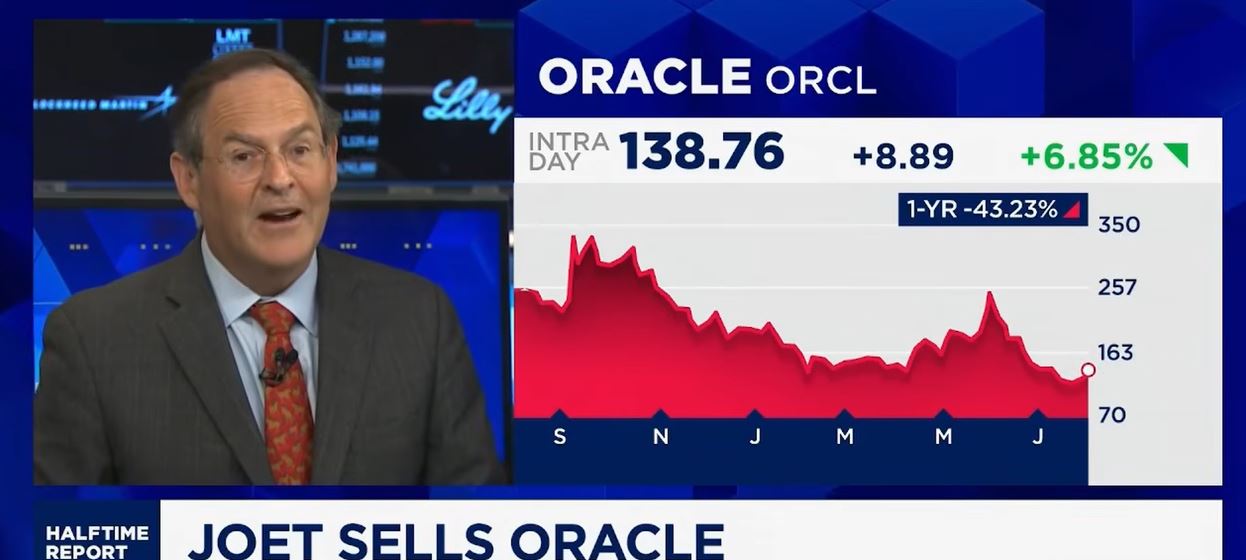
Jimmy’s wrong, return doesn’t come from risk, but performance
Well into Monday's (8/3) Halftime Report, Judge gave viewers a free algebra lesson about A+B equaling C (snicker) in terms of hyperscaler spending.
Jimmy Lebenthal brought up the "little variable" of the financing.
Judge noted the JOET sold ORCL. Jimmy admitted, "I'm not sure that Oracle's gonna work. But I think it is." Jimmy admitted, "Oracle is risky. Obviously it's risky. That's from whence (snicker) (double snicker for that one) comes return."
Well, that's not correct. But let's continue.
Joe Terranova challenged Jimmy on his "enthusiasm and confidence" for ORCL while Jimmy says at the same time that AAPL is done. Jimmy stressed, for what must've been the 3rd or 4th time, "Again, risk is what generates return."
OK. Now we've had enough.
"Risk" is not what "generates" your return. Performance is what generates return. "Performance," in this case, means basically "what the market thinks of your stock." (Which is largely on the numbers, partly on the expectations.)
Saying that risk is what generates your return is like saying your car insurance policy dictates whether you're going to be in an accident.
Joe and Jimmy clashed over whether the market knows what ORCL's backlogs and prospects are; Jimmy insisted the market does not know, or there would be no profit for any investor to make.
Steve Weiss chimed in that he sees ORCL as a higher P.E. than META, even though (sigh) the CNBC graphics showed META at 19 and ORCL at 17. Weiss also said the ORCL P.E. is "right around where Microsoft is," which was something like 25 on the screen.
"Just because the stock is down so meaningfully, I don't think that divines, defines value," Weiss told Jimmy.
Jimmy said he "100%" (snicker) respects Weiss' point, but it's "just a difference of opinion" that META is a better long.
Weiss said, "But numbers are numbers Jim is my point."
Jimmy continued, "If the funding for OpenAI and all these other uh large language models come through, that P.E. in the coming years goes down to like 13."
That's irrelevant, but then Jimmy correctly stressed that the screen said the forward P.E. of ORCL is 17. Weiss sort of insisted his numbers are correct. Sarat Sethi chimed in somehow that "The E is the one that's gonna go higher and that will then compress the multiple, which will then give you a higher multiple down the road," a prediction of a series of events that is about as reliable as a coin flip.
Still waiting to hear whether Kevin Simpson is buying more SPCX as it nears 100, as he promised
CNBC's Morgan Brennan, who generally does the 5 a.m. gig now, reported during Monday's (8/3) Halftime on the SPCX lockup expirations. (This writer is long SPCX.)
Judge said, "All I keep hearing about is lockup, lockup, lockup."
Joe Terranova said he's "not sure" that he likes the lockup expiring "48 hours after earnings." Joe said, "I don't like the setup" (as if Joe "NVDA is the new AAPL" Terranova is ever going to trade a stock like this around an earnings report).
Judge suggested Steve Weiss might "take a little action on this name." Weiss said he might be interested, but "the deluge of stock" hasn't all been discounted by the market.
Judge kept chuckling about whether Weiss had a "beige" or "taupe" background after calling it "monochromatic" at the beginning of the show.
Late in the show, Oliver Renick said SPCX calls were outpacing puts, but the "put activity is happening closer to the money." Oliver said the 95 put and 130 call were most popular.
On Fast Money, Guy Adami admitted that if someone had told him weeks ago that SPCX would be near $100, he would assume the whole market had gotten "smoked."
GME just hit a 52-week low; great look for its EBAY takeover bid
Judge was back — recently, that's been less than a 50/50 bet — but Monday's (8/3) Halftime Report really struggled to get off the ground.
Joe Terranova had to explain to Judge how the JOET ditched MSFT (Zzzzzzzz) just as things appear to be getting good, and also unloading META (Zzzzzzzz) just before Monday's gain.
Jimmy Lebenthal made the case that MSFT is a "very similar analog" to AAPL over the last 12 months, though we're not quite sure about Jim's comparison; it reminds us of Joe saying over the last month that NVDA is just like the AAPL chart of 6 months ago, only to have Joe get stopped out of NVDA.
Judge asked how Jimmy could sell half his AAPL stake if it's broken out. Jimmy said at least twice, "Because it's done."
Joe protested twice, "No it's not." Judge told Jimmy, "This happens almost every time with Apple, the stock ramps into the print, and the stock sells a little bit off." Jimmy said it's not a "little bit off," but 10%.
Jimmy pronounced AAPL "in the penalty box" while conceding it will eventually get to 400, but "not in the next quarter."
Judge said Steve Weiss, who was participating off-site, was "literally taking monochromatic to an entirely new level today." (How does one take monochromatic to an "entirely new level"?) Weiss said he was in the "East Hampton box."
Weiss said he bought META to "size it up considerably" and also bought MSFT after reporting, "to size that up considerably." Weiss said Zuck is "not a prisoner to any prior moves that he's made."
Judge fails to ask panelists whether Tony Romo should be able to go right back to work
Judge on Monday's (8/3) Halftime said the JOET bought XOM and too many other energy names to mention. Judge said, "So, the momentum's gonna continue, obviously," to laughs around the table.
Joe Terranova said "we certainly hope so" and said that energy was "the leading sector" before the "Middle East confruct- (sic) (snicker) conflict, rather." Joe said he's "comfortable" with a 10% energy weighting, and he really likes refiners, or VLO.
Sarat Sethi said he's been taking off energy positions, because "it's done everything I wanted it to do." Jimmy Lebenthal insisted on what ORCL's P.E. ratio is we have to refill the SPR. Jimmy stressed that XOM is a "great big refiner" that nobody talks about.
Steve Weiss' Final Trade was DKS. Sarat said TDG, Jimmy said APO and Joe said STLD.
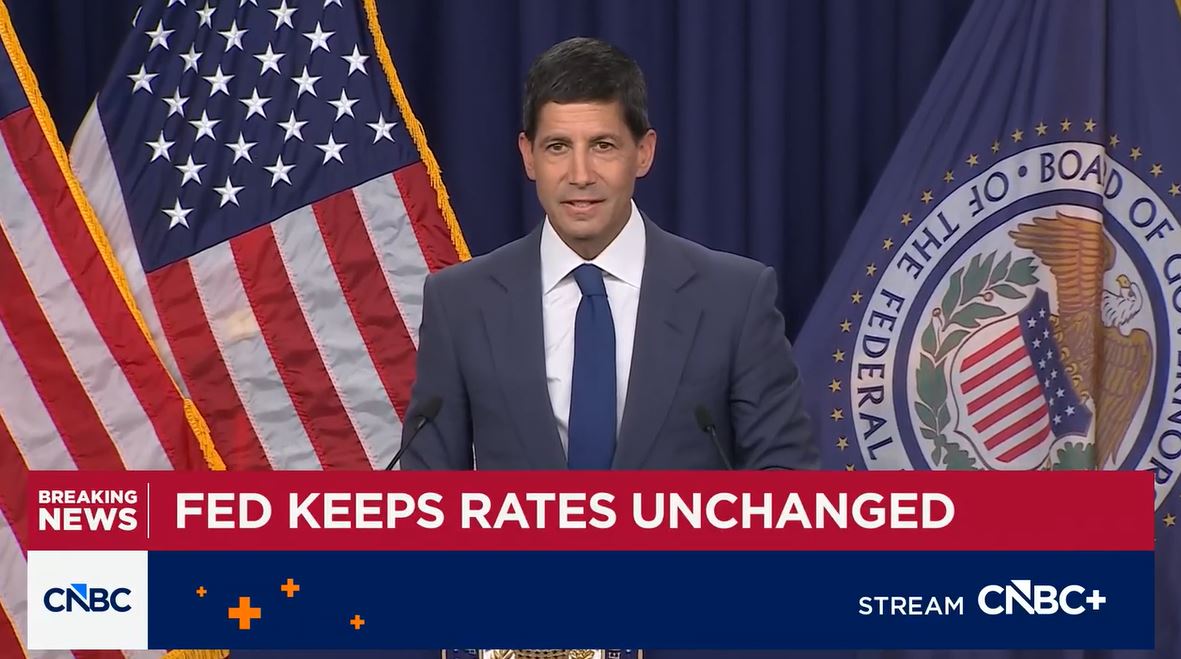
Note to Jimmy — the market’s concern is that this person is saying a bunch of mumbo jumbo that 1) isn’t going to happen or 2) that he doesn’t actually believe, and that he kinda thinks of the whole communication thing as a joke
CNBC's Oliver Renick said on Friday's (7/31) Halftime Report that options traders were buying 7 times as many puts as calls on the TLT.
Halftime guest host Santoli asked if anyone was tempted by higher Treasury yields. Rob Sechan said yes while conceding the market may have "diminishing confidence in Fed credibility," though Rob thinks "it's tough to make that judgment after 1 meeting."
Santoli pointed out, "it's 2 meetings."
Rob said of Kevin, "Rest assured that this guy has not gone stupid."
Now that's an interesting assessment. After 2 Fed meetings, Rob is saying that "this guy has not gone stupid." That's quite a vote of confidence.
Amy Raskin said, "I'm really worried about yields moving up. ... We're in dangerous territory." Amy said the relationship between fixed income and stocks has "broken down."
Jimmy Lebenthal opined, "So there's this concern that there was a huge contradiction in the press conference of, 'Inflation's a problem, but the Fed did not raise rates.'"
Amy cut in, "Not only that, inflation's a 'choice,' he said, so he's basically choosing ..."
Jimmy continued, "What did the market really want. Did they want Chairman (sic, the Fed officially called it 'Chair' under Powell and Yellen, but on its website, it now lists Kevin as 'Chairman') Warsh to say, 'Oh well I voted in the minority to raise rates, and I got voted down'?"
Amy said "I think the 10-year would've preferred a hike. I don't think the equity market would've preferred a hike."
Rob said if there was a hike, the market would've down a thousand points.
‘The market is now discounting a very very very large AI spend in perpetuity’
Jimmy Lebenthal on Friday's (7/31) Halftime Report chalked up AMZN's gain to "breathtaking" results in AWS.
Amy Raskin said stock gains of AMZN and MSFT represent a "rotational narrative in AI."
Rob Sechan said the companies that provided "clarity" about AI did well, while stocks of companies that were "a little murky" had a "more difficult time."
Stephanie Link said AMZN's results give her "so much more confidence in the whole AI/food chain narrative."
Stephanie said that companies maintaining AI spending is better than seeing a "cut" in that spending; "now we're startin' to see ROIs, so we should feel better overall."
But Amy said, "I'm not sure the financing's there" for extended capex spend.
Jimmy observed, "There are margin calls all over the place." Jimmy then made the case for MU being cheap; "I think it's unreasonable, the valuation that we're seein' at Micron."
Amy said she's not commenting on MU, but, "The market is now discounting a very very very large AI spend in perpetuity." Amy said, "At some point people are gonna say, 'Overall, I need returns on this.'"
Jimmy says Brian’s takeover has coincided with ‘nicer’ SBUX employees
Jimmy Lebenthal on Friday's (7/31) Halftime Report said he sold half of his AAPL stake a day earlier; "I actually let the team know here" so people wouldn't think he's "back-dating a trade."
Jimmy said AAPL was "priced for perfection."
Rob Sechan said, "We sold a bunch of it on Wednesday." Amy Raskin said any pullback in AAPL is "normal." Stephanie Link observed, "It's a rich stock, lot of high expectations."
Stephanie Link bought more SBUX, saying it's at the "operating margin inflection point."
Jimmy said of SBUX, "The experience has been really really improved since Mr. Niccols (sic added 's') took over. ... They're just nicer."
Contessa Brewer reported that Tony Romo has been put on leave by CBS.
Rob bought SKHY, admitting volatility may not be "completely over."
Amy bought SHEL and SLB.
Guest host Santoli gave an elongated correction/clarification about what he said Monday about EBAY getting a "rival" bid from somebody besides GME when it was PYPL that got the other bid. (This page didn't even notice.) Anyway, Jimmy said he still likes EBAY; "I think the GameStop, um, uh offer (snicker) has some potential (snicker)." Jimmy said collectibles are a "relatively new category" for EBAY. Santoli said "tickets to, uh, 'The Odyssey' in IMAX, uh, on eBay as well."
Santoli asked Amy about EOG, first calling it "EOC" (sic) but correcting himself.
Stephanie bought more VRT and mentioned "backlog," her term of the summer.
Stephanie's Final Trade was TGT; "the turnaround is definitely working." Rob said MPWR, Amy said SLB and Jimmy said RIG.
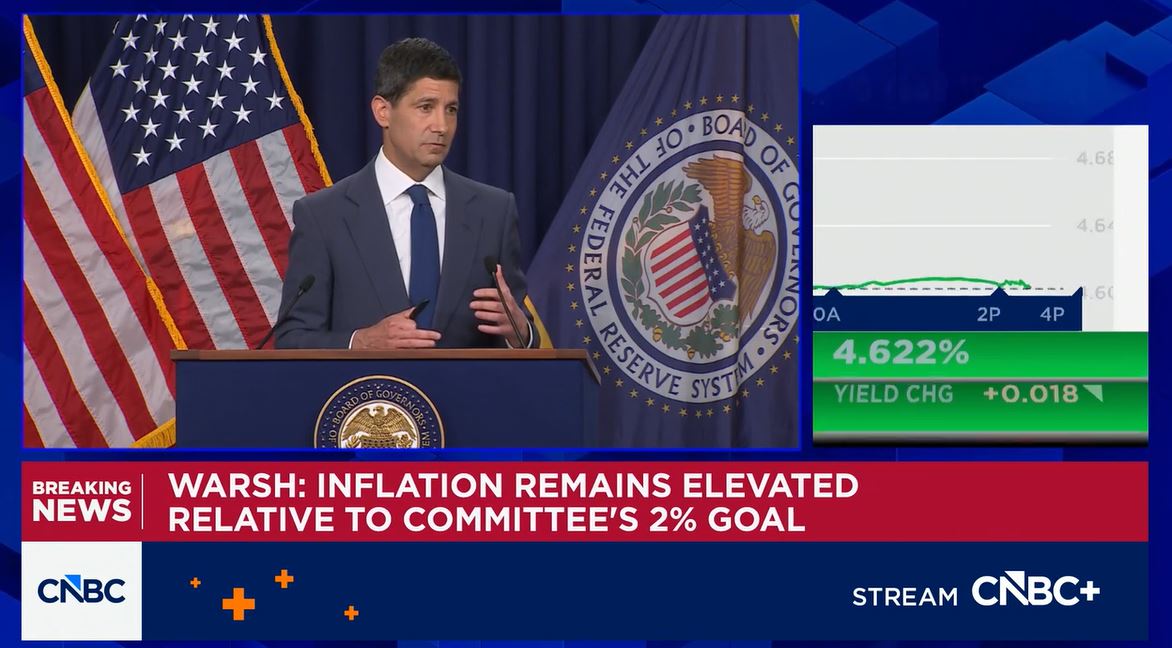
If Kevin, 56, thinks the press conference is counterproductive, then Kevin should have the balls to cancel it
At the end of the A Block on Thursday's (7/30) Halftime Report, Judge finally got to Task Force Kevin's Press Conference, reading some published commentary from Fed watchers.
Steve Liesman joined in from Englewood Cliffs and said the reviews Judge read were "consonant (snicker) with what else I have read Scott and consonant (snicker) with what I observed. I- My initial observation after walking out of there was, I never listened so hard and heard so little. Um, it was a basic, uh, uh, failure, or basic, uh, uh unwillingness to provide details about basic central banking."
Steve said "the biggest concern is, that this is a credibility problem," and, "What people are saying to me off the record and won't say on the record is that their fear here is that Kevin Warsh is too beholden to President Donald Trump and won't say the words about raising rates for that reason."
"Every Fed chairman is tested by the markets, and yesterday, when you saw a really epic, uh, uh, selloff in the 30-year bond, uh, he kinda- he fail- he failed that test."
Judge mentioned the "bold and, line in Sharpie if you will between the White House and the Federal Reserve becomes more of a dotted line if not a completely broken one." Judge added, "It's clear to me that Wall Street is confused," as Morgan Stanley says the Fed will stay "on hold this year" while JPMorgan is "pulling forward" its rate hike from 2nd half of 2027 to December 2026. But Judge said Deutsche Bank says the "baseline" is that the Fed hikes "50 this year."
Steve said it's "OK" to have divergent expectations on the Fed's moves, "but the question is the 'why," that analysts don't have anything to "base their call."
Steve said the 30-year, gold and the dollar are saying, "There's a big gap between Kevin Warsh's very strong pronouncements of the Fed will deliver price stability and how it's going to deliver it. Um, and they doubt that he is as strong as he suggested he is on delivering price stability."
Well, that's a bit of an understatement ... on the one hand, Kevin knows that inflation's been out of control and finally needs to be stopped; on the other hand, he doesn't know what to do until some task forces get back to him. (Translation: The ringers on the task forces will come up with a way to say "Hey even if inflation's 25%, we should still do a CUT!!!!!")
Steve at one point said, "This is a lot like the bond market reaction when they thought Trump was gonna fire Powell." Also, "it's similar to the Liberation Day tariff reaction."
Steve explained that the "fundamental question" is, "Is this a better way to run monetary policy, and the initial overnight trade is that it was not."
Exactly. If Kevin thinks the most important thing for him to say is, "So, apparently it was news that I had a press conference," then he should stop wasting everyone's time, including his own.
Judge says ‘Sharpie’ in back-to-back days
Malcolm Ethridge opened Thursday's (7/30) Halftime Report saying he was "shocked" by how good MSFT earnings are.
"They kinda knocked the cover off the ball," Judge said.
Bryn Talkington said she's never been this "excited" about a MSFT report, and "it's so good for the industry."
Bryn said, "I switch my position from yesterday."
Josh Brown said "most important" from the MSFT report is, "They raised the lower end of the floor on capex but not the ceiling."
We hope it all really is great news. (This writer has no position in MSFT.) It kinda reminds us though of when Iger was facing pressure from Nelson Peltz, and suddenly, DIS had an awesome quarter.
Josh bought SNOW, saying the breakout stems from "an incredible earnings report from May."
Josh said SNOW "was down 22% going into the May print and has completely reversed."
Bryn said the IGV has been building higher lows.
Bryn said PLTR is "probably range-bound for a while," because a lot of momentum traders "have left the building."
Judge brought in Stephanie Link, who sold what was left of her META stake, calling it "dead money for a while." Stephanie said it looks like the spend is endless, and the ROI is unclear, and there's "no details."
Judge indicated that others still have bull calls on META. Stephanie conceded it's "not expensive" at "14 times earnings," but it's lacking the "operating leverage." Stephanie doesn't see "a lot of downside," but she thinks it's "dead money."
Josh said AAPL has momentum "on 2 fronts," one on fundamentals, but also "on the company's AI story being the lowest cost from a capex standpoint and quite possibly the highest profitability (that's a lot of words for 1 fundamental)."
Actually, Bryn said CBRE should go to $170
Josh Brown on Thursday's (7/30 Halftime Report said he bought RDDT, conceding he was buying into earnings Thursday afternoon. "Most of this business is advertising," Josh said. But he said it has a "data licensing business" and deals with OpenAI and Gemini. Josh claimed, "Reddit is one of the most important citation sources for all LLM use." (That's sure reassuring for everyone in search of trusted content.)
RDDT fell afterhours. (This review was posted overnight Thurs-Fri.)
Josh also said he bought DAL; Josh said July 23 "was the busiest day for commercial airlines in United States history. 153,000 flights were tracked." Josh pinned a $100 on the stock.
Josh said ES, not a name mentioned on the show that we recall, is on the Best Stocks list. Josh said "I don't believe in triple tops," he thinks it's "improbable" that the stock falls, "a breakout is more likely." Shannon Saccocia said "delivery" is an important part of the ES business.
Bryn Talkington said she's in KKR, but "they're still in the doghouse" because of "bad sentiment" for the sector. "The market hates these stocks," Bryn admitted.
Malcolm Ethridge, who's long SOFI, said it just had a "stellar" earnings report, but there could still be "some overhang" from the Muddy Waters report.
Judge said an Evercore analyst hiked their CBRE target from 168 to 175; Bryn said, "Was he watching the show yesterday, because I said it should go to 175."
Josh again talked up LYV, like he always does.
Judge joked about the "emotional damage" of Josh not getting his Jersey Mike's sandwich that was evidently brought to the NYSE but got scooped up by all the specialists and traders on the floor.
Josh's Final Trade was AMZN. Malcolm said OKTA, Bryn said INFL and Shannon said IYF (Zzzzzzzzz).
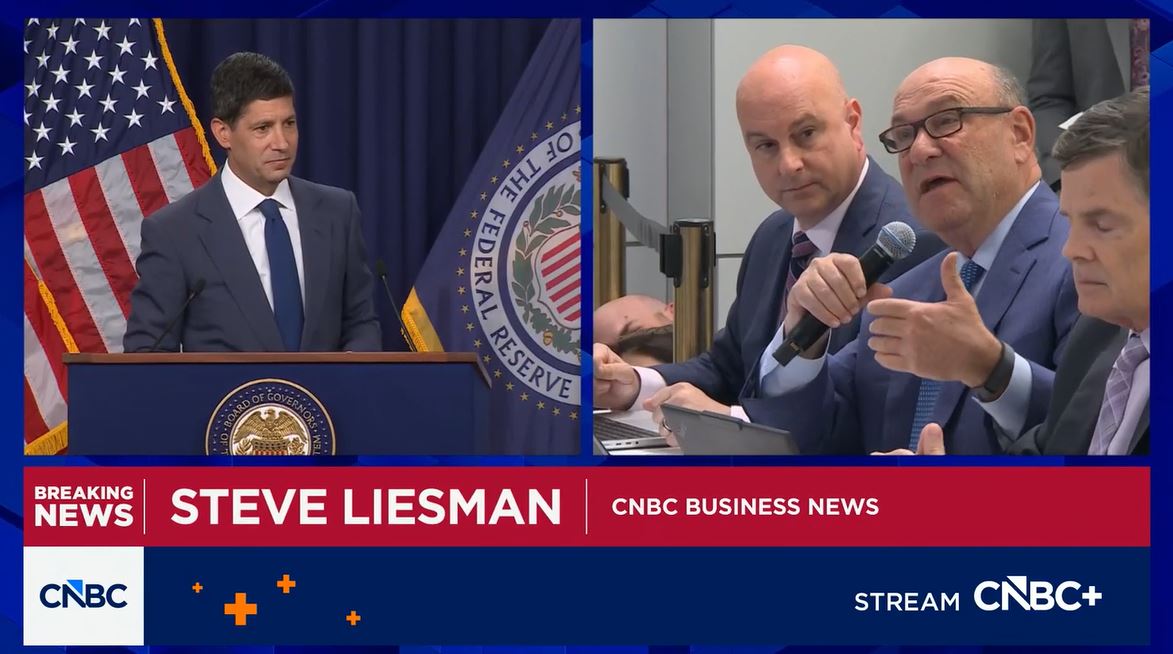
Kevin’s press conference
was embarrassing
What. In. The. World ...
Anyone who was forced to sit through the July 29, 2026, press conference of Kevin Warsh, a/k/a Task Force Kevin, had to be wondering 1) is this some kind of a joke, and/or 2) how in the world did this person get to be Fed chair.
Telling a bunch of stories that had nothing to do with anything, basically condescending to any question that sought to procure information from him, and oftentimes contradicting his own commentary, this has to be the most insufferable Federal Reserve press conference we've ever seen.
At one point, Kevin explained, "We're in the performance business."
Someone asked him what the headline of the day was. "So, apparently it was news that I had a press conference," Kevin offered.
Jeffrey Gundlach joined Judge on Closing Bell, when the press conference concluded, to discuss this performance Wednesday and was far more charitable than we expected, though he correctly said the main response he had to Kevin's remarks is, "What are you waiting for??"
Jeffrey said it sounds like Kevin is "Planning on making a plan."
Jeffrey said there was "zero concern" at the press conference about the employment market.
Gundlach said he doesn't like the "slow pace" Kevin is outlining when Kevin claims he is "adamant" about getting to 2.0, and "not a whisper above."
Jeffrey said Kevin is "very glib" but was giving "inherently contradictory" remarks. "I don't like this task force thing at all," Jeffrey said, adding that there wasn't "a lot there to grab onto" from the chair's remarks.
CNBC's Steve Liesman, who was enlisted to attend the press conference and ask a question, joined Judge's show and explained, "There was this concern that we were asking what we thought were good, legitimate questions and we were not necessarily getting the sort of answers that either made sense or that we understood."
Jeffrey opined, "I think they probably will hike in September."
A couple hours earlier, on the Halftime Report, Bryn Talkington stated, "We're gonna have to get used to his Greenspan-type, you know, of commentary where it's lack of commentary, and we're all left guessing," a tremendously accurate prediction, though Greenspan was clear as day compared with this individual. Steve Weiss said he's in favor of less messaging from the Fed.
Santoli said, "Almost all Fed chairs have hiked, aside from Janet Yellen, within like 2 months of when they got there because that seemed to be the thing to do."
Kevin says capex spending is in the ‘7th inning’
Steve Weiss on Wednesday's (7/29) Halftime Report said GS was down "because now there's some doubts about the IPO cycle."
Weiss said SKHY and SPCX were a "fail," a point challenged by Judge and Bryn Talkington, who said just because the stocks are down doesn't mean the IPO wasn't a success. (This writer is long SPCX.)
Weiss said to him, "that's failing."
Bryn said "the average return for an IPO one year later is negative 50%," so SPCX is "on par."
Meanwhile, Joe Terranova said KLAC is part of the "subsector" of the AI trade "that went parabolic," and positioning got "extreme," but it's still up 50% this year.
Judge said CAT has "been made an AI stock" and is down 25% in a month. Kevin Simpson congratulated Weiss for selling CAT and said capex spending is in the "7th inning" and he's going to hang onto CAT; Kevin doesn't see 1,200 anytime soon but "I think 900 is certainly in the cards."
Joe said CAT "needs a reset," and so does GEV and VRT.
Kevin bought more V on its "unbelievable" report. Kevin said, "The consumer's not slowing down."
Kevin claims NFLX is going to get Sunday Night Football
Kevin Simpson on Wednesday's (7/29) Halftime Report said he bought more NFLX, which was somehow up again Wednesday. (This writer has no position in NFLX but was recently long.)
Kevin said we may look back in a year and say "Man, we could've bought Netflix in the 60s, why didn't we." That's fine, but we've all fallen for that one. Kevin said, "Tight leash, but I think it's a good buy at 70 bucks."
Joe Terranova revealed, "I've tried to buy this stock several times." Joe explained, "costs are gonna remain elevated; competition is as intense as we've ever seen," and there's a "fixation" on live sports with a "significant price tag."
Well, we gotta take issue with the "competition" ... that's exactly the opposite of what Rich Greenfield correctly pointed out a couple weeks ago. Who are all these competitors Joe is warning about? Hulu? HBO Max? Disney+? YouTube is the only surging competitor, but it's different than those others.
Judge said NFLX used to get cheers for adding sports, "now we're- we're questioning that because of what it costs?"
Joe responded that there was "moderation" in revenue growth starting around June of 2025.
Bryn Talkington made a wonderful observation, stating, "Netflix reminds me of Uber. ... You really need to trade these names." (Translation: Don't expect big long-term gains.)
Weiss recapped selling NFLX, explaining, "The company said, we're worried about growth," and it hasn't had a "major uptick in subscriber growth" since adding NFL games.
Judge questioned the "endgame" for NFLX given its bid for WBD, which honestly, seems kind of an unfair question, who knows what the "endgame" of any media company will be in 3 years. Kevin said NFLX used to say no acquisitions and also no ads, but it added ads that are successful.
Kevin said, "Sunday Night Football on Netflix. I think that's coming."
Judge claims Satya’s legacy was being written in ‘Sharpie’
"We're gettin' hit pretty hard here," Judge opened Wednesday's (7/29) Halftime Report, calling it "one heckuva day."
Heckuva day, perhaps. But instead of a heckuva show, Judge and his crew spent probably 15 minutes discussing META (Zzzzzzzz) and MSFT (Extra Zzzzzzz).
Joe Terranova stressed that neither MSFT nor META "can be defined as a momentum stock anymore."
Ya think.
Bryn Talkington said MSFT is "the opposite of a momentum trade right now," with lower highs and lower lows.
Bryn said, "I think the question that we're all dealing with, is what the heck are these hyperscalers spending all this money on, and what are the results." Bryn predicted the MSFT news will be "more on the down side."
Steve Weiss said Chinese competition is "actually good for these companies." Weiss said if MSFT doesn't hit the cloud growth number, it'll be a "major, major issue." Weiss said MSFT is "not one of my bigger positions," but META is.
Judge said there are "many articles (snicker) now being written" about what Satya's legacy will be after people "sort of had written it in Sharpie" a few years ago. Kevin Simpson said it was software that "really derailed this entire company," which is a problem, given that ... it's a software company (or so we always thought).
Kevin suggested the earnings bar is "incredibly low" and the downside seems to be "built in," adding, "We were buying in the 370s," Kevin said.
Bryn persisted, "What are they spending all this money, for what?" Bryn said if OpenAI was a public company, it would've been down "40%" last week.
Bryn said Copilot "still feels like Teams."
Weiss admitted that with META and MSFT, "I violated one of my personal investing tenets, which is that, Never get in front of a capex cycle."
Weiss called Zuck a "visionary" and claimed he's the "best navigator of troubled waters."
Joe predicted of META, "They're gonna try their best tonight to steer the conversation away from capex." Judge said they can try to steer "as much as they want," but "every analysts' question is gonna be about capex."
Bryn said not to get "lured" by "lower P.E.s" for these stocks.
CNBC's Oliver Renick said options flows "lean bullish" for MSFT and META ahead of earnings but he said some speculators are picking up the 500 META put. Bryn advised not "gambling" on buying calls that expire in a few days, but buying the stock and selling calls.
Still no update on Julia getting that Elon interview from Sun Valley rescheduled
Judge on Wednesday's (7/29) Halftime Report said Citi cut its DIS target to 135 and Morgan Stanley cut it to 123.
Joe Terranova, echoing his own recent comments, said "This company is clearly in the midst of an identity crisis." Joe said he was told "years ago" that streaming was the catalyst for DIS, but in the last 5 years, the only catalyst has been activism. Joe said the JOET added recently at 103 and it's been a "losing position."
Bryn Talkington again mocked how the market sold off CBRE and said she bought around "the 130s" and it "should be a $170 stock."
Joe for some reason is obsessed with struggles of medical device companies and pointed to the IHI and ISRG. Steve Weiss said "the hurdle" for devices is because "hospitals are not making any money" and so are delaying purchases.
Joe said GRMN is benefiting from product diversity.
Kevin Simpson's Final Trade was STLD. Weiss said the 10-year, Bryn said CBRE and Joe said AAPL.
Haven’t heard about Julia getting that Sun Valley interview with Elon rescheduled (perhaps that will be the turning point for SPCX?)
CNBC's Oliver Renick on Tuesday's (7/28) Halftime Report said SPCX options imply a 15% move on earnings. (This writer is long SPCX.)
Stephanie Link gave a speech yet again about her "small position" that she's "not even looking at" but just holding for years.
Guest host Santoli, who once again started off the show thanking all the panelists for being there "for the hour" (isn't that their job?), told Josh Brown that when an IPO is said to be "oversubscribed," it doesn't mean that demand will be there "down the road." Josh related how people who don't expect to get IPO shares will put in a request for more than they want expecting they won't get the full amount.
Stephanie actually announced her SPCX buy on June 22, a day it closed at 154, "set it and forget it," a slogan she's said about 4 times since. Stephanie trumpeted at that time that SPCX was "down almost 25% (snicker) from its highs."
Oliver actually reported on 7/17 that someone was buying SPCX 330 calls expiring a week later (snicker). Then there was Kevin Simpson on 7/10 telling Judge, "If this trades down close to a hundred Scott, we'll double down on it for sure."
Joe’s repeated assertion that NVDA is the same chart as AAPL looked like months ago sure had a lot of conviction behind it
Joe Terranova on Tuesday's (7/28) Halftime Report revealed he's already ditched the NVDA "personal position" that he spent the last 2 weeks comparing to AAPL of months ago; he locked in a gain of 5% but "got stopped out this morning."
Stephanie Link "firmly" believes that the capex cycle isn't over.
Josh Brown said the semis and their RSIs and 50-days are "great news" for the bull market.
Joe asserted, "Crude oil is helping out the formula of the market broadening this week for sure."
Stephanie told guest host Santoli, "the broadening trade is working out. I don't know why it has to be one or the other, Mike, I really don't." Santoli responded, "Well, historically it has been."
Stephanie admitted that with META, "I'm getting kinda frustrated" about the capex spending.
Josh cited ALL as a non-tech company benefiting from its AI spend and how that kind of spending may continue to work to the point that, "We may not replay the 1999-2000 capex boom bust. This might be different. This might be sustainable levels of capex as far as the eye can see."
Joe said there's "exhaustion" about earnings expectations for the hyperscalers.
On Tuesday's Fast Money, Karen Finerman asserted that today's NVDA is not like Lucent circa 1999-2000.
A CNBC host teased Judge returning Wednesday to ask Jeffrey for the word/slogan of the day from Task Force Kevin’s press conference
Joe Terranova admitted on Tuesday's (7/28) Halftime Report that GLW's slide was not what he was "anticipating," having talked up the stock for months; on May 12 he said "you want ownership" on corrections.
Joe on Tuesday said you have to be "fully aware" of the GLW earnings disappointment. He's not "rushing in" to buy.
Meanwhile, Phil LeBeau reported that BA actually had positive free cash flow.
Stephanie Link, who has basically backed a BA turnaround for the last 8 years running, said BA is "being conservative" on free cash flow guidance.
Stephanie predicted a "nice 2nd half" for DKS.
Stephanie predicted the UNP deal "gets passed."
NFLX seems to have bounced from 68, as Guy Adami (kinda) predicted
Josh Brown on Tuesday's (7/28) Halftime Report talked up travel stocks on the Best Stocks list; he called MAR the "best in the bunch." Josh said 330 is a "line in the sand." Josh also mentioned HWM, which we don't think has been mentioned on the show, maybe ever.
Stephanie Link bought more IBM and said she's "surprised they negatively preannounced." Guest host Santoli agreed it "wasn't so glaring."
Santoli said CRWD was initiated "buy" by Loop Capital with what Santoli called a "$350 (sic) price target."
Josh gushed about how CRWD could be a "decadelong story." Santoli said the notion of cyber as the "safe place" in software has gotten "very consensusy," but that doesn't mean the consensus is wrong. Santoli clarified that Loop actually gave CRWD a 230 target.
Joe Terranova said the "repositioning" keeps happening in software, which is why the "laggards" have rallied in the last 5 days while cybersecurity names are "down 5-6%." Joe again said he thinks you should own DDOG, a stock he mentions about every show. (Hopefully it won't do round-tripping like GLW.)
Josh's Final Trade was NFLX, "hangin' on for dear life." We're happy for Josh and other NFLX longs and hope the move sticks. (This writer has no position in NFLX but was long recently.) Josh had planned to say TOST also. Sephanie said PWR, and Joe said RJF (Zzzzzzzzzz).
Jimmy back to old glasses
Guest host Santoli on Monday's (7/27) Halftime Report said AAPL hit a new high and appears to be the "inverse to the AI anxiety trade," and he showed a chart of AAPL vs. the NDX.
But Santoli says AAPL is "really expensive."
Jimmy Lebenthal, who was back to his old glasses (we don't know why; this page noted that the new pair on Friday was sharp, but the next thing you know, they're gone), claimed he's been saying "for quite some time" that the Mag 7 shouldn't be "treated like a monolith."
Santoli said the market is "way beyond" treating them that way.
Jimmy continued that he's "not very enthusiastic about Apple right now," citing valuation.
Defending AAPL, Joe Terranova said "it's relative performance to its Mag 7 peers." Joe said AAPL keeps getting the "benefit of the doubt."
Jimmy noted NVDA's surging free cash flow and indicated he doesn't want to see dividends or buybacks. Santoli questioned, "was Apple a sell in 2013 when they started buying back stock and, and, and issuing a dividend." Jimmy said no, but "at the moment, people said, 'What are they doin'?'" and it wasn't looked upon "favorably."
Jason Snipe said of NVDA's slide Monday, or perhaps since mid-May, "The market's probably overplaying this one," and it'll be an "opportunity" in the 2nd half of the year.
Joe suggested the market reached "exhaustion" after MU earnings.
Steve Weiss revealed, "I added to Google on Friday ... I want them to spend, because I want them to be able to capitalize on AI as very, very few companies do." Weiss is "sort of sanguine" about what's been happening, his advice is to "ride it out."
Like we keep sayin’, when Judge returns and asks ‘What’d I miss?,’ the answer will be, ‘Nothin’ ’
Santoli was the guest host of Monday's (7/27) Halftime; he introduced the panel and said, "Thanks for all bein' here guys, thanks very much" ... but isn't that their job??
Joe Terranova said it's "a little bit of a frustrating day" and that the market is figuring out the "next leg of momentum." Joe said momentum is "maybe" going to financials or healthcare, but the uncertainty "leads to a frustrating environment."
Jimmy Lebenthal, back to normal glasses, mentioned how GOOGL and TSLA got "beat up" for high capex numbers. (This writer is long GOOGL.) Jimmy suggested "the Chinese large-language models" that have "some capabilities" are weighing on the capex spenders, as well as the "cost-consciousness in corporate America that's starting to guide toward these Chinese models."
Jimmy stressed, "Seasonality should not exist, but it does. It's real." Santoli agreed and said while it seems people should "front run" the seasonality, "it tends not to, to happen."
Jason Snipe said "There is momentum in capex" but that "the story" has been negative free cash flow. In a comment that typically comes from Joe, Jason said the RSP is "working" and up for this month.
Steve Weiss told Santoli, "I don't think it's all about AI. I think it's about Iran and oil." Weiss mentioned the U.S. supply of weaponry and said Ukraine "got our old weapons."
Rather ominously, Weiss said, "This isn't going away, and that's going to be a constant overhang in the market."
UBER ‘maybe washed out’
CNBC's Mack on Monday's (7/27) Halftime reported on the deteriorating relationship between Waymo and Uber.
Jason Snipe is long UBER and said UBER has been diversifying into a "huge network." Jason thinks the market is "overplaying" the notion of a "binary outcome" in the rideshare battle and there's "a lot that can work with Uber going forward."
Guest host Santoli admitted, "I'm just struck by how depressed the valuation has become in Uber. It's like 8% free cash flow yield."
Jason said "profitability metrics" for UBER keep improving.
Joe Terranova curiously said "hopefully the World Cup acted as a catalyst for, for Uber." ... Because ... everyone's getting rides to watch soccer games? (Even if it was a catalyst, why in the world would people buy the stock for that reason, the "catalyst" isn't coming back for 4 years.)
Joe said the strained Waymo relationship may mean UBER needs to spend more, and the stock made a 52-week low in the morning, but it was having an upward reversal by the time of the show, so "maybe it got washed out."
Jimmy’s right — XOM and XLE are 5-year outperformers
On Monday's (7/27) Halftime Report, guest host Santoli asked the panel about healthcare, citing Krinsky as saying "it's close to breaking a multiyear downtrend."
Jason Snipe said "patent cliffs" are driving the M&A in biotech. Steve Weiss asserted, "Healthcare's being remade," saying companies are able to "outsource" cancer care to a private company, TimeCare, which is "wildly profitable" while making money for HUM and CVS and UNH.
Joe Terranova said there are "idiosyncratic stories" in healthcare that should get some of your dollars.
Joe pointed to the lousy 1-year chart of ISRG. Santoli said, "Device stuff has been tricky."
Joe said HOOD still has a "reliance on crypto." Joe said HOOD had a "miss" in the last quarter and "eliminated 10% of the work floss (sic pronunciation, not corrected)." Joe said HOOD's "in a little bit of a precarious position," he'd like more work on "expense management."
Oliver Renick said there's a "lot of put-buying across the board in energy." Jimmy Lebenthal said XOM and the XLE "over the last 5 years" have beat the S&P "by more than twofold." (That's true, according to the charts we checked.)
Jimmy said Strategic Petroleum Reserves "need to be refilled." Joe said "speculators" don't "trust" any spikes in oil. Joe touted the refiner trade, VLO, PSX, MPC. Santoli said, "They're basically the memory stocks of energy."
Weiss' Final Trade was META. Jason said NOW, Jimmy said EBAY and Joe said INCY. Weiss said if his META trade doesn't work, blame Annie Cornbrooks.
Jimmy’s got sharp new glasses, something The Dominator didn’t even mention
Guest host Dom Chu, The Dominator, said on Friday's (7/24) Halftime Report that Deutsche Bank trimmed its META target from 810 all the way down to 800 (snicker).
Kevin Simpson said the META ad number will "blow it off the chart," but, "If the Street doesn't like the spend, then the stock's gonna get slammed."
Kevin bought more GOOGL, saying "the Street overreacted to this selloff." Kevin said his fund originally bought it because it's a dividend grower. (This writer is long GOOGL.)
But Bryn Talkington stated, "Google just broke the 200-day. That is not good. It needs to get right back above there." Bryn added, "The technicals are getting worse on most of these companies."
Dom said Baird raised its AAPL target from $310 to $330, which is real helpful for buyers. Bryn said with AAPL, "You know what you're gonna get." Bryn thinks they should "retire, like, the 'supercycle' word."
Dom said "the Tesla reaction has been interesting." Kevin said it's "very healthy" that the market is more "demanding" of this stock.
Stephanie for the 2nd time in a week said, "I recently sold Marvell 'cause I made over a hundred percent in like a month and a half."
Jimmy said AMZN has the best setup of megacap tech. Bryn predicted a "bunch of land mines" in the MSFT report. Kevin said MSFT is the "most important" earnings report next week.
‘We’re not going back to 2%’
Jimmy Lebenthal said at the top of Friday's (7/24) Halftime Report, "As much as I think seasonality is inane, should not exist, there's one seasonal pattern that just comes up year after year, and it's this late-summer swoon, August into September."
Jimmy said this trend "should not happen" and should be "arbitraged away." (Well, if it happens every year, shouldn't savvy traders be selling now and scooping up cheap stocks in September?)
As for megacap tech, Jimmy asserted, "I think this capex is healthy." Jimmy added, "This is not the late 1990s and the fiber-optic networks that were dark."
Stephanie Link said "I get worried at the 10-year at 5% ... I do not worry about the consumer at all."
Bryn Talkington said, "I think that, inflation is here. We're not going back to 2%, it doesn't feel like, anytime soon." But Bryn thinks rates are "well-anchored."
Bryn said, "Hopefully, this is not a forever war."
Jimmy said he gets what the 10-year is doing but wants to keep it in "perspective."
Stephanie says in the 31st minute that cybersecurity is a $300 billion ‘total addressable market’
Kevin Simpson on Friday's (7/24) Halftime Report said he bought more PANW. Stephanie Link again talked up cyber stocks and how cybersecurity is going to be "much bigger than AI."
Bryn Talkington's owned BUG for "multiple years" and agreed that cybersecurity "probably is bigger than AI."
Jimmy Lebenthal is "very much a believer" in ORCL.
Kevin sold 205 covered calls in CVX. Kevin cheered how his seemingly small "dollar seventy-five" gain annualizes out to an 11% premium.
Kevin said AXP on Friday was a victim of expectations, as well as a "little revenue miss." (Malcolm Ethridge just said a day ago (see below) that he was hoping for a post-earnings surge so he could sell it; apparently should've sold on Thursday.)
Jimmy called ABBV "an absolute add."
Bryn's Final Trade was GPIQ. Stephanie said IBM, Kevin said GOOGL and Jimmy said AMZN.
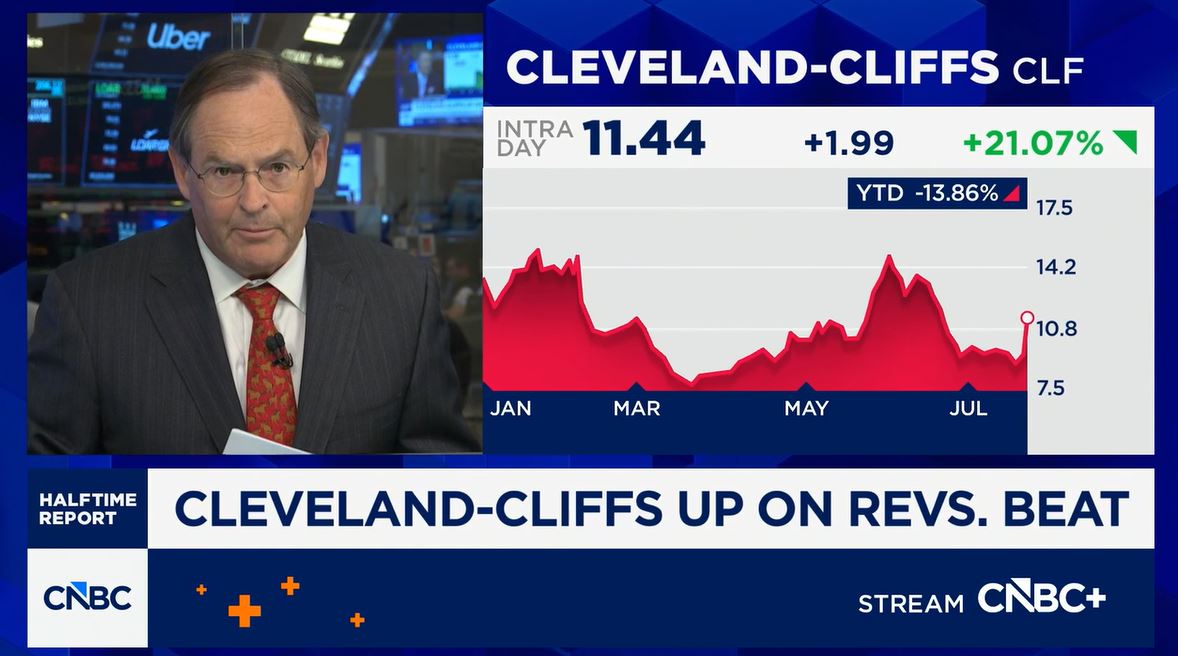
Jimmy gives stark warning about what Iran conflict can do to markets
Eamon Javers on Thursday's (7/23) Halftime Report reported on a pending White House tariff announcement and said the White House is apparently trying to "change the terms retroactively" in the Saudi Arabia nuclear deal and that Donald Trump told Axios he's considering a "massive attack" on Iran.
That prompted Jimmy Lebenthal to make a statement: "If you're making policy decisions in the White House about Iran, you have to put the financial markets to the side. Because in order to get done what needs to get done, you may, over the short term, have to sacrifice the financial markets. Let me be more specific. If you really want to get rid of the nuclear program, if you really want regime change, I know that hasn't been stated, but if that's what the goal is, you're gonna have to do things that are gonna freak out the oil market more than they already have."
Josh Brown advised, "you never sell your energy stocks ... it is the only hedge you have against these types of price spikes and inflation scares and geopol- geopolitical shocks."
A couple hours later on Closing Bell, Dan Greenhaus said of the Iran conflict, there isn't a "rational actor on the other side."
‘At worst,’ it’s only ‘middle innings’ of AI
Jimmy Lebenthal started off Thursday's (7/23) Halftime Report, guest-hosted by The Dominator, Dom Chu, on a cheery note about megacap tech stocks, even despite GOOGL's slide. (This writer is long GOOGL.)
"I get it. There are people who are worried that AI is a bubble," Jimmy said. "I certainly understand that, um, I'm more in the camp of the CEOs of these hyperscalers, the- the Brad Gerstners of the world, who all feel that at worst, we're in the middle innings of this."
Jimmy pronounced the AI trade "alive and healthy."
Josh Brown was talking about TRV again and CB as market winners who benefit from AI. Josh said industrials were "reacting positively to a game-on announcement from Alphabet."
Malcolm Ethridge declared "it's absolutely a stock-picker's market."
Dom Chu rattled off analyst changes to GOOGL, including several target cuts; Jason Snipe said what matters is the "reiteration of overweight" and that the stock is probably getting hit on "operational margin miss" and "negative free cash flow." Jason pointed to what the spending means; "the story has to be about the breadth."
Jimmy added, "What's happened this quarter is very understandable, particularly the negative free cash flow."
Josh asked Jimmy about Google search being "not as good as expected" and whether there could be another equity offering. Jimmy said "they could" do an equity offering, though "I don't think they would want to." Jimmy stressed, "They are investing."
Jimmy said he actually saw search as close enough to being "in-line." Jimmy conceded, "Alphabet may have to figure out some ways to compensates (sic) the Reddits of the world, the Fortune magazines of the world." Josh added, "Or get sued into the Stone Age."
Later in the show, Santoli said, "The thing that's been holding the index up is also the thing that's holding it back," which he called "the constant internal tension" between semis and hyperscalers. Santoli said there's been "a little bit of damage to the trend."
What’s the status of that GME takeover offer for EBAY?
Malcolm Ethridge on Thursday's (7/23) Halftime Report called AAPL a "patience story."
Josh Brown again hung a $400 on AAPL. Jimmy Lebenthal said he's got a "market weight" in AAPL, but, "I have to say, I'm not as enthused as the rest of the group." Jimmy mentioned "34 times earnings."
Jimmy said LMT's gain is "kind of simple," though he's not saying it with "any gladness," that "we're shooting a lot of missiles." Jimmy called the stock a "good hold for the next couple of years."
Malcolm said BX has a "ton of dry powder" and he continues to like it, though it's had a tough year. Josh said JPM has "size and trust" and that's what works for it. Malcolm wondered how Deutsche Bank had JPM at only a "hold" before the upgrade and whether the "hold" was a "typo."
Jimmy pronounced CLF "on track." He said, "I expect further, uh, appreciation from here," as he always does.
Josh buys more NFLX
Josh Brown on Thursday's (7/23) Halftime Report said XYZ could be joining the Best Stocks list (i.e., 52-week high) and mentioned all the goofy things it's done since the pandemic and mentioned Halftime's favorite metric, "still 72% below those highs." Josh isn't in it yet, he needs to see the technical breakout.
Malcolm Ethridge said he's hoping for an "opportunity" to exit his AXP position with a good earnings report Friday morning.
Oliver Renick said calls outweigh puts in USO options activity.
Jason Snipe's Final Trade was ABBV, one he's made before. Jimmy Lebenthal's Final Trade was RIG, one he's made before. Malcolm said CBRS.
Josh Brown's Final Trade was NFLX. Josh said "wish me luck," because he "added to Netflix this week." Josh said "it's one of the worst stocks I own, but one of the best businesses."
This page agrees with that. (This writer recently was long the stock but is no more, according to records.) It's a great company/business. It's just a horrific stock. We couldn't take it anymore. An issue in one quarter is one thing; with this stock, it's every quarter. Good luck to Josh.
Guy Adami on Fast Money indicated that NFLX seems to be holding around the 68 level.
ROI (Zzzzzzzzzz)
Guest host Leslie Picker asked Joe Terranova on Wednesday's (7/22) Halftime Report for the "key thing" from the pending Alphabet report.
Joe said, "Oh it's clearly, are we monetizing the spend via cloud growth." (This writer is long GOOGL.)
Joe said, "We wanna see a continuation of the hyperscaler spend."
Steve Weiss said there are "multiple levers" at Alphabet for showing ROI; Weiss said "the market has to believe ... that you're going to get a return on your AI spending."
Weiss said it's been a "stupid narrative" to wonder "Where's the return on it, where's the return on it," when they "just started spending."
Liz Thomas suggested the ROI on AI really is important. Weiss said he wanted to "clarify," that the ROI will be important, but it's "way too early" to determine what it will be.
Joe said, "The return on investment has been there for the last 3 quarters," citing cloud growth.
Jenny Harrington said the space requires "a lot of thinking" and "a lot of really deep work on individual names."
‘Every decline is a V-shaped recovery’
Jenny Harrington on Wednesday's (7/22) Halftime Report warned about individuals who make panic mistakes in the market.
Steve Weiss brought up one of his favorite slogans, about how today's retail crowd actually has found "since 2008, that every decline is a V-shaped recovery."
Joe Terranova said, "I think the retail community is as smart as they ever have been." But Joe did lament the prevalance of 1-day options. Joe said, "Most people don't even know who Hudson River Trading are. They're making more money than JPMorgan and Goldman Sachs."
Steve Weiss explained how he took advantage of the volatility in FTAI to sell in the morning with shares up 12%.
If it’s all about Hemsley The Great, why does HUM have the same chart? (cont’d)
Emily Wilkins on Wednesday's (7/22) Halftime Report said there's a new crypto bill in D.C. that would prevent presidents and all other elected officials from pocketing money from crypto.
Joe Terranova, harping on his newfound theme that NVDA's chart is going to do just what AAPL's has done in the last several months, recapped his initial NVDA purchase on July 7 at 198. Joe said NVDA is "literally tracing out a very similar pattern" to AAPL's rise from 250 to 330. "So the breakout is unfolding right in front of us (sic last 5 words kinda redundant)." Joe said he bought more at 207.
Steve Weiss said he bought more UNH and credited Hemsley The Great. Weiss said the stock is "reasserting its growth."
Joe said GEV had "disappointing guidance." Weiss said GEV decided to "change the metric" in the conference call. Weiss has got a "small position," but he's not adding. Joe said "you want to own cybersecurity in the software industry (sic last 4 words redundant)." Joe mentioned DDOG, a stock he likes to bring up all the time these days.
Jenny Harrington said "we should be very wary" about the OpenAI-Hugging Face thing. (Other than Don't Buy Tech Stocks, what exactly does that mean? Write your congressman?)
Santoli said there were "2,800 stocks up and 2,800 stocks down."
Joe was "very disappointed" in the COF quarter but he'll "stay anchored" to his personal position in CBOE. Joe touted the "78%" gain YTD in VIRT.
Oliver Renick said options trading in TXN is "very thin" but with a bullish bias. The TSLA 380 call expiring July 24 was getting bought. (Bryn Talkington on Closing Bell later was crowing again about selling TSLA out of the money calls.) NOW options were pricing in an 11% move.
Jenny said "there's a lot of expectations" for the URI quarter. Joe said LVS has been a "tremendous disappointment" in his portfolio. Joe said "the consumer environment really has some lack of clarity with oil prices and yields rising."
Jenny said she's "hoping for the best" for TMO but is concerned because of DHR.
Weiss' Final Trade was UNH. Jenny said AMBP, Liz said RSP (equal weight) (snicker) and Joe said NVDA.
When Judge comes back and asks ‘What’d I miss?,’ the answer will be, ‘Nothing’
As this stock market continues its merry-go-round summer, Stephanie Link said at the top of Tuesday's (7/21) Halftime Report, "I sold Marvell, uh, because I was up over a hundred percent. Same like I did with Teradyne."
Congrats.
Then she bought MU, "because the stock is down about 24% from its highs," always a favorite metric of Halftime panelists.
Stephanie asserted that the AI trade is in the "3rd or 4th inning."
Stephanie added to NVDA; "it's lagged so much."
Joe Terranova said of MU and NVDA, "If you do not have a position, you have what I would call a low-risk, well-defined point of entry here." (But actually, even if you do have a position, it's gotta be the same low-risk, well-defined point of entry.")
Joe admitted that July has been "one of the worst months for the momentum factor in the last 10 years."
Josh Brown said the AI/chip trade is "all 1 trade; the trade got washed out this month," but the market Tuesday has decided that only the technicals were damaged, not the fundamentals.
Josh also suggested the rally was happening ahead of Alphabet earnings, "the cleanest AI story."
Jason Snipe said hyperscaler spending isn't going to slow down.
Late in the show, Santoli said equal weight was lagging market weight, which had to be right up Santoli Jr.'s alley; Santoli Jr. asked Santoli Sr. about the market ignoring higher yields.
‘Normies’ debuts on Halftime
On Tuesday's (7/21) Halftime Report, MacKenzie Sigalos reported on AAPL-Klarna; Halftime guest host Leslie Picker actually said "attenuate," not a word you hear on TV often.
Josh Brown said everyone's getting accustomed to "on-demand information" that's basically just a rewriting/lifting/plagiarizing of Wikipedia and Reddit pages "partly replacing search," and it's all about giving commands, not asking questions.
Josh said AAPL is speeding the "agentic experience on your iPhone," it's coming "so quickly," the techies are already doing it though the "normies" aren't "quite there yet."
If UNH’s chart is all about Hemsley The Great, then to whom do we attribute HUM having the same chart?
Josh Brown on Tuesday's (7/21) Halftime Report said he didn't get much of a pop out of NKE, so he sold it to get some cash for some opportunities that are "a little bit more urgent."
Stephanie Link called NOW "mission critical," a term people like to use with this stock; she calls it a "buy."
Stephanie bought more MS.
On LLY-NVO, Joe Terranova asserted, "I'm not an attorney," and maybe NVO might win its claim, but "legal action is not how you regain market share."
Stephanie Link vowed she's going to hold her "small position" in SPCX for a "very long time" and "not gonna get caught up in the price volatility." (This writer is long SPCX.)
Josh Brown said sometimes people buy LYV or sell LYV, but it "continues to barrel ahead to new highs."
Josh talked up insurance stocks in the Best Stocks segment; he said 85% of the names in the KIE "are above their 50-day moving averages." Josh talked up TRV and CB and AFL.
CNBC's Oliver Renick said there's a "strong bullish bias" in COIN. Stephanie said bitcoin is a "risk-on-asset."
Stephanie's Final Trade was UNH. Stephanie said, "The CEO is doing his job in turning around the company." Josh said NVDA is "finally starting to act better on down days for tech," and NVDA was listed on the screen as his Final Trade, but he didn't specifically say so. Jason Snipe said GS, and Joe said FANG; "if there's complacency anywhere in the market, it's surrounding the price of oil."
Sarat apparently actually thought the new CEO was going to be a catalyst for DIS
Monday's (7/20) Halftime Report, guest hosted by Leslie Picker, was unfortunately quite humdrum.
There was the potential to get something going late in the program when Sarat Sethi took up DIS.
Sarat mentioned the multiple (Zzzzzzzzzz) and then actually said, "We thought we had the catalyst, new CEO ... streaming making money."
Seriously?? He thought Josh D'Amato was going to turbocharge the stock??
Sarat said DIS needs to show earnings growth (Zzzzzzzzz) and that the market is having issues valuing a business consisting of theme parks, streaming and cable TV.
Joe Terranova mentioned Judge bringing up "the note" (from Wells Fargo, which Joe didn't mention) days ago suggesting DIS give up streaming, which this page was way ahead of, suggesting it years ago.
Joe repeated his point that in the last 5 years, "activism has been the only catalyst for this stock" and asked Sarat if DIS should drop streaming. Sarat said streaming is getting "hit everywhere" but didn't really answer Joe's question, instead saying "maybe getting consolidation and separating and then getting buying power," which seems to be a contradictory agenda.
Weiss says ‘paycheck to paycheck’ in the 46th minute
Guest host Leslie Picker opened Monday's (7/20) Halftime Report with a really sleepy question about what kind of capex the market wants to see. Steve Weiss explained why "there's no one answer."
Weiss said AI spending "is not over," but the "debate" is about whether the stocks have already reflected the end. Weiss admitted "it's a convoluted answer to a question that's just not easy to answer."
Joe Terranova, who didn't bat leadoff for a change but still veered into Santoli Jr., said the market "is kind of idling in place." Joe said what's "critical" for capex is "monetization."
Joe said BA is only in the JOET "solely based on momentum"; the position was initiated in April at 229, but now the momentum is "solidly yellow, teetering on being red right now."
Joe gave LMT a "yellow light."
Leslie said Moffett thinks UBER will get "worse before it gets better." Sarat Sethi said he's "getting very interested in this level." Weiss sold it months ago and predicted Monday it'll "continue to be dead money."
Weiss said in the 46th minute, "60% of the country, moreso, lives paycheck to paycheck." (Stephanie Link was on Closing Bell to talk about how great the economy is and perhaps about TAM.) Weiss stressed that gas prices don't have any impact on people who buy World Cup tickets.
Leslie mentioned "my hometown of Kansas City."
Weiss said GEV trades "quarter to quarter"; he thinks the quarter "should be OK," the risk would be in costs, not orders.
Sarat's Final Trade was MS. Weiss said GS, Shannon Saccocia said IYE (Zzzzzzzzz), and Joe said VLO.
Jenny’s gonna go somewhere tonight where someone will announce they’ve dropped NFLX (so why doesn’t she short the stock?)
By Friday (7/17) lunchtime, probably most anyone who already owned NFLX was sick of this stock and tired of talking about it. (This writer is long NFLX.)
But the Halftime Report crew was just getting started.
At the 30-minute mark, Malcolm Ethridge joined remotely to say he bought more NFLX, reiterating his arguments about the stock from a day earlier. He said of the selloff, "I completely get it," but he said it's a "great opportunity to be buying."
Kevin Simpson said he sold some NFLX on Tuesday at 74; "I wish we had sold it all." Kevin said he likes the "entry point" on Friday but insisted, "Content does matter." He rattled off a bunch of shows that aren't on NFLX. "They need to straighten out the content." Kevin said that "live sports is the easy answer."
Kevin curiously added, "Nothing draws the viewer like Monday Night Football," even though Sunday Night Football draws a lot more viewers.
Steve Weiss said he exited NFLX earlier in the week, he noted Malcolm saying it's a good time to buy it, but Weiss said it's only "another good time to buy it."
Weiss said to get more live sports will be costly. "I think this is dead money for at least the rest of the year and maybe longer," Weiss said.
Jenny Harrington, who's evidently an expert on film production as well as REIT dividend payouts, remade her previous argument from a couple months ago that Judge mocked (hit PgDn a few times, that one involved the 28-year-old unemployed guy who's going to make hit movies that won't be on Netflix, but she didn't mention the 28-year-old unemployed guy this time).
Jenny on Friday claimed "the competitive threat is dramatically increased vs. any time in Netflix's history (which is the opposite of what Rich Greenfield said the night before on Fast Money) ... thanks to the amazing AI generation tools."
Jenny even claimed that "everywhere I go," she's hearing "I cut off my Netflix." (Wonder how many have cut off FISV and DOCU too in the last 12 months.) Jenny said, "At best, it's dead money."
Earlier in the show, pointing to headwinds facing the entire market, Jenny said that "on CNBC Pro it says there is 52 analysts covering Netflix. Not one of them even has ... like underperform on it. No sells. And the lowest price target says it's $80." So Jenny predicts a "moment of reckoning." (That was almost Carl's term in 2016.)
Santoli observed, "We first hit 7,500 on the S&P, May 14th. ... Cerebras IPO day."
Task Force Kevin (Warsh, not Simpson) is going to fix our inflation problem once and for all
If not for Kevin Simpson, viewers of Friday's (7/17) Halftime Report, guest-hosted by The Dominator, Dom Chu, would've heard nothing but gloom and doom for the stock market.
Steve Weiss said semis "keep making lower highs." Weiss said "the market is beginning to pull forward ... the end of the cycle."
Weiss said the trade's not "over completely," but he's not sure the "reset" is over either. Weiss said the market is "sleepwalking" past risks of "higher inflation and war in Iran."
Weiss predicted the Iran conflict is "not gonna end until we do much more significant damage, which will include damage to the any- energy infrastructure, which will drive up oil prices, drive up inflation."
Weiss mentioned selling MU; "I made enough money, so why put that at risk."
Jenny Harrington said "it feels like we're in that topping process."
But Kevin predicted earnings season will be a "have and a have-not story." Kevin said NVDA is in a "maturation process, maybe a la Apple." Kevin said it's "a true investment longer term."
Weiss sold CAT; Dom said CAT's forward P.E. is 35. Weiss said the multiple is "insanity" and "lunacy" for a "highly cyclical, capital-intensive company." Weiss asserted, "It's a cyclical company."
Weiss said the AAPL trade is "money looking for a home and then making a story out of it." Kevin said, "I don't think we're near the end at 330," but he wrote a covered call at a 350 strike.
If it’s all about Hemsley, why does HUM have a similar chart?
CNBC's Oliver Renick on Friday's (7/17) Halftime Report said retail traders who "stormed into" SPCX call options are sinking ... but he said someone's actually buying "the 330 strike calls expiring next week."
Kevin Simpson, who owns SPCX, said long term, it'll be "in really good shape," but it just needs to get through the summer lockup period.
Jenny Harrington bought AMT and talked up the MAR 380 price target of Morgan Stanley.
Guest host Dom Chu, The Dominator, said BTIG is making DKS a "top pick" with a $300 target. Weiss likes the stock and the business model but doesn't see how it gets to $300 other than as a "long-term target."
Kevin backed CVX; so did Jenny.
Kevin's Final Trade was AAPL. Jenny said RIO. Weiss said UNH and mentioned "Hemsley," as he does every time he mentions that stock.
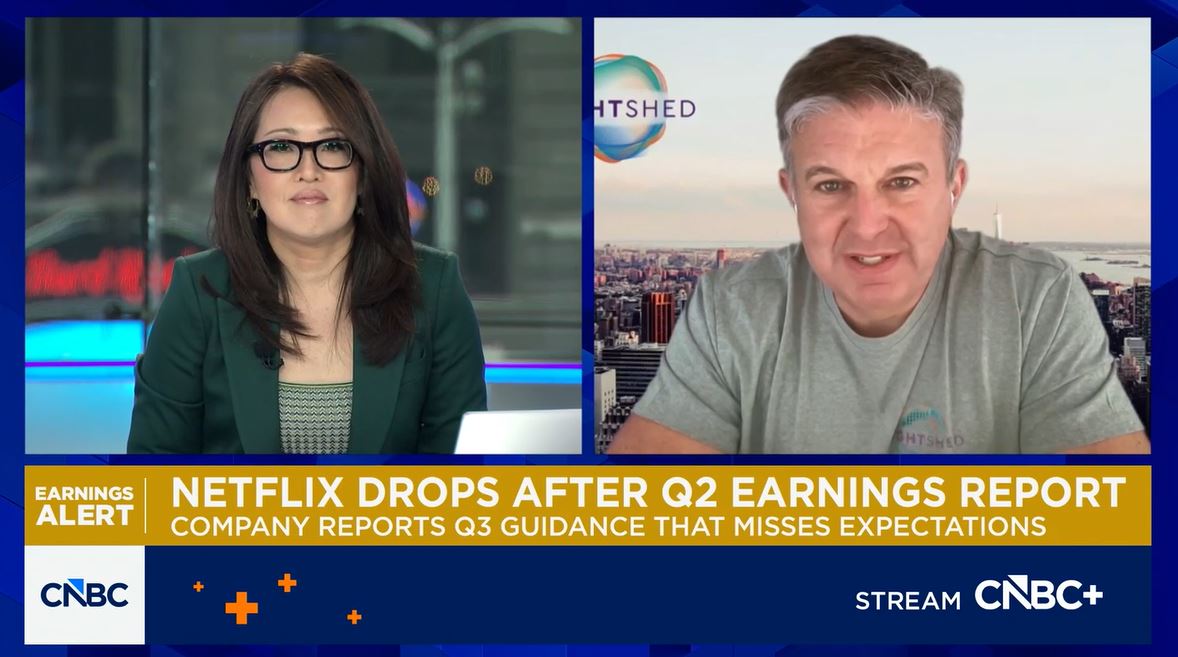
Mel doesn’t ask Rich if it’s management’s fault, or the market’s fault, that NFLX is under $70
Thursday's (7/16) Halftime Report took up the subject of NFLX earnings, before those earnings happened. (More on that in a moment.)
Thursday's (7/16) Fast Money took up the subject of NFLX earnings, after those earnings happened. (This review was posted overnight Thursday-Friday.) (This writer is long NFLX.)
Guy Adami led off the show stating "free cash flow was a disaster" and that stock support is the "old high from October of 2021," which was around 68. "That's your level," said Guy, predicting a "huge volume day" on Friday.
Karen Finerman wanted to know the reason for the free cash flow shortfall. "Clearly headwinds here," Karen said, outlining a few of them but noting the buyback could help the stock.
Steve Grasso said NFLX "cost of content" sounds like "it's going up," and viewers are "static." Steve said the stock just broke October 2024 levels. "So the next support, is like 60," and "this thing could fall out of bed," but Steve also said, "This is probably where you wanna actually buy Netflix, where sentiment is so bad. Right now, could it be worse."
Steve said he'll give it a "couple more days." Karen suggested NFLX has "room to improve costs with AI" (which is just what the Hollywood trade unions wanna hear).
Guy (and Mel) pointed to Tom Rogers coming on the show a year ago and how Tom "turned on a dime" on the stock, and how it's cratered ever since.
But things were just beginning. Later in the show, star guest Rich Greenfield proclaimed, "This is fundamentally investors believing that Netflix has gone ex-growth."
Rich said, "2 people have already texted me saying, 'This is now a legacy media company,'" prompting Rich to observe, "It feels like peak bearishness. People just don't believe that there is growth left in streaming, which I think is fundamentally incorrect when you look at this."
However, "There's no way to disprove it other than just time," Rich said.
Rich said the competition is actually diminishing, "Hulu's basically being sunset by Disney ... eventually HBO is going away and it's gonna be folded into Paramount Plus." However, that's not really the issue. The issue is whether NFLX remains an elite stand-alone company ... or just another cable TV stock.
Steve Grasso told Rich he agrees with buying at peak bearishness, and Steve suggested costs are peaking and the ad business is growing. Guy Adami said NFLX is "best in breed" and mentioned "Total Addressable Market" (snicker). Karen said, "I'll be looking to buy more," and Karen made NFLX her Final Trade.
Market looks less and less interested in possibility of NFLX acquiring NBCUni
On Thursday's (7/16) Halftime Report, guest-hosted by Leslie Picker, panelists made very eloquent comments about NFLX and were generally optimistic about the stock, though of course they weren't aware of the free-cash-flow disaster that was hours away. (This writer is long NFLX.)
Josh Brown said every time he's bought NFLX when it's had a tough stretch, "I always make money, eventually, in the stock."
Josh said there's been a "daisy chain of unfortunate events." Josh reiterated that NFLX should try to do a deal for NBCUni, "way better than the Warner deal ever could've been."
But we gotta say, that subject really didn't come up at all hours later on Fast Money (see above), so we kinda doubt the market actually cares whether NFLX even makes a bid. (Which seems hard to believe.)
Josh mentioned something else that wasn't mentioned later on Fast Money, that the Hollywood "trades" have "huge concern about 2nd seasons for some of their hit shows not connecting with viewers."
Jimmy Lebenthal asked Josh, "Who's winning the bet with you and Jenny?" Josh admitted, "Jenny is winning," and explained that the bet was made with both NFLX and DIS hovering near $100, and the bet was, which one gets to $120 first. (Josh picked NFLX.) (Hit PgDn a bunch of times to find it on this page.)
Josh added, "I don't know if viewers care or not: It's not just that she has to buy me the cheeseburger of my choice anywhere in New York. It's that she has to eat one with me."
(Honestly, we're strongly thinking neither stock is going to qualify, so the bet looks like a wash.)
Malcolm Ethridge said NFLX has raised prices twice in 2 years and "in that time they've added 40 to 50 million paid subscribers." Malcolm added, "This thing's a utility ... so basically buying here at 73 or 74 a share, you're getting in probably at the lower end of where it's gonna be." (That was still borderline possible as of early Friday morning, but unfortunately, this page kinda thinks 73 might seem like a gift in a couple weeks.)
Josh said NFLX is "42% below its highs," always a key metric of Halftime panelists. Josh conceded there could be a "bad report," but he thinks a lot has been "de-risked."
Why not still more multiple expansion for all the AAPL value investors?
Malcolm Ethridge on Thursday's (7/16) Halftime Report kind of gave a speech about IBM and concluded, "I might come back to it eventually, but it's gonna be a while."
Jimmy Lebenthal, who drew a CSCO comparison, said he takes Malcolm's comments as, "This is at best dead money for at least the next quarter." Josh Brown agreed it won't be a V-bounce. Shannon Saccocia said, "This is a really tough quarter to have a tough quarter." (Yeah, just ask NFLX.)
Referring to his recent buy that is rapidly looking like a bust, Jimmy joked, "Micron apparently only trades in increments of 5% a day or more." Jimmy stressed that "technicalities" (not "technicals") involving margin calls are affecting the chip space. Jimmy asserted, "Margin debt in the U.S. is 55% higher now than it was a year ago." Josh joked that that leverage isn't spread evenly among the S&P 500. Jimmy stressed, "Don't play the rotations."
Malcolm bought CBRS but indicated it's only "a little bit of a flier for me," it needs customers besides OpenAI.
Santoli said it's hard not to "marvel" at the market's "immaculate rotation."
Josh said TGT is on the Best Stocks list. Josh said it's starting to catch up with WMT. Malcolm bought CB to "get in position" before earnings.
Jimmy's Final Trade was MU. Malcolm said RKT. Shannon said IYH and Josh said AAPL, mentioning "400."
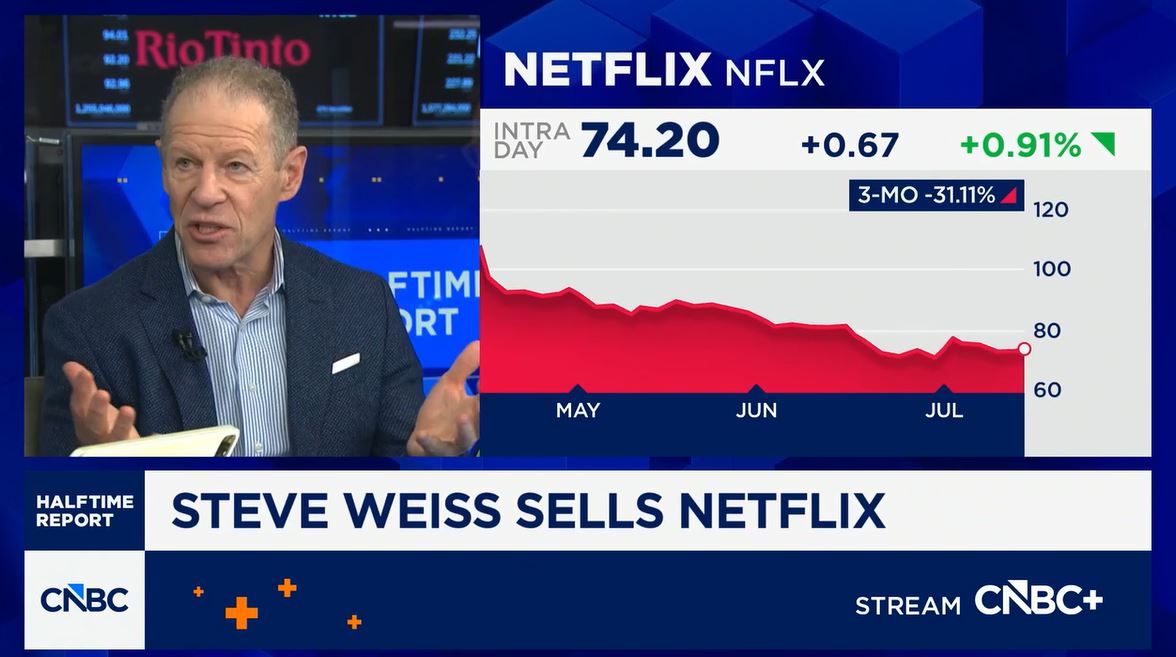
Weiss calls market
‘Groundhog Day’
Joe Terranova on Wednesday's (7/15) Halftime Report said the Mag 7 is "fighting for leadership once again." But Judge said there's been "head fakes" in that group.
Steve Weiss offered, "This is like 'Groundhog Day.' One day, the market's up, and yesterday the headlines were all, 'Semis are back, semis are back.' And then we're taking a look today, and guess what, semis are gone again."
Honestly, what Weiss described is NOT really "Groundhog Day" (he's referring to the Bill Murray movie, not the popular Feb. 2 tradition), but it's a good line (which Halftime needs more of, to be frank), so we'll let it pass.
He is correct in his implication that headline writer are declaring a new/old trend virtually every day.
Weiss said he exited MU because "we're closer to the end of the AI trade, not AI fundamentals, but AI trade." Judge questioned that declaration; Weiss explained that AI fundamentals are still great, but he's referring to "the outperformance of the stocks." Judge said David Solomon was talking about this being just the "early innings" of this "phenomenon." Weiss said he's not saying it won't come back.
Weiss bails on NFLX (while no one takes up the DIS question)
Steve Weiss on Wednesday's (7/15) Halftime Report said he sold NFLX, stating "streaming has gotten more competitive," and "they seem to be trying to find a lever for growth." (This writer is long NFLX.)
But Weiss said "the odds are more that it'll trade up" on this quarter's earnings after taking a hit 3 months ago.
Rob Sechan said he "bought it recently ... you've been paid to buy these dips." But Rob conceded "valid concerns around saturation, competition, uh, stickiness of their content, slowing subscriber growth."
Still, Rob said NFLX has the "lowest content spend per subscriber" and is expected to produce "15 billion in free cash flow this year."
Rob concluded, "I think they're gonna be fine."
Judge asked for a 3-year chart. Weiss said he didn't know why the bounce last quarter "didn't hold." Judge revealed that he didn't even remember which shop on Monday suggested DIS should exit streaming, "who was it" (actually Wells Fargo), but apparently he was throwing out that topic to Wednesday's panel. Nobody really took it up, which is too bad, because that's a very interesting topic that produced a great conversation on Monday, even if Jimmy got tripped up by Judge's perfectly accurate skepticism about the effects of the Middle East conflict on that stock.
Instead on Wednesday, Joe Terranova said it's "statistically factual" that NFLX has "lost market share" in recent years to AMZN, AAPL, Paramount (snicker). But Rob said those other entities "are gonna struggle with the investments in new content that they can make." Joe said "OK. It's a lot of spending."
If you're long NFLX, you'll find optimism in the fact that none of the negative arguments — not even Joe's — really indicated there's anything wrong with this company. Weiss is simply frustrated with the stock. Fine, so is everyone. It did kind of tread water for 2 years from early 2018 to early 2020. We're currently about a year into a downtrend. Maybe its glory days are over, or maybe this is just another pause.

Rob blames SPCX’s slide on ‘hot money’
Judge on Wednesday's (7/15) Halftime Report noted SPCX stock was actually trading below its IPO price.
Joe Terranova explained that "the debt market really has been the adult in the room for SpaceX."
Broadening the conversation beyond SPCX, Joe pointed to MU and SKHY and suggested "maybe there's just too much supply as it relates to the memory name ... broke the fever in memory." Joe said there's the "seasonality of July" (snicker) in which we see "liquidity weaken." Joe said the Mag 7 outside of AAPL had gotten "ridiculously cheap."
But Judge asked Rob Sechan about SPCX having an "almost steady decline." Rob explained he invested "privately at various, uh, levels" (translation: He wasn't buying in the 200s). Rob claimed his "advice that day" of the IPO was "there's likely to be an opportunity to be a better buyer," though "we didn't think it would come this quickly."
Rob said SPCX is an "unbelievable business" with an "evangelistic following." Judge asked why the stock is falling. Rob said "I think it's caught up in the momentum" as there's "a lot of hot money in this market," including "levered ETFs" (we're hearing that a lot this month) on MU and SKHY; "They're in and they're out quickly." Rob's not sure he buys the stock "supply" argument.
Steve Weiss said SPCX is "symptomatic" of the market; "the weakest holders of any company, of any stock, are the new holders, because they have no history with it." Weiss admitted, "I traded it; lost a little money but not a lot." He said there's a continuing "unwind" of momentum names.
Bill suggests that NVDA is the kind of company that gets taken private (while adding that it won’t happen)
Judge on Wednesday's (7/15) Halftime Report said Warren told Becky that Warren initiated BRK's investment in Alphabet.
But that was all that Judge mentioned about Warren's interview.
Rob Sechan said it's "interesting" that AAPL is the most expensive Mag 7 name. Bill Baruch said AAPL's in a "breakout" that could take it to 370; Judge noted that Josh Brown already pinned a $400 on it this week.
Bill said he likes NVDA and even said, "If it wasn't a 5 trillion dollar company, might even think that they take that thing private at some point," though he clarified, "this size, that's obviously not on the table."
Bill said MU is his largest position, and his "cost basis is like $70."
Steve Weiss said "real issues with Iran" are affecting the daily market, and Weiss tangled with Bill over the relevance of what the price of oil was before the war with Iran.
Rob Sechan chalked up IBM's warning to "redirection of corporate spending into other areas." He said IBM "stubbed their toe," but "I think they can get back on track."
Judge has yet to mention any VSNT initiatives in the way of Rotten Tomatoes
Judge on Wednesday's (7/15) Halftime interviewed Matt Hong because VSNT made a deal for Germany's Bundesliga soccer. Matt said it's a "great addition to our portfolio of live sports." Judge clarified, "You don't need a paid Fandango account to stream these games."
Steve Weiss gushed about GS, and Rob Sechan gushed about MS.
Joe Terranova opined, "I think Blackstone's probably seen the worst."
Judge said "therein" at one point.
Kate Rooney said Anthropic is starting to line up pre-IPO meetings and could list in October.
Joe said UAL has declined this month as jet fuel has risen "accordingly."
Santoli said "the bar was incredibly high" for AI/momentum stocks and said the IBM warning was "filtering through" that trade.
Bill Baruch's Final Trade was LLY. Rob said VST, Weiss said META and Joe said TROW.
Grasso ‘thinking about’ buying IBM
Honestly, Tuesday's (7/14) Halftime Report didn't actually spend a whole lot of time on the story of the day, IBM.
Brian Belski praised IBM because "they came out and talked about it."
Rob Sechan said he's "gonna continue to be patient" in IBM; "we're still up 60% in the name."
Josh Brown crowed about how great CRWD is in the wake of IBM's announcement and how cyber has defied software headwinds.
Joe Terranova predicted "continued concerns" about "IT software services names" and said the spending is "going away from them." Joe talked up DDOG.
On Fast Money, Karen Finerman said IBM's slide took the stock "all the way back to the end of May." Karen was "surprised" by the "magnitude of the reaction" and said she's "sort of intrigued" by the name. Steve Grasso said, "I'm thinking about buying it," maybe it has another "10% to the downside."
Tim Seymour said CNBC's Kate Rooney "always delivers great news, um, or at least, the way she delivers it is great."
Not sure why Dave couldn’t just pull up a chair at Post 9, but whatever
We at first thought Tuesday's (7/14) Halftime Report was going to give us the Warsh congressional testimony.
But Judge immediately cut away for David Faber's interview with DJ David Solomon upstairs at the NYSE within sightlines of Judge's Post 9 set.
Solomon told Faber, "I feel lucky to be up here with you today."
Faber asked if the GS results are a "one-time peak" or "new baseline." Solomon didn't really answer but said "this moment, this environment is just super-aligned with what we do really well." (Translation: There's a buncha IPO activity.)
Faber asked about the word "bubble" in AI, etc. Solomon in a wordy answer said he doesn't see a "bubble" but a "trend."
Solomon said, "Americans wanna take risk and participate ... Europeans don't, don't buy single stocks, take risk, Americans do."
Joe Terranova said there's "much more upside" to GS. Brian Belski said "the turnaround is complete at Citigroup." On Fast Money, Karen Finerman's Final Trade was C, which she bought.
Are ‘value’ investors still going find an excuse to buy AAPL at 95 times earnings?
On Tuesday's (7/14) Halftime Report, Judge said KeyBanc cut its AAPL rating; Joe Teranova of course disagreed (even though the stock's climb is nothing more than multiple expansion).
Joe said the stock is "somewhat exhausted" and figures to go "sideways" before it breaks out again. Judge said the valuation is "35 times." Josh Brown though said the valuation is "not gonna matter." (Funny how valuation matters when we don't like stocks but doesn't when we do.)
Brian Belski also chimed in with a positive comment about AAPL, related to the "Russell 1000 Value Index," an index that gets discussed all the time.
(Jimmy Lebenthal wasn't on hand Tuesday to further clarify that, Oh, it's the Middle East war that's hurting DIS. No, check that, it's the lack of good movies, and the stock was slumping before the Middle East war ... but it's definitely NOT the focus on streaming ...)
Josh Brown's Best Stocks list, like all the other 52-week-high lists, has found TRV, as well as DAL. We're not sure the point of this segment other than for Josh to offer mythical "stops" you can use when owning the stocks.
Josh's Final Trade was JPM. Rob Sechan said MS, Brian Belski said IVZ and Joe Terranova said NVDA, "buy more right here."
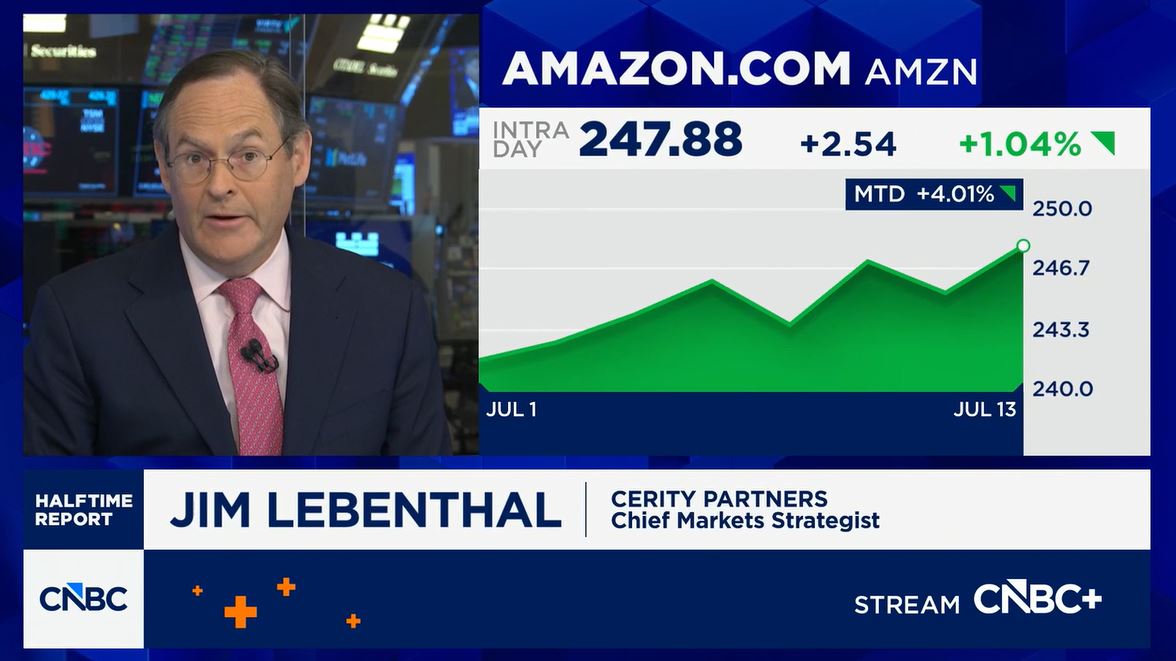
Joe soars, Jimmy stumbles in roundtable on DIS streaming
Right near the tail end of Monday's (7/13) Halftime Report, Judge put together what has to be one of the show's best discussions in many years.
Judge said Wells Fargo is asking, "Should Disney exit streaming?"
That's a very good question, if only because this site first made that suggestion YEARS ago. (It's in the archive somewhere.) And around that time, one panelist, Steve Weiss (who wasn't on Monday's show), actually echoed that idea.
But now here we are in 2026 that's already half over. Judge said Wells cut the DIS target from 146 (snicker) to 125 and suggests a "40%" boost to the stock by ditching streaming.
DIS long Jimmy Lebenthal said he's gonna "applaud the analyst for recognizing ... that something bold needs to happen at Disney," with its "moribund" share price.
That's interesting, because we haven't actually heard Jimmy saying that something "bold" needs to happen; he's been predicting for years that the streaming will be going gangbusters.
But Jimmy said ditching streaming isn't the right move. "If you get rid of streaming, then you've got the melting ice cube of linear TV."
We're not sure how the former causes the latter. Isn't linear TV a melting ice cube anyway?
Jimmy then curiously claimed that streaming is not "what's holding the company back," rather it's "ongoing geopolitical concerns about what higher oil prices and conflict in the Middle East means for the theme parks, for the experiences."
Jimmy actually called streaming a "crown jewel" (snicker).
Joe Terranova evidently had heard enough, and then, in his finest commentary in months if not years, cut in, "Really? Crown jewel. I'm not sure I'd call it that, Jimmy. The stock over the last 5 years is down 47%. I think this note is a reaction to that. ... I think it has an identity crisis more than anything else."
Joe said he's "not happy" that DIS in the JOET, bought at 103. "I think the balance sheet looks worse than it did 5 years ago ... they're not really making any strides in streaming," Joe added.
Sarat Sethi, who's long DIS, said "there's a bigger thing here," pointing to streaming being "huge" during the pandemic, but now it's about "funflation" (snicker) in streaming; "how much can you really charge for all these things." (Translation: There's too many streaming subscription services available now.)
Sarat said "there's a lot of value," but the stock needs a catalyst.
Joe very astutely pointed out, "In the last 5 years, the- the biggest catalyst for the stock has been activism."
Meanwhile, Judge evidently also found Jimmy's assessment curious and asked Jimmy, if "geopolitics are somehow hindering people from going to the theme parks, tell me why Marriott's stock price is up on the year, tell me why the airlines have done so well in the face of geopolitcs and rising fet juel prices," because that's a "disconnect" from Jimmy's argument.
Jimmy's response was, "The opportunity is there at Disney," which doesn't address the question, but then Jimmy went off on another dubious tangent, stating theme park price hikes "have been even more than the price increases than we've seen- that we've seen at Delta."
Judge correctly said that seems like a "specious excuse."
Jimmy said there was concern before the Iran war about "the inflation in theme park tickets," and now there's "even more pressure on the consumer," so, "I do think that's what the distinction is."
"Distinction???" Of what???????? What in the world is he talking about???????
Jimmy added, "I don't think streaming is the problem," but offered yet a new angle: "The studio releases just haven't been that good."
Jimmy would like to see "oomph" in "getting better studio releases."
Judge said "OK but now we've- we've come to other things on the list."
Joe asked about ESPN; "where are we on ESPN," saying DIS hasn't "levered" (could've been "leveraged," hard to tell) that asset at all. Jimmy said, "I will agree with you, unfortunately."
This mythology that launching streaming is such a no-brainer may not have originated on CNBC but definitely was hyped up literally about 15-10 years ago by CNBC voices who assumed that streaming for a content provider was simply found money; "Oh, whatever they charge for that, I'll pay it, for my kids," CNBC anchors would say.
In fact, Iger knew that it's a mess, it's basically the cable TV business without a basket of offerings, there's endless subscriber churn, and Bob resisted it forever, to the point he quit in favor of letting someone else deal with it, that someone was Chapek.
NFLX has — so far — been the only streamer to thrive, probably because it has/had no legacy studio/cable assets to distract it from the marketing, which is the real necessity of streaming. (This writer is long NFLX.) NFLX may enjoy that stand-alone status in streaming for a while, or it may be a melting ice cube that will eventually relegate all streamers to cable TV companies. This page has previously argued that rather than do its own streaming, DIS simply should've just licensed its content to NFLX and collect a check every month while NFLX deals with the marketing and churn. Instead, DIS took on a massive overhead headache.
So Wells is right. But it may be too late anyway.
Jimmy is known for making cogent, very reasonable arguments about the stock market, but, to be candid, his defense of DIS on Monday was a massive bust on par with whatever happened to the San Antonio Spurs in Game 4 of the NBA Finals.
It’s actually Tang Tan
Judge opened Monday's (7/13) Halftime Report with AAPL; Joe Terranova, who's successfully been long, said, "It's a tactical trade, and I've been buying the breakouts when I see them," though he's not going to "buy further."
Sarat Sethi suggested AAPL is a "safe ship in a storm." Sarat also curiously claimed that AAPL has "proven over cycles that they can innovate," a point Weiss would surely challenge if he had been on Monday's show.
Joe stressed how "the analyst community has this embedded skepticism" about AAPL given how its 12-month price target is much closer to current price than with other Mag 7 stocks.
Jimmy Lebenthal was downplaying the AAPL suit vs. OpenAI, which was just the first of 2 times he got tripped up by Judge on this day.
Judge said, "You realize who, who left-"
Jimmy said, "I do realize, the product manager, what is it, Tam Tang (sic) is his name?"
Judge said, "No, I was talkin' about Jony Ive. He's not just a somebody. Or an anybody. He's THE body."
Jimmy said, "I do realize that ... I gotcha Scotty. I gotcha."
Judge continued, "What are you saying then?"
Jimmy said he doesn't think AAPL is "fearful" of losing devastating trade secrets.
Judge said, "This is almost a protect-this-house move."
Jimmy said, "I don't think it's that dramatic."
Judge gave up; "I've made my case ... I'm gonna stop arguing what I think is the obvious, but, it's OK."
Joe kinda sided with Judge. Jimmy responded, "I'm not dismissing it. I'm putting it in its place." Jimmy pointed to AAPL's stock Monday as revealing, "We're not too worried about this."
No indication that Elon has rescheduled that Sun Valley interview
Jimmy Lebenthal on Monday's (7/13) Halftime Report again said "knitting," regarding overall stock market approach, as in, "This is a time that you have to stay true to your knitting (snicker)," though Jim said "this is a time when many styles can work."
Jimmy advised holding through the day-to-day volatility; Jimmy noted his recent MU buys and stated, despite what it was doing Monday, "I'm not thinking of getting out of that."
Stephanie Link talked up NVDA but said she's not adding to META "because it's a bit frustrating."
Stephanie said NVDA is "really out of favor" and "the chart looks horrible," those are reasons she likes it.
Stephanie talked up the banks, but Joe Terranova cautioned that expectations for banks have suddenly gone from low to high.
Judge said ORCL has "had a really rough go ... new 52-week low." Sarat Sethi said, "We like it still at these levels, it's painful, but we're holding it." In a curious argument not too far removed from what he was slinging later about DIS, Jimmy said the stock has stumbled because of the "monumental debt offerings" from AMZN and SPCX.
Steve Liesman said Waller was making "pretty hawkish" comments on Fed policy. Steve wondered whether the speech was "run by" Warsh and did Warsh encourage it. "What we don't know is who the intellectual pulling guard is for this new chairman, right," Steve explained to Judge.
Sarat bought RACE saying it's "sold out for 2 more years." Sarat also bought SYK and sold ZBH and ZTS. Sarat's Final Trade was MS. Jimmy said BLK, Stephanie said COF and Joe Terranova said VLO.
Halftime stood up by Elon
From the top of Friday's (7/10) Halftime Report, Judge was relentlessly pitching a pending interview of Elon Musk by Julia Boorstin at the Sun Valley thing and noting that the show's usual commentary could be cut off at any moment for this significant media event.
Suddenly in the show's 12th minute, Judge said the Elon interview was "apparently no longer happening."
Then came Julia, who explained, "We just got word that he has to postpone." (That's an interesting word, "postpone" ... as opposed to "cancel" ... what would he have to "postpone" it for, a surprise DOGE crackdown? Surprise Sun Valley brunch?)
Julia stated, "We hope he will give us a new time for this interview."
Judge said, "It's an unfortunate development, for sure."
NOT to try reading too much into this ... we have to take CNBC at their word, that this interview was scheduled and actually confirmed, and the other side "postponed" ... but since we didn't hear from the other side, perhaps they might've been thinking, "We told them we'd TRY to do it," and it just didn't happen to work out, and so probably shouldn't have been advertised in the first place. (It's not like Musk is a "CNBC contributor" who's at risk of losing that special distinction.)
It's also possible CNBC might be furious over this but can't afford to vent on air because they're hoping Musk will still do it another time in the near future.
But we don't know, and it's not worth losing sleep over.
The fact that CNBC includes a clip of this brief discussion on the Halftime Report web portal indicates CNBC believes having people know that they did (apparently) have an interview scheduled with Musk outweighs the embarrassment that he didn't actually show up for it.
Kevin says he’d double his SPCX stake ‘for sure’ if it gets close to 100
Meanwhile, there's the matter of SPCX stock.
Judge on Friday's (7/10) Halftime said SPCX has a "literal, out of this world TAM (snicker)."
Kevin Simpson admitted, "We're down a little bit on it, as most investors are at this point."
Kevin said a Musk interview "would've been awesome."
Kevin told Judge that "from a legal perspective," it may not be possible to combine TSLA and SPCX, but "under the surface, a lot of a merger has already taken place."
Kevin said of SPCX, "If this trades down close to a hundred Scott, we'll double down on it for sure."
Bill Baruch said he doesn't own SPCX, as he doesn't typically own IPOs this soon, but "it's on my radar."
Judge said, completely seriously, "We'll see what happens, if, uh, if he does in fact reschedule the interview."
Bill’s back in the gold trade
A year ago, Bill Baruch touted gold-miner stocks on the Halftime Report, and it was an awesome call right up until about February.
Since then, they've been an utter disaster. (This writer is long AEM.)
But Bill's going back to the well, saying Friday (7/10) that he actually bought GDX and asserting there's "seasonality in gold picking up here in July."
Bill claimed the chart, which is a disaster, "is actually pretty constructive."
Bill even said he thinks the "biggest catalyst" is Kevin Warsh's June press conference that was taken as "very hawkish," while Bill deems Warsh "misunderstood."
Weiss calls Zuck a ‘visionary’
Bill Baruch on Friday's (7/10) Halftime Report said, "Our base call in the 2nd half of the year is Mag 7's going to outperform."
Bill said NVDA is "waking up" and that AAPL is "making highs." He added in AVGO and said those names are "gonna run."
Kevin Simpson bought META, he said it's gone from "blindly spending" to having a "path at least" for producing AI-related revenue. Kevin also made NVDA his Final Trade.
Steve Weiss said he bought more META early in the week; Weiss said it's grown to a "monster-size position." (Tip: META stock doesn't care how many shares are owned by Weiss vs. someone else.)
Weiss then made the argument that CEOs of MSFT, AAPL and GOOGL were "managers," whereas Zuck is a "visionary," so he'll get "ahead of the others."
Jenny Harrington boasted that "we added to this 2 weeks ago, 555 dollars."
‘Not sure’ MU is ‘investable’
Steve Weiss on Friday's (7/10) Halftime Report referred to Iran's "Republican National (sic) (snicker) Guard."
Weiss predicts higher oil prices that could "pressure the market" (how many times have we heard that in the last few years). (But we didn't hear 2/3 paycheck to paycheck this time.)
Kristina Partsinevelos discussed the SK Hynix IPO; Judge said "good stuff."
Bill Baruch gushed about MU and said "it's gonna stay a low multiple," but if it does go to a 20 multiple, "it's gonna be a lot higher."
Jenny Harrington said there's "so much ambiguity" with MU that "I'm not sure it's really investable." Weiss said, "All roads lead to Taiwan Semi."
Weiss bought FTAI, saying it's had a "massive change" and is now a "power-generation company (snicker)." Weiss admitted it's a "recent" buy and thus "I'm down in the trade," but he'll stay "for a little while" for the "pretty good upside."
Bill called CAT a "multi-year play." Jenny talked up MAR but suggested you could wait for a "blip" to buy it.
Jenny said LAMR is a "tough call," it's a great company but maybe there isn't a whole lot left. Weiss asked Kevin Simpson if he'd "add to CAT here." Kevin said he has a max percentage holding, but if not for that restriction, Kevin admitted, "probably not," but he wants to be in the name and would buy on weakness."
CNBC's Oliver Renick, who did NOT have an interview scheduled with Elon Musk on Friday, said some options trader put on a "very bearish position" in CRCL.
Weiss can't talk about UNH without mentioning "Hemsley"; he thinks the stock can keep going. Bill has "high hopes" for FAST. Jenny said CAG has been "derisked" and it might pop even if there's a "crummy quarter."
Weiss' Final Trade was DKS. Jenny said CLX, and Bill said NBIS.
Stephanie takes issue with NVDA being in the ‘penalty box’
Stephanie Link wasn't on Thursday's (7/9) Halftime Report panel, but she joined in to say she bought NVDA.
Stephanie said NVDA has been a "big laggard" that's "going to play catch-up." Josh Brown said he agrees with Stephanie on NVDA but seemed not terribly enthusiastic about this buy; "the momentum crowd has completely left the stock." But Josh thinks it's better than a momentum stock.
Bryn Talkington said she's been in NVDA "for a long time" but had some of her position "called away at 200." Bryn said she wonders if it might take a "long time" for a $5 trillion market cap company to get to $10 trillion.
Bryn went on to say NVDA "seems to be in the penalty box" and then said it "clearly is" in the penalty box.
Stephanie said, "I don't know if I would use that word; I think it's too strong, they've done nothing wrong."
Haven’t heard about Lourenco and CLF for a while; it was $14 in early June
Josh Brown on Thursday's (7/9) Halftime Report said he was recently making the point about how leveraged ETFs are "mainstream" and apparently play a part in some of the wild swings in the semi/chip names.
But Josh said the RSI for the SMH is a "very healthy" 49. Josh suggested if you haven't been in the SMH, now there's an opportunity.
Bryn Talkington said, "Josh did a great job walking through the insanity of the levered ETFs, which is creating huge volatility," which brings huge option premiums.
Jimmy Lebenthal's advice to viewers was, "Stay true to your knitting (snicker) as far as what type of an investor you are."
But Judge suggested that by buying MU, Jimmy was not following his own advice; "What do you mean, aren't you defining what you are- you- you're going against what you're doing."
Jimmy insisted, "No, I'm saying that fundamentally, Micron is a value stock to me."
Then Jimmy asserted, "At times, certain styles will intersect."
Jason Snipe said he's been wondering, "Is this really a rotation, or is this a rebalancing?" Jason said MU has been attracting both momentum and value investors.
Jimmy’s mention of ‘1 month’ in Rick Rieder discussion rankles Judge
Judge on Thursday's (7/9) Halftime Report aired a "pretty revealing" clip of Rick Rieder saying a day ago on Closing Bell that he was rebalancing his AI exposure.
Opining on this commentary, Jimmy Lebenthal said it depends on time frame; "if you have a time frame of 1 month, you know, maybe the Mag 7 isn't for you," but "3 months or longer," they're buys.
Judge pushed back that Rieder is "not a 1-month investor, by the way, you know, I don't know what you mean about time frame."
Jimmy assured, "I was not impugning Rick Rieder," rather, Jimmy was simply saying that he wouldn't call the Mag 7 a buy right now at the moment.
Judge hasn’t had Lee Cooperman or Carl on the show in ages
Santoli on Thursday's (7/9) Halftime Report seemed to knock all the market assertions about momentum and pullbacks.
CNBC's Oliver Renick said someone was putting on some bullish but complicated trade on the QQQ.
There was yet another panel discussion/agreement on how awesome AAPL is, where as far as we can tell, it's been the same old products for 15 years and a multiple-expansion story.
Jason Snipe said it wasn't a great year for SNOW, but then they had a strong report last quarter; he said it's "worth owning." Judge said it's up 21% YTD despite all the headwinds in software. Jason said NOW is "also worthy" of owning.
Josh Brown said CRWD has overcome the software stigma when practically every software name was getting hit.
Josh said C is on the Best Stocks list. Josh congratulated Jimmy for believing in the name long term, and Josh thinks it has room to run. Jimmy said he agrees "there's a lot more to come" and even mentioned Banamex, which we think we've been hearing about for 10-15 years. Jimmy suggested C is another stock where "different styles of investing intersect."
Bryn Talkington's Final Trade was CBRE. Jason said NVDA. Jimmy said C, and Josh said LYV.
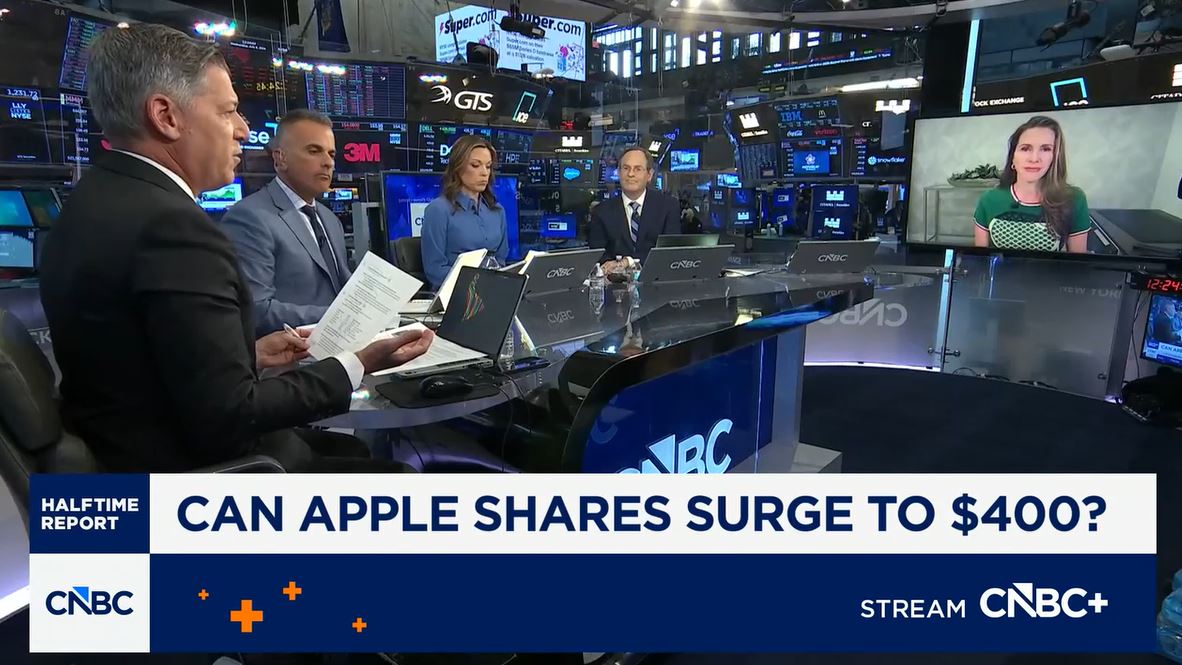
Maybe NFLX could buy a refinery ... start an autonomous-driving division ...
It used to be that CNBCers would recoil in horror at the thought of NFLX needing to "buy" growth. (This writer is long NFLX.)
Nowadays, people actually want NFLX to get into the theme-park business.
Judge on Wednesday's (7/8) Halftime Report mentioned late in the show that DIS, NFLX and GOOGL are "said to be interested in the U.S. World Cup rights," which Judge said Alex Sherman (who wasn't on the show) thinks can reach $2 billion.
Jimmy Lebenthal said $2 billion would be a "bargain" for any company getting it; Jimmy predicted a "bidding war."
Joe Terranova touted the importance of live sports events for streamers and then, incredibly, urged NFLX, "Go after NBC Universal," because it would create a "rivalry 10 miles apart" with Disneyland and Universal Studios that Joe likened to (snicker) 1950s baseball in New York.
Incredibly, Jimmy said, "I'm totally with you; that's what Netflix should go after."
Weiss would say that ‘2/3 of the country’s livin’ paycheck to paycheck’ (and that bitcoin has no use case)
On the subject of the health of the U.S. consumer, Jimmy Lebenthal on Wednesday's (7/8) Halftime Report pushed back on Judge's contention that "consumer credit numbers are pretty high by the way."
Jimmy conceded they're high "on an absolute level" but "not on a ratio-to-disposable-personal-income (snicker) level."
Joe Terranova added his 2 cents worth; "Delinquencies are moving higher."
Jimmy responded, "They have normalized ... This one, I'm not gonna back off on. Consumer credit is good right now."
Jimmy tries to time an MU purchase based on technicals
Joe Terranova said at the top of Wednesday's (7/8) Halftime Report, "It is safe to say that enough deleveraging has occurred in the momentum factor," but it's "vulnerable to further downside" if the whole market goes down.
So a particular subset of the market might be in trouble if the whole market goes down.
Joe asserted, "I do think we're close to the bottom" for KLAC, LRCX, AMAT and MU.
Liz Thomas suggested momentum "still has more flush to go," but she doesn't see "the beginning of a large bear market in the U.S."
Jimmy Lebenthal, who announced an additional MU purchase on Wednesday, said this has been "a correction looking for a reason." Jimmy said there's, "outside of Meta, very little reason to think that this cycle is in any way over."
Judge took issue with that statement, arguing, "The cycle being over, I don't- I don't think we have to go to the extremes of saying something like that ... I don't think we're saying the cycle's over. 'Cycle over' and 'near-term top' are 2 different things."
Bryn Talkington praised Jimmy's buy of MU and offered, "It's hard to get too bearish, especially in those memory names," because of the "incredible" earnings power. Bryn said we're in a "healthy correction."
Jimmy explained that he bought MU in the morning when it was up and the market was down, though MU was down by the time of the show; "I may have gotten the technicals wrong" in the morning, Jimmy admitted. Joe backed Jim's buy and said technicals indicate "this is exactly where you are supposed to buy the stock."
All of the momentum/MU conversation was sandwiched around a presidential press conference from NATO; once it got going, Judge quickly bailed on that one.
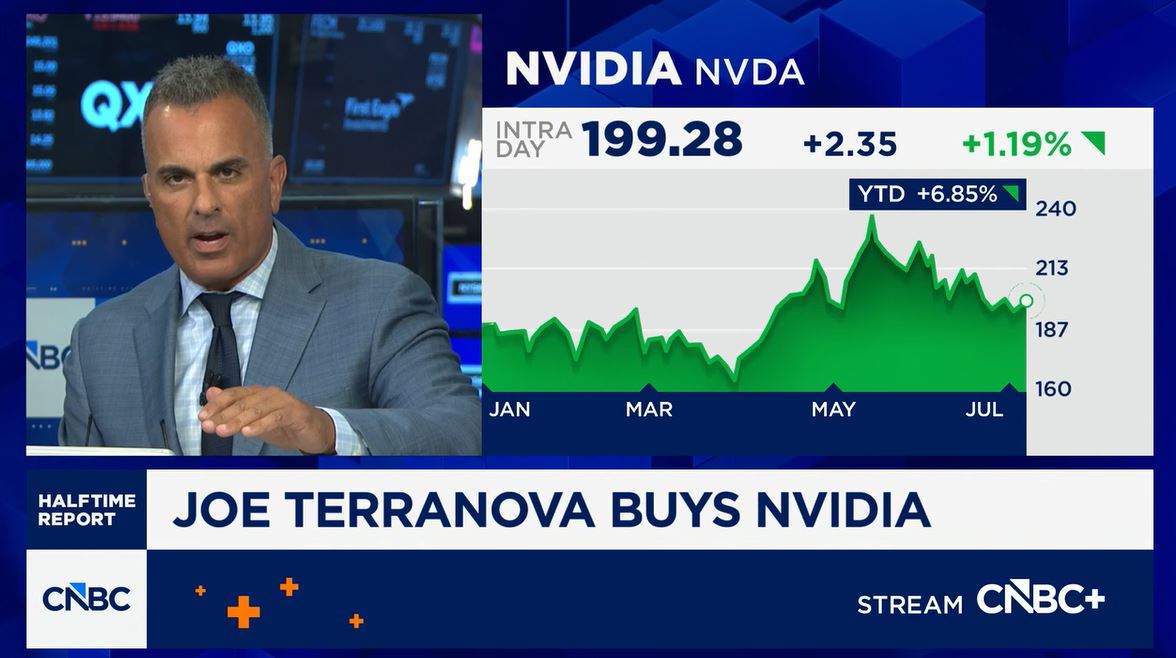
Joe now thinks NVDA is a buy because of the multiple (despite protestations)
Joe Terranova on Wednesday's (7/8) Halftime Report talked up AAPL and admitted "disappointment" at the WWDC and reminded Judge that Judge was there (which was one of CNBC's biggest travel busts in recent memory).
Joe said the AAPL analyst community only has a 12-month price target of 318. Bryn Talkington said AAPL is doing the same thing for years and isn't delving into "experiments" that may not work and she's not concerned about catalysts, including supposedly foldable phones; "who cares."
Joe also talked up the NVDA buy that he trumpeted a day ago; his reasoning this time started with NVDA's "18 times" forward multiple while it's "20 times" with the S&P and "23 times" for the Nasdaq, all of which is a curious argument because a day ago, it was about how the chart supposedly matches AAPL's of months ago.
"I'm not making the valuation argument," Joe claimed.
The Fast Money gang on Wednesday had an excellent discussion about NVDA; Karen Finerman staunchly defended valuation while Steve Grasso and Guy Adami suggested this could be the "pinnacle" (Grasso's term) for the stock. Steve Liesman actually called Mel "Michelle."
CNBC’s Halftime crew seems unconvinced about 7-Eleven’s claim
Contessa Brewer on CNBC's Halftime Report on Wednesday (7/8) reported on 7-Eleven suing NKE over some shoe colors and apparently July 11 promotion.
Contessa admitted that the footage being shown was just random Nike gear. Judge said, "I wanna see the shoe." Moments later, when they showed the actual shoe, Joe Terranova said it looks like a Miami Hurricanes shoe.
CNBC's Oliver Renick pointed out "airline stocks are up since the war began." Someone bought a bunch of 90 calls in DAL. Judge, perhaps still thinking about NKE 7-Eleven shoes, got discombobulated in the transition to panelist comments. Jimmy Lebenthal said DAL is "no longer ahead of itself" because it's "off 10% in a week." Joe said "demand is remarkably strong" for DAL and UAL.
Joe said oil stocks are "dependent" upon crude not sliding below $70. Bryn Talkington said FANG should continue to do well. Jimmy called XOM a "long-term hold" regardless of where crude is. Joe touted VLO.
Bryn's Final Trade was selling September 70 calls in DRAM for $7. Jimmy said VRTX. Liz Thomas said VNQ and Joe said NVDA.
Joe claims NVDA has a ‘similar pattern match’ to AAPL of months ago
Josh Brown on Tuesday's (7/7) Halftime Report gave AAPL a lofty target, stating, "I think it's goin' to 400."
Rob Sechan asked about AAPL's "34 P.E." Josh said, "That's never mattered," and the stock has been a "better buy at higher multiples."
Judge rattled off some non-tech names that are up. But Joe Terranova wanted to continue the previous conversation, saying, "I mean, my biggest position tactically is Apple, so, I love what Josh said, I would've liked to have commented on that."
Judge said, "You don't get everything you want on this program, Joe, you wanna throw a little tantrum over there, we can, can have you do that, but, that's why we're-, we moved on," as others chuckled. Joe said insurance companies have "pricing power."
Discussing his "HALO" trade, Josh pointed out how "asset light" companies such as software giants used to be market favorites, now it's the companies with "physical assets."
Joe indicated he golfs with Josh "every Friday."
Joe at one point suddenly teased, "There's a Mag 7 that has the same setup that Apple had at the end of March when I initially bought it." Judge vowed it would be revealed later in the show.
(We got kinda interested, only because we wondered if Joe had been studying this all along, or whether he just noticed the chart while someone else was talking.)
For his Final Trade, Joe explained the technicals on NVDA, "a similar pattern match to when Apple broke out from its sideways consolidation November through March." Joe affirmed NVDA is a "personal buy," and it's already in the JOET.
Stephanie brings up ‘total addressable market’ in the 5th minute
In what's become the daily exercise of "What's Micron doing?," Tuesday's (7/7) Halftime Report began with Joe Terranova saying the market is having "a fight for leadership."
Joe predicted, "I think more deleveraging as it relates to the momentum factor is what lies ahead for all of us."
Stephanie Link said that "19% of the S&P 500 is semiconductors," and that percentage has grown "3 times" since 2022.
Josh Brown declared, "The market has been drunk on some of these momentum trades for a very long time," and "there's gonna be a hangover" at some point.
Josh and Rob Sechan both singled out levered ETFs; Rob said "the unwind" of those kinds of instruments is "equally, uh, ferocious" as the gains.
Stephanie's been adding to AMZN and quoting Andy Jassy again.
Joe in the 15th minute mentioned ORCL debt offerings and asked the panel, "Have you followed what has gone on with SpaceX, in the secondary market with their debt offering. Very weak demand" that's "affecting the equity price."
We’ve now heard that two companies, HOOD and STT, are going to dominate the Trump Account market (because 4-year-olds are going to be choosing between equal-weight and market-weight strategies?)
After Joe Terranova briefly sparred with Judge on Tuesday's (7/7) Halftime Report as to whether Joe could talk about AAPL or move on to other subjects, like the non-tech stocks that Judge wanted to talk about, Joe said he personally sold GNRC and bought COST.
Judge appreciatively said, "The floor is yours."
Joe said GNRC is a "classic example of a momentum trade," and he's "getting in front" of funds selling it. Joe bought COST because of valuation and a belief that the "reset has completed its process."
Stephanie Link talked up TFC while conceding it might be "sideways" for a bit. Rob Sechan sees "a lot of upside" in ASML. Josh Brown again talked up TTAN.
Josh talked up ADM, mentioning soybean prices, for the Best Stocks list. Josh also mentioned STT and said "Trump Accounts are defaulting to their fund, SPYM. That's the default for all the new Trump Accounts." Joe said agriculture is "building strong tailwinds."
CNBC's Oliver Renick said there's been positive options activity in the IGV, as well as some call buying in AVGO.
Stephanie touted NOW, which was her Final Trade, as "mission-critical software."
Josh Brown's Final Trade was TOST, and Rob said MSFT.
Jimmy says buying MU is ‘like buying Nvidia 3 years ago’
Jimmy Lebenthal told Judge on Monday's (7/6) Halftime that there will be opportunities to add to MU, but Jimmy doesn't have to do it on Monday.
Steve Weiss stressed that stock buyers will be inclined to be quicker to call the end of the hyperscaling cycle before the companies do. Jimmy again defended buying MU only recently after a huge gain, claiming it's "like buying Nvidia 3 years ago." (Hopefully, for Jimmy's sake, it's more like 3 years ago than 3 months ago.) (This writer has no position in MU or NVDA.)
Weiss recounted selling MU on Thursday, explaining he'd rather be "first one out" than the last, and made the everybody-on-the-same-side-of-the-boat argument. Weiss pointed out that NVDA in 2026 "can't catch a bid" despite continued great news.
Rob Sechan said he trimmed KLAC; Joe Terranova said results from MU don't indicate anything wrong with the outlook.
Rob suggested "seasonality" could be trouble for the market.
Later on Closing Bell, Malcolm Ethridge expressed caution about 2x and 3x levered ETFs but suggested "buying the dip" in NVDA.
Oh joy, a ‘pretty sideways’ market
Judge opened Monday's (7/6) Halftime Report by mentioning "the mike is hot, so we learned over the last 15 minutes or so," continuing a trend of the show getting sidetracked by off-camera and/or non-stock-market material; in this case, it honestly wasn't that big of a deal because Judge had nothing more for the A Block than to keep asking everyone whether Monday's market is gonna be how it is for the rest of the year.
Then viewers got Santoli Jr. explaining what Judge called the "momentum rebound." Santoli Jr. said the market "resiliency" during the recent momentum unwind was powerful, but Monday is "nothing more than a rebound."
But Joe did go on to predict "very wild swings in the Nasdaq" will continue.
Rob Sechan said he's "buying into the weakness" in the momentum group.
Steve Weiss suggested the market's at "an extended inflection point."
Jimmy Lebenthal bluntly said "the jury is still out; you can't answer it in a day" and prompted Judge to cut in, "Is it still out??"
Then Judge challenged Jimmy's throwaway comment that healthcare's rally last week had "nothing to do with AI." Judge said, "I would suggest to you that it has everything to do with AI."
Santoli Sr. said the market is "pretty sideways" and that Monday is just a little flip between healthcare and tech.
That CMCSA spinoff move is sure unlocking lots of value
Judge on Monday's (7/6) Halftime Report said Goldman cut its NFLX target from 120 to 110. (This writer is long NFLX.)
Rob Sechan said he bought NFLX in March and is "probably a little down on it." He said it's at 23 times earnings, "way off the peak premium."
Judge said the NFLX bounce after the WBD fiasco/whatever "looks like a great head fake for investors." Rob said he thinks owning the stock is a "risk worth taking." Steve Weiss said he added a "very very small" amount the other day.
Jimmy credits Judge for a good line
Leslie Picker on Monday's (7/6) Halftime Report talked about the "forced purchases" ahead for SPCX now that it's joining the Nasdaq 100.
Rob Sechan said there's "evangelistic support" for SPCX because of its "unreplicable" business model. Steve Weiss suggested the market has perhaps already accounted for the inclusion of SPCX in indexes.
Weiss said it's too early to call the bottom in software. Judge said ORCL is down for 9 days in a row. Jimmy Lebenthal said "the stock is just a pinata." Judge stated, in his best line of the day admittedly, "There's no candy falling on the floor though." Jimmy said, "Excellent extension of the analogy that I made."
Jimmy said he thinks a pending ORCL equity raise is weighing on the shares. Joe Terranova said "it's not looking too good" for the JOET rebalance. Joe touted CRWD and DDOG but admitted "I did a horrible job on Twilio," apparently getting stopped out on the low. Joe again suggested ZM for its Anthropic relationship.
Judge kind of mocked Raymond James for downgrading DAL from "strong buy" to "outperform." Jimmy said it's been great, but the stock is "ahead of itself" and "it's punching above its weight class." He said he'd wait until after the earnings Friday to start a new position.
Contessa Brewer pointed out how odds on the U.S.-Belgium World Cup match flipped after the red card reversal. (Which means some dudes outthought themselves.) (This review was posted overnight Mon-Tues.)
Rob's Final Trade was META. Weiss said GOOGL, Jimmy said APO, predicting 140 "in short order." Joe said AAPL.
Wide-open race for
Call of the Year
The midpoint of the year has hit — and we're really struggling with Call of the Year candidates from CNBC's Halftime Report and Fast Money.
In February and March, this page was really impressed by Steve Grasso's great suggestion that you could buy NFLX at 75. It surged. But recently it fell below that level. So a great trade, but a tough sell as Call of the Year when you could buy it lower just a few months later.
One candidate for Bust of the Year is Bill Baruch's comment Jan. 8 that "You need to make your money in the first quarter" because "the year could really level out from April to November." Actually, Q2 seems the quarter to make money in 2026.
Josh wants NFLX to make a bid for NBCUniversal
On Thursday's (7/2) Halftime Report, Kevin Simpson's Final Trade was GOOGL.
That may have been kind of humdrum, except the next recommendation was perhaps the show's most interesting moment.
Malcolm Ethridge's Final Trade was NFLX; he thinks it's a "great opportunity to get in before their next growth catalyst." (This writer is long NFLX.)
Josh Brown weighed in, saying, "I think they're gonna take a run at, uh, NBCUniversal, and I think the market is gonna love it."
Malcolm questioned NFLX getting into the parks business. Josh said, "The market wants to see them do something aggressive. ... I hope they do make a bid for it."
Josh said NBCUniversal is a better target for NFLX than WBD was. We're not really seeing that. Netflix certainly has no use for NBC News. Or a theme park. Or Peacock. Sky? Maybe. No question, Netflix would be interested in Universal Studios' library, but what would they do there, unbundle it from the theme park?
There may be a bid of some kind, but we doubt Brown's contention that the market will "love it."
Stephanie Link's Final Trade was TGT. Josh said NKE and wondered if he "literally" called the bottom in that stock.
‘Intel was gonna go bankrupt’
Brad Gerstner was the star guest of Thursday's (7/2) Halftime Report, as this is the Independence Day that will launch Trump Accounts that Brad spearheaded.
Brad credited Judge for providing exposure to the Trump Accounts in either 2020 or 2021, "when we first talked about it on the Halftime Report," which "caused it to go a little bit viral."
Brad made a fine and eloquent statement about how kids will now have these accounts. Judge asked Brad whether SPCX, which Brad mentioned at one point, is going to be contributing to accounts, "are we gonna get something from SpaceX where they become a contributor here as well?"
Brad's response was, "I'm uh, you know, I'm uh, unabashed, uh Michael Dell and I are- are- are the chairmen of, uh, you know, going out and talking to everybody and getting them to give to the kids of America." Brad continued on before saying, "So yes, I've talked to SpaceX and Google and OpenAI and Anthropic." (But Judge didn't ask if Brad talked to SpaceX; Judge asked if SPCX is actually contributing.)
As for tech stocks, Brad said "the setup going into the back half of the year is great."
Judge asked Brad about OpenAI possibly giving a 5% stake to the government. Brad said he's against it; "I don't believe in taxing, uh, or taking shares from companies ... we fought a revolution 250 years ago so that the king couldn't show up and just take 3 acres of land because they decided on, on some given day that, that their land- your land was now theirs."
Brad said he's OK with the government stake in INTC; "Intel was gonna go bankrupt."
‘Couldn’t ask for a better setup to go into the 2nd half’
Josh Brown opened Thursday's (7/2) Halftime Report with about as good of a pronouncement as the stock market can get:
"I think you couldn't ask for a better setup to go into the 2nd half," Josh said, than having a bit of catch-up trade going on with "a little bit of a breather" in momentum stocks.
Judge seemed to agree with Josh: "This is exactly what the doctor ordered if you're bullish this market, isn't it?"
Permabull Stephanie Link of course said "For sure." Stephanie predicted "broad-based earnings, um, results across every sector."
Malcolm Ethridge though said, "I think you guys better curb your enthusiasm on this rotation that we're talking about. Let's see how much longer it lasts." Malcolm added that "the semis are really what has gotten out of control, uh, in the last few months."
Malcolm suggested some of the Mag 7 capex commitments might "start to unwind a little bit." (That's possible, sure, but Weiss has been saying for at least 15 years that the telcos may decide to stop subsidizing iPhones.)
Kevin Simpson said it doesn't have to be "either/or."
Josh pointed to the KRE as indicating not a hot AI trade but strength in the economy. Josh said that indication of the economy is "way more important" than whether chip stocks get another 10-20%.
Kevin’s ‘incredibly bullish’ on a stock Burry is shorting
Malcolm Ethridge made a bold prediction, and quickly found skeptics, on Thursday's (7/2) Halftime Report.
Malcolm said, "My big bold prediction that nobody's asking me for for the 2nd half of this year? OpenAI probably is the next one to start walking back those spending commitments that a lot of this (market rally) is based on."
Kevin Simpson stated, "That's not happening in the next 6 months."
Permabull Stephanie Link said, "Not happening in the next year. Or 2. Or 5."
Malcolm said he'd bet Stephanie a Jersey Mike's sandwich, which sounds pretty good; that was a topic Judge mentioned during the show.
Meanwhile, Stephanie bought more AMZN "strictly on valuation."
Stephanie also bought more NOW, a stock that's occasionally gotten nibbling on the show all year. "The risk/reward is- is so good here now," Stephanie said.
Judge said META was "giving a lot back" from gains a day earlier on its newfound cloud business.
Josh Brown suggested looking at the IGV for "value in tech" rather than the Mag 7.
Judge said Truist gave CAT a 1,218 target, up from 1,043. Kevin Simpson said Michael Burry is "shorting the stock," but Kevin is "incredibly bullish" on CAT. Josh said it's easy to manage a long CAT position; you can use the rising 50-day MA of 913 as a stop.
Josh said LYV, one of his longtime favorites, has joined the Best Stocks list. He predicted a "2 handle" by the end of the year.
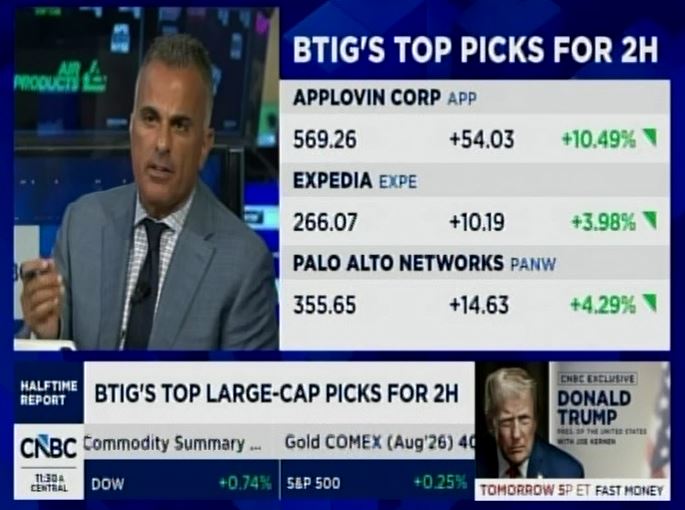
Screen graphic notes Donald Trump is ‘Pres. of the United States,’ for those who didn’t know
Bryn Talkington on Wednesday's (7/1) Halftime Report said she's "very comfortable owning bitcoin and ethereum," but owning the "derivatives" has "not worked out."
Steve Weiss said bitcoin is a "legitimate trading vehicle," but he doesn't see "any intrinsic value."
Brian Belski suggested SPOT could outperform because of something about how it does or doesn't fit into indexes. (This writer is long SPOT.)
Belski said PANW isn't getting enough credit for Cyberark or something else; Judge and Weiss noted how much the stock is up and the multiple; "they're getting more credit than they should," Weiss said. Belski insisted it's "very very early" for PANW and it'll be a "mega winner."
Bryn said CBRE "should be so much higher."
Joe Terranova bluntly stated, "Defense names are not working." But Belski praised LMT, the "creme de la creme" of defense stocks with a great long-term dividend.
Joe touted ODFL.
Oliver Renick, who hasn't been on this particular show for days, said META calls were popular, as well as those for KWEB.
Bryn won’t buy NKE even though ‘maybe’ it goes to 49
NKE was a bit of a talker on Wednesday's (7/1) Halftime Report; Josh Brown wasn't on the panel, but he did mention owning it on Tuesday, and in fact, it did go up on Wednesday after a rocky overnight earnings response.
Bryn Talkington on Wednesday said despite the bounce, she won't buy NKE; "the turnaround is taking too long" and it's "stuck in the mud."
Joe Terranova cut in, "Bryn I would ask you to put the trader hat on for a second and consider buying it ... it is potentially washed out ... classic example of bad news and good price action."
Joe even suggested NKE could move to 57. Bryn grimaced and said no, "forget 57," Bryn said "maybe it goes to 49," but she'd rather sell TSLA calls.
Steve Weiss said he agrees "100%" with Bryn on not buying NKE; "once a fashion loses its appeal ... it's so so hard to get it back." Brian Belski said LULU's got a "better opportunity" for a turnaround than NKE.
If Halftime is going to keep talking about not choosing between equal weight and market weight, we’re going to switch to Fox
Judge opened Wednesday's (7/1) Halftime Report saying the S&P 500 "hasn't had a negative July since 2014."
Joe Terranova got off to a rocky start in saying, "I think that is gonna be the theme for the remainder of 2026 — the continuation of what is a bullish trend."
Joe then did curiously claim, "The opportunity lies in where the underperformance ultimately has been in '26," which is discretionary, financials and "also finding the opportunity in the Mag 7."
So Joe thinks the market is going higher in the 2nd half, and he thinks laggards may catch up.
Fair enough.
Steve Weiss mentioned "it's a bifurcated economy" (but didn't say paycheck to paycheck this time) and that "AI spend" should continue to "power the economy."
Weiss said he looked at the top 50 stocks in the S&P, and "only 8 of them are not associated with AI."
Weiss said there's been some broadening, but it's an "overstatement" to say the market has really been broadening out. Judge insisted the market has been broadening out; "over the last month ... financials are up 7%." Judge insisted about 6-7 times "they're not" AI plays, while Weiss tied financials' success to the IPO pipeline.
Brian Belski, who did say "at the end of the day" at least once, offered, "We actually do believe in the broadening."
Bryn Talkington, who wasn't at Post 9, said the IGV is making higher lows, and there's a "base" being built. IGV would be Bryn's Final Trade.
We thought the conversation was in the clear, until we heard Joe say, "The right way to look at this is, yes, you're not trying to pick which is going to be the better performer, S&P Equal Weight or the S&P Market Cap."
Late in the show, Santoli Sr. suggested the market was having a "momentum liquidation." He said WMT "does look kind of ugly." Santoli Jr. at one point said WMT "technically looks awful."
Judge spends much of the show being distracted
Steve Weiss on Wednesday's (7/1) Halftime Report said the META question has been about how much of a return it will generate from the capex spend, but given META's gain Wednesday, Weiss claimed, "that question's been answered."
Judge and Joe Terranova were more interested in the breaking news, reported by Judge, of the Celtics landing a Knicks player. It was only one of many times Judge went off on tangents Wednesday.
Bryn Talkington said sentiment is going to "weigh on" private equity and certain financials. Joe said he would buy BX.
Brian Belski at one point suggested AAL is "underinvested" because it's a "small mid-cap" in the airline space. Judge asked Belski about flying in to La Guardia on United, made a couple obnoxious references to how good the meals were, then at the end mistakenly said Belski flew AAL, which Belski corrected.
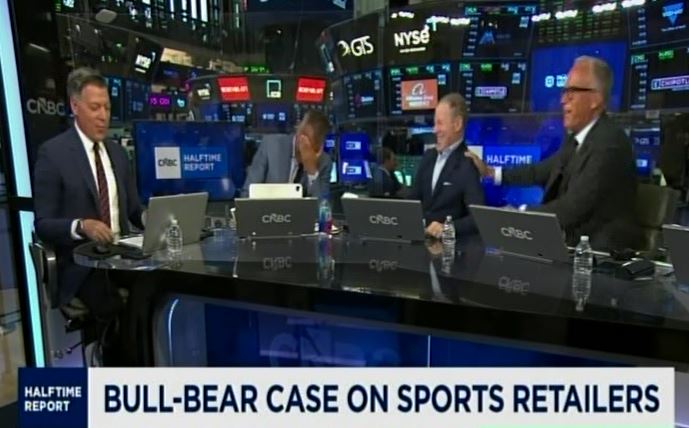
‘It’s not my analysis, but I know it’s his’
It probably should've led this page for a day.
But it's not, because it didn't make any sense.
About midway through Wednesday's (7/1) Halftime Report, Steve Weiss and Brian Belski and others were comparing NKE with LULU and other shoe companies when some kind of inside joke took place.
Weiss told Belski something like, "You gotta be a Buck watcher. You gotta watch the Bucks. And see what the logo is on the back of the Bucks. Mainstream analysis. It's not my analysis, but I know it's his." Then someone, we think Weiss, said, "How long you been divorced?," prompting a Laff-a-lympics (even from Joe) and Belski to pat Weiss on the shoulder as Judge took off his mike and called for a break.
Normally, we're all into theatrics, especially when Judge makes faces while mugging for the camera, but we honestly don't have any idea what the hell they were talking about.
Belski's Final Trade was UNM, Weiss said GOOGL and Joe said SJM and wasn't shut out this time by Judge like a day earlier.
Basically everything but ADBE
Tuesday's (6/30) Fast Money had a Will Rogers Alert as the panel was joined by Dan Ives, who was questioned by Mel where the "best opportunities" are in tech.
Dan touted hyperscalers "and then I think it spreads to software," and he also thinks "chip names continue to go higher."
Basically everything.
Frustrated, Mel responded, "Is there a subsector in tech that you don't like, I mean, or are you just bullish across the board. ... What don't you like."
Dan's answer was, "To me it's really within software."
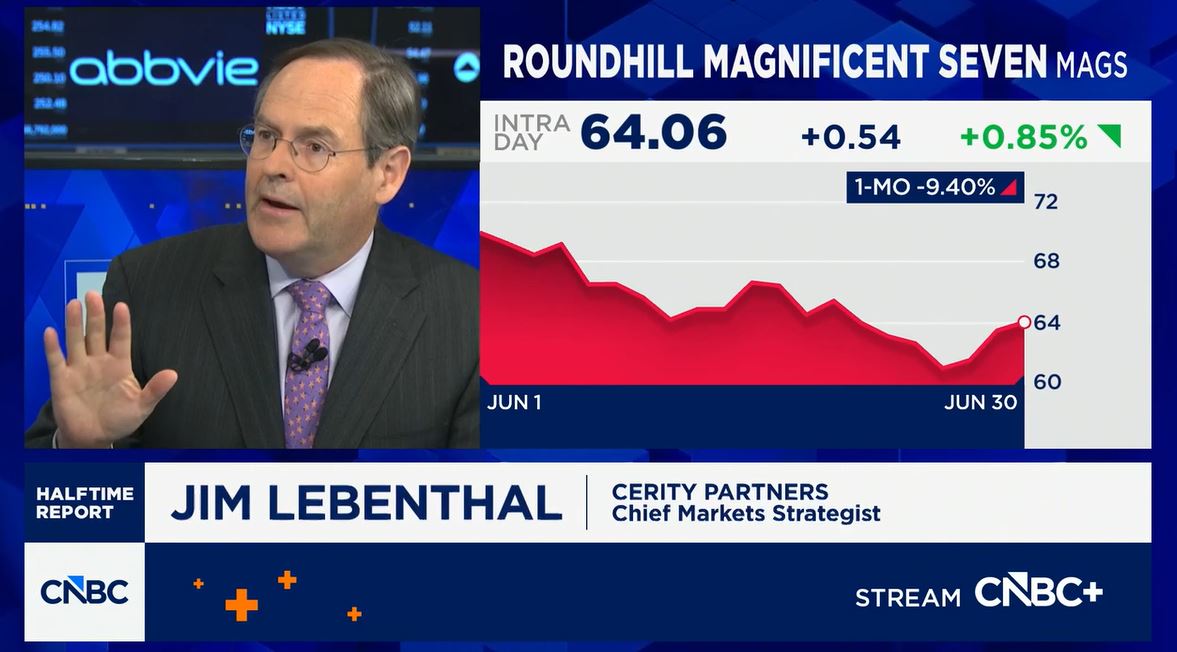
Judge finally cuts to the chase on Jimmy’s endless disclaimers
In a rare, refreshing moment of common sense, Judge on Tuesday's (6/30) chided Jimmy Lebenthal for Jimmy saying he's "not suggesting to anyone watching" that they should sell AAPL, GOOGL, etc.
Judge said, "Nobody's taking it that way. You don't need the disclaimer, we get it ... everybody knows that."
Jimmy protested, "I didn't think everybody knew it." Jimmy said, "I think you may see better growth in share prices outside of technology."
Fair enough.
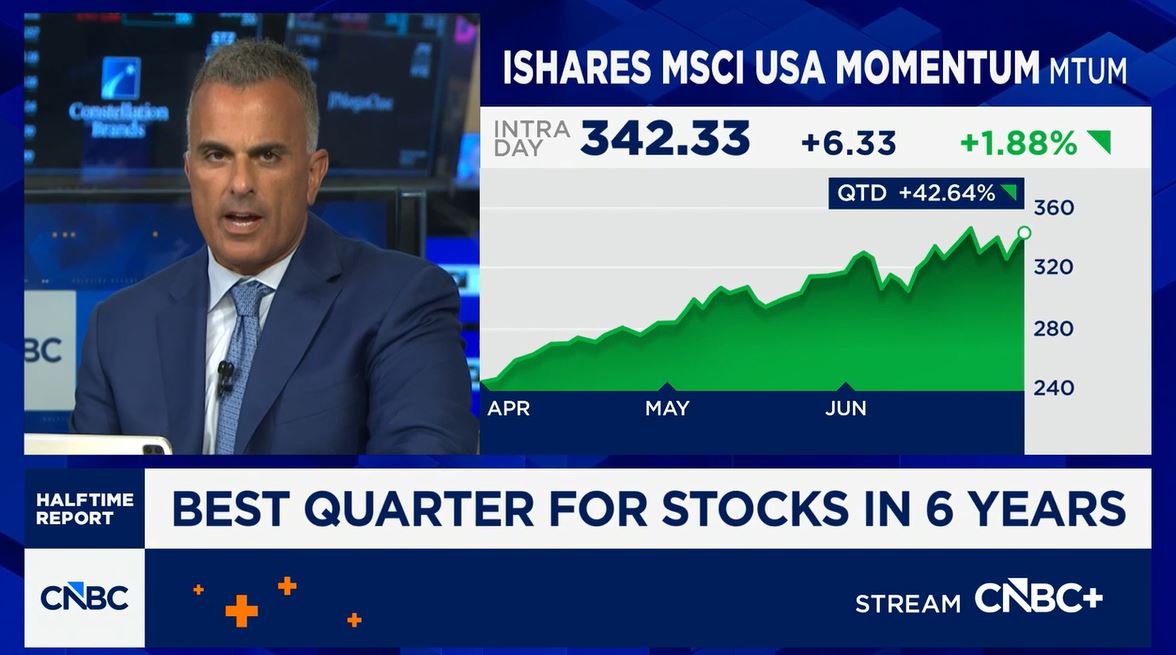
Joe isn’t really making it clear as to what you should/shouldn’t choose between (at least he’s not advising us on pro lacrosse teams)
Sigh.
We've maybe got this sorted out.
Santoli Jr. opened Tuesday's (6/30) Halftime Report declaring momentum's percentage gain for the quarter at "greater than 40%," then he stated, "That is my compass for 2026 and for the 2nd half of the year," just a day after saying you shouldn't try to pick the year-end winners.
"I think momentum is your guide," Joe asserted, before adding, "I think if you're looking at the S&P Equal Weight, S&P Market Cap, and you're trying to pick a winner, I think that's a foolish endeavor ... it's vacillating between which one steps forward and takes the leadership ..."
Joe added, "It's been about semiconductors for sure; software has struggled."
OK. So if we understand that series of commentary correctly, Joe is saying that you should NOT be trying to pick whether equal weight or market cap will outperform.
But he does seem to indicate that "momentum" and "semiconductors" are what's working.
We weren't the only ones confused by this advice against picking a winner, as Jason Snipe said "you don't need to pick either one," those choices being "momentum" or "value centric" like health care and financials.
Jimmy Lebenthal said "Let's not try to time those rotations," rather, play the "broadening of the rally." Then Judge and Jimmy quibbled over tech-vs.-chip-vs.-Mag-7 earnings growth that quickly made our head spin.
Jason offered, "I think we'll see more of the same in the 2nd half." Judge said, "'More of the same,' what does that mean." Jason said it means "I think momentum will continue to have energy and juice," but there's "some life" in the broadening.
Josh Brown asserted that momentum isn't exactly a broad category, as "8 out of the 10" momentum-stock leaders "are all trading based on the same theme," which is the data center build.
In any case, Josh unveiled a chart showing the equal weight tech RSPT is up 41% YTD vs. the Mag 7 down 2.88%. "That is the chart of the year," Josh said.
Josh warns NKE could see a ‘3-handle’
Judge on Tuesday's (6/30) Halftime Report said NKE shares "are down 48 percents (sic plural) (snicker)" from their 52-week high.
Josh Brown, who bought a little NKE, said it'll be a bad quarter and "everyone knows it" and the only thing that matters "is the '27 guidance."
Josh said the NKE earnings revisions have been "absolutely relentless." Josh said if there are positive signs about China, that would be great, but if the China business "keeps deteriorating," then "this stock probably sees a 3-handle."
Jimmy Lebenthal said he's rooting for Josh's trade, but, "Every quarter is just worse than the next (sic) one." Josh suggested "or the last one."
Josh's buy was evidently too early, as NKE shares fell afterhours. (This review was posted overnight Tues-Wed.)
Joe says Trump Accounts ‘significant catalyst for Robinhood’
Halftime Report panelists in a couple of instances Tuesday (6/30) admitted a few bad calls.
Discussing HOOD, Joe Terranova admitted he "advocated for the exchanges" entering the year, and "I got it wrong." Joe said exchanges "have to wrestle with the prediction markets and 24/7." However, HOOD "stands out to me," because, "The Trump Accounts are a significant catalyst for Robinhood."
Josh Brown revealed 3 "terrible calls" that are actually out of the Best Stocks list. The first was T, "no bottom in sight." Another was CBRE, despite having "nothing but incredible results." And CVX was the last.
Judge skips Joe’s Final Trade, apparently doesn’t realize it
Jason Snipe on Tuesday's (6/30) Halftime Report said he bought more ABBV and said you should own it in the 2nd half.
Josh Brown talked up CFG again, and Joe Terranova mentioned FITB.
Jimmy Lebenthal again was asked about DAL and again said it's "a little overbought" though he's "sticking with it." Joe again made his "duopoly" point about DAL and UAL.
Judge actually interviewed at Post 9 an exec from the Premier Lacrosse League, Paul Rabil, the co-founder.
Jason said he likes AXP; Josh said RKT "looks good today, but it's really gone nowhere for a year." Josh made the distinction between UBER and Waymo business approaches as the two end their Phoenix partnership. Jason said that's "kind of a non-story."
Jimmy's Final Trade was MU, after Jimmy referred to "Adam Parkit (sic) (snicker)," then corrected to "Parker." Jason said PANW, Josh said AAPL and Joe apparently picked AMGN based on the screen text, though Judge never asked him.
Retro bust: Julia says CMCSA split ‘admits the lack of synergies from the vertical integration of Comcast’s acquisition of NBC Universal back in 2011’
Monday's (6/29) Fast Money may have otherwise been a humdrum show, but Mel and her crew and CNBC's Julia Boorstin put together a heckuva take on the great Comcast unwind that dominated business headlines.
Mel turned to Julia, who, noting CMCSA's price, said, "Investors are welcoming a Comcast split for unlocking value."
Then it really got good.
"This split admits the lack of synergies from the vertical integration of Comcast's acquisition of NBC Universal back in 2011," Julia declared.
Exactly. And no, this page is/was NOT rooting against CMCSA's acquisition of CNBC and the rest of the NBCUni.
Rather, everyone including this page had reasons to be skeptical from the beginning ... and then far more reasons a couple years ago when SpinCo/Versant was announced as a way of giving away CNBC for a song.
For how many years did CMCSA have some agreement with GE in which it gradually took over all the shares?
It kinda makes one think that the execs at CMCSA didn't actually ... know what they were doing.
Even a chucklehead could figure out that CNBC has far more "synergy" with NBC News than with Rotten Tomatoes. But no. CNBC had to be separated from NBC because it's a cable channel and cable channels destroy stocks. And so CNBC's peacock logo had to go in favor of generic trash.
Melissa correctly indicated that this is dubious decision-making. "I mean this happened so quickly after the Versant spinoff, Julia, you have to wonder; I mean things haven't changed that much in terms of, you know, lack of synergies between a media business and a-, and a cable broadband company. I mean that existed back then too."
Julia responded, "The Versant business is such a small business compared to this NBCUniversal asset." (So what was the great benefit of getting rid of it and forcing it to change its logo?)
As for the current state of cable TV, Julia actually said The Golf Channel "derives 50% of its revenue from booking golf courses."
Julia said that despite CMCSA's announcement, "Wolfe Research projects- predicts that the breakup won't actually occur," predicting CHTR will talk with CMCSA and NFLX will make an offer (oh my, that's all we need again; is $25 possible for that stock) (this writer is long NFLX) for NBC and possibly Sky.
Referring to CMCSA, Dan Nathan said that when a stock is "down 65%" over the last 5 years, "you have to do something." Steve Grasso observed, "It doesn't seem like there's a clear-cut strategy in the entire sector."
Tim Seymour actually claimed with a straight face that the VSNT spinoff "was a good deal."
The headwinds facing cable television are not anyone's fault.
Pretending to have a big plan for it ... and then basically revealing that there's no "clear-cut strategy" at all ... is when execs start to look like a buncha jokers.
(Nobody brought this up on Fast, but what are the chances David Ellison is thinking 1) we blew our money on the wrong asset and 2) Dad can you write us another check.)
The Fast Money coverage is objective reporting on a (sorta) parent company, the way journalism should be.
You go, CNBC.
Joe says NFLX, AMZN and AAPL have to be interested in NBCUni
On Monday's (6/29) Halftime Report, guest hosted by Frank Holland, Jenny Harrington talked about buying CMCSA last week and at that time thought the stock was "so boring." Jenny said she bought it after doing analysis on how long it'll take the broadband ice cube to melt. Frank let Jenny give a much longer speech about this purchase than was necessary.
Frank asked Jimmy Lebenthal, who owns DIS, whether the CMCSA move changes things for other media companies. Jimmy said the CMCSA spinoff is "takeover bait." However, the conversation wasn't nearly as crisp as on Fast Money later. Jimmy suggested NBCUni will find buyers because, "In this industry, size matters." Joe Terranova suggested there's no reason NFLX, AMZN and AAPL wouldn't be interested in the NBCUniversal assets.
If there’s a rate hike, ‘I don’t think it matters’
Joe Terranova at the top of Monday's (6/29) Halftime Report said the end of the quarter "tempts you for the wrong behavior."
Joe then reverted to Santoli Jr., stating both equal weight and market weight are rewarding investors, and you don't have to try to pick the year's winner.
Permabull Stephanie Link said something about Total Addressable Market, "The economy is doing much better than most people expected."
Jimmy Lebenthal said he agreed with Joe's suggestion of not chasing market rotations. Joe suggested it's like using a baseball platoon system without picking a "starter."
Joe reiterated, "I think the high is in for yields" and he doesn't see rate hikes in 2026.
Stephanie Link actually said "at the end of the day."
Jenny Harrington said she agrees with Joe about no rate hikes this year, but even if there was a hike, "I don't think it matters," because the economy "can handle it."
Joe suggested ONTO as a "derivative" play in memory.
Jimmy said DAL is "overbought," but he doesn't want to sell it, primarily because, "I don't wanna take an enormous tax hit."
Jenny said she was "laughing literally" because the government turned down the JetBlue-Spirit merger, "so dumb."
Joe touted MNST.
Jimmy's Final Trade was VRTX. Jenny said VZ, Stephanie said IBM and Joe said GLW.
Judge should come up with a more recent term than ‘Caddyshack’
Judge on Friday's (6/26) Halftime called Steve Weiss "Oscar the Grouch."
Weiss wondered if Judge might knock Weiss' clothes. Judge explained, "You can only call it the Caddyshack outfit so many times ... joke gets stale."
In the greatest success of the day if not month, Weiss somehow earned a fashion compliment from Jenny (Should Be Played By Jessica Chastain in the movie) Harrington, who said Weiss' clothing "looks nice today."
Judge says ‘therein’ again
Steve Weiss posed a question at the top of Friday's (6/26) Halftime Report on MSFT and certain other Big Tech: "Are these now just regular old companies that have huge capex currently and in front of them, and what is the return going to be."
Judge said "therein (snicker) lies the problem ... at least in the near term, the juice has been squeezed." Weiss agreed it's been "completely squeezed."
Weiss bluntly stated, "The AI trade dominates everything."
Judge said Hartnett is looking at the "$60 level" of the MAGS, which is some kind of Mag 7 fund. Apparently quoting Hartnett, Judge said, "'You go below 60,' he says, 'and then it's risk off, for the summer at least, for the Mag 7.'"
Bryn Talkington joked they should rename MAGS as LAGS. Bryn noted "The Q's are up 15% for the year." (This writer is long QQQ.)
Bryn said MSFT and META are "not executing on their strategy" and are "literally pivoting like on a daily basis."
Bryn said Copilot "still is not great," and META is "just like burning money."
Kevin Simpson suggested: "We're going from a momentum trade to a fundamental trade within tech."
Eamon Javers said the U.S.-Iran conflict could be in a situation where we "basically just don't move forward from here at all."
Later, Eamon had additional breaking news on presidential thoughts about European digital services taxes.
Weiss bails on GLD
Once again making a point that he has probably made literally, at least once a year for 15 years on the Halftime Report, Steve Weiss on Friday (6/26) wondered aloud whether "the telcos" are "willing to subsidize" (Zzzzzzz) as much of the iPhone price as they have been.
Kevin Simpson bought more NVDA on Thursday at 194. He said it's "less expensive on a valuation basis (snicker)."
Bryn Talkington, who seemed to already own SPCX heading into the IPO (see below), said, "We had a position that was in a fund that we were able to sell. So, we sold that. Because it was a liquid fund, and we were able to sell it."
Bryn said IPOs of even great companies often have rocky first years, so she wants to "watch it" for "a few quarters."
Weiss said GS is now his biggest position, and it "trades in line with IPO cycles, particularly in technology." Kevin mentioned GS' dividend hike.
Weiss unloaded the GLD, saying, "Gold didn't do what I thought it was supposed to do." He said gold might "stay below 4,000."
Bryn sold APO, evidently because sentiment is so negative.
Weiss indicates CEOs’ and other execs’ comments at conferences tend to be predictable
Judge on Friday's (6/26) Halftime Report said Baird raised CAT's target.
Steve Weiss said "valuation is an issue" for CAT, and it's "an AI trade." Judge said, "It's an AI stock until it isn't." Weiss said "exactly," and "I think we're closer to the isn't."
Jenny Harrington said she was at an energy conference and CAT and GEV have a "long, long, long" outlook that is strong.
Weiss wondered, "How many companies got up and had any words of caution about their stock, had any negative comments on the fundamentals."
Jenny said, "That's not unique to energy. That's any conference you ever go to on any subject in any industry."
Weiss said, "That's exactly my point."
Judge said, "It's not like their bullishness is unfounded. We're- we're tripping over ourselves to build data centers."
Weiss admitted, "Absolutely right," but "no CEO I know has ever gotten up and called the end of the cycle."
Meanwhile, Kevin Simpson said MCD likes to "hover" around 300, and if it gets there, "that's about it."
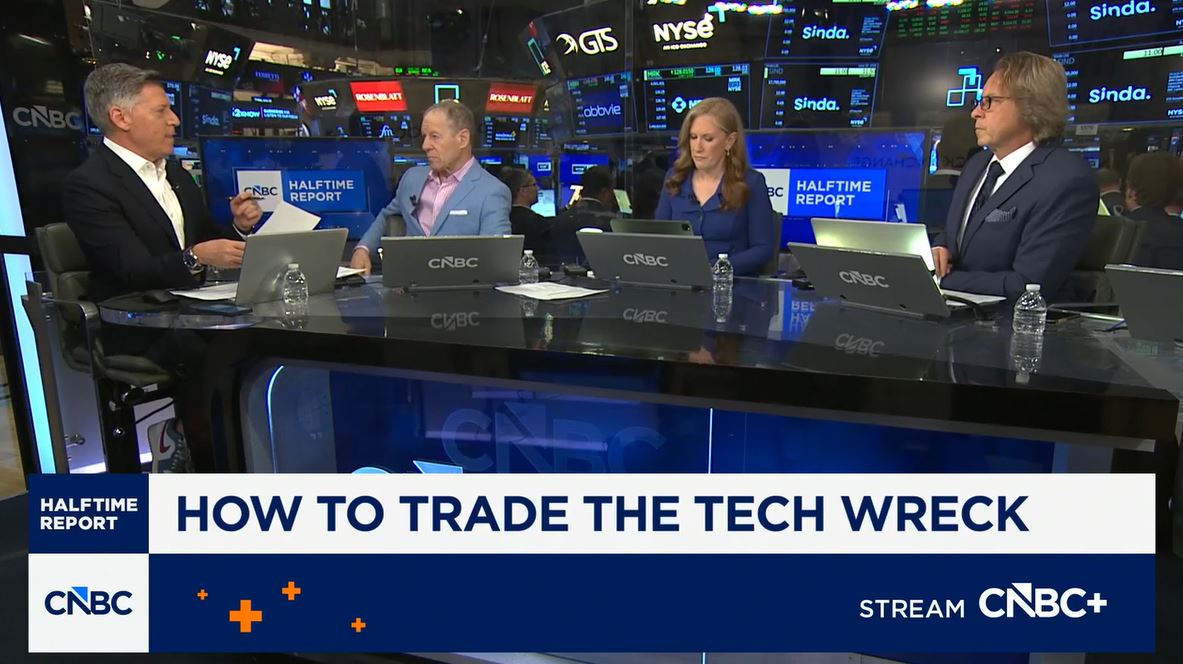
Judge must have about 5 pairs of sneakers, was wearing NKE at Post 9 again
Steve Weiss on Friday's (6/26) Halftime Report said UNH is "balancing the portfolios" of being up when AI stocks are down; he's staying with it, though "at some point" there will be healthcare headwinds.
Bryn Talkington said PLTR is "settling in" but keeps making "lower highs."
Ozanian turned up at Post 9 to discuss a new CNBC Sports Department post, "most valuable sports empires." (What a grabber of a topic.) Jerry Jones' family is No. 2. Stan Kroenke was No. 1.
At the end of the show, coming back from commercial, Weiss was heard saying something about "look it up." Judge said, "Your mike's open." Weiss asked for a "head's up" next time.
Weiss said there's "rumors" about NFLX being interested in LionsGate and that it seems like there's a sense of "we need more content," which is "not a good look for the stock, for the company." Weiss said it "trades quarter to quarter," but it's "too cheap to sell." (This writer is long NFLX.)
Judge asked Jenny Harrington about FISV, yet again, Jenny said the worst is behind it.
Weiss again talked about DKS and said he thinks it keeps going.
Bryn's Final Trade was UBER. Kevin Simpson said NVDA. Jenny said ENB and Weiss said META.
Joe admits Wednesday’s pre-earnings call on MU was botched
He's always been a stand-up guy.
As Judge devoted nearly the entire A Block of Thursday's (6/25) Halftime Report to ... ahem ... MU, Joe Terranova recapped his lunchtime advice on the stock from a day earlier.
Joe admitted, "I took the perspective yesterday ... I didn't like the setup. ... And I advised the viewers who didn't own it not to rush in and buy it today."
As for now, Joe added, "Here's what I would do ... Let's say you're gonna buy 100 shares. I'd buy 25 shares at some point this week. Get it out of the way. Below the market, I'd put an order in for 50 shares at 950. And another 25 shares at 750. If you never get those 75 shares, at least you're participating."
Judge says ‘therein’
Judge on Thursday's (6/25) Halftime Report said it seems like, regarding MU's business model, "This time is different" (snicker).
Joe Terranova agreed there's been a "paradigm shift" in the stock. Joe said it's "secular" now, "this is a (sic) irreplaceable resource."
Jimmy Lebenthal revealed, "I'm in it, as of today, I initiated." But then Jimmy told Joe, "I'll take the other side of the narrative that you laid out ... what I believe is, this is a cyclical stock. It's just a question of where we are in the cycle. And I would say, at worst, we're in middle innings."
And, actually, this page agrees with Jimmy, and not with Joe's "paradigm shift." (This writer has no position in MU.)
Jimmy said the current multiple, which Judge said is 10, is "using yesterday's earnings estimates."
Judge asked Jim, "How can you declare yourself a card-carrying member of the Value Investors Club when you're buying this where it is."
Jimmy said we'll see within a week that MU's price is "7 times forward earnings," and also, "Micron's gonna be buying back a tremendous amount of shares."
Then the group piled on. Josh Brown said MU is "200% above its 200-day moving average." Jimmy assured, "I did not load the boat." Joe asserted, "The risk-to-reward setup is poor. That's without question. It was poor yesterday, again, it's poor today." Judge told Jimmy, "I don't care if you bought $5 worth or $5 million worth. You can't make an argument against that with, 'Well, I didn't load the boat.' You were willing to buy it at this price, therein (snicker) lies your investment decision as it is (snicker entire phrase)."
Jimmy said, pointing to Joe's theory, "This is a time to start building your position." Unlike what Joe suggested, however, Jimmy added, "I'm more likely to be buying more of this higher, than I am lower."
Evidently, Judge’s opening text wasn’t written by Josh
Permabull Stephanie Link, who never met a Total Addressable Market she didn't like, mentioned precisely that term in Thursday's (6/25) Halftime Report's ... 4th minute.
Judge opened with a statement that Josh Brown disagreed with. Judge in his intro said, "Micron's moment ... a continued rotation ... If you thought that Micron was just gonna, you know, relaunch the entire AI space with their blowout quarter, not happenin' today."
"Oh I disagree," Josh said.
"Well look at the hyperscalers," Judge said.
"That's not the AI trade," Josh said. "The AI trade is not the hyperscalers ... The AI trade is working really well today."
Josh added, "As a matter of fact, the Mag 7 as a group are dragging down the returns of the S&P 500 year to date."
Judge said it's a "fair assessment," but "there were some out there" who thought "this was a critical moment for the AI trade at large."
Josh and Stephanie Link tangled over who got to describe the MU story in detail; eventually both did.
Stephanie says it’s ‘painful’ watching football on Netflix
Thursday's (6/25) Halftime Report took up the confounding case of NFLX. (This writer is long NFLX.)
Josh Brown said that NFLX's losing battle for WBD evidently "opened up a new conversation" about what the company needs to do for growth. Josh said "I bought the stock into this downturn," and he "wouldn't be opposed to adding more," but "technically this thing is completely broken."
Permabull Stephanie Link said she bought NFLX because it did not get WBD. Stephanie said the competition has "only gotten stronger."
Josh said "they got football"; Stephanie cautioned "they gotta get football right," it's "painful" to watch a football game on NFLX.
Joe Terranova said, as he's done all year actually, "Spotify's chart and Netflix's chart is (sic) literally identical." Joe said both peaked in June 2025.
Still haven’t heard Weiss’ 3rd reason for selling MU
Late into Thursday's (6/25) Halftime Report, Oliver Renick said of bitcoin, "It's the selloff that never ends."
On AAPL, Josh Brown said as a trader, he'd be "standing back," but for an investor, it's a "great opportunity."
Josh said the KRE is making highs and CFG is on the Best Stocks list, he suggested a possible "8 handle." Permabull Stephanie Link bought TFC for its Total Addressable Market.
Joe Terranova said FITB is "at an all-time high."
After everyone kinda talked up financials, Josh mentioned what CVS is doing, stating there's a "whole big market out there" besides Mag 7.
Santoli asserted, "The market recognizes, most of the easy AI trades have been exploited."
Jimmy Lebenthal's Final Trade was QCOM. Stephanie said ROK. Joe said MRK. Josh said SPG.
On The Exchange, Sully & Kelly were at the CBOE in Chicago with Diane Swonk and others.
Weiss leaves viewers hanging on 3rd reason for selling MU
Joe Terranova opened Wednesday's (6/24) Halftime Report kinda in Santoli Jr. Mode, saying "a lot is on the line for this evening," regarding MU's results.
Joe advised, "I think if you don't own the name and you're listening to us right now, I don't think you're buying the name today" and that the market has "priced it for perfection." (That proved a misfire, as MU shares surged afterhours Wednesday.) (This review was posted overnight Wednesday-Thursday.)
Judge said Wolfe says to watch 977 in MU.
Steve Weiss said he sold a third of his MU stake this week, Monday and Wednesday, for "3 reasons," one being that it became an "irresponsibly large" position, another being that analysts are "every day" playing "can you top this" with the price target, and then ... he never really gave a 3rd reason.
Weiss said of MU, "historically, it's expensive."
Liz Thomas said the hot chip stocks at some point have to "take a breather," but there's "still plenty of life here."
As panelists haggled over supply and demand and whether it's a new era for chips or whether it's just kind of a spike in the same old cyclical story, Liz said it's "absolutely a secular trend." Joe said a couple times, "This time is different."
Joe said even if MU falls to 800, "it's not even at the 50-day moving average yet."
Weiss said he bought most of his stake "at 350 a share" in April. (Congrats.)
Joe: ‘No shot’ of hiking rates in 2026
Liz Thomas volunteered on Wednesday's (6/24) Halftime Report, "I don't wanna get into a Fed conversation now but I don't think they're gonna hike this year at all."
Joe Terranova chimed in, "I think there's no shot that we're raising rates this year, um, I think that the next move is actually gonna be a cut."
Judge said Dubravko, who hasn't been on the show for a while and wasn't on Wednesday, raised his target to 7,800 (Zzzzzzzzzz).
Judge said PFG got a downgrade to a sell by BofA. Joe said he "strongly" disagrees and said the analyst had a neutral rating as it went higher, and it's the "best performing financial stock in the JOET ETF."
Joe said we're going to see a "rebuilding of positions" in consumer discretionary and that even UBER is gaining.
Santoli got a little extra time with an earlier-than-usual appearance.
Joe is back to talking about LPX
Steve Weiss on Wednesday's (6/24) Halftime Report said he's been looking to sell GLD because there's "significant downside."
As bad as gold has been, Weiss said "Thank God I don't own bitcoin ... which shows no signs of moving higher."
Liz Thomas predicted gold will be "a frustrating long for the next few months."
Joe Terranova sold FCX personally in June and said there's been a "very fast reversal" in commodities.
Joe mentioned VMC and even brought up LPX, an old favorite he used to mention almost as much as PANW, admitting, "It's a name I used to talk about years ago."
Joe explained how SPG outdueled the "nonbelievers."
Judge mentioned Alphabet (apparently GOOGL, per screen graphic, and not GOOG) going into the Dow. Weiss said he likes the stock, but entering the Dow doesn't necessarily bring a sustained bounce. Joe said being included in the Dow is not "that significant," a pretty good point.
Weiss' Final Trade was DKS and Liz said XLF (Zzzzzzzzzz). We wuz hoping Joe would say "LPX," for old time's sake, but he said GRMN.
Sounds like Josh’s plan to ‘manage risk’ in NKE is to buy more if it sinks
Josh Brown opened Tuesday's (6/23) Halftime Report explaining why he actually bought NKE with "half a position."
Josh noted, "This thing is trading where it was in 2015," and he said it's "73% below highs," but it's "looking like some people are coming in at this level, routinely."
Among other reasons, Josh also pointed out Tim Cook's NKE buys and said he thinks NKE "nailed it" with the Knicks/NBA playoffs, even mentioning Timothée.
Judge said Evercore actually downgraded NKE on Tuesday.
Joe Terranova stressed that it's easier to "manage the risk" of a high-performing stock than a slumping one (editor's note: we're not really sure that that assessment is true) and demanded Josh reveal, "Tell us how you're gonna risk-manage this name." Josh said he's starting with a half position and indicated he could dollar-cost average if it goes lower.
Brian Belski said he bought NKE a year ago and sold in January because it's "operationally broken." Belski asked Josh whether he sees himself in the stock for 6-12 months. Josh said, "I don't see myself in the stock 12 months from now."
NKE, the new TGT?
Kevin Simpson on Tuesday's (6/23) Halftime Report talked of buying more SPCX and said "this is a better entry point" this week than what it was last week.
Kevin said he "took a small position Friday" and "bought a little bit more" on Monday.
Brian Belski said he doesn't own SPCX but does own TSLA and that he's playing for a merger.
Josh bought CFG after talking it up recently. Joe thinks "Josh's move is the right one." Joe said CBOE is a stock that he "established a personal position in today." (Translation: he bought it).
Kevin bought AMGN and ABBV and called them an "AI-adjacent play."
Judge said GEHC got a bull call from RBC. Joe said it's a recent pickup in the JOET.
Belski said TGT "used to look like Nike does now." He said it's having a "massive turnaround."
Kevin said he agrees with a downgrade of HD.
Belski likes CELH for the long term. Belski also backed TTWO.
Nobody on Halftime brought up Dan’s notion that NFLX and SPOT are going to merge
Kevin Simpson on Tuesday's (6/23) Halftime Report said MU doubled because the earnings doubled, and it's not unusual for the stock to have "a little air pocket."
Veering a bit into Santoli Jr., Joe Terranova said chip stocks "broke the fever in the momentum factor."
Josh Brown said, "The problem with momentum is that the holders are low conviction."
Hours later on Fast Money, Dan Nathan said he "never in my lifetime" thought that MU would have a $1 trillion market cap.
Meanwhile on Halftime, Joe Terranova had to personally sell TWLO; Joe said he got "stopped out," so it wasn't a "willing sale." Joe said he lost 18%, and he can look back on prior successful trades in the stock, but it doesn't "alleviate" the feeling of selling a loser.
Today’s golf scene: ‘The fans were kind of against me’
Josh Brown on Tuesday's (6/23) Halftime Report said IBKR, long one of Joe Terranova's favorites, is on the Best Stocks list. Josh said if you're a trader, then 88 is your "pivot point."
Josh also brought up CAT and said owning it is a bet on continued AI capex buildout. "Traders can use 940 here," Josh said.
Josh said he still likes DAL. Kevin Simpson touted CAT.
Joe touted IBKR, saying "we" got it at a basis of 43, but "we" actually refers to him personally. Judge said it was OK to say "we." Belski touted DAL, "by far the best airline," and mentioned the refinery buy.
Santoli said "Small caps leading is more of a source of volatility than it is reassuring, uh, in this instance."
Judge had been touting the Golf Channel Promotion Wyndham Clark interview; it finally happened in the last 15 minutes. Wyndham said SoFi is one of his sponsors. Judge impressively asked Clark about the crowd at Shinnecock. Clark said "The fans were kind of against me," but he "embraced it" and tried to show them "love and kindness."
Josh's Final Trade was CFG. Kevin said AAPL. Belski said FNB and Joe said TRV. Judge joked, "I'd like a little FNB right now, I'm a little hungry."
Dan Nathan says NFLX will ‘probably’ buy SPOT
Judge barely mentioned NFLX, so it was up to Fast Money to deliver the day's headline.
On Monday's (6/22) Fast Money, guest hosted by Sully, Courtney Garcia said NFLX is a "mature" company and "at a certain point, they're not gonna be able to increase their prices forever." (This writer is long NFLX.)
Courtney says it's not a stock you want to be "jumping into." Sully said it seems like it's been a while since "everybody sort of talked about a- a Netflix show." Guy Adami noted the stock is lower than at the February "trough." Guy said he gets the reasons why, but "I still think the stock is way too cheap."
Dan Nathan must've had lunch at Burger King because he uncorked the Whopper of the Day, stating, "I think you'll probably see a Spotify merger," meaning NFLX buying SPOT. Tim Seymour said, "I'm not sure a merger with Spotify is gonna help the stock," saying "people would be concerned about that."
Dan said it would be a "behemoth" and "could take out a lot of costs."
Tim said there's not one big overhang on NFLX, rather, "it's a lot of little things." Honestly, we gotta think that makes the stock less desirable.
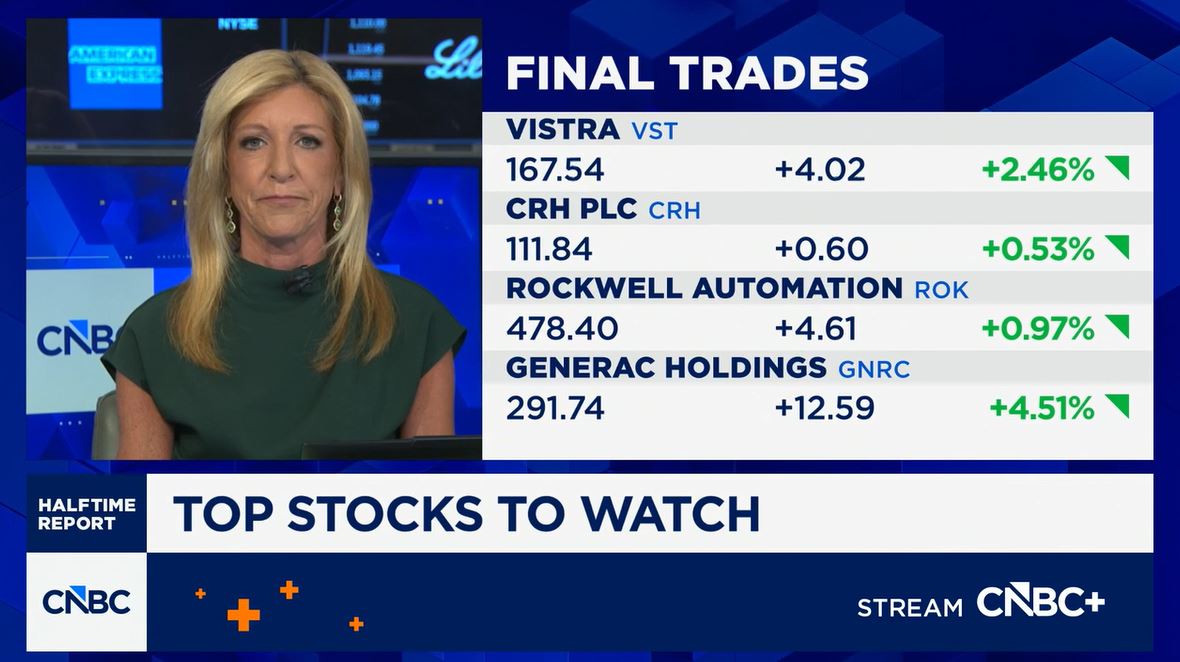
Stephanie says you can hold SPCX for 10-15 years ‘because of the total addressable market,’ then admits she doesn’t have ‘confidence’ in that TAM
Judge opened Monday's (6/22) Halftime Report with Stephanie Link announcing a buy of SPCX.
"It's a 2% position; it's very small," Stephanie assured, explaining her approach is "set it and forget it."
And in this telling comment, Stephanie said she thinks she can own it for "10, 15 years. And it's because of the total addressable market."
Stephanie mentioned another of her favorite stats: "down almost 25% from its highs."
Joe Terranova asked Stephanie why "the market is troubled by this debt offering" for a $29 billion bridge loan. Stephanie indicated there's an issue for "anybody that's raising debt" in today's market, but she has "no problem" with it.
Judge then noted the total addressable market is "according to them" and then mentioned the "lockups" to come. Stephanie admitted, "Do I have confidence in the 28.5 trillion TAM? I don't. No. I really don't." But "half of that" would be big.
OK. So Stephanie thinks you can hold it for 10-15 years because of the total addressable market, though she doesn't really have "confidence" in current TAM projections.
Rob Sechan said we still haven't had "price discovery" yet in SPCX.
Judge suggested the SPCX IPO may have "marked a moment of reflection" (snicker) in terms of "speculative moves within the AI universe."
Jimmy Lebenthal said he agreed with the "a moment" characterization but doesn't think it's "the moment."
Jimmy stressed that he doesn't think this is a "late 1999, early 2000 uh moment." Jimmy told Stephanie he disagrees on SPCX valuation though he plans to buy it at some point, even "below the IPO price."
Jimmy explained that Elon Musk is "too P.T. Barnum-esque for my liking," saying Elon apparently mentioned a "sexual, uh, conntations for the- for the letters S.E.C."
Jimmy actually claimed, "I have to have actually Elon Discount as opposed to an Elon Premium."
Rob chuckled, "You are out of your mind, an Elon Discount!"
Stephanie said, "Since 2010, Tesla is up 25,000%." But Stephanie admitted, "I'm not sure what the right price discovery is."
Later, Joe asked Stephanie if she'd buy SPCX if Elon wasn't the CEO and founder. Stephanie said "I don't think so." Judge said, "I don't think that's a real fair question. I mean, honestly."
Jimmy at one point recalled what AMZN did since the late 1990s, having to fill the "air pocket," and Jimmy suggested "I think the same thing will happen with SpaceX."
It wasn't till Final Trades that Judge said Stephanie sold NFLX to buy SPCX. (This writer is long NFLX.)
Guy has the Joke of the Day
Joe Terranova on Monday's (6/22) Halftime Report called FANG "the one name in the Permian that you wanna own."
Rob Sechan said Trivariate's upgrade of energy is a "great call," but it "scares" him a bit that "a lot of people" have that view. Joe said if you're buying the XLE, "you are buying it for what happened before the conflict."
Jimmy Lebenthal bluntly suggested crude will be 70-80 "for the rest of the year." (We sorta think that puts him at odds with presidential predictions.)
Stephanie Link backed the bull call on DKS and called it a "coiled spring, 2nd half of the year." Joe suggested SCHW or IBKR as plays on exchanges.
Robert Frank unveiled CNBC's Elite Advisors list, which includes Rob Sechan's NewEdge. Judge congratulated Rob; Rob made gracious remarks about the success of the firm.
Rob did reveal, "Our involvement as a firm with CNBC certainly I think was a factor." That at first seemed like, well, maybe CNBC is just touting its own. However, Rob indicated that having NewEdge folks such as himself on CNBC has broadened the firm's exposure, which is a fine reason.
Rob's Final Trade was VST. Jimmy said CRH. Stephanie Link said ROK, and Joe said GNRC.
Later in the day, Sully, guest-hosting Fast Money, stressed that the term is "champing" at the bit, not "chomping."
Discussing oil, Sully said, "Sometimes natural gas prices in the Permian are negative. People pay- you have to pay someone to take your natural gas."
Guy Adami said, "I would pay Brian to take my natural gas."
Joe down 18% on TWLO
Joe Terranova on Monday's (6/22) Halftime Report said panelists haven't been focused on "the continued decline in software."
Judge said CRM is "down 14 days in a row ... longest streak ever."
Joe said PLTR "cannot sustain any type of rebound." Joe admitted he "reached too high" for TWLO and is down "about 18%" on that stock. Stephanie Link said cyber stocks have done well and called IBM a "screaming buy" and mentioned the quantum computing "total addressable market."
(Stephanie also was talking about the total addressable market of data center stocks.)
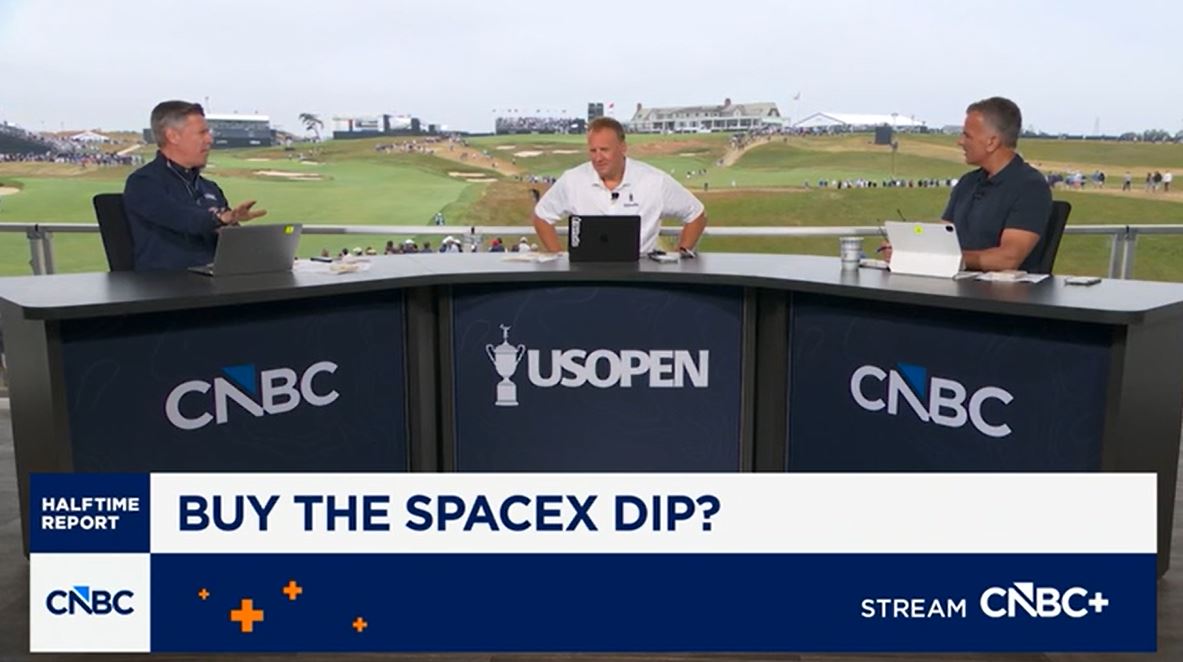
Din-ecock: Ghastly sound effects mar Halftime’s round at the golf course
Thursday's (6/18) beleaguered Halftime Report, from Shinnecock in the latest VSNT cross-marketing contraption, is not going to be an Academy Award nominee for Best Sound. (Or Best Sound Mixing.)
First, Judge and Josh Brown and Joe Terranova sounded like they were speaking in a cavern. Then viewers began to realize that there's some kind of squeaking metal going on here, a clanging from the wind that Judge never acknowledged. Honestly, it sounded like someone next door was wheeling around a metal cart.
Joe gushed about how great momentum's doing. Josh suggested maybe "algorithms" or "bots" were responsible for Wednesday's Warsh-related selloff.
Josh said, "I think the better places to be continue to be the takers, not the makers," which didn't necessarily make a whole lot of sense, except it's something about the companies selling AI stuff rather than buying it. Joe talked up GLW and said MU isn't a meme, it's going to be more and more "integral."
For some reason, there was talk about pricing power. Judge said, "The 2 companies that probably have the most, uh, degree of pricing power from a consumer standpoint, probably Netflix and Apple." Joe tried to complain about NFLX's stock performance, but Judge said "that has nothing to do with the level of pricing power they have." (This writer is long NFLX.)
Josh claimed that a lot of SPCX longs are not buying the stock, "they're buying the potential returns of the stock." (Sometimes they call those people "flippers.")
Joe said "price discovery is beginning to work" with SPCX, and he thinks it "consolidates" in the current area.
Joe gushed about GS and how David Solomon has looked at the businesses and "skinnied it down." Josh said, "To be fair, a lot of what he had to unwind was also some of his projects." Joe said "he had the fortitude (snicker) to admit that they needed to pivot."
Joe bought some JPM. Joe talked up VRTU, which is run by his pals.
Judge basically nominated Terry Duffy for the Hall of Fame.
Joe also bought the XBI.
Eamon Javers reported that JD Vance said something about "gentleman's agreements that are on the side of this deal" with Iran. Judge observed, "Gentleman's agreement sounds somewhat unprecedented."
After the A Block, Judge brought in Golf Channel celebrity Rich Lerner. Judge called Rich "the busiest man in show-biz (snicker) today (emphasis on 'today')."
Afterwards, Josh said MTSI is on the Best Stocks list. Joe said he's not calling anything an acquisition candidate, but it's among companies that could be a target.
Santoli suggested it's a day of "in chips we trust."
Josh talked about how HOOD is trading above "every moving average." Joe said HOOD has had some bad news and good price action, which Joe says the show doesn't talk about often enough.
Joe said defense contractors are in the JOET but apparently aren't very impressive.
Joe's Final Trade was GLW. Josh said MTSI.
Steve Liesman, Kevin pronounce ‘productivity’ differently
In a remarkable case of timing, Wednesday's (6/17) Halftime Report began just as Donald Trump was taking the podium in France ... and CNBC chose to preempt the entire Halftime Report.
Kevin Warsh then did his first Fed chief press conference during Power Lunch and Closing Bell. Late in the press conference, CNBC's Steve Liesman asked about "productivity" and pronounced the first 3 letters of that word as "pro."
Kevin responded that "the committee had a discussion of productivity" and pronounced the last word as "PRAW-ductivity."
Moments later, Nick Timiraos got his own question and said "productivity" and, while it kind of waffled in the middle, pronounced it more like Steve did than how Kevin did.
Kevin's press conference ended during CNBC's Closing Bell hour, and when things got turned over to Judge, Judge actually said, "Welcome to the Halftime Report (sic), excuse me, the Closing Bell. I'm Scott Wapner." (At least he didn't say, "I'm Steve Weiss.")
Judge's star guest, Jeffrey Gundlach, who typically is on the show after Fed press conferences, said Kevin is "buying himself some time" by announcing "5 consultant task forces" and that the "phrase of the day, without any doubt, is 'We will deliver price stability.'"
Jeffrey said he gets the impression that "it's unlikely that rates will be changed until the fall."
Jeffrey said it's "very clear" that inflation, not employment, is going to be the focus. Jeffrey made kind of a speech about how the Fed isn't going to follow the 2-year like it used to.
"I'm not really a big fan of consultants," Jeffrey admitted, though he noted that Kevin is bringing a "new era" to the Fed.
"I applaud him for being original," Jeffrey said.
Judge said it's "apparent" that, "There's a new sheriff in town. And his name is Kevin Warsh."
Jeffrey said numerous times that Kevin seems fixated on "a number that starts with 2."
Jeffrey said the inflation rate "is coming down" and that Jeffrey heard David Kelly talking about that on the "pregame show, uh, uh, I guess it's Halftime Report, or whatever it is." Moments later, Judge clarified, "For the record, the prior program is called Power Lunch, but you get a big pass, because I called this program Halftime Report and in fact it's Closing Bell. So, it is what it is." Jeffrey said, "It's good. At least I didn't call it Mad Money." Judge said, "Well, that's good too."
Grasso says there could be a ‘dramatic chase’ for SPCX
On Tuesday's (6/16) Fast Money, Steve Grasso suggested SPCX could be "a real, dramatic chase," because "the float is so ultra-small."
Karen Finerman questioned that it's a "small" float. Steve said "only 4% of it's available." Karen said it's still "a hundred billion dollars." Steve explained that there's "not much that's available."
Meanwhile, Karen said, "Oil is telling you the Iran conflict is over. And the rest of the market is telling you, 'We're not buying it.'"
Weiss may have bought AVGO a little early
In a fairly quiet edition of the Halftime Report on Tuesday (6/16) guest hosted by Frank Holland, Josh Brown said SPCX is in "its own world" and "impervious" to other market factors and we can't "infer" anything about the market simply by that stock.
Joe Terranova said that last week, we got a "dramatic lifting of sentiment," and it's reflected in SPCX. Joe said dividend stocks are doing well, and "This is a very healthy marketplace."
Joe talked about an all-time high for the equal weight and touted CAT, EW, MNST and WSM as non-AI stocks that are making highs. Joe said "capital is now relaxing (snicker)."
Joe also said, "I think you wanna play momentum." Joe said SPCX options launched Tuesday; "That's gonna add to the volatiility that's currently in place," although we're not quite sure what he meant; what "volatility" is SPCX experiencing?
Shannon Saccocia stressed the "rate environment."
Joe and Josh talked up financials; Joe mentioned JPM and C; Josh talked up a "breakout in progress" in CFG. Joe talked up GL. Jenny ($12 Sundae) Harrington said "the insurance business is a huge beneficiary of AI.
At the end of the A Block, Joe said "dispursement" (sic) (snicker) but corrected it as "dispersion."
Can’t wait to see the details of the Iran ‘deal’
Josh Brown on Tuesday's (6/16) Halftime Report said HOOD is laying off 10% of its workforce, and the company says it's "from a position of business strength."
Josh bought HOOD and doesn't see resistance until 115 or 120. Joe Terranova praised the "price action" in HOOD and said "fundamentally, they've gotten ahead of some of their peers."
Josh touted UNP, saying the "buyers continue to step in," and JBHT, which he said is "knocking on the door of 300."
Jenny Harrington said "consumer sentiment is still terrible."
CNBC's Megan Cassella reported on how an awful lot of things involving the Iran deal seem to be unclear. Joe said "raging bulls" on energy stocks have to be "somewhat disappointed," because there wasn't a "sustained spike" in oil despite a conflict in the Middle East. Jenny argued about how great her energy stocks are. Jenny argued with a BTIG call to sell AXP.
Shannon Saccocia's Final Trade was IYJ, Josh said HOOD, Jenny said SCHW and Joe said STT.
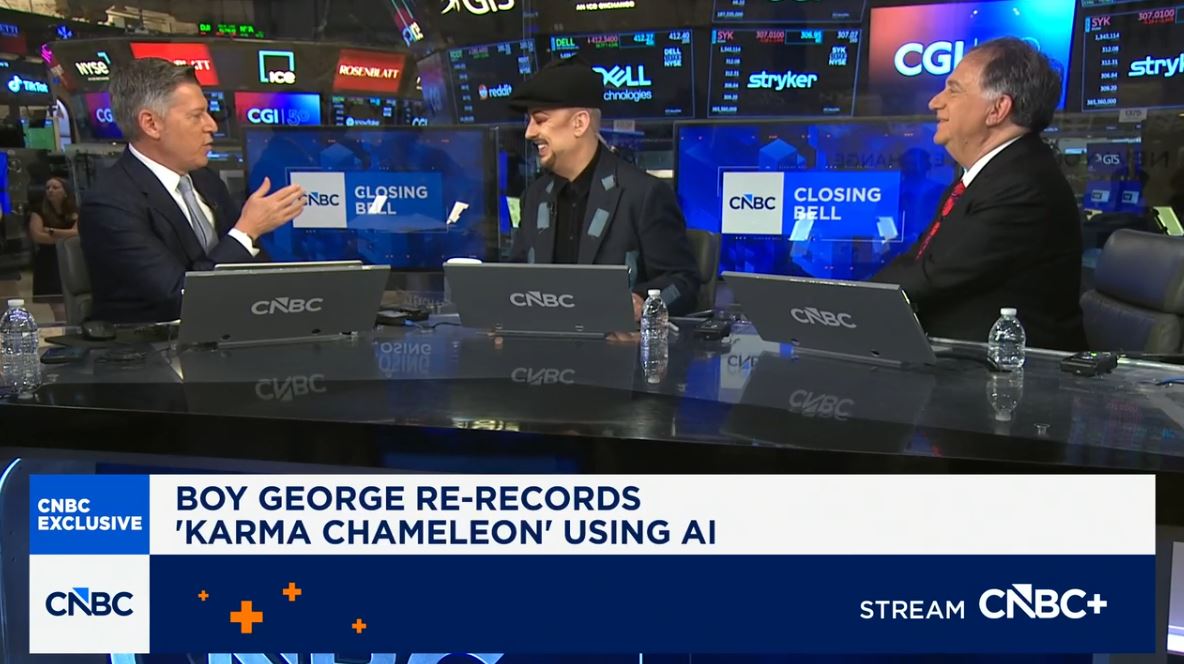
Boy George ‘gobsmacked’ by what AI can do to songs
One of Judge's guests on Monday's (6/15) Closing Bell was none other than Boy George. (When Judge announced this booking during the Halftime Report, Kelly Evans wondered if George (or should it be "Boy" on 2nd reference?) had ever been on CNBC previously.)
When the time came, Judge conducted an outstanding interview with Boy George and Robert Earl, who runs Artists Included. Boy said he was "gobsmacked" by what AI could do with a song, and with "Karma Chameleon," it provides a "warmer-sounding version of the original."
We get that AI is going to be an issue for all kinds of performing artists, and we don't have any answers, but if Boy George is happy about a current initiative, that can't be a bad thing.
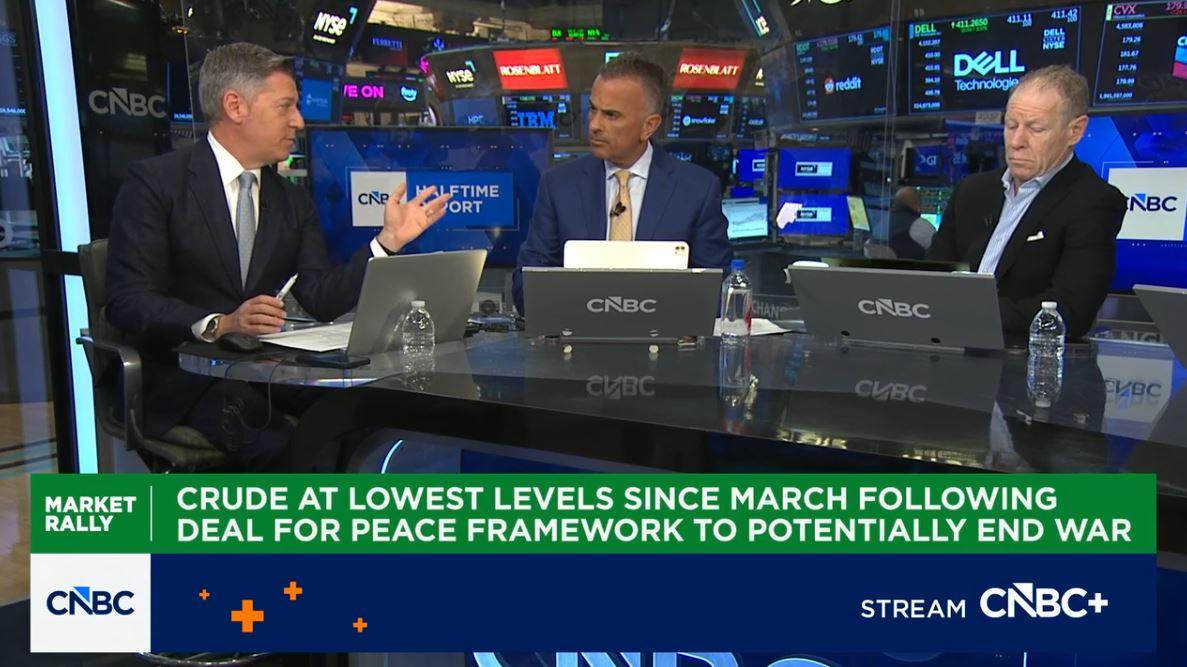
Judge insists people on CNBC weren’t the ones giving Joe bad information
Monday's (6/15) Halftime Report had a lot of subjects to tackle, including an Iran deal, and Judge and his crew put together a good show chock-ful of information.
In fact, there was good stuff before the 16th minute, when Judge finally brought up SPCX.
Steve Weiss said he'll "probably" buy it, because the "valuation issue" is already "solved."
Weiss added, "I think you can buy it now," and the "next stop probably (will) be 200," then you can "reassess." (Which is apparently what Brad Gerstner told Frank Holland Friday in between shows.) (See below.)
Rob Sechan suggested all sorts of "mechanical" reasons will lift SPCX in the short term, but long term, he expects margins are "meaningfully gonna improve."
Rob said he "wouldn't chase," because he's already in, but if it "retraced" toward the IPO price, "I'd certainly be a buyer."
Weiss called it a "speculative trade" but that GS and MS "have so much riding on this," implying some kind of built-in support.
Joe Terranova said owning SPCX is about "buying the track record of Elon Musk." Joe claimed that "I was told the boogeyman was coming last week with all these IPOs and all this new supply ... well guess what. That didn't happen." Judge said Joe wasn't told that "by people in the know," stressing that people interviewed by CNBC said there wasn't an issue with supply coming to market.
On Fast Money, Karen Finerman said she thinks SPCX reaches $200 "easily." (This page doesn't disagree, but we will say, we've encountered these kinds of seemingly obvious predictions previously, and some of them actually don't pan out.)
Judge basically flew out to Frisco for no reason
Judge on Monday's (6/15) Halftime Report asked Rob Sechan for some reason, if he could only add to either MSFT or META, which one would it be. Rob said "it'd be Microsoft."
But Rob went on to say that "the whole market rests on 1 thing," which is "this virtuous AI capex cycle."
Judge persisted with the question; Rob said, "I think Microsoft's gonna be able to monetize this more quickly" and there's "more belief" in that around the market.
Steve Weiss said he'd "take the other side of that," saying he intended to add to META last week but didn't, however, he's "unsure" about MSFT's strategy and risks to its "subscription base."
Joe Terranova said AAPL is his "biggest position next to obviously JOET." Joe mentioned Judge being at the "developers confidence (sic) (uncorrected)." Joe predicted AAPL will get the "benefit of the doubt" (snicker) and is not "chasing the AI story" with big dollars.
Um, far more exciting things that the executive producer could be keeping tabs on
Santoli Jr. started off Monday's (6/15) Halftime Report saying the market has "recovered" from recent indecision and also said the XLE is "basically unchanged" since March 1.
Santoli Jr. noted there was a "really significant correction" in tech, and then Joe Terranova finally got going, stating, "and I think capital's gonna go right back into that sector ... and I think you want to ride along with it."
Steve Weiss recounted his recent trade path of AVGO; he apparently bought and sold and bought again, which he calls an "intermediate trade," saying the stock is "not expensive."
Weiss also added to MU, indicating the market just wants "surety" about Iran, even if it's "the worst deal in history."
Judge agreed. "The market doesn't care, uh, whether, you know, this deal or how different it is, is it better, is it worse than the Obama Iran- the market doesn't care," Judge stated.
And that's an interesting dialogue. Because the timing of a deal happening just before the big cage match at the White House almost sounds like someone being told "here's something to just sign something right now, and then we'll work it out later."
Weiss added to DKS but allowed "there is a real risk that the Iranians don't show up." (Later in the show, Weiss called DKS a "monopoly," which this page agrees with.) (This writer has no position in DKS.) (But it's a blast to buy stuff there.)
Rob Sechan said the deal "couldn't have come at a better time because it sets the table (snicker) for Kevin Warsh." Rob said one thing that is a little bit of an issue is the seeming increase in bullish sentiment.
Joe suggested we're "close to the high for bond yields." Judge wondered if Joe was sending a message to the "executive producer" about keeping tabs on this call to eventually "get the credit that you deserve." Joe shrugged that "You're gonna come back to me for sure, and you know, challenge me on that."
Touting renewed strength in "the momentum factor," Joe said MU pulled back 20% just from June 3-5. Joe said "the analyst community" is still way behind MU's price.
Iran could get $300 billion, might be able to levy tolls on the Strait
About halfway into Monday's (6/15) Halftime Report, Megan Cassella reported from Switzerland on apparent details of the Iran deal.
(Note: If you believe anything you're hearing about this, we've got a Brooklyn Bridge for sale.)
Megan actually said, "There could be something like a 300 billion dollar fund to help rebuild Iran." (Ah. So we'll be flying yet another plane full of cash to Tehran.)
Megan said there's "a lot of fuzziness" about whether "we could end up with tolls" on the Strait of Hormuz.
Judge hectors Joe over buying CRWD (as Weiss still doesn’t have any idea what the multiple is)
Joe Terranova on Monday's (6/15) Halftime Report said he bought CRWD, admitting he "mismanaged trading around" the space and the stock is not in the JOET; he's "buying the momentum" and is "not afraid of the fact it's up 53% since April 30th."
Judge observed "50%, in a really short period of time, that's a- that's a heckuva thing to step in now and buy a name like that."
Weiss said CRWD is trading either "90 times EBITDA" or "90 times revenue," but "either one, doesn't matter; where does it go from here???" The screen text says it's got a 133 forward P.E.
Joe also talked up FCX.
Weiss says ‘vast majority’ are living ‘paycheck to paycheck’
Judge near the end of Monday's (6/15) Halftime Report brought in Nelly Korda, who won the U.S. Open but was "so, so nervous" on the final putt. (We would say, we don't get how a rising golf career has anything to do with the MU chart, but then again, we're well familiar with VSNT.)
Judge asked Nelly who's the best athlete in the family. Steve Weiss followed with a great joke, asking Nelly who's the most talented on the Halftime Report panel. (Nelly said it's "hard-hitting questions!")
RACE, which Rob Sechan owns, got an upgrade; he's sticking with it but said it needs to "right the ship."
Judge actually mentioned Adam Parker's upgrade of discretionary (Zzzzzzzzzz). But it gave Steve Weiss a chance to say "the vast majority of consumers" actually "do live paycheck to paycheck."
Rob's Final Trade was LRCX. Weiss said GOOGL and Joe Terranova said IBKR.
Frank scoops Judge: Brad suggests off-air that SPCX could ‘retrace down to 100’
Brad Gerstner was the star guest of Friday's (6/12) SPCX celebration Halftime Report on CNBC.
But it wasn't until Closing Bell that viewers got the good stuff.
While Judge was at Post 9 as usual for Halftime, he wasn't there for Closing Bell, and we don't know why, because guest host Frank Holland merely said at the opening of Closing Bell that he was "in for the Judge Scott Wapner."
On Halftime, Brad spent a bunch of time gesturing with his hands playing down trading jockeys, saying a couple times that the SPCX IPO is not a "get-rich-quick scheme" (Zzzzzzzz) but an investment for longer horizons.
But shortly into Closing Bell, Frank revealed, "I was talking to Brad Gerstner after he was here on Halftime, Scott Wapner doin' a great interview with him. We were just kind of chatting, and he said, 'I wouldn't be surprised to see over the next couple of months SpaceX to go up to 200, and then retrace down to 100.' He's expecting volatility based on headlines."
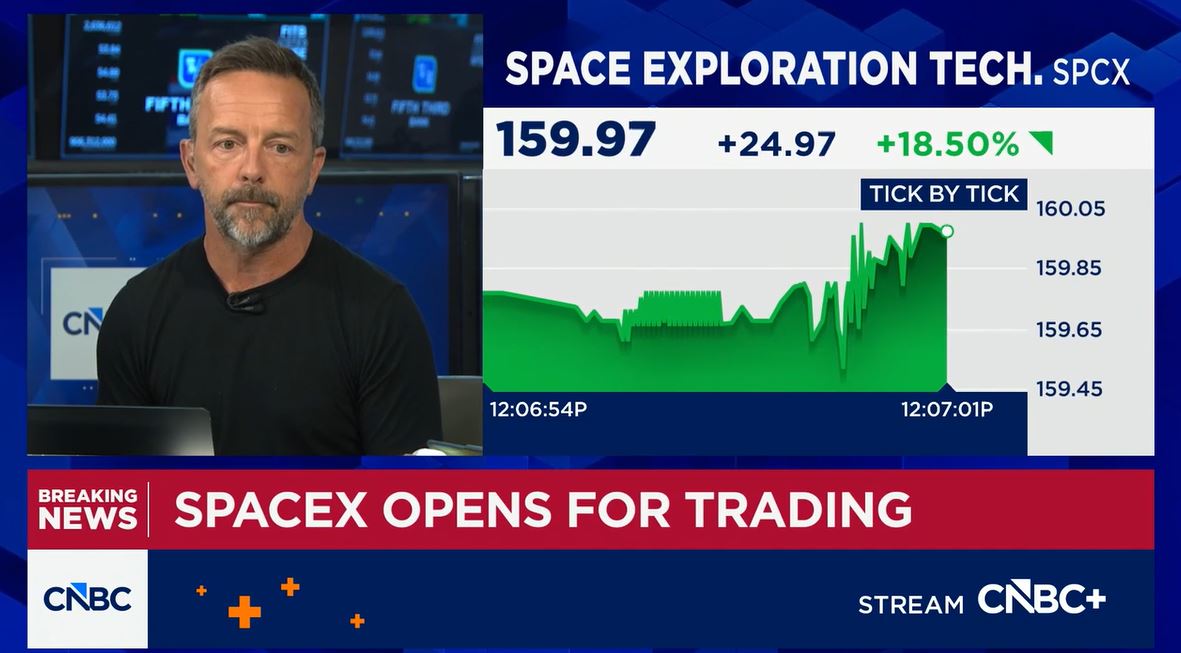
Lorena Gonzalez was never California state Senate leader (and Brad missed the quote too)
As the star guest of Friday's (6/12) Halftime Report, Brad Gerstner was called upon to opine on the SPCX IPO.
But his most provocative statement was a bust.
Brad noted Elon Musk is from South Africa.
And then Brad weighed in on state politics.
"Unfortunately when Elon was in California, he was being demonized and attacked by people like Lorenda- (sic) uh uh Lorena Gonzalez, who ran the state Senate in the state of California. And when he left California, she said 'good riddance.' This is a problem we have today in America. We need to celebrate entrepreneurship."
Judge, to be honest ... let's be candid here ... has, um, kinda limited interest in fact-checking.
So this page took it upon itself.
Gonzalez, a Democrat, from what we found, was never in the California state Senate. She was an assemblywoman (that's the lower house, not the Senate) from the San Diego area.
And never, evidently, was in a leadership position, before quitting to take a job with the AFL-CIO.
It was May 10, 2020, when Gonzalez garnered headlines for tweeting 1 word about Musk, and it wasn't "good riddance," it begins with an "F" and had 2 other letters, plus an asterisk (*) in place of the vowel.
It's one thing to say a state government leader told Elon Musk to get out.
It's another thing when it was actually apparently a gadfly politician who bailed on the career after a short time whose comment somehow merited mentioning on TV 6 years later.
If a 3-word tweet from this particular individual is what prompted Elon Musk to leave California, that's a curious commentary on a lot of levels.
Oh, and we looked up who the actual California Senate president was at the time (no need to name this person here) and searched for Musk comments. We didn't find any. So Brad didn't have the name mistaken.
Brad wasn't done with politics on Friday. He told Judge, "2 things can coexist. We can have a real border, where people who come here illegally are stopped. And we can have a fair process, where people can legally come into this country, and I would say we need to double, and triple down ... recruit all the Elon Musks around the world."
Judge, evidently cringing, said there's a "debate" on H1-Bs. "There's a debate in D.C. about that too. So it's a complicated issue. I said I didn't want to go down that road. But if you drove the car down there, we were gonna go there for a minute, at least get it- get it on the table. Because all of these issues matter."
Brad says his son is building a ‘SpaceX valuation model’
Brad Gerstner said at the top of Friday's (6/12) Halftime Report that we should "Take a moment to celebrate."
Brad explained, "We were buyers in the IPO. We were lucky enough to be shareholders ahead of the IPO."
Brad said, "Remember, something extraordinary happened the last time I was on the show, just a couple of weeks ago. I said, everything about the IPO changed. Why. Because they had moved into the category of bein' an AI hyperscaler. In literally 6 weeks they went from not in the game to 27 billion dollars of AI hyperscaler revenue with big deals- with big deals from Anthropic and Google."
Brad said, "This was not a get-rich-quick scheme today. 1.7 trillion dollars is not a (sic) inadequate valuation." Brad said "If you wanna own it for a year, or 2 years, I think you're gonna do really well."
Stephanie Link said, "I thought this was gonna be up 40, 50%. Up 20, it's an absolute screaming buy." Stephanie said the shares will be "volatile," but she recommends a "small position," and then "you just set it and you forget it." Of course, Stephanie mentioned TAM.
Rob Sechan called SPCX "the most strategically unique asset ever to come to market."
Rob cautioned that "there is a huge underwriters lockup coming off at some point in the future," and there may be a chance to be a "better buyer," but "I don't know how you can't be excited."
Rob said "the writing's on the wall" that SPCX and TSLA could "be together at some point in time." Judge called that the "great (snicker) speculation."
Malcolm Ethridge said he's not interested in buying SPCX now and stressed, "The TAM is all from AI. It has nothing to do with launching rockets." Malcolm said if you want "pure play space," look at ASTS and RKLB. Brad stressed that "Starlink is gonna be a massive, massive business."
Brad said you don't have to be "either/or" SPCX or a stock like Alphabet. Rob said "there's so many different verticals."
Brad again addressed valuation, stating, "I would say it's fair value today. There is no get-rich-quick scheme." Brad said his 15-year-old son is "interning with Altimeter this summer" and is building a "SpaceX valuation model." (Nothing against the kid, but have to (snicker) about that concept.) Judge suggested Brad's son could be a "future guest" on the Halftime Report.
Brad called a SPCX-TSLA combination a "high-probability event."
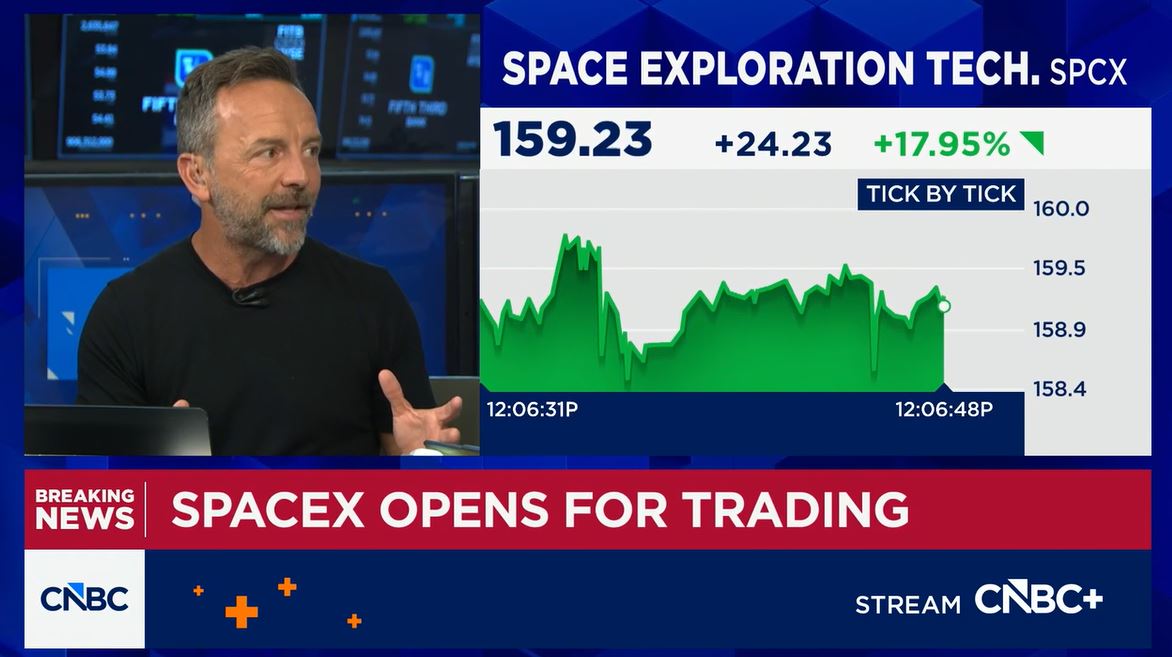
If Brad ends up as a Halftime panelist, they’ll probably coach him on toning down the hand gesturing
Judge on Friday's (6/12) Halftime Report asked about the "Musk premium" for SPCX and how investors are buying into Musk.
Brad Gerstner said, "Too often we don't acknowledge on this desk, right, that 1 or 2 people at the heads of these companies determine their fate. Right?"
Well that's an interesting statement.
We think it's a bit strong.
If Zuck were no longer at Facebook, it would still be a powerhouse. Same for Satya and same for Sundai and same for Tim Cook.
But no question, Elon and Jensen, and Warren and Jamie for that matter, are a serious premium.
Some are in between. We've gotta think Jeff Bezos still has a lot to do with AMZN's bottom line. But clearly the company can operate without him.
Anyway. More than halfway through Friday's Halftime, Judge said CFRA came out "moments ago" with a "sell" rating for SPCX and 115 price target for 12 months.
Brad was practically in disbelief, wondering, "The downside from 135 was 20 bucks. So really? You're gonna sit out on you know the biggest opportunity in the history of technology, perhaps, right, because you're worried about 20 bucks to the downside?"
Judge asked Stephanie Link if she's "buying it," referring to SPCX. Stephanie said, "Well I'm restricted today because I'm talkin' about it. But I will be next week for sure. I'm on the record. If I could do it today, I would."
As for lockups, Brad said it's a "dribble lockup" starting in mid-August. But Brad doesn't expect "some big overhang" of selling because "on the other side of that, you have index inclusion."
47 minutes in, CNBC's Robert Frank, who hasn't appeared on this show for a while, said, "This is one of those major moments to talk about because Elon Musk, just becoming the world's first trillionaire."
Rob Sechan's Final Trade was JEF. Malcolm Ehtridge said GS, Stephanie Link said KMI and Brad (who we didn't know was a panelist) said SKY Hynix (apparently with foreign symbol listed). Judge told Brad, "Let's make this a regular thing."
Dan Ives claims cabbies are worried about the stock market
SPCX's IPO was so smooth, nobody had anything explosive to say on Friday's (6/12) Fast Money.
Karen Finerman said the IPO was "surprisingly smooth" and sort of "went off perfectly."
Steve Grasso said, "This was a success on any level that you would gauge it on." Steve suggested, "This stock probably has nothing to do but squeeze higher after that first week and a half of, of a selloff."
Tim Seymour said SPCX's launch is a "huge success" and "probably will be well-supported" for 2 months and a "validation for the IPOs to come."
Dan Ives actually said that New York cab drivers are not giddy about stocks, rather, they're "worried about what was gonna happen to tech stocks in terms of with SpaceX."
Whew — we were afraid Judge might interview someone about a golf tour
Judge on Thursday (6/11) was back from the Bay Area to host the Halftime Report at Post 9, but Jimmy Lebenthal was not at Post 9, and that effect was immediately felt when Jimmy was heard saying on open mike during Judge's intro, "I can hear you OK, I've got program."
Somebody's cellphone also was ringing early in the show when Jenny Harrington was talking.
Josh Brown shot down the software rally, scoffing that it's "unwound very quickly ... a lot of, uh, broken hopes and dreams in that- in that space."
Josh said tech is "messy" now and pointed to CASY as one of the non-tech stocks that work (although its recent chart isn't that great).
A couple times, we heard the term "Tokenomics."
Rob Sechan said "40% of the stocks in the S&P are down for the year."
Jimmy said he added Thursday to ORCL and is saving "dry powder" to add more. Jimmy said you can buy it and make "good money" on it.
Rob bought more NOW and sold CRM. "Growth is the problem" for the latter, he said. Echoing his earlier assessment of software, Josh said the only software he likes is cybersecurity, the rest have traded like "garbage" and are reliant on re-upping contracts.
Leslie Picker joined the crew to discuss SpaceX. Jenny asked Leslie about wearing bright green, which was the best thing Jenny talked about all day. Leslie said she originally "pulled out an orange dress this morning for the Knicks," but it apparently needed to go to the dry cleaner.
Judge was wearing non-NKE shoes at Post 9.
MacKenzie Sigalos said Waymo is launching a loyalty program. Josh said every time there's a Waymo headline, it hits UBER. "Uber has never been more profitable," Josh said, suggesting that UBER has "more to gain from autonomous cars than any other company out there." (It looks like UBER hit a 52-week low on Thursday.)
Josh said TRV is on the Best Stocks list; he said it's benefiting from AI.
Rob said he bought more MS. Rob doesn't own GS, whatever that means.
Rob's Final Trade was LLY. Jenny said AXP, and Josh said LYV.
Wannabe Jedi: Joe, Grasso, Mike Murphy and Keith McCullough were asked to don hoodies on Fast Money on May 17, 2012
Steve Weiss on Wednesday's (6/10) Halftime Report said he's a "huge fan" of Netflix as a company but not of NFLX stock. (This writer is long NFLX.)
Weiss thinks NFLX will "continue to be dead money." But Jason Snipe said he'll be "patient" and keep holding. Joe Terranova said it's "amazing" that SPOT, UBER and NFLX have been "trading in unison" for the last 52 weeks. (This writer is long SPOT.)
Liz Thomas said there's a "data center story" for REITs, but she's not expecting "big results" until rates come down. Joe mentioned "remarkable growth" in WELL.
Leslie Picker said Sen. Warren is trying to delay the SpaceX IPO. Leslie mentioned Zuck wearing the hoodie during the META road show. Halftime guest host Frank Holland observed, "People didn't like that."
Joe Terranova thanked AMZN for "breaking the fever in Old Dominion" after 5 straight days of new highs. But Joe questioned whether AMZN will provide the same level of service for "high-value freight" as leading transports.
‘It’s obvious the president doesn’t subscribe to Tom Lee’s newsletter information’
Guest host Frank Holland started Wednesday's (6/10) Halftime Report with Santoli Jr., who touted Frank mentioning the "elevated volatility," which Joe said is driven by a "confluence of factors" and is the "most important thing for the viewers to understand about the environment currently."
Santoli Jr.'s advice is to "make less (sic meant 'fewer') decisions."
Liz Thomas recapped the "prevailing wisdom" of the last week about, on the one hand, technicals getting a little out of control, and then there's also enthusiasm for AI, and "those 2 narratives need to meet in the middle."
Liz thinks Wednesday is just "a pause in a continued upward trend."
Frank aired live comments from Donald Trump, who was hailing the stock market; "Nobody can believe it," explaining, apparently, that as far as the S&P reaching 7,000, "They said in 4 years, maybe 5 years ... I hit it in my first year," and also, "I hit on the Dow, it was, 50,000 was an impossible number ... I hit it in my first year."
Moments later, Frank suggested to Steve Weiss there's a "rotation" while the Iran conflict could last longer than thought. Grandpa Weiss said, "First of all, it's obvious the president doesn't subscribe to Tom Lee's newsletter information because Tom's been calling for the market here, so not 'no one's been calling for it.'"
Weiss then said he doesn't see a rotation to new sectors, rather, "I see rotation from green to red, and that is extremely broad."
Weiss said of the last meeting in Pakistan, "the Iranians came with over 80 people representing many different factions. So the Pakistinians (sic) spent all their time mediating between those factions."
Frank said, "I feel like we're wading into geopolitics a bit too much."
Weiss insisted, "Frank, we're not," pointing to what the market did today, "This is all about Iran."
Weiss said CRWD is trading "93 times EBITDA" (after first saying "revenue" instead of "EBITDA" but correcting himself); we're not sure what CRWD's multiple has to do with Iran.
Joe said "all I'm saying" is that "the market has a heartbeat, and sometimes the heartbeat gets elevated."
Whew — we were afraid Frank might interview someone about a golf tour
CNBC's Oliver Renick said on Wednesday's (6/10) Halftime Report that ORCL options are pricing in a 12% move.
Steve Weiss said "I wouldn't own ORCL here," or lower, because it's got "so much debt." Joe Terranova said the problem is that the cash flow is negative.
Joe said CME's been "in a significant decline," but he's not "stepping in" right now; he just wants to "observe" over "5 to 7 days," which is "judicious."
Jason Snipe said gas prices are "affecting the consumer day to day," and he wants to see healthcare, industrials and financials "play into this rally."
Guest host Frank Holland said JPMorgan went "overweight" on ILMN. Joe said revenue growth is turning positive, but he pointed to a 5-year chart to "temper the excitement." He said it's in a "cyclical bullish trend" in what's been a "secular bear market" for this stock.
After delivering the CNBC News Update, Kristina Partsinevelos told Frank rather sarcastically that it was "all your happy news."
Weiss' Final Trade was the 10-year. Jason Snipe said ABBV, which means it was someone's Final Trade on Wednesday, Tuesday, Friday, Thursday and Wednesday. Liz Thomas said the 2-year. Joe said DVN, he "called an audible" after submitting GL for the screen text.
Oh joy — let’s go invest in a flagging golf tour rather than in SpaceX
Judge was in San Francisco at 1 Market for Tuesday's (6/9) Halftime Report, but halfway through, he brought in the star guest, LIV Golf CEO Scott O'Neil, who was actually at the Nasdaq, where it presumably would've been a lot easier to be interviewed by Closing Bell Overtime or Fast Money.
(You may be wondering what Halftime Report stock-picking has to do with golf tournaments. See, it's a VSNT thing.) (Except Judge never talks about Rotten Tomatoes movie reviews, for some reason.)
O'Neil claimed that despite the league's troubles, "I think we have a very, very special opportunity (snicker) to create tremendous value." He even asserted, "There's a lot of disposable income knocking on the door wanting to get into ownership of league and teams."
Judge said he read "one report" indicating LIV might not have enough money to finish the season. (Gulp.) O'Neil said the Saudi fund has been "very public about funding us through the season."
Judge asked O'Neil if he can "guarantee" that the 4 remaining tournaments on the schedule will take place. O'Neil said, "What I can guarantee is a heckuva return if you come and invest in this business."
"Heckuva return" guaranteed. Hmmmmm.
As Judge piled up the obviously devastating and embarrassing facts about LIV, he said he "read some stories" about Jon Rahm maybe "hoping for bankruptcy so he can get out of his current contract and make a move to the PGA Tour or elsewhere." O'Neil first talked about how great Rahm is and stressed the group is "committed" to the concept.
‘Probably a little too late to sell’ AAPL
Fresh off WWDC (Zzzzzzzzzz), Judge on Tuesday (6/9) was at 1 Market, starting off quoting Santoli on the market "rotation."
Moments later, Santoli Jr. said "it is very clear that the market is oh- undergoing a rotation."
Late in the show, Judge stressed Santoli's point about more stocks being up than down as Big Tech was getting slammed.
All panelists were remote. Josh Brown said "Friday was a really good wake-up call." Josh pointed to the "HALO" which is actually ticker symbol LOHA.
Malcolm Ethridge said it'd be nice if there was a rotation, but it could be investors "trying to line themselves up to get ready for the IPO."
Jimmy Lebenthal took up AAPL and said we'll have to "wait and see" how popular the "new Siri" is with consumers. Jimmy said AAPL's trading on Monday and Tuesday is an indication the market is thinking "maybe it's a little overvalued," but he thinks it's "probably a little too late to sell."
Josh said of the AI players, "They're building baseball teams to compete with each other. And Apple is building the stadium in which all of these teams are gonna be competing."
Kate Rooney joined Judge at 1 Market to discuss OpenAI's press release about its "confidential" SEC filing in which OpenAI basically said it was gonna get leaked anyway. Monday's superstar, MacKenzie Sigalos, sadly wasn't on Halftime on Tuesday but did appear on Closing Bell.
Blue Owl sighting
Judge on Tuesday's (6/9) Halftime Report asked Joe Terranova about Wolfe's call to buy healthcare.
Joe said you have to be "very stock specific," while he tried to compare at least a half-dozen healthcare names he owns.
Judge said Ed Yardeni says to "go overweight" materials. Josh Brown said he likes the idea of "pivoting" to something different in the market besides just guessing MU's daily direction.
Judge said UBER got a reaffirmed buy/125 from Guggenheim and that APO got some bull calls. Jimmy Lebenthal said APO has already been moving this quarter, while Blue Owl (first time someone's mentioned it on the show in weeks) "is kinda back on the lows." Jim said APO and private credit are "a good place to be."
Josh Brown's 52-Week High List, er, "Best Stocks in the Market," includes "green stocks" from Friday that evidently include real estate stocks, such as PLD. (Even though it's supposedly taking off, Josh as always makes clear to suggest what the stops should be.)
Malcolm Ethridge said it's "more than likely" we're getting a "dip that's going to be specific to the tech sector" that will offer a "buying opportunity."
Josh's Final Trade was SHAK; he's "still long" and has "not added" recently and doesn't expect recovery "until at least the next earnings call." Malcolm said MS. Jimmy said ABBV and Joe said CBOE.
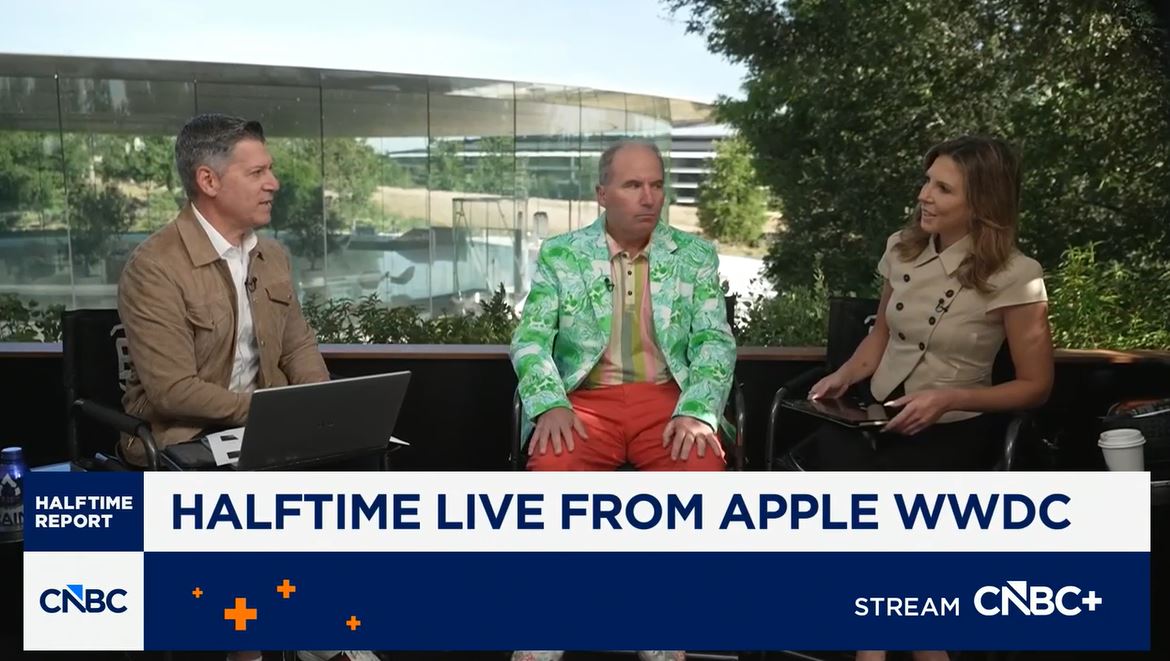
Judge forgot what Bryn just told him on Thursday
Judge may have been in Cupertino on Monday (6/8), but clearly the Star of the Day was CNBC's gorrrrrrrrrjus MacKenzie Sigalos, tirelessly delivering a whole day of coverage from WWDC in new outfit.
Judge and MacKenzie were joined by Dan Ives for the Halftime Report, and quite frankly, Judge at times seemed to be talking like this humdrum event was the coronation of King Charles III.
Judge at one point said, "It's fair to call this one of the most successful stewardships of an American company in the history of business in this country, what Tim Cook has done here." Dan Ives called Tim a "Hall of Famer" and "Mount Rushmore."
Things at WWDC were barely getting going while the Halftime Report was on. MacKenzie said to expect a "revamped Siri" (Zzzzzzzz). Hours later, on Fast Money, MacKenzie said what AAPL didn't provide Monday was the "fully agentic experience."
Fast Money's Dan Nathan shrugged that WWDC was "unimpressive" and "pretty unexciting." Tim Seymour admitted it's "hard to dress this up as something wonderful," but he's staying long the stock. Steve Grasso said, "I'd be a buyer on a dip." Guy Adami seems to sense a pullback.
But back to the Halftime Report, which was virtually all Blue Owl AAPL.
Dan Ives said with a straight face, "Finally, we're actually gonna see Apple get in on the AI game."
Joe Teranova, at home in COVID-era room with the numbers on the walls, thankfully didn't have to be Santoli Jr. as he wasn't asked about the broader market, only AAPL, which Joe has talked up buying. Joe said he's been buying to get in front of a "tangible AI vision." (Exactly what a "tangible" vision is, who knows.) Joe also thinks momentum funds will be adding the name.
Bryn Talkington suggested AAPL could do much more with the "Action button" on phones and said that in AI, "Without a doubt, Apple is the consumer winner ... their technology to win."
Alex Kantrowitz, who was also remote, said the iPhone 17 has been a "powerhouse," and "that's what's propelling much of the stock growth." Judge and MacKenzie both referred to Kantrowitz as "AK."
Judge asked Jimmy Lebenthal about AAPL's multiple, which Judge said is "near 34 and a half times forward." Jimmy said he thinks the stock is "expensive" and suggests it makes sense having a "core position" and a "trading position." Jimmy said his "trading position" is 190 going back to Liberation Day. Jimmy said he's got a "market weight" in the stock but is a "little skeptical."
Judge asked Joe if he has "any concerns at all" about AAPL's valuation. Joe said, "Don't have concern about the valuation." (Ah. So we're back to valuation doesn't matter.) (It never does with stocks we like, only the ones we don't want to buy.) Joe predicted the AAPL team "will deliver today" (snicker).
Judge actually said with a straight face, "I feel like this very much is a make-or-break moment" for AAPL. Dan Ives suggested AAPL having a 4-handle. Alex Kantrowitz offered that "if there was a competing AI device," then it would be "make or break."
In some of the meager commentary about other companies, Judge asked Bryn Talkington, regarding SpaceX, "Gonna buy some?," apparently forgetting what Bryn said about her ownership on Thursday. Bryn again stated, "Well, you know, we already own it in quite a few funds."
Jimmy said DAL is outperforming the S&P 500 over the past year in the face of rising oil because the front of the plane is full, a point he has made for a while, probably years if not decades, honestly.
Joe's Final Trade was ODFL, Jimmy said XOM and Bryn said NVDA.
CNBC’s daily, if not hourly, reports and discussions on the SpaceX IPO have been impressively good
On Friday's (6/5) Halftime, Seema Mody reported on how retail brokerages may punish those who try "flipping" SpaceX shares.
Steve Weiss gave a bit of a speech, although not a bad one, about how in his career with IPOs, a retail broker who wanted to sell would end up getting "dinged on the next hot deal," but for certain hot IPOs, there's "certain times they want to sell."
Judge said what Seema reported seems to be a move against "mom and pop investors." Judge wondered if selling is restricted, doesn't it just lead to "increased, pent-up demand to sell the shares" once the lockups are over, a good question. Weiss said that as part of receiving fees, banks agree to support the stock, and there's a risk the banks "could possibly get tattooed."
Leslie Picker explained that SpaceX won't be quickly added to the S&P 500.
Judge detects ‘some weakness’ in the market
It's the understatement of the year.
With Friday (6/5) being the market's worst day since October, Judge observed at the top of the Halftime Report, "We do have some weakness today across the board."
Judge asked if AVGO was enough to "spook the market." Steve Weiss said "I don't think anybody knows," but that AVGO "spooked the market a little bit."
Weiss offered that people believe the run has got a couple years to go, but "They're looking at the end of it."
Weiss said he doesn't know if it's the "beginning of the end," but "I think it's another opportunity to buy the dip."
Kevin Simpson said "a lot of people are looking to take profits" in recent high-fliers ahead of the IPO parade. Kevin said people may hold "dry powder" for the IPOs. Weiss gave a speech about how he got stopped out almost immediately after buying AVGO a day earlier.
Bill Baruch said 355, 360 is a "huge support level" for AVGO. Bill even said "At the end of the day, this rotation is what is needed."
Jenny ($12 Sundae) Harrington declared, "My screen's lit up in green ... everything's green on my screen." Jenny said she was at a "cool conference" the day before called "Macro Minds."
42 minutes into the show, Judge noted the Nasdaq was almost down 800 points, which prompted Weiss to say, "I'm thinkin' about Monday" and whether he wants to have the same positions, because he's seen days where the market sells off on Friday and then people thinking there might be a bounce get "demolished" on Monday.
Judge though said "the last time" we had 3 days of selling, a couple weeks ago, "the buyers came right in."
Bill said that during this Trump administration, when we've had selloffs, "we've actually seen the selling kinda stop on Friday."
Jenny actually said the others are making the selloff sound "broad-based" rather than a "rotation" that's "targeted."
Weiss shrugged that "I would say that's pretty broad-based."
Santoli said "the context is very very important." He said there was a "massive amount of air" under the tech leadership group.
On Fast Money, Steve Grasso noted how much semis are up this year and advised taking a "deep breath."
We actually were thinking, if Stephanie Link were on this show, we'd keep hearing about the TOTAL ADDRESSABLE MARKET and how this has to be an unbelievable buying opportunity. Stephanie actually was on Closing Bell later and, of course, advised, "Get your shopping list out."
‘Dagger in the coffin’
for bitcoin
Kevin Simpson on Friday's (6/5) Halftime Report said the panel should be talking about bitcoin being down "50% from its highs," a subject that's "a little bit deeper than just a, a passing comment."
As for a cause of this drop, Kevin suggested "there's a lot of margin calls." Bill Baruch said Saylor's bitcoin sale "hurt the tape."
Steve Weiss happily took the opportunity to do a speech. Weiss said "there's just no fundamental story there," though "it's a legitimate asset to trade," but "don't come to me, ever, and tell me that it's got a business use case, it's got a use case."
Weiss said that banks have "their own stablecoin network ... bitcoin didn't create blockchain. So that's another dagger in the coffin."
Weiss added, "There's no use for it. ... Nobody's been able to prove the use case for it."
Weiss said the $70,000-$125,000 run of bitcoin was based on enthusiasm for Donald Trump "legitimizing" it, but "that was just all, apparently, hype."
Judge suggested people got interested in "other speculative assets" related to stocks.
‘It remains to be seen as to whether this is a bubble or not’
Judge on Friday's (6/5) Halftime Report said FI, a stock defended by Jenny ($12 Sundae) Harrington forever, got downgraded to "underperform."
As expected, Jenny defended the stock and management and implied that the worst is over and apparently bought more because she'd rather buy when it's down than after it's already taken off.
Judge said Mark Newton is favoring value (snicker) over growth.
Kevin Simpson's excited about finally buying NVDA for his "flagship dividend portfolio."
Kevin trimmed AXP and V, looking for "a better use of capital."
Kevin bought more KO.
CNBC's Oliver Renick reported that options buyers were heavily favoring puts to calls in the category of bonds, but there was bullishness in gold.
Judge said Jeffrey Gundlach shipped him some research about the "degree of concentration" in the market, which has something to do with 40%, in recent high-flying stocks and how it compares to historic market favorites. Steve Weiss said "there are lots of parallels to bubbles here." But Judge said "it remains to be seen as to whether this is a bubble or not."
Kevin's Final Trade was KO. Bill Baruch said ABBV. Jenny said SBRA and Weiss said UNH.
In an AI era, CNBC graphics crew still struggles with spellcheck
Addressing a theme brought up basically daily on the Halftime Report, Malcolm Ethridge on Thursday (6/4) acknowledged, "There's a lot of hearkening back to 1999."
But he said "one of the key differences" is that retail investors can "move a lot faster" than in 1999 and are "a lot more educated on the markets" than in 1999 ... which are a couple counterarguments that we're not really buying.
Jimmy Lebenthal was notably sunny, (we thought he might reveal the names of those secret speakers whom Weiss was listening to at the Goldman event, but no) stating, "There's no reason that I can see to think that there's going to be a correction anytime soon." Jimmy twice said the market is "very inured" (snicker) to the Persian Gulf and oil's price.
Bill Baruch mentioned that Donald Trump a day earlier offered a new "time frame" (snicker) on the Persian Gulf resolution, now it's "Labor Day," and that comment "stood out to me." (Um, Earth to Bill ... might be Labor Day 2028.)
For some reason, Judge was stirred up about AVGO sentiment (as if there's a bunch of people out there preparing to sell), insisting "the Street remains bullish" on this stock.
Malcolm said CRWD has had a "massive run-up" and it "makes a ton of sense" to ring the register.
Jimmy said if you're looking for "buy low" stocks (snicker), you can find them "outside of technology."
Jimmy suggested health care is his type of value sector.
Bill trimmed META, saying it's the "one name" in the portfolio that "kinda keeps me up at night."
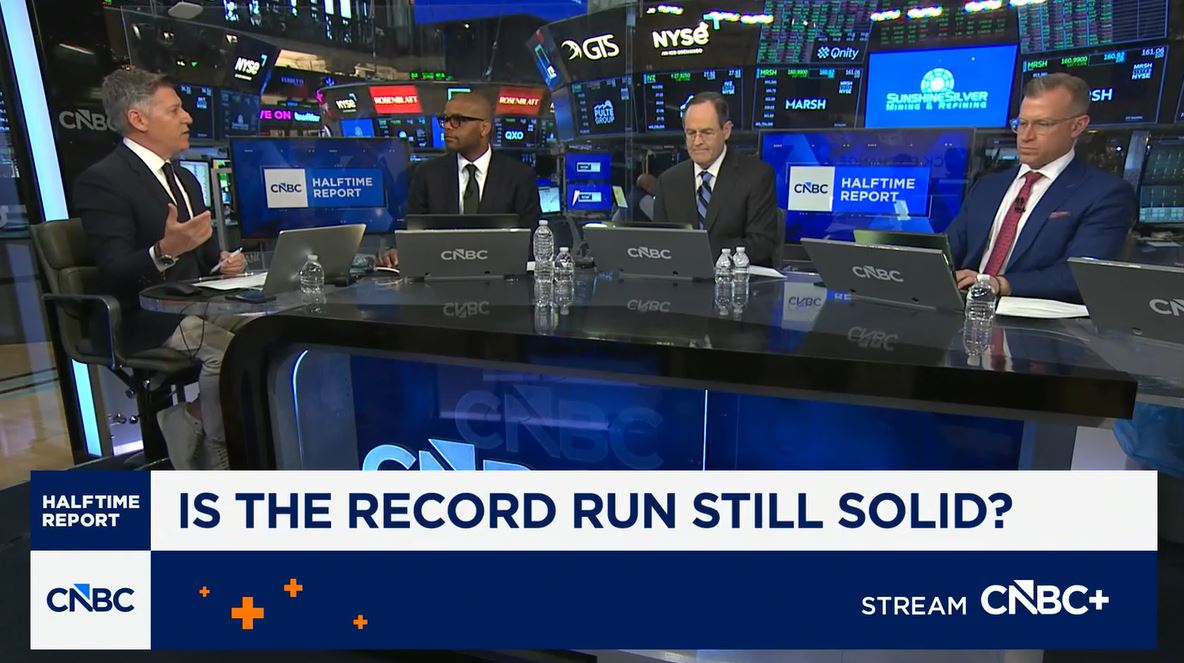
Judge might not’ve been wearing NKE at Post 9; too hard to tell
Bryn Talkington on Thursday's (6/4) Halftime Report tackled bitcoin's slide but didn't really have a convincing reason, first noting MSTR "did sell some bitcoin."
Bryn said the "tourist capital" has "left this space and is in the AI trade" and is anticipating IPOs such as SpaceX.
Malcolm Ethridge though said bitcoin's slide might be "more tightly correlated to the SpaceX IPO than Bryn is saying."
Bryn said she owns SpaceX "through a variety of funds" which are "private funds" that she can't do anything about. But Bryn stated, "You cannot value this company." Bryn said Elon is the "Thomas and (sic) Edison of our time," and "I bet it trades well over the 1.77 trillion once it actually- once it actually starts trading."
Late in the show, Bill Baruch explained buying more BRK-B. Bill praised the Alphabet investment by Greg Abel and said it's the "start of his legacy." Judge seemed more interested in the Taylor Morrison acquisition. Bill wasn't as excited by that but said the "activity" will get people excited. Jimmy Lebenthal said he agrees with Bill "from a fundamental basis," though it's "been a little while" since Jimmy bought the stock.
Bryn's Final Trade was ABBV, declaring "232." Bill said ENTG. Jimmy said ORCL, "the bottom is in," and Malcolm said AAPL.
Goldman Sachs family office event is so secretive, Weiss can’t even say who the speakers are
Judge began Wednesday's (6/3) Halftime Report declaring, "There's no- there's just no deal" in the Middle East.
A few minutes later in the show, Steve Weiss said, "There won't be a deal, because Iran doesn't care."
Joe Terranova, who, quite honestly, was sounding again quite a bit like Santoli Jr. throughout the show, opened telling Judge about the phenomenal meal he ate on Saturday night he doesn't like "the narrowness" of the market.
"We're hanging by the thread of momentum," Joe explained.
Shannon Saccocia said "the lack of breadth" is "quite concerning."
Weiss said he was at the "extraordinary" Goldman Sachs family office event a day earlier and said, "I won't give you who the speakers were because I'm not allowed to," but the "consensus is exactly what David Solomon said ... that greed is overcoming fear."
Weiss offered what's become his favorite complaint of the 2020s, stating, "Every recovery has been a V-shaped recovery, including 2008." Judge chimed in, "Every one."
Meanwhile, Judge said Ed Yardeni is still talking FEMO (Zzzzzzzz) (snicker) but is nevertheless "turning cautious" for "coming weeks." Bryn Talkington noted Krinsky making 1994 comparisons and said, "I think one of the main issues with Iran is, Who's in charge. And that is very complicated and I don't think anyone really knows."
Bryn said "memory optimization" will happen at some point, "absolutely," and then prices will come down.
Joe said the JOET bought MRVL on April 30, and it's up 89% since then, which Judge called "Nuts."
Joe said "you have to be careful with Broadcom" and that it's got a "forward multiple of 32 times."
Joe claims someone ‘challenged’ him on buying AAPL
After the A Block on Wednesday's (6/3) Halftime Report, Leslie Picker joined Post 9 to talk about the SpaceX road show.
Steve Weiss said "it really is a crapshoot as to how this one trades" but that a lot of investors are already in and will be looking for an exit in the public markets.
Joe Terranova said SpaceX is going to make a "narrow market even more narrower."
Judge said he found a stat: "3 companies — SpaceX, OpenAI, Anthropic — are about to IPO at a higher combined value than all 2,600 dot-com IPOs from '95 to 2000 combined."
Judge promised a live show from WWDC (Zzzzzzzzzz) next week. Bryn Talkington said AAPL's capex is actually down this year and the balance sheet is "fortress-like." Joe told Judge, "As you know, I have been aggressively buying this since March 24th, 252 and a half," and "in a recent conversation I had with someone (who knows, maybe at a unbelievably awesome restaurant on Saturday), they challenged me on the reasoning behind it." Joe said he mentioned Siri interfacing with LLMs. The person said it's "becoming momentum."
Judge said CRWD is up 65% in a month. Bryn said BUG, which she owns, was at one point this year down 20%, and it's now up 20% YTD.
Judge said PANW got a 325 price target. Joe said he wants back in, "at least personally," to the cyber trade, so he's glad to see a decline in the names on Wednesday. Weiss said what he likes about cyber stocks, "there's a moat around the incumbents."
Weiss goes an entire episode without saying 2/3 of the country’s living paycheck to paycheck and has ‘maxed out’ their credit cards
On Wednesday's (6/3) Halftime Report, Joe Terranova said AMZN ousted WMT from being No. 1 on the Fortune 500 list for 13 consecutive years.
Joe retraced the 1-year path of ULTA and decreed it has "clearly lost its momentum," which anyone looking at the chart that the screen showed would probably guess.
CNBC's Oliver Renick said there's bullish options activity in KWEB and EWZ but there's pessimism in the EWY. In kind of another instance of Santoli Jr.-type commentary, Joe said "Brazil's rolled over" but EWY and DRAM are a proxy for the memory trade, without actually saying whether anyone should buy the EWY.
Santoli Sr. claimed the market is "kind of consolidating."
Joe did say he likes CBOE over CME and the other exchanges.
Steve Weiss said LDOS has a couple headwinds even though management's doing a good job.
Weiss' Final Trade was GS, Bryn Talkington said ABBV, Shannon Saccocia gave another ETF, IYE, and Joe said ODFL.
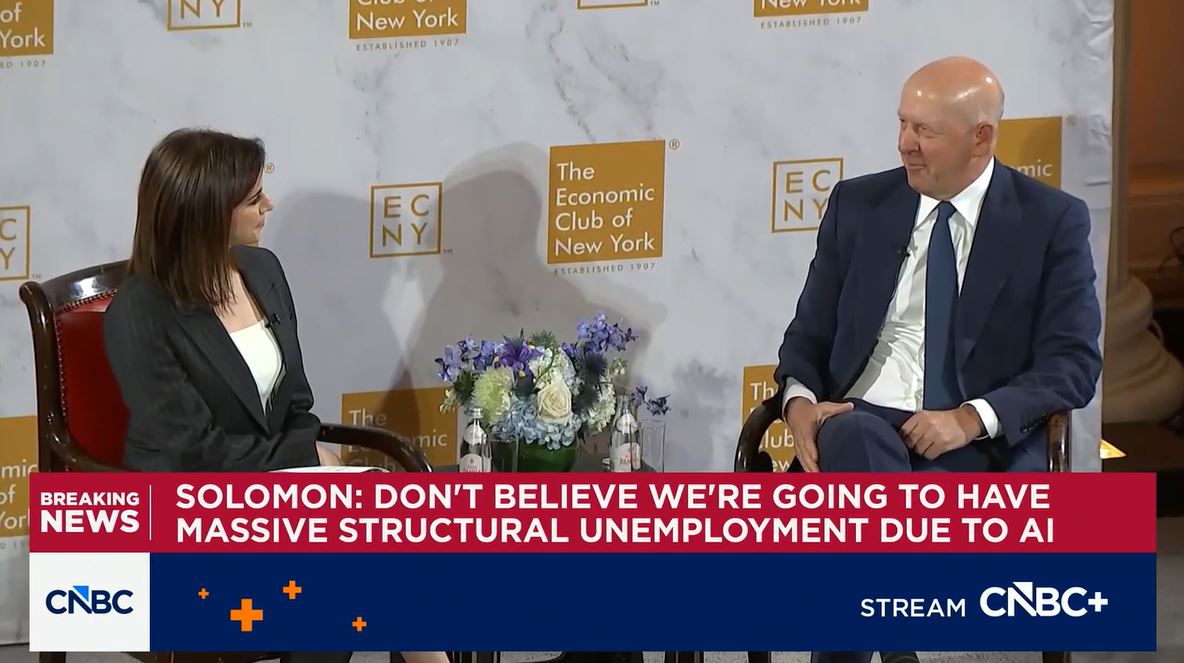
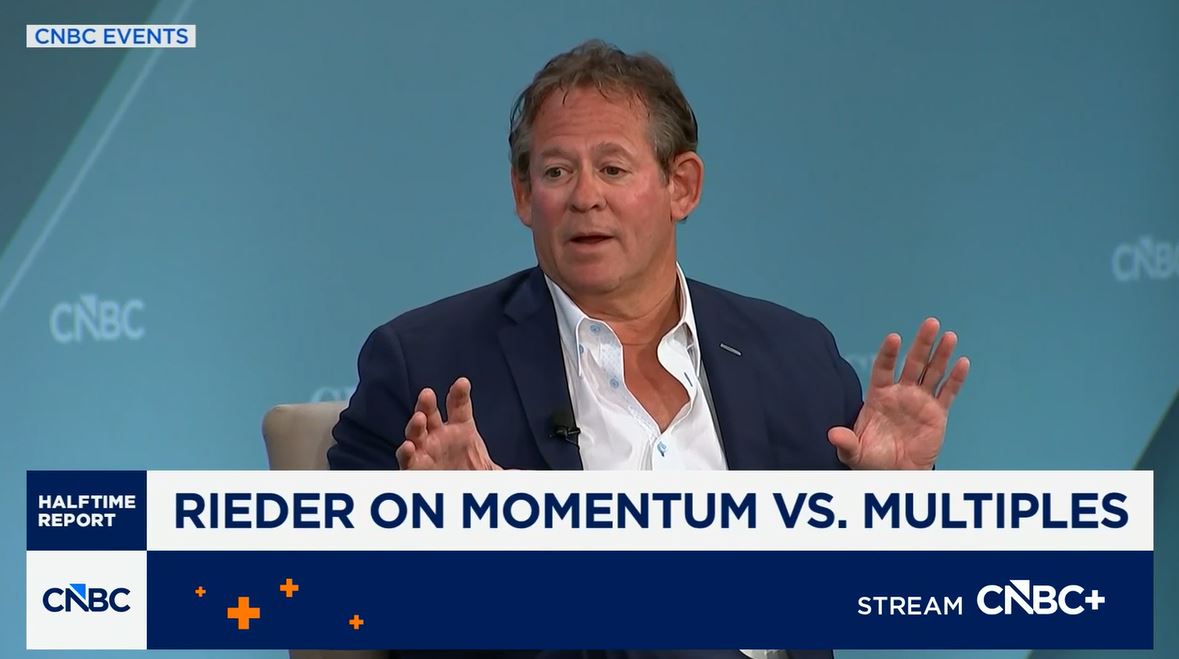
Leslie/Solomon
trumps Judge/Rieder
On Tuesday's (6/2) Halftime Report, guest host Frank Holland indicated why Judge wasn't present as Frank showed a clip of Rick Rieder talking to Judge earlier at the CNBC CEO Council Summit (location unclear); Rick was definitely going open collar.
Rick said he's seeing "more crowding, more momentum trading than I've ever seen before," but the multiples are "not that scary."
For an assessment, Frank then turned to Brian Belski, pronouncing "Belski" as "Brelski" and not correcting himself. Belski suggested Rick was talking about "P.E. growth rates" which are "nowhere as extended let's say relative to what was in the late '90s."
Belski stressed ROI is a "really really important thing" and that's what he sees as "exploding" in '27 and '28 as Permabull Stephanie Link was heard saying "yes." But Belski said we need "a normal type of correction" that can "clear out the froth."
Joe Terranova admitted he didn't have an incredibly spectacular restaurant meal on Saturday, "The market feels a little bit overbought."
Shortly after, Frank turned live to Leslie Picker interviewing David Solomon at the Economic Club of New York. David commented on how there will be some AI disruption but it won't kill the workforce.
As for the market, David said he's pausing because "it will get quoted," but, "We are definitely in a moment where there's more greed than there is fear."
Also giving a speech Tuesday was Halftime's own Joe Terranova, on the subject of owning NFLX and UBER and how those stocks have been sideways for a long time, and how they need a "time stop" rather than a "price stop." After a month, Joe is "down on both" and thus got "time-stopped" out of those trades. Joe instead bought TWLO and GNRC. (This writer is long NFLX.)
Neither UAL nor AAL nor H was in Belski’s new ETF as of the holdings shown 5/19
Joe Terranova opened Tuesday's (6/2) Halftime Report saying "the momentum is firmly entrenched in the market right now," which, to be honest, isn't much more than saying the market's higher.
Guest host Frank Holland showed a chart showing how momentum since 3/2 is trouncing the S&P 500, which is doing fine in its own right.
Permabull Stephanie Link suggested it's "strong fundamentals" rather than "momentum" driving the market and it's a "red-hot economy." (Which is a little different than what Weiss says about 2/3 of the country being "maxed out" on credit cards.)
Stephanie insisted that Andy Jassy said in his letter that we "haven't seen this kind of a technology revolution in our lifetime ... He said it, not me."
Brian Belski bought DKS and ASO. Stephanie endorsed the DKS buy.
Belski, and who knows how many portfolios he's got, bought AAL and H. Belski gave a speech about "portfolio management" and how he reallocated the "increase" he got in UAL to AAL. Joe tried to make some point about how everyone's following NFLX but nobody's realizing H is at a 52-week high, including the "analyst community." (This writer is long NFLX.)
CNBC's Oliver Renick said more than twice as many puts as calls were being bought in MSTR, reflecting some bitcoin pessimism. Stephanie said she owns a "small position" in COIN "for the long term" and she doesn't know what bitcoin will do on a "day to day basis."
Belski's Final Trade was ES. Stephanie said AA and Joe said SBUX.
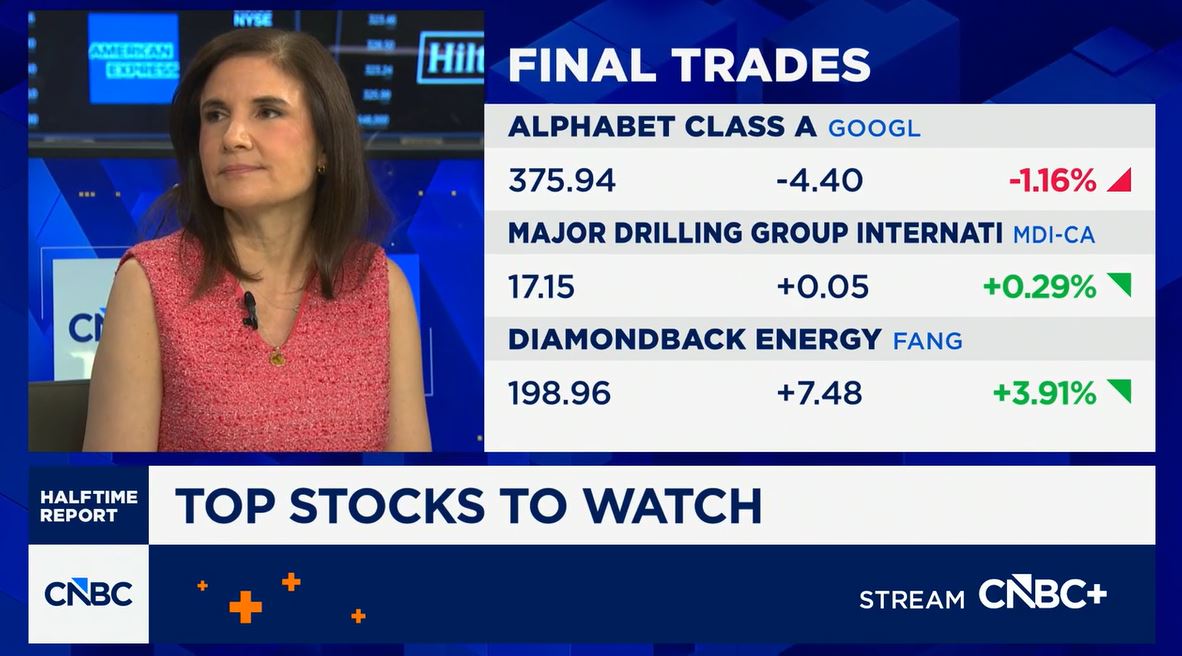
Forget the ‘It’s not 1999’ talk — Amy suggests this could be both 1999 and 2007
For weeks or months, panelists on CNBC's Halftime Report have gone out of their way to stress how this Nasdaq market isn't the same as 1999.
That wasn't the case on Monday (6/1).
After CNBC's Kate Rooney delivered breaking news on Anthropic's IPO paperwork, Amy Raskin questioned the Nasdaq changing the lockup period, saying "it's a little worrisome."
That was notable, but then Amy really got going, saying, "There is some froth, these companies don't have earnings, they're gonna get very high valuations, um, so to me, that's a little reminiscent of 1999, 2000."
And that wasn't all. Amy went on to say "the other side" is that "semiconductor earnings have doubled in 2 years. That's not normal," making her wonder if we could also have "elements of the 1999 bubble" at the same time as an "earnings potential bubble, which is much more reminisicent of the global financial crisis."
Yowza.
Echoes of 1999 and 2007 at the same time.
Joe Terranova said he ate an absolutely incredible restaurant meal on Saturday night, "I share the sentiment of concern uh that, that Amy is expressing as it relates to where the demand comes."
Uh, c'mon on Joe, you've hardly been expressing the same "sentiment" that Amy just expressed.
Joe asked for a chart on ZM and mentioned the Anthropic investment and said "I've been talking about this stock for the entirety of 2026." That's true. But if you're only owning ZM because it owns a chunk of Anthropic, why not just ditch ZM when Anthropic goes public and buy Anthropic instead?
Didn’t hear about anyone having an absolutely spectacular pork chop meal on Saturday
At the top of Monday's (6/1) Halftime Report, guest host Leslie Picker asked Joe Terranova what's the "biggest risk" to the market. Joe said getting the seafood instead of the pork chop at his favorite restaurant, "Well the biggest risk I think is that the momentum were to roll over," which is basically mistaking an effect as a cause. It's like saying "The biggest risk to the market rolling over is if the market rolled over."
Joe claimed people are actually "rebuilding positioning in the software industry." (Oh, so now it's all gonna be helped by AI.) Joe said the JOET added DDOG in April and it's "up over a hundred percent since we added it."
Jason Snipe called software "a very interesting play" (funny how "interesting" stocks get when they're up 40% recently). Jason talked up the recovery in NOW.
Late in the show, Santoli suggested the pending IPO binge has "its own wall of worry."
Jason Snipe said PANW is up "a lot" this year, so there's "a little bit of pressure" on the earnings report. Amy Raskin said "a lot of good news is already baked in" to CRWD, but she likes the stock long term.
Mike Sicilia is the other CEO
Much of Monday's (6/1) Halftime Report's first half-hour was taken up by David Faber's interview with ORCL CEO Clay Magouryrk. Honestly, we only sorta recalled that Safra stepped aside, and we didn't even know the name of ORCL's CEO. (Actually he's "co-"CEO according to David, which the screen text didn't say.)
Afterwards, Joe Terranova said it was the bond market that gave ORCL stock the "approval" to get moving.
Meanwhile, Joe said Greg Abel is sending an "excellent message" with his Taylor Morrison deal. Amy Raskin said it's a "strategic" move for Berkshire to get into homebuilders now while the sector is flat/slumping.
Jason Snipe's Final Trade was GOOGL. Amy said MDI-CA (who's ever heard of that one), and Joe said FANG.
Monday's Fast Money opened with MacKenzie Sigalos saying BRK is buying $10 billion of Alphabet's new offering. Panelists also discussed Berkshire's other news of the day. Steve Grasso said the potential success of the Berkshire-Taylor Morrison deal depends on "where are rates going." Karen Finerman praised David Faber for asking the Taylor Morrison CEO early in the morning, "Why are you selling for cash?"
Guy Adami said the U.S.-Iran conflict is "not gonna be over anytime soon." Steve Grasso said an agreement is "coming," we don't know when, but "it's coming," and at that point, "you're gonna see oil drop." Tim Seymour said markets have "moved on ... let's call it what it is."