[CNBCfix Fast Money Review Archive — March 2026]
Sully asks, ‘Is there an Iranian nation right now?’
As Iran headlines powered the stock market on Tuesday (3/31), Sully on Power Lunch was asking a guest, "Who's speaking for the Iranian nation, assuming, and I- I mean this respectfully to the people there, 'cause it's not their fault, is there an Iranian nation right now?"
The guest indicated that there are indeed people in leadership positions in Iran.
But Sully asks a good question.
News flash: Panelists on the Halftime Report think NFLX should not have bid for WBD (a/k/a Joe basically capitulated near the bottom)
Julia Boorstin reported during Tuesday's (3/31) Halftime on NFLX's interest in more NFL games. (This writer is long NFLX.)
This page has noted that Halftime viewers are going to be hearing someone on the Halftime Report for the next 6 months questioning NFLX's bid for WBD.
On Tuesday, Brian Belski stated that it was a "very very good thing they didn't get the Warner Bros." (Actually, if they had gotten it for a decent price, it quite possibly would've been a good thing.) Belski said NFL interest is "very good news for Netflix."
Josh Brown said, "I don't understand why this stock is still below a hundred." Josh said it deserves "more of a premium multiple."
Stephanie Link rattled off NFLX's metrics and questioned why it hasn't recovered more.
Joe Terranova recapped how he bought NFLX in May 2024 at $66 (which really doesn't do anyone any good right now) (at least he didn't give us a Kevin Simpson-META trade history lesson) and sold at $80 in February; "didn't want to take a loss on it." Joe said "at some point," he'll be back in the stock.
Josh made NFLX his Final Trade.
Joe’s ‘punitive’ market eases
Judge opened Tuesday's (3/31) Halftime recapping the day's Iran headlines, although the market didn't really get turbocharged until late in the show.
Joe Terranova mentioned Tuesday being the "last day of the quarter" as a market factor and said the market was "deeply oversold" and Monday afternoon "was incredibly punitive," Joe's word of the month.
Permabull Stephanie Link told Judge, "If we wait for certainty, Scott, the market's gonna run away from us on the upside."
Judge said, "You hope."
Stephanie said, "Hope is not a way to invest, for sure." Stephanie said she's been "buying throughout this entire downdraft."
Brian Belski contended, "What's going on right now is exactly what happens in an earnings-driven market."
Belski described himself as "tactically convicted and structurally bullish longer term."
"I think this is a- a fantastic time to be convicted (snicker) in your stock picks," Belski said.
Josh Brown said "A lot of long-only managers point out all the opportunities here, but they were fully invested 9% higher in the S&P. ... So it's like, all right, so, with new money, you like the same stocks that you liked 20% higher? OK. I don't know how helpful that is." Josh said the "best comment" was Stephanie noting that valuations have dropped. Josh also said that the "momentum washout" referenced by Joe was "helpful."
Judge once again rattled off a chart of what CNBC claims are forward P.E.s.
‘Wholesale vomit’
In an interesting purchase, Josh Brown on Tuesday's (3/31) Halftime Report said he bought IGV because he thought Friday afternoon looked like a "wholesale vomit."
Stephanie Link is "really shocked" at META's pullback; of course it's an "opportunity" for the long term.
Judge aired a morning clip of Jensen on CNBC and then talked about Judge's own interview with Jensen at the Super Bowl, and both Judge and Joe Terranova gushed about how good Jensen does at making financial observations.
Joe said, "I don't see what the issue is with Nvidia," it's "running in place" and all that's been happening is "moderation" in revenue growth.
Joe said TER is offering a "great entry point."
Joe said AAPL is a name he's "comfortable trading."
Judge promised a "real-world view" from Nikesh Arora on Mad Money on Tuesday.
Josh said T and VZ are on the Best Stocks list; he said "literally," 5 years ago their nicknames were "dumb and dumber."
Late in the show, while Santoli was kickin' it into high gear, Judge reported on new Iran headlines about the possible ending of the U.S.-Iran conflict and wondered if the market would just resume "the way it was."
Joe suggested a stop in CF at 119-120. Belski's Final Trade was BRK-B. Stephanie said NOW, and Joe said AAPL.
Tom: Selloff 90% over
On Monday (3/30), to be quite honest, Judge went through a run-of-the-mill Halftime Report in which no one really advocated buying or selling anything.
But a couple hours later, viewers got the good stuff from Tom Lee on Closing Bell, when Tom said he thinks we're "90 to 95% through the selloff."
Tom asserted, "Stocks tend to bottom early in a wartime su- situation."
Marc Chaikin in the Doc commercial actually says with a straight face, ‘We’ve both got plenty going on, and neither of us needs the attention’
Steve Weiss at the top of Monday's (3/30) Halftime Report basically admitted there's nothing to do in the market.
"We just don't know what the risks still are," Weiss said.
Weiss asserted, "Midterms always go to the other party from the incumbent ... So that'll put an end to his pro-business agenda, if in fact that's what it was."
Weiss said the market for the intermediate and long term "looks fine," but he's not ready to buy short term yet.
Weiss said if we send troops into Iran, "that would be a major leg down."
Judge said Mike Wilson thinks 7,800 is "achievable, assuming a recession is avoided."
Joe Terranova said Monday was going to be the first day WTI closed over $100 since 2022.
Weiss trimmed MSFT; "Frankly I'm exhausted by it." Sarat Sethi though stressed that MSFT and Alphabet are strong companies that "have levers to pull."
Judge showed a chart of how forward P.E. ratios for Big Tech have come down (remember, basically anyone can make a forward P.E. into whatever they want). Joe predicted that tech will "lead us out." Joe said even ADBE "can participate" if there's a market recovery.
Kari Firestone said of META and MSFT, "it's an opportunity, if you don't own these stocks, I think both are attractive." (But if you do own these stocks, aren't they just as attractive?)
Joe seems to think people were most hesitant to sell AAPL and NVDA, but Monday may be the "last vestige of that bullish sentiment maybe neutralizing (snicker) somewhat."
Judge and Joe have diametrically opposing viewpoints on sentiment in the cyber sector
Joe Terranova on Monday's (3/30) Halftime Report happened to say that cybersecurity stock sentiment is "consistently bullish."
Judge, on the other hand, said that lately, "it's been almost consistently bearish."
Joe said he keeps hearing about the "fundamental tailwinds that rightfully exist" while the stock prices fall. Judge wondered why Joe said "rightfully," if it's "rightfully intact," why isn't Joe buying the dips? Joe said there's a "dislocation between price and fundamentals."
Kari thankfully doesn’t mention the Malcolm Ethridge-Rob Sechan BX debate
CNBC's Pippa Stevens reported on Monday's (3/30) Halftime that a bunch of KitKats were stolen in Europe.
MacKenzie Sigalos said Reuters is reporting that SpaceX could cut HOOD and SOFI out of the IPO. Joe Terranova pointed out that for HOOD, "it was crypto that broke it."
Joe Teranova bought some more GS, calling it the "clear winner in this environment."
Sarat Sethi called BMY a "patient (meaning investors being patient, not about people at doctor's offices) story" and a "long-term hold." Sarat likes AXP, saying it's in the "right space."
Sarat said if oil comes down, DAL has a "much better trajectory" than its competitors.
Steve Weiss said he wouldn't be surprised to see more downside for CAT.
Judge asked Joe about UBER. Joe said he's not interested; "Uber's broken down."
Judge said LDOS was headed to a 9-day losing streak. Weiss claimed he "spoke to the company last week" because he's "bothered by" the slide. He said they "slightly missed the last quarter," but it's also caught up in the "software debate."
Joe suggested CF is going higher. Weiss picked UNH for Final Trade, saying it's "discounted a lot of bad news." Sarat said MS, Kari Firestone said BX, and Joe said ALL.
Jim seems to think a company with a brand-new CFO shouldn’t buy things (as if buying a regional bank amounts to a ‘battle’)
The Dominator, Dom Chu, on Friday's (3/27) Halftime Report had news of a "Bloomberg report" about C looking to buy a regional bank (snicker).
Longtime C fan Jimmy Lebenthal offered a host of reasons why C shouldn't do this, suggesting they should "probably" spin out Banamex before buying a regional, also this isn't necessarily "how you want to battle-test (snicker) a brand-new CFO."
Jim also mentioned consent orders and said, "The timing of this is a little, a little surprising."
Judge questioned why C shouldn't make a buy. Jim again mentioned "brand new CFO" and "consent orders."
Stephanie Link said this is "great news for the regional banks."
Why in the world is it important for Kevin to inform us of every META trade he’s made in the last year and a half?
Kevin Simpson on Friday's (3/27) Halftime Report said he sold META and said he appreciates Judge giving him a chance to discuss "Trade School."
And we thought, how complicated can this be.
Kevin explained all the times he bought META in the last year and a half, initiated at 560. Most of it got called away in August 2025 at 730. Then he trimmed in December and January and got "stopped out" Thursday at 550. In total, "We made a tremendous amount of money on a trade," Kevin boasted, pointing to "active management" over buy and hold.
Others would point to Kevin selling some of it at the high, the rest of it not at the high. (And still others would point to "Everyone buys this stock occasionally and generally makes some money on it" and how in the world does Kevin's "active management" have greater insight into where META stock is going than the guy on the city bus?)
As panelists discussed NVDA dropping, Stephanie Link trimmed AVGO, which she thinks might be a little "vulnerable."
Rob likes to say ‘re-rated’
Though he did have a sensational gray jacket, the most exciting thing Judge could say at the top of Friday's (3/27) Halftime Report was "we need to watch" the 10-year.
Permabull Stephanie Link said there's no case for either a rate cut or rate hike at this point.
"I still believe this to be short-lived," Stephanie said.
Judge said the S&P is down 8% from its January high.
Rob Sechan said, "Markets have re-rated from a 24 P.E. down to a 19 P.E."
Rob would be "at the ready" to buy because we've learned the "No. 1 bet" over the years is, "Don't bet against the White House."
Jim Lebenthal said, "I strongly agree with wait and see."
Kevin Simpson said it's a "fool's errand" to try timing the market, but it doesn't hurt to have "a little bit of dry powder" available.
After the A Block, Judge said news of an Anthropic model was sinking cyber stocks. Stephanie said she hates to say it, but "it's a battleground group." Stephanie said PANW is trading at 10 times price to sales while CRWD trades at 24, and she's sticking with PANW, and "eventually I'm gonna be buying more." Kevin said "Claude has become the great disintermediator." Kevin said he bought PANW "the other day at 160."
Rob said they're still "powerhouse" companies, but they've "re-rated a lot."
‘Re-rated’ = ‘gone lower’
Stephanie Link on Friday's (3/27) Halftime Report said she bought more NFLX; she's "slowly adding to it." (This writer is long NFLX.)
Of course, every time this happens nowadays, the panelist has to mock the NFLX bid for WBD. Stephanie said she "didn't really understand" why NFLX was going after WBD. And, of course, "It's still down quite a bit from its highs."
Rob Sechan said NFLX's pricing power is "confirmed" and the stock has ... yep ... "re-rated."
Rob said he's been invested privately in SpaceX, "obviously an amazing business." Rob predicted "a lot of demand" and interest for an IPO. Rob suggested pricing at $1.5-$1.6 trillion. Jim Lebenthal said the key is hanging on and mentioned how those who held through the early Facebook post-IPO stumbles "made a lot of money."
Rob's Final Trade was VST. Kevin Simpson said CAT (thankfully he didn't feel the need to detail every CAT trade he's made in the last year and a half), Jim said C (of course) and Stephanie said TGT.
Panelist is asked, ‘What are you talking about?’
It's rare when a Halftime Report panelist gets raked over the coals for selling a stock, but that's basically what happened to Rob Sechan on Thursday (3/26).
Rob, who vigorously defended BX on Feb. 26 when Malcolm Ethridge said it's a sell because the sentiment is so bad, said Thursday he actually sold BX in both client and his own portfolios, but he's considering buying it back personally after the 30 days pass.
Rob said Thursday he thinks BX might be "dead money" for a little bit but he's not seeing "massive issues in these portfolios."
Malcolm Ethridge, also on Thursday's panel just like on Feb. 27, demanded, "What are you talking about?" #ouch
Rob protested, "What do you mean, what am I talking about?"
Malcolm said Rob "beat me up for saying this sector has a sentiment problem," and Rob "defended it until the cows came home ... 10 straight minutes of you defending private credit." (Honestly, we're not sure it was actually 10 minutes, but it did go on for a while.)
Rob protested, "I'm taking a tax loss!" (Ah. Nothing is more important to Halftime panelists than tax losses.)
Malcolm continued that it was only "2 weeks" ago (actually 4, unless we missed a resumption of this debate a couple weeks ago) that Malcolm said it's time to sell BX and Rob said "heck no," now, "you're basically having it both ways."
Rob said, "We are making other changes in our portfolio. We need tax losses, and we don't have many."
Rob said he could be buying "the entire BDC basket in a month."
Josh Brown said he likes the "instinct" of Rob's move to perhaps buy private credit names soon as the stocks are down "40 and 50%," but it might be "early" as fundraising may be challenged for a while.
‘You’re not complacent.
You’re worried’
Judge opened Thursday's (3/26) Halftime Report shrugging that it's a market of 'Oil's green, stock's red." (Honestly, we're not sure if there should be an apostrophe in "stock's" ... Oil is singular, so the expression could be referring to a single stock, which would match the possessive ... but it could be that "stocks" are plural with no verb while oil is singular.)
Josh Brown said you don't have to change your strategy to make day-to-day Iran war trades. Malcolm Ethridge said that 4 weeks ago, people probably thought this would be just a "blip" on earnings reports, but now CEOs are "less sure" about guidance. Steve Weiss said that while we're talking about Iran, we're less focused on the issues in private credit. Weiss is "basically staying pat."
Rob Sechan said the market's "only off 5%" and indicated the market's fundamentals have had "restoration," saying the forward P.E. is "19.7; the 10-year average is 19."
Judge said if there's "complacency anywhere," it's that Iran may be "short-lived."
Weiss suggested complacency isn't the issue. "Depending on where you are in the market, you're not complacent. You're worried," Weiss said. Josh said, "To Steve's point, there are absolute wipeouts in almost every sector," other than maybe utilities.
MSFT slide so bad, Weiss is even questioning the CEO
Judge on Thursday's (3/26) Halftime Report offered a graphic on MSFT's "meltdown."
Rob Sechan said MSFT is playing "catch-up" and hasn't yet shown a great ROI on AI.
Josh Brown said MSFT's OpenAI partnership may have gone from "balloons" for the stock to an "anvil."
Steve Weiss put the issue in stark terms, stating there's a "bigger question," which is, "Is he the right CEO," because of the deals with OpenAI. Josh noted OpenAI is "doing 3rd-party deals with everybody else" after teaming with MSFT.
Malcolm Ethridge mentioned the strength of the "installed base" globally of MSFT. Weiss said there's a question of how many licenses "go away" with AI.
Rob said he bought NOW but isn't calling the bottom.
Malcolm bought OKTA, saying it's "falllen enough."
Weiss buys DKS
Echoing Halftime Report commentary of about a year ago at this time (well into the summer), Malcolm Ethridge on Thursday (3/26) said SPOT, which got an upgrade, "pairs perfectly with like a Netflix" because it's becoming a "utility."
(We're still waiting for Joe to resume pairing up those stocks and telling us how great they both are, which he did last year well into the summer.)
Steve Weiss bought DKS, which he called a "unique asset." This page does not know where DKS is going but agrees it's unique and thinks it tends to eventually always bounce back. (This writer has no position in DKS.) It was also Stephanie Link's Final Trade Monday.
Josh Brown said the debate in Congress over stablecoin yields is the "biggest story" affecting crypto. Another important development is the "tokenization of trading" that's "inevitable." Rob Sechan said ethereum is the "fundamental backbone" for the "tokenization" that Josh mentioned.
Judge pronounced "interesting" as "industring" (snicker) but corrected himself and clarified.
Josh said DELL is on the Best Stocks list and pointed out how it's different than the 1990s DELL (as if anyone didn't know that), though at the moment, it's a "little bit overbought." Josh called it "very different" than ADBE or MSFT.
Santoli said there's only "low-conviction trading" in the market.
Rob's Final Trade was META. Weiss said cash. Malcolm said IBM and Josh said CRWD.
Sadly, the 5 p.m. Fast Money has been rather boring all week. (They'll probably start talking about their acronym portfolios again.)
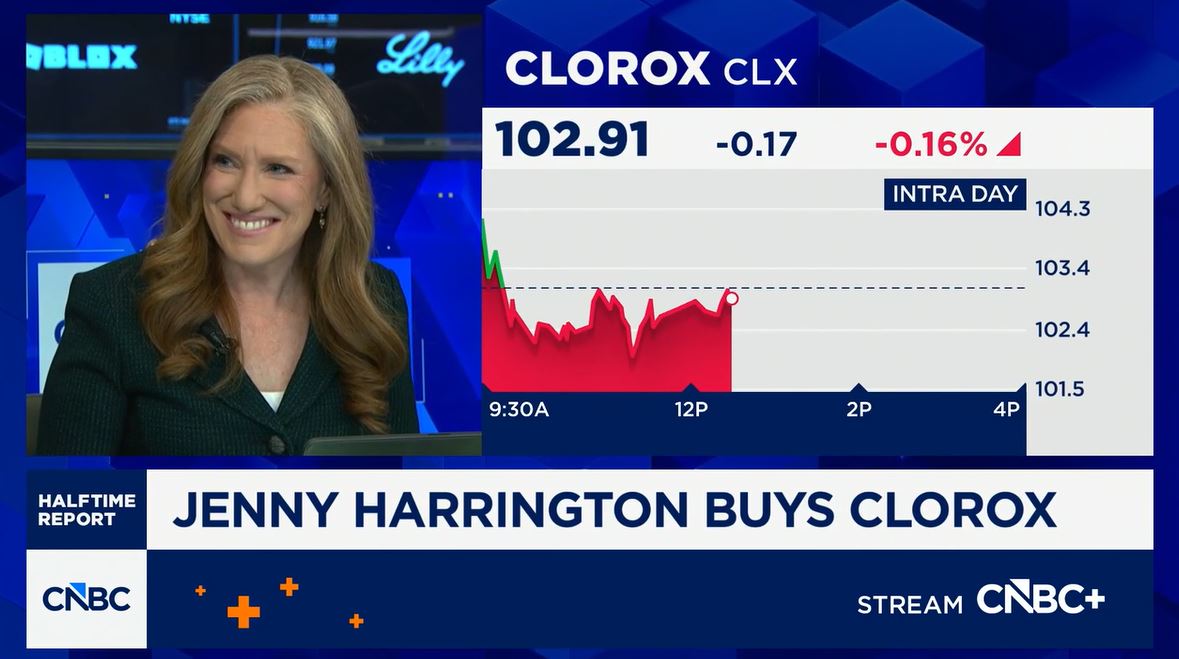
Judge fails to convince Jenny that retail investors know what they’re doing
Jenny Harrington on Wednesday's (3/25) Halftime Report said Laszlo Birinyi used to preach that the "best contrary indicator" was the AAII.
Judge pushed back that in the last couple of years, "Retail has not been a contrarian indicator within this market." Judge continued, "They've made damn good investment decisions."
Jenny said "Fine," but Jenny said when we see "everyone's going this way/everyone's going that way, it always- it always makes me skeptical."
Judge said, "That's a different nuance than suggesting the retail investor is just an automatic contrarian indicator as you were suggesting that they are."
Jenny said "the 4 most dangerous words in investing are 'This time it's different.'"
Later in the show, Jenny gave a speech about buying CLX. Jenny accused Judge of "picking on me" in earlier conversations about the "economics" of the market (see below) and the retail investor.
Judge said he wasn't picking on Jenny, he was "stating a fact."
Jenny accused Judge of starting on a "negative note" even though "I have a great vibe." Jimmy Lebenthal wondered what the "catalyst" for CLX is now and whether the dividend is safe. Jenny insisted the dividend is "super super safe." Jenny indicated that CLX will trade with respect to oil.
Very late in the show, Santoli said he likes the debate over whether retail investors are still contra-indicators. Santoli said that in 2021, "ARKK was their favorite," so he's not sure the retail investor "somehow got it figured out"; he thinks they're just part of the "matrix." Jenny said Judge should say "sorry" for his previous comments given what Santoli said.
Jenny tries to parse between ‘economics’ and ‘economy’
Jenny Harrington claimed early in Wednesday's (3/25) Halftime Report that Donald Trump goes to the "economics" for some kind of feedback.
Judge pushed back, "I think you follow the stock and bond markets."
Jenny said that's "one and the same," meaning that "economics" and stocks/bonds are the same, not that "stock and bond" are the same.
Judge said it's "not the same" and that econ impacts aren't known, but stocks can be observed daily.
Jenny insisted, "I said the 'economics,' not the 'economy.'"
Jim Lebenthal said earnings have actually been "revised higher."
When Judge said oil may be the only thing that matters to the market, Josh Brown chimed in, "The program is 6 minutes old, and so far, Scott, you've done nothing but drop truth bombs."
Hmmmm ... we thought it was Judge's job to be the show's traffic cop, not to issue stock-market pronouncements. (Maybe he's inspired by Santoli's guest-hosting gig.)
Josh said stock owners want this to be 2024/25, but it's actually utilities leading on Wednesday, and then, invoking a famous song by Chicago, Josh asserted, "People don't know what time it is."
Joe Terranova, who this time didn't demand that anyone stop trying to make short-term market calls, said trend-following funds are claiming to be "neutral."
Jenny says ‘Parents need to do a better job’ of policing addictive social media behavior
Jimmy Lebenthal on Wednesday's (3/25) Halftime Report suggested private credit fears are what's "in play" with MSFT doing so badly. Jim of course thinks it's "overblown."
Jenny Harrington said META's in a "Catch-22" because it needs the "addictiveness of social media" to generate that kind of revenue, but then they end up in court cases. Jenny said, "Parents need to do a better job."
Joe Terranova excitedly talked about buying GLD, saying he was a buyer around 404. Bill Baruch joined remotely to say he bought more of the miners. He said he moved money from DJP and bought GDX as well as CDE and AEM and KGC and HL. (This writer is long AEM.)
Josh Brown said "I like what Joe's doing" and said gold is at a 30 RSI.
Judge seemed to indicate that Hubert Davis got screwed.
Josh: NFLX under $100 is ‘free money’
Josh Brown on Wednesday's (3/25) Halftime Report said that under $100, NFLX is "free money." (This writer is long NFLX.) Josh said "it's Netflix vs. YouTube in the battle for control of the living room."
Joe Terranova had to recap the Warner Bros. situation, which we're going to be hearing about in regard to NFLX for probably still another 6 months.
Jenny Harrington defended how high she sold JBLU. She said she'd have "very cautious apprehension" about any supposed merger talks.
Judge unfortunately tried to squeeze in a few "Calls of the Day" (Zzzzzzzz) during Final Trades. Judge practically mocked Jenny's speech about KNTK. Jenny's Final Trade was AMBP, Josh said NFLX, Jimmy said C and Joe said AAPL.
Joe wants people to ‘stop trying to call the near term’
Joe Terranova on Tuesday's (3/24) Halftime Report said we've lost "all defined trends" in stocks, which is, apparently like when Curt in "American Graffiti" finds himself in the arcade with those Pharaoh thugs, an "uncomfortable position."
Judge said Wolfe is calling Monday's market "nothing more than a dead cat bounce." And Judge said Krinsky says a close under 6,627 will be 4th straight under the 200-day, and "any resolution rally is still a fade."
Judge, with a straight face actually, called Donald Trump "the technician who matters most of all."
Kari Firestone said that Monday at 7 a.m., she was on a plane when "suddenly, the futures went nuts," which showed how much the market wants a resolution with Iran. But there was "no confirmation," or else "the S&P could've had a 5% day" on Monday.
Kari in the 7th minute mentioned what Judge called the "HALO stocks," the first time in a week or two we've heard that term.
Joe said, "I think we are higher 12 months from now" (not the first time we've ever heard that on the show) and advised people to "stop trying to call the near term." Judge told Joe, "You are in a sense calling the near term," because Joe has to be "tactical." Joe shrugged, "I wear 2 hats," where he tells people "on a daily basis" to stay invested for the long term.
Joe said he'll buy the GLD with a 375 stop. Joe also bought AAPL.
Doc and Marc Chaikin teamed up because for the first time in many years, they realized they have the same market perception
Judge in the 15th minute of Tuesday's (3/24) Halftime Report mentioned private credit and ARES limiting withdrawals.
Kari Firestone owns APO and BX. Kari conceded that in "hindsight," it would've been great to sell months ago while the trades were "crowded." Kari pointed out that banks have to give depositors their money, while private equity can "gate them."
Shannon Saccocia asserted that private credit troubles are "not systemic."
Joe Terranova said the "requirement" for a bottom in private credit is that "software has to bottom."
Judge said MSFT isn't helping software, and he has a "hard time" seeing software recoving until MSFT finds its "footing"; Judge said the chart looks "terrible."
Brian Belski said "we sold all of our Blackstone in February; we were late, we owned it for 5 or 6 years."
Jim’s book available
Brian Belski bought TGT and talked it up as a turnaround story on Tuesday's (3/24) Halftime Report.
Kari Firestone bought FLS and sees "big opportunities" for that company. Belski bought more NFLX; he says he bought it Feb. 24, which coincidentally was a day after the bottom and right around the bottom and it was in the upper 70s. (This writer is long NFLX.)
Belski called KBH a "perfect name to own" in discretionary.
Brandon Gomez delivered his first CNBC News Update, but he's been around a bit and just got an expanded beat.
Belski sold USB, saying the "in-between" banks have a "scale problem."
Joe Terranova likes the GILD acquisition, which Belski endorsed also. Kari called TMO "attractive." Belski likes FDX "way more than UPS."
Belski's Final Trade was an emphatic COST. Shannon Saccocia said IYC (Zzzzzzz). Kari said NEE and Joe said VLO.
Judge said Jimmy Lebenthal's book is "out today."
Judge catches up with Jeffrey, Tom Lee on Closing Bell
Judge on Closing Bell on Monday (3/23) welcomed Jeffrey Gundlach, who like Judge wasn't on CNBC during the previous week's Fed day on Wednesday.
Jeffrey first noted the VIX in the last few weeks hasn't topped 30. He also recapped how gold early in 2026 had surged past his own expectations before having a disastrous week last week.
"At this level, I think it's a very good opportunity to add to gold and add to commodities," Jeffrey said, adding, "Gold was so wildly overdue for a correction."
Jeff conceded he likes to identify "the word of the day" or "phrase of the day" from Jay Powell's press conference, and this time it's "We don't know," which was heard "many many times."
Jeffrey said Jay Powell isn't a "shrinking violet" in his dispute with Donald Trump.
Also on Closing Bell, Tom Lee told Judge, "Investors who think the war needs to end for stocks to bottom aren't studying history."
Stephanie says administration has been ‘very consistent’ on messaging about Iran conflict timeline
Joe Terranova opened Monday's (3/23) Halftime Report saying the market isn't in a "binary" situation (translation: We didn't hear "Problem solved" with a "big whoosh down").
Joe said there are a couple things to note, one of them being "systematic trend-following funds" eyeing "3 closes below the 200-day moving average." Joe also pointed to the "significant rise in yields," which he thinks will "push lower."
Joe declared "the notion of a rate hike is absolutely misguided."
Permabull Stephanie Link said, "I don't believe anything that Iran has to say," and "I actually think that the Trump administration has been very consistent with saying to us, this will be short-lived, is it 4-5 weeks, 5-6 weeks, but not months, not years."
Stephanie said "we are way oversold" and "I would not be surprised to see a couple of days of nice euphoria here."
Jimmy Lebenthal offered, "I think the president did just tip his hand."
Bryn Talkington said we need to get over 6,624 and that we're not "out of the woods."
Late in the show, Santoli re-created how the whole morning in the stock market had gone. Santoli said it's "kinda the tariff playbook." Judge agreed, stating, "The market has seen this movie before."
Jim says to buy ORCL
Halftime Report panelists on Monday (3/23) offered some quick takes on some prominent international ETFs.
Judge asked Stephanie Link about EEM. Stephanie said she owns EWZ, and "it's up 15% year to date." Joe Terranova said you want to own EWY and also mentioned EIS. Offering helpful (seriously) stats, Bryn Talkington said "20% of EEM is roughly Alibaba, Taiwan Semi and Samsung," while EWY is 45% SK Hynix and Samsung.
Meanwhile, Jimmy Lebenthal thinks LNG is still going higher.
Jim bought EBAY, seeing it as a "good way to play the discretionary sector."
Jim said MSFT will be a "battleground stock" until Azure numbers pick up.
Stephanie bought more TFC. Joe said there's a "degree of resiliency" (snicker) in regional banks.
Judge mentioned that there's a "bipartisan bill to ban sports from prediction markets" and disclosed, "We have a commercial relationship with Kalshi." (Not to be confused with "Kensho," which CNBC used to note using for stock market stats.) Jim said he thinks what happens is, "These prediction market companies are regulated a little more than they are now." Stephanie touted LVS for being outside the U.S.; Joe backed that stock.
Bryn's Final Trade was ZM. Jim said ORCL, though Stephanie admitted she wouldn't own it and apparently said as much in stronger terms during the commercial break. Stephanie said DKS, and Joe said FCX.
Joe had to "bail my friend out" during the post-A-Block commercial break and barely got back to the set in time.
‘Very hard to figure out how this ends’
Judge was not present for Friday's (3/20) Halftime Report, and guest host Leslie Picker opened the show asking why markets haven't swung more wildly, or what might cause them to.
Bill Baruch said he wants to see how we "finish the week." Bill said there's been a "halt on money flows," but there's been "good earnings."
Bill said the market has become a "cash" market, and, "At the end of the day, it's gonna continue to be a stock-picker's market" (groan) (Zzzzzzzzz).
Steve Weiss said market stability has been "great" if you're an index investor, but "if you're a stock investor ... there's been significant carnage." Weiss pointed to META and CAT.
"I still don't see why you'd want to put money in here," Weiss said, suggesting it's "catching a falling knife."
Bryn Talkington said "the big catalyst is ... oil prices," and while Donald Trump may want to end the Iran conflict soon, it's "existential" for Iran's leadership, and "they don't seem to want to go away."
Bryn said the S&P and Nasdaq are "slightly below" the 200-day, and the market needs them to "catch a bid."
In the 21st minute of the show, Bryn said of the Iran conflict, "It's very hard for me to figure out how this ends."
Weiss told Leslie, "When it's safe to buy really depends upon your time frame." Weiss said if you buy the right companies, not the ones "tradin' on dreams," you'll be higher a year from now. (Which sounds like Bill's "stock-picker's market.")
Weiss said, "Momentum's pretty much dead now across the board."
Bill admitted he remains "pretty fully invested" with only 4% cash.
Jon Najarian and Marc Chaikin have teamed up for infomercials because, for the first time in many years, they’re actually seeing the same things about the market
Among the many cogent market observations from Bryn Talkington, Steve Weiss and Bill Baruch on Friday's (3/20) Halftime, Bryn said, "The financials are trading like we're going into a recession."
Bryn even said, "If you're gonna go invest right now in financials, I really think you have to dollar-cost average." (Translation: Bryn thinks they're probably going lower.)
But Steve Weiss said he likes financials, and in private credit, the "fears are overstated."
Bryn shrugged at "stagflation," saying only in the '70s did we have "real stagflation," and it'll be a "narrative that passes very quickly."
Guest host Leslie Picker asked for the difference between the '70s and now. Bryn said "we relied on the Middle East for oil," and "we had huge manufacturing." Weiss said he doubts we'll have a "stagflationary environment," but it's the "direction towards it" that can be "scary." Weiss said "labor remains tight," another difference with the '70s.
Weiss said, as he tends to say, "2/3 of the people ... live paycheck to paycheck."
Bill and Bryn seem to think gold miners are merely having a ‘healthy correction’
Early on Friday's (3/20) Halftime Report, Bill Baruch said "I still like the case for gold" though there's "some technical damage there."
We thought that might be the end of it. But later in the show, Bill gave a lengthy summation of the sector, which has taken ghastly hits in just the past week.
Bill said he thinks gold miners should be a "core position," though they've had a "cliff dive" of bullish sentiment recently. He said he still loves CDE, AEM and NEM, but it is a "commodity" space and the stocks "just have to work through this." (This writer is long AEM.)
Bryn Talkington said retail investors are "all in" on metals, and metals are having a "healthy correction," but it's still a "secular bull market" in the space.
Leslie wants to see ‘Peaky Blinders,’ gives shout-out to Versant property
Bill Baruch on Friday's (3/20) Halftime Report said "there's a lot to be excited about" with TSLA, though the chart is a little troublesome. Which of course opened the door for Bryn Talkington to talk about selling calls, specifically May calls at 420.
Bryn said 420 is "probably a peak" for TSLA until there's "new news."
Bryn said she expects DELL to take market share from Super Micro.
Steve Weiss said he's got a trading short in PSKY because it's "still overvalued" despite pulling back.
Weiss owns GEV but lamented it's not a bigger position. He said FTAI has been hit to the point it's attractive, but he doesn't want to buy just yet. Bryn predicted GEV will "easily have a 9 handle" when the market gets straightened out.
When NFLX came up (this writer is long NFLX), guest host Leslie Picker, who put together an excellent show and stunned in chic black, said "Peaky Blinders" is "on my, uh, plans for the weekend to watch that, um, great Rotten Tomatoes rating." Weiss said of NFLX, "I think you own it; I don't think you trade it." He added, "I'm glad they didn't win Warner."
At the end of the show, Bill touted EEM but said we have to get past the Iran conflict. Bryn suggested the EWY, though producers showed the chart for EWI.
Bryn's Final Trade was "dollar cost average CBRE." Weiss said "cash," and Bill said NFLX.
Um, the Fed chair angered the president by hanging around when the president wanted him out, and the president wants punishment for that, that’s why the DoJ is involved; it no longer matters when Jay goes ...
Even though Judge was back, Thursday's (3/19) Halftime Report was once again partly preempted by White House commentary, a frequent occurrence this week. Eamon Javers said for Japan, the Strait "might be a situation where they feel they have to get involved."
Once Halftime got going, Judge said the odds of a Fed rate hike in June are higher than a rate cut (a topic that also led off Thursday's Fast Money). Josh Brown said he thinks that's "crazy."
Let's fast-forward here to Thursday's Fast Money. Karen Finerman pointed out that the president is asking why wouldn't they cut rates now, but Karen questioned, "Why would you cut right now?"
Steve Grasso said, "There's no reason for a rate hike, though."
Karen said she agrees. But Grasso added, "It's either flat, or down, from here," and Karen said she could agree with the "flat," but Grasso said Powell is "out in May," a point challenged by Karen and Mel.
Karen rather naively (we have to say) suggested that all the administration had to do was "run out the clock" to get Powell out, and now the DoJ has only prolonged it, and so Karen admitted, "I don't understand." Thankfully, we do. (See headline of this item.)
Tim Seymour brought up Peter Frampton (and one of Frampton's song titles (not one of the Big 2, but probably No. 3)) while discussing the private credit scene with a guest. (Guy Adami mentioned probably No. 1 afterwards.)
Back on Halftime, Josh said financials "look absolutely horrible" and are the key to the market; "We can't afford to lose them to the extent that we are," and they've gone from "lagging" to "detracting."
Malcolm Ethridge bought GS, around 785. Josh said "the anti-Goldman," HOOD, is in a "50% drawdown" and cautioned it could be a "$50 stock relatively quickly."
Josh hasn’t been to Iowa
Josh Brown on Thursday's (3/19) Halftime Report said CASY is on his Best Stocks list, after determining that no one on the panel has ever been to one. (Their loss.) He said it's one of the few companies that benefits from higher gasoline prices. QSR also made the Best Stocks list.
Judge mentioned Morgan Stanley's "gutsy" upgrade of CCL. Asked simply whether CCL is a buy, Shannon Saccocia gave a speech about the "2 sides" to the consumer and experience-spending. (Tip: Shannon doesn't opine on individual stocks.)
Judge seemed to think the KNSL downgrade was a big deal. Josh Brown said he owns it and calls it a "very niche business within the insurance industry," he's been adding on the dips, which Josh says have been happening all year. He said despite the downgrade, he's not selling.
Judge brought up the RIVN-UBER deal and said CNBC producer Meghan Reeder pointed out that, "buried in Rivian's 8K," is that the company doesn't expect to be "adjusted EBITDA positive in 2027." Josh Brown yet again outlined how UBER is going to be the platform for any ride-hailing platform, autonomous et al.
Near the end of the show, Santoli was in his regular role and able to opine on why the market was going up or down, although being the guest host a day ago didn't stop him (see below).
Malcolm Ethridge's Final Trade was OKTA. Shannon said IYH. Josh said PSX but "roll your stop up, get tighter."
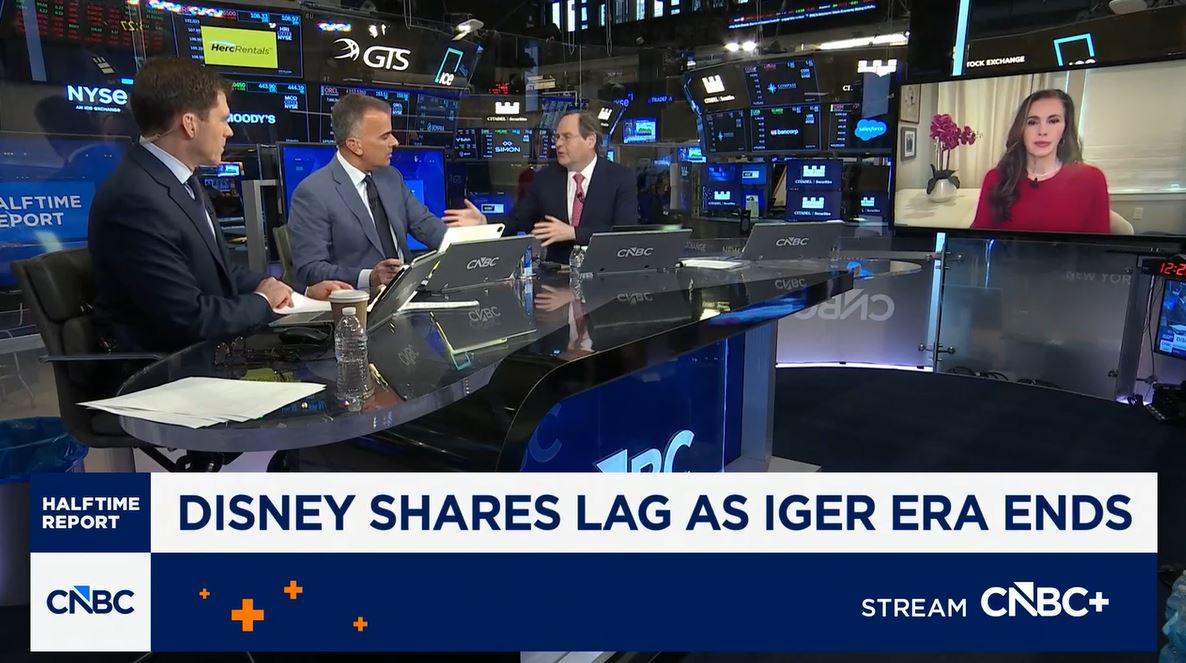
‘No signs of anxiety’ for Josh D’Amaro on first day as he keeps ex-CEO happy for 9 months (a/k/a will Bob be in the bullpen in 2029)
On Wednesday's (3/18) Halftime Report, Julia Boorstin reported on the change at DIS.
Santoli, guest hosting for Judge, observed that "It's, on a 10-year basis, almost exactly dead flat. However, it's probably the best legacy media stock over that period of time as well."
Jim Lebenthal stated, "I think it's a good company. ... I think as a company, it's doing the right things."
Now that's an interesting statement. What exactly are those "right things"? It's run the same theme parks for 70 years. It makes a Captain America movie every couple of years. It runs, like just about every other legacy media company, a humdrum streaming service. It finally thinks its 75-year-old CEO is finally willing to step aside even though the guy replacing him could've been elevated to this job years ago and apparently wasn't on any other company's potential-CEO-hire radar screen.
What exactly are these "right things" that it's doing?
Jim continued, "If you look at the stock, you would think like, you would think Mike this is Disney in 2021 when the pandemic had shut down the theme parks and debt had gone out of control."
That one got our attention. Because when we look at the DIS chart (and we're not rocket scientists here), it looks like the stock in 2021 was actually about double where it is today. Why was the stock at 191 if the pandemic had shut theme parks?
Jim admitted, "It's uncomfortable to hold it. But I think if you're patient and you wait (sic last 3 words redundant), you are going to be rewarded."
Joe Terranova admitted the JOET bought DIS in October (for reasons unclear) at 112.62 and sold in January for 112.80 and made a "whopping 18 cents."
Joe asked Jim, "How could I look at Disney as being a growth company when ... parks has now overtaken entertainment when they have continually raised prices on streaming, and that's been ineffective in terms of stimulating the growth, and the cost of sports just continues to rise."
Jim said you can find a growth company here not from the stock price but EPS growth relative to multiple (Zzzzzzzz).
Santoli noted that the parts of the company that are in "secular decline" become a "smaller part of the company."
Joe asked of Jim, "What's the jewel of the business right now?"
Jim said, "The theme parks."
Santoli cut in, "The theme parks plus the franchises, arguably."
Joe shrugged, "The theme parks take you right back to where we knew Disney to be, not to where we thought Disney was going."
Jim asked to "amend" his answer and stated, "They've got many crown jewels." Santoli said, "Gotta leave it there."
A couple hours later, after DIS had put on its presentation, Jon Fortt was hosting Closing Bell for Judge and brought in DIS observer James Stewart, who reported on Josh D'Amaro's debut: "I think it was very reassuring to, uh, people both inside and outside the company. It all went very smoothly. It was very highly choreographed. It was very upbeat ... He seems very confident and comfortable in his own skin, no signs of anxiety, and especially no signs of any tension with- with Iger. Because the last time around, we knew that relationship was in trouble on Day 1."
Jon asked Stewart, "Well, do you think Iger really keeps his hands off the steering wheel?"
James indicated that maybe investors shouldn't expect another Bob callback: "Well he's still on the board till December 31st. And my advice to D'Amaro is, you- you've gotta keep him happy for a few more months. He wants to participate? Fine. But I'm getting the feeling from people inside the company and others and- and, my sense from him is, he wants this to work, he's gotta make it work for his own legacy ... I don't think he's gonna be intrusive. ... It looks like a new era is finally taking shape there."
Maybe. But when Josh has to make his first big decision about allocation of resources and some department feels like it's getting screwed, you can bet they'll be giving Bob a call.
We were hoping to hear Jeffrey’s Word of the Day from the Fed press conference, but Judge was off, so Jeremy Siegel was brought in for Closing Bell
Fed meeting press conferences typically are followed by Jeffrey Gundlach telling Judge that Fed rates are pegged to the 2-year, but Judge was off Wednesday (3/18) and Closing Bell was helmed by Jon Fortt, who instead summoned Jeremy Siegel.
Jeremy said the most interesting thing about the day is that Jay Powell is telling Trump, according to Jeremy's interpretation, "You're not getting rid of me unless you drop the suit."
Steve Liesman asked to re-air the clip of Powell stating, "I have no intention of leaving the board until the investigation is well and truly over, with transparency and finality."
This is an interesting little showdown the president of the United States is finding himself in.
Joe LaVorgna said war in Iran is the "big wrinkle" in the economic outlook.
Earlier in the day on the Halftime Report, returning to his commentary from a week ago, Jim Lebenthal said, "I don't wanna hear any more talk about rate hikes ... The problem for me intellectually is, I can't take it off the table."
Bryn Talkington called the new Fed chair a "game changer" and asserted we'll get rate cuts, "it's not if, it's when." Joe Terranova said he agrees with Jim and Bryn and added, "I actually think they should be cutting rates in this environment."
Santoli seems to blur the lines between hosting a show and opining on the show’s topics
Wednesday's (3/18) Halftime Report was guest-hosted by Santoli.
Joe Terranova said everyone wants a "V-shaped bottom," but it's turned out to be "far more punitive," his word of the month apparently. Even so, "I don't think you wanna flinch" and go to more cash.
Bryn Talkington said "we are just range-bound" despite all the headlines. Bryn said Donald Trump may want the Iran war to end soon but it's "existential for the mullahs" and a "very complicated situation for investors."
Jimmy Lebenthal said there are opportunities in the stock market but you "may end up kicking yourself" if you buy now and things go lower, however, down the road, you'll be rewarded. (Translation: Jimmy's not sure we've bottomed yet.)
Santoli at times seemed to confuse his typical role with Wednesday's guest-host role, such as when he was supposed to transition from Fed/inflation to private credit in the 17th minute, and later, when he took up the SEC assessing whether to scale back the frequency of earnings reports.
Jim said his "measured opinion" on quarterly earnings reports is that he'd prefer to "go to semiannual." He said emphasis on quarterly earnings leads to "short-termism." But Jim allowed that there would be "unintended consequences" that he's not considering now.
Santoli cut in, "We have 6-month reporting in Europe. Do we have higher valuations? Do we have companies that have more strategic long-term thinking ... I'm wondering what problem we're trying to solve here."
Joe said his position on this subject will be "selfish," but it's about using the "quality" factor for evaluating stocks; "I need those revenue numbers, uh, every 90 days."
Bryn wondered, "Why is the SEC wasting time on this right now."
Santoli somehow had the show ending at the 58-minute mark, so there were commercials ahead of the start of Kelly’s Exchange
Late in Wednesday's (3/18) Halftime Report, Leslie Picker was at a JPMorgan event on a new initiative about wealth management for athletes. (News flash: Some wealthy athletes don't manage their money like Jenny Harrington.)
Leslie discussed the new WNBA contract with A'Ja Wilson, who was on hand with JPM's Kristen Lemkau, who assured she "grew up loving sports" and said that JPM realized, being around young athletes with sudden wealth, "there was a gap to fill" as far as money management.
Meanwhile, Joe Terranova said the JOET bought MU in October around 223. Joe said the growth is based on the premise of "triple divot- (sic) (snicker) digit rather revenue and earnings gains," but at some point, DRAM pricing will moderate.
Bryn Talkington agreed with Joe's take and said MU and related names will have a "similar fate" as NVDA over the "next year or so." Santoli observed, "Micron at 9 times earnings; I don't know if you're supposed to buy these when they're cheap or expensive."
On the day's token look at financials, Jim said C and APO were up. Jim said financials were "gangbusters" last year, and it's "OK" if they take a "pause" in Q1 2026.
Bryn predicted "this will pass" for the "firms that did good underwriting." Joe said there are places to "rotate" within the financial sector, and he touted exchanges and insurance companies.
Bryn's Final Trade was ZM. Joe said ROST and Jim said C.
First commercial came
at the 50-minute mark
It was a day with Judge. But not THE Judge.
Tuesday's (3/17) St. Patrick's Day Halftime Report was preempted in half by Oval Office remarks.
Then when guest host Santoli got a chance, he went 20 minutes straight ... which means we'll have to check the next VSNT quarterly report to see if there was a hit to ad revenue.
Joe Terranova said the market could probably handle oil up to $100 as long as it's in a range. Permabull Stephanie Link said "the economy is hangin' in."
Josh Brown ran headlong into a debate with Santoli when he said "today's investor" no longer sells at times that yesterday's investor would've.
Santoli demanded, "Did we have a 'modern investor' 11 months ago Josh when everybody was liquidating everything at the lows?"
Josh said, "I don't know that everybody did that."
Santoli said, "Oh come on. Look at the flows."
Josh said "401(k) flows never stopped, and that's the real money."
Unconvinced, Santoli concluded, "We magically got 20% down with nobody selling, I guess."
Also debating were Brian Belski and Joe Terranova, as Brian predicted big gains for underrated financials. Joe took issue with that and stated, "Financials were the favored sector coming in to 2026." Belski shot back, "No way was it the favored sector."
"We just gonna disagree," Joe eventually said, before claiming that "a lot" of momentum funds were "all significantly overweight" financials.
Joe for the 2nd straight day likened Aaron Judge home runs to NVDA; Aaron Judge may only hit 35, not 55-60; "that's still a really good season." Stephanie Link demanded to know who the "incremental buyer" in NVDA is. Joe said the stock might be "running in place," which isn't bad.
Stephanie bought NOW, calling it "quality on sale."
Joe suggested DAL benefited from a "pull forward" on summer bookings.
Josh made a lengthy case for UBER, like he always does, about how it's the platform that will be in demand. It was his Final Trade. Belski said PNFP, Stephanie said BAC, noting it's "down 14% from its highs," always the favorite metric of Halftime Report stock-buying. Joe said EBAY, saying he was "puzzled" a while ago when the JOET bought it, but not anymore.
Eamon Javers finds president’s comments about Chinese military help ‘striking’
Monday's (3/16) Halftime Report was surprisingly guest-hosted by Squawk Box legend David Faber, whose yeoman effort was sandwiched around some remarks from the White House.
For a while late in the A Block, David cut away to Donald Trump remarks, then switched back. CNBC's Eamon Javers observed that, "It is just striking to sit here and listen to a president of the United States requesting military aid from the Chinese in the Persian Gulf."
Meanwhile, Joe Terranova mentioned "Hormuz" in his opening statement, said we haven't had a Monday opening higher since January and said it's "somewhat of a punitive environment."
Jimmy Lebenthal said, "It's not as bad as the 20% of oil being off of the market as was initially presumed."
Amy Raskin said U.S. investors are "more sanguine" than those in other parts of the world.
Amy said that coming out of the Iran war, oil services names should be good. Joe said he bought CF at 104 on March 2.
Panelists spent a lot of time debating how much energy (Zzzzzzzzz) you should have in your portfolio.
Amy Raskin said NVDA is "sort of stuck here for a little while" and needs something "really monumental" to clear $200. Joe said he thinks the only Mag 7 stock that's cheaper than NVDA is META. Joe likened NVDA's year to perhaps Aaron Judge hitting 30 home runs instead of 50. Joe said that over the last 6 months, the S&P is up 1% and NVDA is up 5%; "that's not so bad."
It was around the 50th minute when David got into Blue Owl. Jim said we should expect "elevated outflows" in private credit. Jim stressed, "The facts that we see on the ground say that the credit cycle has not yet turned down." Jim was touting the "due diligence" done by Cerity that Jim implied other firms don't always do. Jim said "gates are in place" in the sector, which is "relatively illiquid."
Joe said it's good to "isolate the narrative" for those not lending to software, because, "If in fact you are lending to private software, there is literally no transparency on what the real value of those loans are." David said, "Blue Owl has a dividend yield of 10.4%."

The CNBCfix Oscars primer
Judge doesn't talk about culture, so this page will take it upon itself. (Of course, some big moments in culture are seen on competing media entities, so let's cut Judge a little slack.)
Sunday night, some envelopes are going to be opened, crowning certain films and filmmakers for eternity.
Are they going to get it "right"? Let's take a look ... (this preview was posted early Saturday, 3/14/26).
Sinners, One Battle After Another, Marty Supreme — These 3 are going to vie for most of the biggest awards. Those categories are as much of a toss-up as the Oscars can possibly be. None of these 3 is a bad film. What they also have in common is that they're underwhelming, given the hype they acquired. The gut here is that "Marty" gets shut out; the others split the biggies.
Jessie Buckley — The only lock in a major category. Her movie, "Hamnet," is an outside contender for Best Picture and Best Director, and it would not be an outrage if it won those categories too. Not as aspirational as the 3 titles above, it succeeds better at what it's trying to do.
International — Here's where the real action is. A gift to cinephiles, there are several gems here. Unfortunately, 4 are so highly regarded that they will probably have to share votes. 2 of them, "The Secret Agent" (Brazil of the '70s) and "Sentimental Value" (Scandinavia modern family drama), are also Best Picture nominees. Neither likely will win that prize, but either would be a fine choice if it did. In both films, the greatest drama is in the first 10 minutes, but the rest holds up.
Sirât — See above (and photo at top). Nominated for Best International Feature film but not Best Picture (unfortunately), this is a humdinger of a movie. There's a musical vibe you'll feel even when the music is not playing. Though a nominee for Best Sound, it is generally regarded as somehow least likely to win that category. The details of what's happening in this film are spare. You're here for the atmosphere. If you remember/long for those '70s films that kind of gave you a charge, Go. See. This. Film.
Paul Thomas Anderson — He's going to win something; the guess here is Best Director and probably Adapted Screenplay.
F1 — Pundits have mocked this film's nomination for Best Picture. In a 10-film field though (it should revert to 5), it's not a reach. It's the popcorn movie of the year, and it's entertaining, if too long.
Frankenstein — There's a lot of wading through the debris to get to the decent payoff, and admittedly beautiful ending, of the last 45 minutes. Scenes with the monster are good; scenes of the scientists are tedious.
Bugonia — Emma Stone cannot make a bad movie. This one is tethered to hostage drama. There's just not a convincing enough conclusion. Curiously, Stone and Yorgos' "Poor Things" (2023) is still fresh enough in the mind to make some think that "Frankenstein" (above) is kinda something we've already seen recently.
Best Supporting Actor — Sean Penn is the front-runner and Stellan Skarsgård is not far behind, but honestly, any of the 5 nominees could win this category and it would not be a shock.
Train Dreams — A rich film that is worth seeing. Probably not stimulating enough for major awards, but Adolpho Veloso, who is not the favorite, in cinematography would be quite deserving.
Donald — Like it or not, the Oscars have generally refrained from criticisms of the president. #IfBillieisthere,whoknows
Conclusions — It's been a tough decade of moviemaking, and this is another not-so-great year of the 2020s, though it's better than most other years this decade. Last year's big winner, "Anora," is superior to this year's leading contenders, and hardly anyone saw "Anora," so there you go.
Weiss accuses Jim of ‘condescending’ after Jim tells Weiss to ‘calm down’
In the 23rd minute of Friday's (3/13) Halftime Report, Judge said ADBE's CEO is departing.
As you knew would happen (sort of predicted a day ago), regardless of how good the quarter was, Jim Lebenthal was going to be buying more ADBE.
Jim explained Friday that he's buying "just in my personal account," and the reason is "I think the fears are overblown."
Jim pointed to buybacks and said "I've done this many times before," citing C and GM, and "it's worked out," though he's "not expecting anybody to pat me on the back." (He didn't mention that he's also bought dogs, and kept buying those dogs, that didn't work out.)
In a reference to Jim's new book (see below), Judge wondered if Jim doesn't feel like he's "on a subway car to nowhere" with this stock. Jim agreed there's a "sense of doubt" in buying a stock like this.
Then it was Steve Weiss' turn.
Weiss, who this week (on a day Jim wasn't on the show) explained why ADBE is in trouble, asked Jim about earnings growth, EPS and net income and the impact of buybacks. (It was too much rapid-fire, we couldn't keep up.) Eventually, Weiss asserted, "The point is that their growth is based on financial engineering, and the growth of the company has significantly declined."
Weiss complained to Jim, "You said this the last few quarters, 1 more quarter, they don't produce, then I'm out. ... You're buying the stock without even knowing who the new CEO is."
Jim told Weiss to "calm down." Weiss protested, "Jimmy there's no need for that, OK. OK, there's no need for that. I'm talking to you."
Jim said, "OK. You're talking to me with a tone that I'm- I'm not sure I'm gonna respond to."
Weiss said, "Sorry I'm not condescending like you. So, you said you would sell each of the last 3 quarters. You haven't. Yet you're buying more. So explain that inconsistency."
Jim said, "Yeah. The- Well, I don't see it's an inconsistency. What I see is that the operational results of the company are frankly quite good, and the share price has gotten cheaper, and so I'm willing to step in from that."
Judge, seeking an exit from this dialogue, said, "All right, all right. We'll see how it develops from here, OK? Maybe we'll have this conversation some other time."
This page isn't going to comment on Weiss' tone or EPS questions. But we fully agree with Weiss' recap of Jim's stance on this stock. Back on Aug. 11, Jim stated that if ADBE (then around $333) doesn't move, he'll be inclined to move on; "it's not a hill I want to die on." And so reporting on these kinds of stock calls (which is a curious endeavor, admittedly) feels like being Charlie Brown while Lucy is pulling away the football. Because when Jim says he's not dying on a hill for a stock, he's doing just that.
Judge says good news about Hormuz would trigger a ‘rally/rip like you haven’t seen’
Bryn Talkington on Friday's (3/13) Halftime Report said the 200-day for the S&P is 6,600, which Bryn called "gravity" and "strong support." Bryn said that people will "continue to be skittish" going into weekends. Bryn said "this is a great time to be selling calls." (Tip: If it's a great time to sell calls, then that by definition would sorta mean it's a really dumb time to be buying them.)
Steve Weiss said he's hanging onto cash because he doesn't want to catch a "falling knife." He said he recently bought FTAI, but it was "a major loser."
"This is not a trading market," Weiss explained (although it kinda seems like it is).
Jim Lebenthal said, "It comes down to the Straits (sic plural) of Hormuz." Jim again is talking "end of March" as the deadline for the market being OK in regards to Iran resolution.
Judge was quoting Hartnett's note about '07-'08. Kevin Simpson said you can kind of always draw "comparisons" to other times when markets were disrupted.
Judge told the panel, "It's the probabilities, not the ifs."
Weiss said it's a question of whether there's greater risk to the upside or downside. Judge said he doesn't know how that can be answered "with any pure level of conviction."
Weiss said, "That's exactly the point."
Judge curiously asserted that if there's a positive headline about Hormuz or oil, there will "probably" be a "rally/rip like you haven't seen."
That seems kind of strong. We do think there'd be a rally, but one like we "haven't seen"? Isn't the market just going to go back to AI fears?
Bryn said it's hard to "map out how this actually ends." Judge said, "Let's be honest, you know, what- what is a, you know, perhaps fair amount of resistance today by the Iranians, may not be tomorrow."
Weiss said there are "headline risks," but "this is nothing like '07-'08." Judge suggested Hartnett is simply "looking at some of the trading patterns. I don't think he's- he's saying that this is another '08."
Kevin turned a big gain in BLD into a loss
Leslie Picker on Friday's (3/13) Halftime Report provided the latest on private credit; apparently interest is still higher than everyone might think.
Judge said Bryn Talkington has invested "in some of the Blue Owl BDCs." Bryn said, "I keep adding to OTF." Bryn said they disclose the loans "every single quarter." Bryn said it's "frustrating" that there's this notion that "private credit is bad," when you have to "separate the wheat from the chaff."
Kevin Simpson said he bought more CAT a day earlier. Kevin said he agrees with Steve Weiss that it's not a "tradeable market," but Kevin thinks it's an "investable market."
Kevin said he bought INTU at $400 and also bought PANW.
Kevin bought more NVDA, of course suggesting writing calls against it.
Diana Olick reported that mortgage rates are rising.
Kevin said he got stopped out of BLD a day earlier at 360. Kevin said he bought it at 400, it ran to 550, and "in a month, it went from 550 to 360." "Luckily we only lost 10%," Kevin said. Weiss said "they're the ugliest charts I think there are of any group, I mean, it's just crazy."
Bryn's Final Trade was the well-known GPIQ. Jim said C, Kevin said NVDA and Weiss said META with a downside risk of probably "600."
On Closing Bell, Permabull Stephanie Link (who found a show to be on Friday) said you can't wait forever for "certainty" or you'll miss opportunities, and you have to be looking for "bargains," and this adminstration "does not want oil prices higher, especially into the midterm elections."
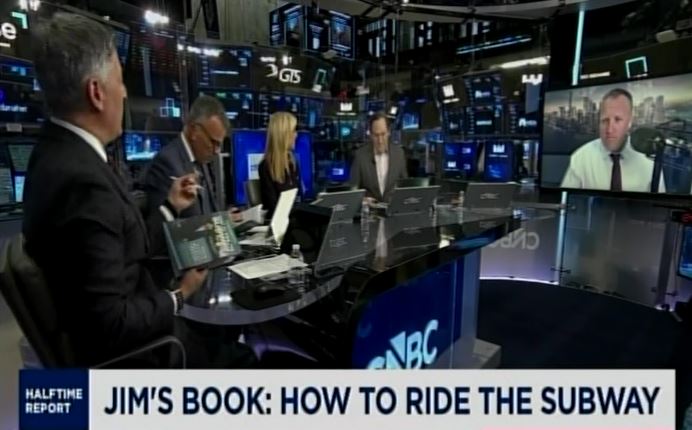
Joe attempts to speed-read Jimmy’s book as Judge and Jimmy are promoting it
Late into Thursday's (3/12) Halftime Report, Judge touted Jim Lebenthal's new book, "How to Ride the Subway," and viewers learned a few interesting details in what was an excellent segment of the show.
You may wonder, as we kinda did, how riding the subway has anything to do with stock-picking. Jim explained that the book offers lessons on investing "and also in life ... how I live my life." And that, quite frankly, is worth sharing and something that doesn't happen enough in the Halftime sphere.
Jim noted that he is referred to as "Jimmy" on the cover and apparently by acquaintances, though he uses "Jim" for perhaps more professional/formal circumstances. "Jimmy is the real me," Jim/Jimmy said.
(This page may use "Jimmy" from time to time; perhaps we should do it more often in fact, but somehow we're kind of locked in on "Jim.")
Judge is growing exasperated with administration’s variety of timelines for what’s happening in Iran
Jim Lebenthal stated as fact on Thursday's (3/13) Halftime Report, "The president has said it's a 4-week operation."
Judge scoffed, "We can even stop with the, what- the 4 or 5 week, month, this/that, because the messaging has been so inconsistent. ... If you're gonna hang your hat on, uh, it's gonna be 4-5 days, or now 4-5 weeks, or 4-5 months, good luck."
Jim asserted, "Straits being closed will leave a mark, but it will not be fatal if it's- if it's opened by the end of this week."
Judge pointed out, "You realize today's Thursday."
Jim said, "I'm sorry if I misspoke. I meant by the end of the month. By the end of the month. Thank you. Let me be very clear. By the end of the month."
"OK," Judge said.
To Jim's credit, as this dialogue unfolded, he did initially make some reference to month, not week.
‘This is not Venezuela’
Josh Brown on Thursday's (3/12) Halftime Report said he can't remember a time where we're this close to an all-time high but with "as little conviction" in the market as we've got.
Josh opined that even if the Strait of Hormuz is solved tomorrow, it doesn't change the "lack of conviction" in the market.
Joe Terranova said he'll be "fully candid," he doesn't know what to do with CF. He'll hold it, but "it's binary" dependent on the Strait of Hormuz.
Joe sold CNQ and PBR.
Judge said JPMorgan is suggesting possible cracks in the retail investor. Permabull Stephanie Link said "War is scary" and "This is not Venezuela," but maybe retail investors are just "taking a pause."
One Big Beautiful Bill apparently viewed as a 2026 stock market catalyst
Joe Terranova announced at the top of Thursday's (3/12) Halftime Report, "We are unfortunately all becoming oil traders."
Judge said Krinsky "moments ago" was calling 6,550 "critical." (But that doesn't mean it's actually going to get there. So wouldn't 5,550 also be "critical"? And 3,550? And 2 ...?)
Permabull Stephanie Link noted the uncertainty in the market but asserted "the data in the economy is actually all right."
This was a new one for us — at least, we haven't heard anyone say it since about last July, but Stephanie declared, "One Big Beautiful Bill has yet to hit."
Joe said "everything" boils down to, "Can you secure the Strait of Hormuz or not?"
Viewers can look forward to another episode of Jim saying that whatever the fears, AI hasn’t hurt ADBE yet
On Thursday's (3/12) Halftime Report, Jim Lebenthal said OWL and APOL will be "hampered for a while" because fundraising is in "decline" and the appetite (snicker) for private credit has "plummeted."
But Jim said the strong performance of the Owl Rock Credit Income Corporation "will continue" because of the management.
Judge praised Stephanie Link for actually buying stocks she touts. (Perhaps that's an issue we weren't aware of with other people on the show.) Stephanie bought TFC.
Stephanie bought more PANW and IBM. Stephanie said, "Palo Alto's down 24% from its highs," always the preferred metric of Halftime Report stock-buying.
Stephanie said she sold TER, "because I'm up 100% in the stock," always the preferred metric of Halftime Report stock-selling. She bought more AVGO, which is "down 19% since last quarter ... 2 quarters ago."
Jim said he's "pretty sure" he'll be on the show Friday to discuss ADBE's results.
Judge introduced Frank Holland as "Frank Thomas" for the CNBC News Update, and everyone got a chuckle. "I was a pretty good batter," Frank revealed.
Josh Brown said he "couldn't believe" that SBUX made his Best Stocks in the Market list. Josh thinks it can get to $120.
Stephanie bought NFLX. (This writer is long NFLX.) Stephanie said it's at 30 times when it's historically been 34 times. Josh Brown seconded NFLX as his Final Trade. Stephanie said TGT. Jim said RIG and Joe said CME.
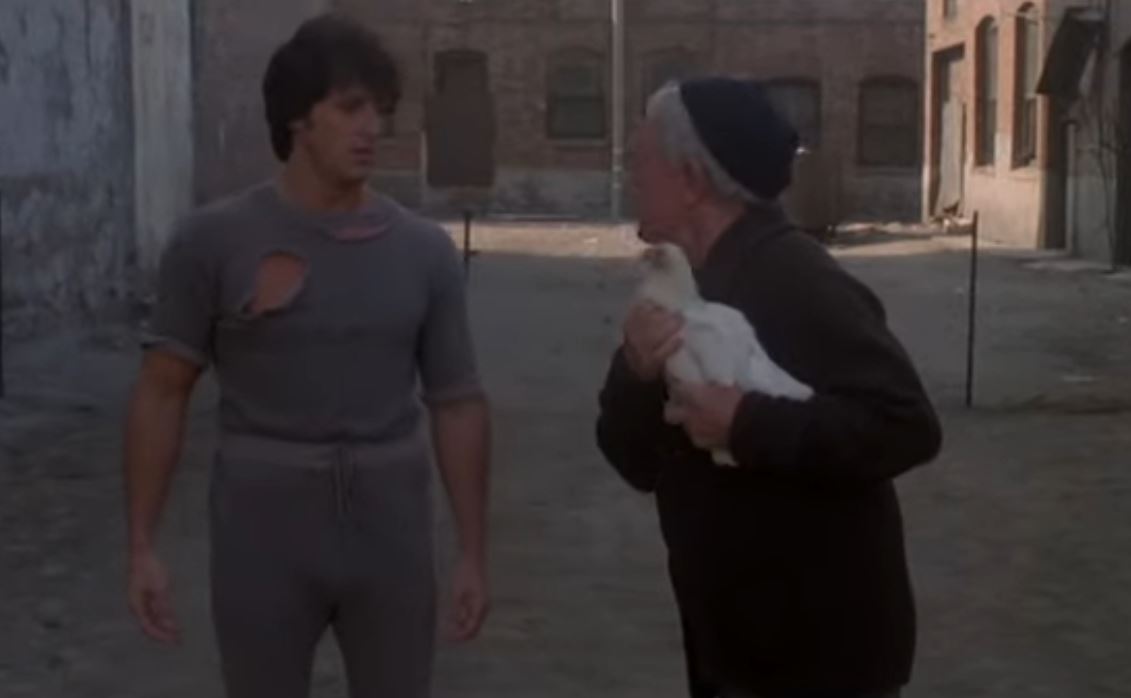
Joe, Frank completely botch a couple references to ‘Rocky’ films
This page was just complaining (see below) how Judge never devotes any time to cultural subjects.
During Wednesday's (3/11) Halftime Report, we perhaps got the reason why.
Joe Terranova was talking about refiners and oil stocks and advised viewers to "maintain exposure" to names such as PSX and VLO and MPC, but "if you're now in the moment and you're trying to race to catch it, you're not going to. Because it's the equivalent of the 'Rocky' movie where he's chasing the chicken, trying to catch it. You're just not going to catch it."
Well, um, that's kinda misstating it. The movie is "Rocky II," and his trainer (Mick) is showing Balboa some old-school training methods, which includes chasing a chicken and catching it with the idea of improving one's quickness.
But the scene occurs when Balboa is only halfheartedly training (because his wife is resisting his decision to fight), and Balboa thinks this training tactic is "embarrassing ... ain't very mature," doesn't want to do it, is certainly not racing to catch the chicken and even pronounces himself a "Kentucky fried idiot" for taking part in this endeavor.
After Balboa gets fired up, he does catch the chicken, which is at odds with Joe's observation.
That would've been bad enough. But then guest host Frank Holland made a ghastly mistake in telling Joe that when he heard the "Rocky" reference, "I thought you were gonna go, uh, Adrian yelling at Rocky that you can't win when he's supposed to fight Mr. T."
Adrian said those words in "Rocky IV," when Balboa was about to fight Ivan Drago, not "Rocky III," when Balboa twice fought Mr. T.
‘This has become a horrible environment’
Joe Terranova opened Wednesday's (3/11) Halftime Report saying the market's looking for an "inflection point," but there isn't one, "based on the evidence."
Joe said it's "more of cyclical volatility, more of a cyclical correction." Joe said, for those in the financial sector, "If you are paid on your revenue production ... this has become a horrible environment ... and you are participating less ... very punitive environment to be in."
Steve Weiss said, as he's prone to do, "Return is defined by your point of entry." (Tip: It's defined equally as much by your point of exit, but whatever.)
Weiss advised, "Don't get upset, you know, about the volatility. Don't try to trade this volatility," because that's a "sucker's bet."
Weiss predicted "substantial job cuts from AI," which he said would be a "short-term positive" but bigger trouble longer term.
Weiss also gave a speech about the "shadow lending system" of private credit that actually was a pretty good primer in a soundbite; he said the concern is not the biggies but the "2nd- and 3rd-tier players."
Jason Snipe said software is trading at a 16 times forward multiple and there are "opportunities" there.
Weiss says the idea that AI can sink Adobe is ‘not so ridiculous’
On Wednesday's (3/11) Halftime Report, Steve Weiss once again said that "2/3 of the country lives paycheck to paycheck."
(How making this observation helps him trade, we have no idea.)
(Then again, at least he didn't say or imply that Mr. T was in "Rocky IV.")
Guest host Frank Holland said some analyst has an IRON trade; which means the analyst succeeded in coining a slogan that got picked up by CNBC.
Jason Snipe said ORCL had a "phenomenal print."
Joe Terranova said some of the "massive storm clouds" over ORCL from the end of January have dissipated.
Shannon Saccocia outlined the challenges on ORCL without making a call.
Weiss said, "I think software is gonna be very challenged. When you can write code without ever having, uh, learned how to write code. Uh, that's problematic for software companies. And that's Salesforce, and that's, uh, Adobe for sure, it's all the others ... People wanna say, 'Well that's ridiculous, can't get rid of Adobe.' It's not so ridiculous. ... We just don't know." Weiss said CRM is "easy to replicate."
Joe said LLY trades like a biotech, and biotechs kind of peaked in late January.
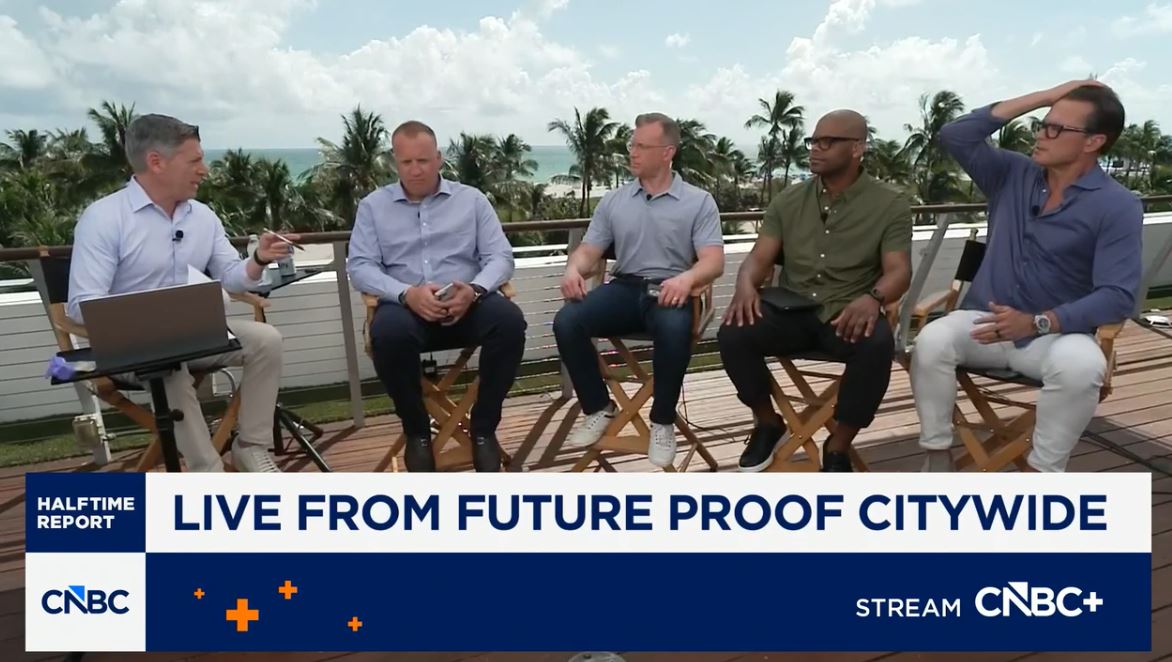
Judge in the 18th minute once again implies that Brad Gerstner’s letter is what turned META around (But it’s been a while since he mentioned Eddy Cue)
Judge on Tuesday's (3/10) Future Proof Halftime from Miami Beach said Deutche Bank upgraded tech and software and on other days, that subject would be "the lead of many programs."
According to Judge, Deutche thinks AI disruption fears have "peaked."
Josh Brown said if there wasn't a war, they'd be talking about AI's impact and what Anthropic is doing.
Judge said Wells Fargo is saying the stock market is likening software companies to "department stores," an interesting analogy. Malcolm Ethridge curiously said that market perception reminds him of the dot-com boom, when "internet shopping was gonna kill everything, and what we ultimately saw was, online shopping just made it easier for these stores to do their business."
Well, it may not have hurt WMT ... but it didn't exactly help department stores.
Bill Baruch said he bought more ORCL; "it's down 60% from the highs," always the top stock-buying metric of the Halftime Report. Bill twice noted ORCL is "testing the 200-week moving average."
Rob Sechan suggested current software multiples "discount" the bad news. Judge and Rob clashed over whether "the smartest guys in the room" (which Rob indicated are MSFT and AMZN) are correctly plunging into capex "catchup" now; that's what Rob seems to think. Judge complained, "Being the smartest people in the room doesn't really matter ... We learned our lesson in '08. You don't think that the smartest people in the room got some stuff wrong in 2008?"
Judge was compelled to claim, "Meta had to go through its worst year from a stock performance to find a religion along with Brad Gerstner's note."
Bill indicates this is what people should expect in Year 2 of a presidency
Judge on Tuesday (3/10) brought a Halftime panel of Josh Brown, Malcolm Ethridge, Bill Baruch and Rob Sechan to Future Proof, but this wasn't the Huntington Beach Future Proof, rather it was "Future Proof Citywide" at Miami Beach.
Josh said "I think you trust the equity market here," moreso than the price of oil.
Judge said Ed "Roaring 20s" Yardeni raised his odds of a "market meltdown" to 35%.
Rob tried to explain differences between having new money and rebalancing (of course ... the taxes), which sounded more like a wealth-management symposium than a TV soundbite.
Malcolm said "we might be acting a little too complacent right now as investors, simply because the president today alone has already shown that he's looking in 2 different directions to gauge which- which stance he wants to take vs. Iran."
Malcolm said it "could go on a little bit longer than we've already assumed."
Rob wondered, if that's true, why are energy pros "complacent" about the price of oil being lower down the road when they seemingly know more than the rest of us (one of basically 2 references Rob made to the smartest guys in the room). Malcolm said he's talking about people looking at 401(k)s and wondering if it's time to jump in.
Bill said "This is par for the course ... it is Year 2 of a presidential cycle."
Judge seems surprised that it can actually rain during the afternoon in Miami
Well into Tuesday's (3/10) Halftime Report at Future Proof Citywide at Miami Beach, Jason Wenk of Altruist joined the set as Judge said, "literally getting a passing shower here ... you never know what Miami I suppose is gonna bring, uh, in the middle of the afternoon."
Well, we know from Albert Hammond Sr. that It Never Rains in Southern California. ("TV breaks and movies ...") (And that, by the way, is on the Mount Rushmore of '70s Soft Rock, a spectacular subject that Judge somehow doesn't have the brass to discuss.)
But we didn't know that it's apparently unusual for rain to fall in the afternoon in Miami.
Josh Brown said he's a customer and shareholder of Altruist.
Bill Baruch sold UBER, an often-discussed stock on the Halftime Report, from his "concentrated portfolio where we own no more than 10 names." Josh conceded it's a "tough name to be in" that's in "technical no-man's land."
Josh talked up AMGN and ABBV among his Best Stocks.
Josh said there are 3,600 people at Future Proof Citywide, and "60% are at their first-ever Future Proof event."
Tuesday's Fast Money was rather quiet; Karen Finerman said ORCL's report may be good enough, but she's not chasing and it's all going to hinge on the commentary.
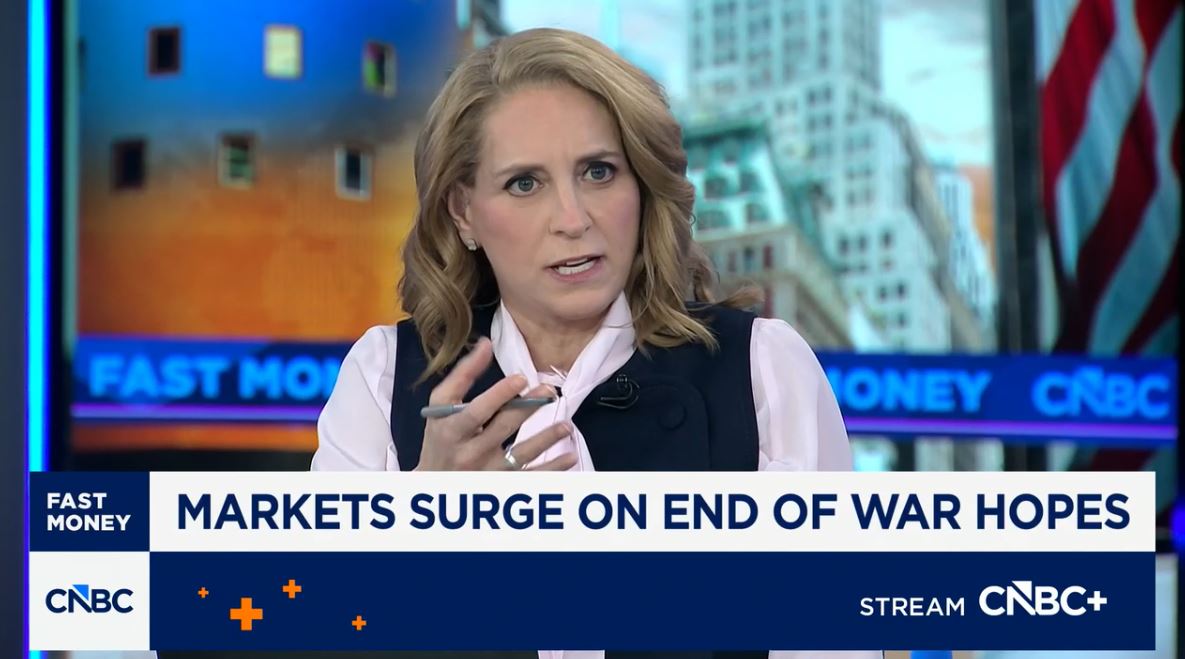
Karen speculates as to the objectives of the attacks on Iran
On Monday's (3/9) Fast Money, Steve Grasso kind of gave a speech about oil and the conflict with Iran that didn't seem to culminate in an actionable trade.
Karen Finerman then said the administration seems to have the same timeline as with Liberation Day: "I think it was 5 or 6 trading days, and then- and then they said 'All right, enough. Uh, we're going to, you know, delay.' And so this was about the same amount of time," Karen said. "This is a president who very much sees his success as, you know, how is the market doing?"
Karen said, "It depends what the objectives were."
Grasso cut in, "Leadership change."
Karen said, "This isn't a wholesale change of leadership at the moment" and "maybe it's enough to declare victory and leave; I guess that's what this is."
Well, now that's a very interesting question ... why are they doing this ...
The precedent was determined that as long as Iran has any nuclear material or nuclear "ambitions," it is subject to being attacked.
There have been high levels of hostilities in the Middle East since October 2023. Iran did not have a nuclear agreement with the West as a form of protection. The "test run" last summer found that Iran could not really defend itself against this kind of assault. In recent weeks, its currency collapsed, people protested, making it seemingly vulnerable to upheaval, and a series of talks with the United States achieved no agreements. The "objectives" seem to be to occasionally inflict enough damage and target enough of its leadership so that exasperated moderates come to power. Perhaps it is believed that those moderates would come to power overnight, or perhaps it is believed that it will take significant time and that the past week is simply another brick in the wall.
Guest Paul Sankey said of the Strait of Hormuz, "Making it safe again is, is gonna be a real issue- a real nightmare, and I don't think this is over by a long way."
Mel used air quotes (she's been doing that forever) when saying "declare victory."
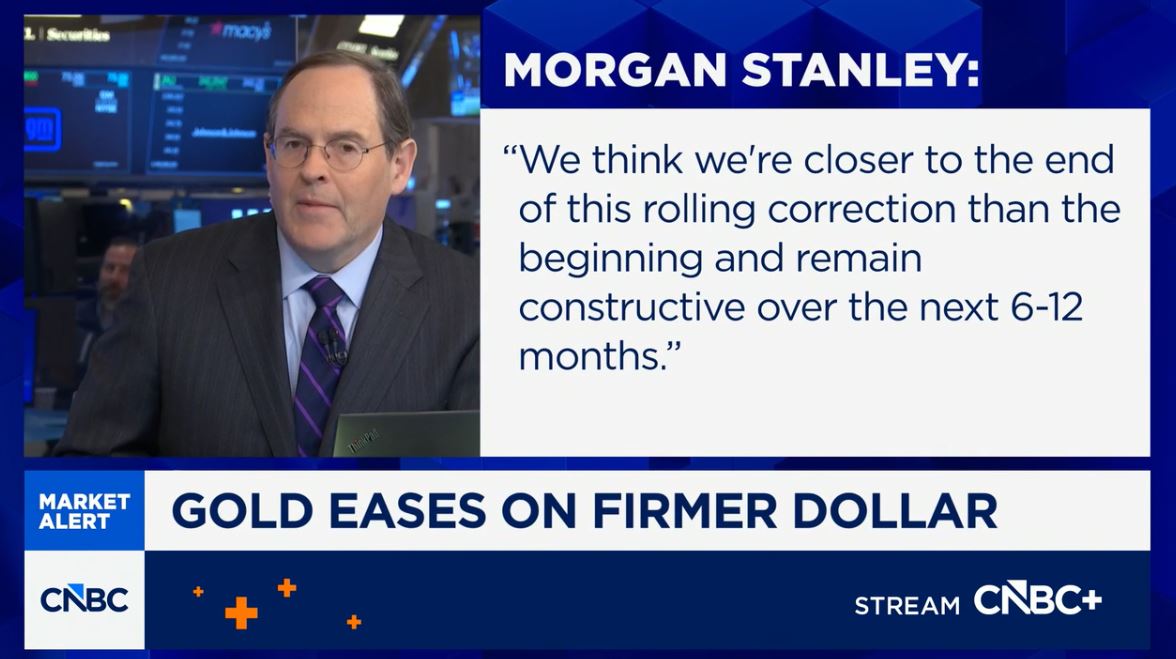
Jim seems to be overhyping things with ‘talking about raising rates’
It was shock & awe on Monday (3/9) — not in the Iran conflict, but in Jim Lebenthal's Halftime Report contention that some people on the Fed were actually talking about hiking rates.
Jim cautioned that damage is piling up on global oil infrastructure, and if this conflict isn't resolved soon, it'll start having a long-term impact.
Jim said traders are hoping to see vessels passing through Hormuz "this week."
Sully delivered some news to the show, saying the Iranian foreign ministry is warning that any tanker in the Strait "must be very careful," which Sully said sounds like a "slight deescalation."
Sully pointed out how oil futures through July gradually are pricing lower. Joe Terranova said there's "significant backwardation."
Joe then stated a potential side-effect of this war: "I think as oil goes higher, that's telling you you probably need some more rate cuts."
Jim claimed, "At the last meeting, they were actually talking about- some people were talking about raising rates," which Jim said "should not be off the table for anyone," prompting disbelief from Joe, Steve Weiss and guest host Frank Holland.
Joe seemed to think Jim was advocating for rate hikes, pointing to the "earnings recession" of 2022 and demanding to know if Jim wants them to raise rates. Jim chuckled, "No, that's why I'm saying, Be aware of it!"
Weiss said, "There's no chance of the Fed raising rates. Not while jobs are going the other way." Frank said they all thought Jim was saying "we may need to raise rates." Jim said it's a "warning shot" from the last Fed meeting.
While this page would never in a million years presume that Federal Reserve policy is ever iron-clad, we did wonder why, if Jim is correct, this hike notion hasn't been mentioned much (if at all) on the show this year.
According to an NBC News report on Feb. 18, "At their most recent meeting, Federal Reserve officials discussed scenarios in which an interest rate hike might be appropriate, according to minutes of it released Wednesday. 'Several' Fed officials thought there was a 'possibility that upward adjustments' to interest rates 'could be appropriate' if inflation continues to track above 2%, as it has for nearly five years."
Literally, Jim appears to be correct; they were "talking about raising rates." But saying that it's possible that future conditions could dictate such a move hardly seems like talking up a hike.
According to the transcript of Jerome Powell’s last press conference, the chair said: "We don't take things off the table, but it isn't anybody's base case right now — anybody's base case — that the next move will be a rate hike. But, ultimately, we'll do what we think is the right thing. But that's not where people's expectations are right now."
Weiss mentions ‘stagflation’ (but whatever happened to ‘soft landing’?)
Joe Terranova started off Monday's (3/9) Halftime Report talking about "the rhythm of the market," which sounds like a Gloria Estefan song; Joe said the rhythm this year is a "roller coaster."
Joe basically advised taking "the other side" of every trade that's moving.
Steve Weiss said, "I'm tired of the word 'resilience'" and said the market goes up "90% of the time," so anyone who has sold and stayed out, "the market's higher."
Weiss said, "This is volatility on steroids," though Weiss pronounced it a "nuisance" but said he is concerned about "stagflation."
Repeating another of his long-running refrains (besides "90% of the time"), Weiss said, "2/3 of the country lives paycheck to paycheck."
Grasso willing to take flier on HIMS, but story could fall apart
Joe Terranova on Monday's (3/9) Halftime Report opined on what ORCL has to talk about during earnings. Joe said he's "not necessarily sure" that management will make the sale. Joe said he likes CDNS and PLTR a little more than ORCL.
Steve Weiss bluntly stated, "D.A. Davidson has no idea of the impact of AI on any company."
Weiss is calling MSFT a "core position."
Dom Chu handled ETF Edge; his guest, Kim Arthur, called The Dominator "Dominique."
Weiss is long GEV but said its valuation is "kinda high."
Jim Lebenthal offered NVDA as a Final Trade, Weiss said NFLX (this writer is long NFLX) and Joe said LYV, saying it got past the "obstacle" of the DoJ without noting that a bunch of states are rejecting the settlement and are still going to sue.
On Monday's Fast Money, Steve Grasso said he'd take a "flier" on HIMS, because "the next level here could be another 40% higher, but just leave yourself a little bit of a leash to the downside, because if the story falls apart, you don't want to be part of it."
Mel had a brief moment of dead air when she welcomed Wesley Clark and either Wesley didn't realize Mel was waiting for his own greeting or did offer his own greeting but too quickly and too quietly for Mel to notice.
So much has changed in the last 10 days, the president should do a State of the Union Update next week
Steve Weiss at the top of Friday's (3/6) Halftime Report summarized the stock market actually quite well.
Weiss said it's a "daily occurrence," where overnight futures sink, "then we get buyers, bargain-hunters coming in," and "I don't see that changing anytime soon, except for the fact that I have to believe the president is looking at this as he does, he pays attention to the market, pays attention to the polls, and saying, 'Maybe we gotta get out of here sooner.'"
Weiss even drew a comparison to the '70s before stating it's not really the same thing: "When you had the oil shock, at the same time you had low presidential approval ratings, and you had inflation. So we've got 3 of those elements in place. What's different now though is that the market's different, the investors in the market are different, and they look at these as opportunities, and I agree with that."
Judge said, "The situation's obviously a little different," explaining that there's no "oil embargo" to the same "extreme," and that Jimmy Carter referred to a "malaise" that we don't seem to have now. (How could there be, when we just heard a 108-minute State of the Union address that has to be one of the greatest speeches in the history of the world.)
Weiss agreed and said it's a matter of "which buying opportunity" you're selecting.
Judge said we don't even have a "crisis of confidence."
Shannon Saccocia said the FOMC may be more concerned about inflation than the market thinks.
Jim Lebenthal agreed with Weiss' description of the daily markets, but, as far as bargain-hunting, "I would be surprised if that happens today," given that we're headed into the weekend. Jim said the market is waiting for news about tankers going through the Strait of Hormuz.
Josh Brown said the performance of oil-related stocks doesn't seem to indicate this is a "new oil-price regime."
Don’t tell Joe, but SPOT — like NFLX — has caught fire
Well into Friday's (3/6) Halftime Report, Judge said CFRA upgraded NFLX with a 115 target. (This writer is long NFLX.)
NFLX long Steve Weiss repeated that NFLX is better off backing out of WBD and that Paramount-Warner is now a "weakened competitor."
That was kind of the same thing we've been hearing for a couple weeks. But what really caught our attention is the recent rally in SPOT. (This writer is long SPOT.)
It used to be, in 2025, Joe Terranova spent spring and summer talking about how NFLX and SPOT were a pair of impressive streaming stocks that kind of traded together.
That was fine, except that Joe kept talking about how great those stocks are well after early July, when both stocks started to take a monthslong dive ... and didn't bother telling anyone to buy them in February.
In the last couple weeks, NFLX stock has taken off, because of a well-publicized news event that everyone knows about.
What's really kind of crazy is that SPOT has rallied at basically the same time, in a chart that's practically a mirror image, when SPOT had absolutely nothing to do with bidding for Warner Bros. assets.
Hopefully, someone will explain which tail is wagging the dog here.
Steve Grasso suggests spike in WTI is ‘deflationary’
On Friday's (3/6) Fast Money, Karen Finerman said oil's spike creates "a more difficult job for the Fed."
But the Most Handsome Fed Chair Of All Time is still going to twist enough arms (who can we fire?) to cut interest rates by 50 basis points, correct?
Steve Grasso wondered, "What happens if the spike in WTI crude is deflationary." His argument basically was, if more of your money is going to the gas pump, "you have less money to spend on retail, restaurants, travel."
"Wait a minute," Karen demanded, wondering if Steve is arguing that "If oil were to plummet, that's highly inflationary."
Steve said in that scenario, "it is inflationary, to a certain degree." But he said we have a "supply shock," which isn't inflationary, "because booms are inflationary."
Grasso also cautioned, "Be careful if you're looking at WTI. 'Cause the bottom can fall out of WTI a lot quicker than it could fall out of Brent."
Jim’s not buying airline stocks because he’s not trying to be a ‘hero’
Judge on Friday's (3/6) Halftime Report brought up airlines, which gave Jim Lebenthal yet another chance to talk about DAL.
Jim predicted that when Middle East crisis "clears," airlines will "resume their hike."
Judge wondered why Jim wasn't scooping up shares on the pullback on Friday. Jim said that's a "really good question," but his firm is getting "new money coming in all the time," and he's not "trying to be a hero" on Friday with a "shooting war" going on in the Middle East.
Because, many times in pop culture, we've heard people dubbed "heroes" for buying Delta Air Lines stock.
Software ‘at best’ only hit a tradeable low
Judge on Friday's (3/6) Halftime Report told Steve Weiss that banks are the "most important stocks" right now. Weiss acknowledged that the IPO case for banks has "damage."
Jim Lebenthal said financials are being affected by some economic indicators that are getting "a ittle wobbly."
Josh Brown suggested that the rallies this week in software and pressure on semis are "countertrend."
Judge showed a chart showing massive outperformance of the IGV over SMH — for the last 8 days. Jim suggested it could just be "short covering." Weiss said people may have tried to "hide" in software, but "at best, at best, it's a tradeable low."
Weiss bought more BABA, mostly citing P.E. ratio. He called it "value hunting."
Shannon Saccocia suggested restaurant stocks, which have taken a hit recently, could be a buy "from an overarching perspective," because they're "down on oil."
On Fast Money, Steve Grasso said if you want to "dabble" in ORCL, Friday's price is a good spot for a "flier."
What’s China doing with the ‘carte blanche’ Tim Seymour claims it now has?
Judge on Friday's (3/6) Halftime said Jefferies says CBRE is actually an AI winner. Josh Brown bought the stock recently.
Meanwhile, Josh finally realized what TGT has been doing (tip: Check the 52-week high list); now it's on the Best Stocks list. Josh suggested, "There's something powerful happening with this turnaround."
Indeed. We noticed it on the 52-week high list a week ago and wondered how is this happening. (This writer has no position in TGT.)
Santoli said the market has been "hopefully rational" that $92 oil is a "fleeting thing."
For Final Trades, Josh offered TTAN, Steve Weiss said LDOS, Jim Lebenthal said GOOGL and Shannon Saccocia said KRE (Zzzzzzzzz).
Jenny gets ‘super-granular’
In a sleepy episode of the Halftime Report Thursday (3/5) in which utterly no one had any table-pounding buys,
Judge said the market is about whether there are any more mediocre, AI-challenged companies that David/Larry Ellison can borrow tens of billions of dollars to buy people are willing to buy the dip.
Bryn Talkington said a lot of sectors have dips to buy.
Kari Firestone offered that the market "generally" calms down a couple months after "geopolitical events."
Jenny Harrington said she loves times like this "because I can get super-granular (snicker) right now." Jenny rattled off a bunch of international positions she added to that were down 7%; Judge complained that the producers didn't know before the show and thus couldn't prepare charts.
Judge at one point declared, "it's almost impossible" to know how AI is really going to affect software companies.
Bryn said, "I own Zoom. I can get my arm around Zoom all day long."
Kari explained how she compared Forward P.E. ratios (which is always whatever someone wants it to be) of "old economy stocks" with "new economy stocks" and found old economy is at 30.33 and new is at 21.20.
Kari mentioned "disequilibrium"; Judge said he was just about to use the term "equilibrium."
Judge said Bernstein put a 525 on AVGO.
Jenny bought BBY and took issue with Judge's description of "disappointing" sales.
Kari bought more NVO. Kari said, "The reason that I bought it, it's down 72% from the peak," which tends to be the No. 1 metric of Halftime panelists.
Jenny's Final Trade was FLNG. Kari said NEE, and Bryn said ZM.
On Fast Money, Carter Worth advised fading the gains in energy stocks. Guest Erik Hirsch seemed to think private credit fears are overblown. "Saying there's a private credit issue is like saying there's a stock-market issue," Hirsch said. Guy Adami said, "Julie Biel is a huge fan of Stevie Ray Vaughan."
Bill suggests MSFT is having a spring-2025-Alphabet moment
MSFT was a popular stock on Wednesday's (3/4) Halftime Report, as Steve Weiss and Bill Baruch each reported buying more.
Bill cited Charlie Munger's advice on waiting for stocks to test a "200-week moving average."
Bill asserted, "Capitulation has happened in the software space." Bill even said, "I think this could be, last spring, where everybody hated Alphabet, this is that moment for Microsoft."
(We kind of doubt that, but if Bill's correct, this is certainly a contender for the Call of the Year.)
Joe Terranova said MSFT is a "safe" software play, but if you want high beta, "just go buy the private equity names." Judge said that takes "guts."
Judge said the IGV (Zzzzzzzzzz) (snicker) is up 4% this week and may be "fully washed out."
Bill bought more CRWD on Monday ahead of earnings.
Bill said AVGO is at the 200-day; he expects another solid earnings report.
Bill said, "I think we're gonna see a risk-on rally broadly."
For the 3rd day this week, Joe mentioned buying the EIS.
Grasso is again the front-runner for Call of the Year for suggesting buy NFLX $75 in January
Steve Weiss on Wednesday's (3/4) Halftime Report said he bought more NFLX. (This writer is long NFLX.)
Judge pointed out NFLX is up "23%" in the past month. Weiss admitted, "I didn't catch the bottom in the 70s."
Weiss said what he likes is that Paramount, as a rival to NFLX (which it really isn't, but whatever, we'll go along with it), is actually "much weaker" with an "obscene amount of leverage." Weiss said NFLX saved $90 billion by backing away, and he's "super pumped up" about the stock and thinks it'll be a "top performer this year."
Weiss' trade is fine, but it's still later than Rob Sechan's awesome Final Trade of a week ago, and even Rob has to rank behind Steve Grasso's remarkable forecast on Jan. 21, with NFLX closing around $85, when Grasso said, "If you want to get greedy in this stock, look back to November 2024 levels. $10 lower from here. If not, dabble at these levels right now."
Meanwhile, Bill Baruch said TSLA has held around 400, "where it needs to," and it's having "success with- with self-driving." He suggested adding as well as buying it if you don't already own it.
Weiss pronounces stock market in ‘pretty good shape’
Joe Terranova, who has wrestled with whether there's sort of been an "all-clear" or not been an "all-clear" this week, at the top of Wednesday's (3/4) Halftime Report stated, "I think a lot of people are looking for this to be the bottom this week."
If nothing else, Joe said, "I think you take the bear market scenario completely off the table." Joe concluded, "You have the buildings of a bottoming process," and, Santoli-like, Joe added, "Let's see where we go from here."
Judge said it "show yous" (sic) (snicker) instead of "shows you," but corrected himself. Liz Thomas said we may "need" to get to 6,500 for a bottom. Liz said we need "deescalation" in order to bottom, and "I'm not convinced that it's done yet."
Liz said we may not be done with the pullback, but we won't have anything "disastrous."
Bill Baruch said we're in the "trough" and there's less chance of a bigger correction than last week, and Monday and Tuesday were "positive," so we're in a "very good scenario."
Steve Weiss said there have been "scary things in the headlines this week," but "indices" have "barely moved." Weiss pronounced the market in "pretty good shape."
Santoli said the market's priced in a "relatively benign scenario" for the Middle East.
Weiss says China is telling Iran not to bomb the Middle East’s oil infrastructure
Steve Weiss on Wednesday's (3/4) Halftime Report said he trimmed TSM; he announced that he started buying "when it was in the 70s," and of course it got larger than his other positions, so, "Just from a risk and a portfolio management standpoint, I had to take some off the table."
Or put another way, his other stocks are underachieving.
Weiss asserted, "I also think that China probably has had to talk to Iran and said, 'Stay away from bombing out the infrastructure in Saudi, everywhere else.'"
Bill Baruch sold SLB; he wanted to "monetize something" out of energy's move.
Joe Terranova advised, "Do not get out of the refiners."
Weiss said that "everybody" who buys oil on these Mideast events thinks they're getting in early, but actually, "they're all gettin' in late."
Joe says dollar lower
Liz Thomas on Wednesday's (3/4) Halftime Report said she thinks the dollar stays weak, and "I think EM is a good spot to be."
Bill Baruch agreed that the EEM is a "great spot to look at." Judge pressed Bill on whether we're at "peak memory" and if so, could Hynix be an anchor on the EEM on any kind of "rollover." Bill indicated people chasing just South Korea could be on the wrong side but pointed out there are "other names" in the EEM.
Joe Terranova said, "I do believe the dollar continues to move lower. That supports the emerging markets story."
Bill touted ILF as well as EEM.
Liz thinks IGV has bottomed
Steve Weiss on Wednesday's (3/4) Halftime Report said CAT and GS have been a "wild ride."
Weiss said CAT is "still overvalued, but there's nothing to reset the value as long as the capex spend keeps happening."
Joe Terranova suggested PHM may do better than other homebuilders because of a "stronger average selling price." Joe said GLW has been "phenomenal," he bought at 109 in early February, one of panelists' several references during Wednesday's show to great winning trades with low cost basises.
CNBC's Dee Bosa spoke with Mo Assomull at the Morgan Stanley "TMT" San Francisco conference. ("TMT" apparently stands for Technology, Media & Telecom.) Mo said the mood among software CEOs has improved in the past month; "It's not all panic." Judge promised Larry & Curly on Closing Bell. OK, he didn't, just a joke, sorry Mr. Assomull.
Liz Thomas' Final Trade was IGV; "I think we bottomed." Weiss said he's been "gettin' my butt kicked by BABA," but he's going to add. Bill Baruch said LNG, and Joe said GS.
On a quiet Fast Money in which Guy Adami and Karen Finerman spent a lot of time talking about how they agree on some things, Karen said the market is "getting used to this new mode that we're in." Sara Eisen interviewed Marc Benioff, who of course doesn't see wreckage happening from AI but thinks it's going to help everyone.
Tom Lee: Markets near bottom
On Tuesday's (3/3) Closing Bell, Tom Lee told Judge, "Markets have been taking this much better than expected. I don't think anyone can say, uh, we're bottomed yet, but this is what looks like the makings of a bottom."
CRWD under $400 a ‘screamer’
Malcolm Ethridge said on Tuesday's (3/3) shortened Halftime Report that if CRWD sells off on earnings, he'll buy; he said that around 385, it's about where it was before the outage of 2024.
Josh Brown recapped the CRWD outage and the stock's boomerang; Josh went on to knock the "fairy tale," presumably referring to the notion of AI sinking cyber stocks, explaining that Anthropic's "bug detector" isn't going to cause Fortune 500 companies to "rip out" their cybersecurity, it's "the dumbest thing I've ever heard."
Josh added, "I think this thing under 400 is a screamer."
Joe Terranova again mentioned buying EIS.
Krinsky’s got a rhyme
Tuesday's (3/3) Halftime Report got half-preempted by Oval Office remarks; when things got started, Joe Terranova explained that we don't have "confidence in the clarity" of whatever's happening in the world to have the all-clear to buy stocks.
Joe curiously recounted, "On a day like yesterday, where it looked as though you had the all-clear and the market's gonna break out to the upside," it wasn't happening Tuesday. The funny thing is, that sounds like revisionist history in 1 day, as Joe had stated on Monday that markets won't have an "all clear" but just "rotational volatility." Evidently, by Tuesday, Joe seemed to think markets were providing an "all-clear" on Monday.
Nevertheless, Joe said on Tuesday that to get "alpha," try CF and SU and CNQ and financial exchanges like CME, and also the Mag 7.
Judge said Krinsky's note says, "When missiles fly, it's time to buy." Malcolm Ethridge said it's a market "where opportunities are created," though you shouldn't buy "across the board." Still, "This is the buyer's market," Malcolm said.
Sarat Sethi said he's adding to DIS, which doesn't seem to have anything to do with Mideast wars, but whatever.
Josh Brown said he sold DVN, apparently because energy has had so much outperformance in the past month.
Joe at one point suggested there's opportunity in emerging markets and suggested EWZ, EWW and once again mentioned EIS. Josh said the rally in international stocks "has legs."
Josh says ‘right bidder’ ended up winning WBD
Judge at the end of Tuesday's (3/3) Halftime Report asked Josh Brown about NFLX.
Josh recounted how he got out of "most" of his position as it broke below 100; "the Street just hated the deal ... I think it's probably a situation where the right bidder won the company. Like, this- Paramount needed this. Netflix didn't need it."
Josh said, "I did add a little bit in the 70s," and it's "back to being a constructive name," and it's an "opportunity" for those who missed it over the years.'
Josh's Final Trade was TOST. Sarat Sethi said DIS. Malcolm Ethridge said NOW and Joe Terranova said RMD; "a lot of people have sleep disorders like me."
Oval Office remarks delay Judge’s daily update on private credit
At the 40-minute mark of Tuesday's (3/3) Halftime Report, Judge said, "I think we need to discuss ... private credit," which Judge called a "big story."
Judge said BX was taking a hit over "record redemptions" in its "flagship private credit fund," which is called BCRED (what a catchy name).
Sarat Sethi is long BX and said some people will take redemptions, but "longer term, Blackstone is a great way to play the alpha in the market." But Malcolm Ethridge said he sold BX last week for the "sentiment problem" in alternative investment managers. Malcolm said the "safest" place in the sector is CG.
Josh Brown said the problem for these companies is that "they've kind of made this big bet, that wealth managers and their retail clients are gonna act like institutions. Unfortunately, the- these- the NAVs haven't even dropped and people are freaking out. Individuals are never going to behave like institutions."
Josh gets away with saying ‘AF’
Late into Tuesday's (3/3) partly Oval Office-preempted Halftime Report, Josh Brown said chemical stocks are on the Best Stocks list, led by ECL; Josh said, "This is HALO AF."
Judge was heard on open mike saying "this is cable" as someone else laughed.
Josh said you can buy ECL now and also mentioned LIN and SHW, though he said he wouldn't "run to" SHW, which makes you wonder why he brought it up. Sarat Sethi suggested buying LIN's products, hydrogen and liquid gas. Joe Terranova said the JOET owns LIN and ECL.
Judge cracked, "I know what HALO stands for, but AF? No I'm just kidding. Don't- don't don't go there."
Josh chuckled, "We're gonna have to leave it there, Judge. We'll be right back." But Judge continued, "Now I'm all flustered," then asked Josh about ACHR. Josh said he owns JOBY too and these aren't big positions as they represent experimental technology.
Fish warns of Iranian ‘renegades’ taking matters ‘in their own hands’
In the latter half-hour of Monday's (3/2) Halftime Report, Judge brought in Fish, the star guest, to ask, of course, about oil.
(Because nobody brings in Fish to talk about Brad Gerstner's 2022 open letter demanding META stop spending so much money on the Metaverse.)
Fish told Judge, "If this was 5 years ago, 3 years ago, the price would be $110," so the market is recognizing a "general oversupply."
Fish said the biggest risk in this "equation" is the "refinery capacity." Fish likened refineries to pizza ovens and said if you don't have enough ovens, the price of pizza will go up, even if you've got plenty of dough and ingredients.
Judge foisted Ed Yardeni's view that this Iran operation will be quick and it'll be back to Roaring '20s. Fish said he has "no idea" if this will be a short or long conflict. But Fish raised the issue of, even if there's a cease-fire, "renegades" in Iran who "take matters in their own hands." (Jessep said that was impossible under his command at Gitmo, which ended up tripping him up in court.)
Fish said there will be a premium on refiners. Judge tried to get Fish to make a call on refiner stocks. Fish agreed that those stocks would be part of it, but "I will leave to Joe and you guys" to sort out.
Fish again mentioned the "renegades" and noted that in Venezuela, "It looks like everyone's playing ball."
Joe Terranova is watching tankers and said FRO, TNK and DHT are seeing "a significant premium." Joe said if you expect a "significant disruption as it relates to the Strait of Hormuz," then "this is exactly where you would go." Presumably, that means he would buy those stocks. But Joe allowed, "I don't foresee that happening" and that the "price action" Monday is "telling you that." Except 1 of those 3 was up 2%, one was down 2%, and one was virtually flat, so we have no idea what the "price action" is signaling. Joe said he's holding VLO and suggested MPC and PSX.
Tim Seymour claims China now has ‘carte blanche’
On Monday's (3/2) Fast Money, Karen Finerman said she thinks of ZM as a "survivor" in the software space and is thinking of adding, but would be "inclined" to do it with calls. Tim Seymour said he likes MSFT. Guy Adami said, "I think the low for the short term is in in IGV."
Much of the show did involve assessment of the attacks on Iran, and Mel brought in an excellent guest, Matt Gertken.
Tim Seymour (who might be one of those Fast Money voices who has been predicting a China takeover attempt on Taiwan) tried telling Gertken that after U.S. actions in Venezuela and Iran, China has "carte blanche." Gertken said he's got a "1/3 chance" that China uses "hybrid or quasi-military action to increase the pressure on Taiwan" this year or next year. Gertken said that "way down the road," it might be that neither China nor Taiwan sees a "pathway" to happy relations, so conflict could happen, but Taiwan is a mountain defended by the U.S. and Japan and would be a tougher assignment than the "easier invasion" of Ukraine.
Gertken said the U.S. is "flexing its muscles in taking low-hanging fruit" against regimes in Venezuela and Iran that have "squandered their domestic stability."
Karen Finerman predicted Donald Trump will reach a "pain point" in terms of how much he cares about Iran and then "he'll resolve it quickly, one way or another."
Judge nearly gives BDCs the day off
Judge on Monday's (3/2) Halftime Report didn't get to private credit until the 19th minute, then Santoli mentioned Blue Owl for the first time during the show.
Santoli said, "It's almost like we got something else to worry about."
Jim Lebenthal reiterated what we think is the same point he's already made about 2-3 times in the last couple weeks, that there's a "liquidity issue" in private credit regarding "redemptions" that will take a few months to wait out. But he doesn't see a "credit crisis."
Stephanie Link sees opportunities in big banks that have been "hit really hard."
CNBC auto/airline ace Phil LeBeau pointed out that "the first quarter hasn't gone as planned" for airlines.
Judge asked Phil about "AI-related job losses" in the travel industry and whether companies adopting AI would travel less. Phil referred to Scott Kirby, Ed Bastian and Robert Isom and stated, "All 3 said that they have seen very strong demand for corporate travel." Phil likened concerns of AI blunting business travel to Zoom "during the pandemic."
Jim doesn’t say a word about the number of humans on the NYSE floor
Joe Terranova opened Monday's (3/2) Halftime Report basically admitting (not his actual words) that the stock market decided strikes on Iran are somehow a non-event.
Joe explained that "certainly equities were discounted over the last month," and the "significant geopolitical shock" that could've sank stocks on Monday "is not unfolding," so we're "back to where we were last week."
Joe said it's the Mag 7 that was "coming to the rescue" on Monday.
Judge actually went to Santoli in the 2nd minute. Affirming what Joe said, Santoli said, "Nobody even allowed much of a dip to occur this morning before, uh, essentially buying it."
Stephanie Link said with all that's been thrown at the market, the S&P is flat on the year.
Stephanie noted oil was only up about $5 and the 10-year yield wasn't plunging.
Jim Lebenthal said, "You don't want to see this become a regional conflict." (The only thing he left out was the Strait of Hormuz, but they did mention that on Fast Money.) Jim said the ISM quietly was "nicely into expansion for the 2nd month in a row."
Burnishing his credentials as Santoli Jr., Joe said "I'm a little bit more, uh, aligned with what Mike said before" in that we won't get an "all clear" for the markets. Joe said he thinks we'll have "rotational volatility." Santoli said the market is "building in an expectation" that action against Iran won't be "long-lasting" or "particularly disruptive."
Joe bought the EIS, saying even though it's up Monday and at an all-time high, he's looking "2 to 3 years" ahead.
Joe said he trimmed 25% of his OIH (Zzzzzzzzz); "I already have about a 30% gain in the position since January 12th."
Jim said he has to start thinking about trimming XOM, which may catch Judge and viewers "by surprise," but "it has simply grown to be too big in my portfolio." (Always a great reason to sell a stock — the amount of the other holdings in your portfolio.) Jim said he still believes in the trade, but the oil market before last weekend was "definitely in an oversupplied situation globally." Jim touted RIG, a stock he always likes, month after month, year after year.
Jim's Final Trade was LMT. Stephanie said NFLX. (This writer is long NFLX.) Joe picked CF.
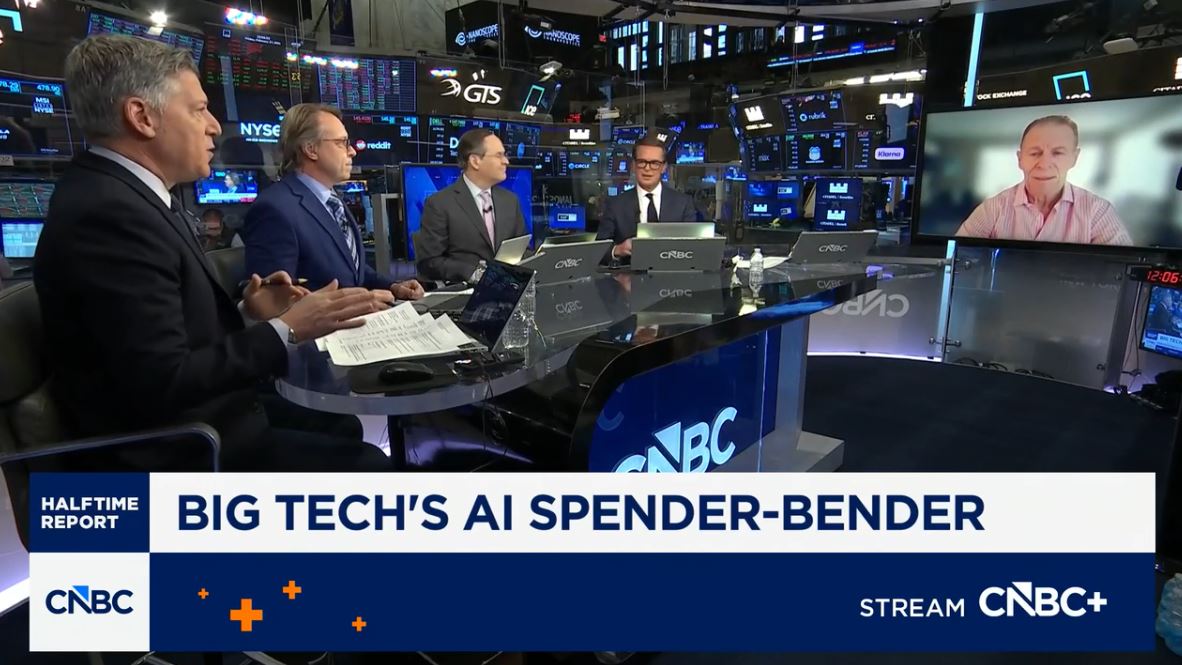
The entertainment value was a lot stronger than the logic in Jim and Weiss’ job disruption debate
On Friday's (2/27) Halftime Report, Steve Weiss managed to get into a couple of scrapes, but the one with classic nemesis Jim Lebenthal was the best, maybe the best of the young year.
Judge had urged everyone to read Steve Sedgwick's CNBC op-ed on how "Block's layoffs should be a wake-up call on AI and jobs." But then Judge said Greg Ip shrugged in the WSJ that "Tech has never caused a job apocalypse. Don't bet on it now," and that Ed Yardeni is "not too worried about this recession-mongering," which Judge said Ed calls "AI Derangement Syndrome."
Obviously siding with the latter group, Jim, who was at Post 9, for the 2nd time this week pointed out that there are "roughly 300 people on the floor of the New York Stock Exchange. 30 years ago, I was here, and there were 5,000 people."
Jim said financial industry employment "has gone up by 20%," and that digital technology has made price discovery "better" at the NYSE.
Weiss, who was part of the panel remotely, countered that he doesn't think you can make that "connection" because "we've never had a technology that can actually replace workers. ... That's what Dorsey's telling you."
Jim insisted, "I just described it right here"; where are the runners between the specialist stations at the NYSE, the paging clerks. "Technology has quite often replaced workers."
Weiss pushed back, "You must have statistics on how many of those workers didn't retire, right, or didn't go into another industry."
Jim said, "I just gave you the numbers ... if you want to disagree with me, find other numbers."
As the two sorta talked over each other, Weiss demanded "let me talk."
Jim said, "Can you say something that has numbers to dispute the numbers that I gave you."
Weiss said, "The numbers you gave me have no correlation to the financial industry. The jobs in the financial industry were created by the democratization of investing."
Jim chuckled, "All right, whatever. Whatever. ... He's just gonna disagree to disagree."
Weiss said, "That's a bunch of crap. You guys don't want logic."
Jim cut in, "We do want logic. We want logic backed up by data. By data. ... I don't like it when you do this, Steve. You just say 'I disagree' for the sake of disagreeing and you give no logic to back it up."
Weiss complained that Jim's "not even letting me talk."
Rob Sechan opined, "Steve, he gave you every opportunity to talk and back it up- up with numbers."
Weiss said, "That's absolutely not true, Rob. I tell you what, Rob: Why don't you be quiet right now, and you Jim too, and I'll give you my logic. OK? ... Index investing has gone from a fraction of the market to the majority of the market. That democratized investing. That's what's driving the financial services jobs. You've seen household, uh, exposure to equities continue to increase. That's what drove financial services jobs. Getting rid of jobs on the floor of the exchange, which is a- which is such a minor data point, has nothing to do with the growth in financial services. Period. End of story. Unless you can tell me how getting rid of a clerk on the floor led to greater job growth in financial services."
Jim protested, "One more time ... Financial industry employment is up 20% from 5.7 million at the turn of the century to 6.8 million right now."
Weiss said, "So tell me how reducing the floor population created this? That's your assumption."
Jim said, "Steve, my goodness. Like, Why are you- why are you trying to disagree. You said technology destroyed jobs."
As there was considerable talking over each other, Judge intervened, saying, "I let that go long enough." Weiss said, "Jimmy, no offense, but it's never been an effort to disagree with your work." (We think those were the words, though Judge was talking over him.)
Well, hmmmmm ... the funny thing about this exchange is that both had quality points, but neither actually nailed it in his presentation.
We have to pick apart Jim's NYSE example, because 1) he left it incomplete, 2) it doesn't support his larger point (which is a fair point) and 3) it in fact is basically Weiss' argument.
Jim said there used to be 5,000 people "on the floor" (that's the key verbiage), and now there are 300. But Jim didn't say whether most of those other 4,700, or all the guys in those old outcry pits, are still doing the same job but doing it remotely from their office.
But let's assume, for the sake of Jim's argument, that those 4,700 positions have been completely eliminated. That is basically Weiss' point, that this is what AI could do to a lot of industries, not over 30 years but in short order. (Although exactly what industries, we haven't really heard many specifics from Weiss ... we highly doubt we're going to see AI replacement police/firefighters/teachers/health care workers/trash collectors/airline crews, and all of those professions by the way report having serious understaffing issues in many parts of the country ... It seems like the most vulnerable workforce to AI disruption is Uber drivers and cabbies (and that's been projected for about the last 10 years and really doesn't seem a whole lot closer to actually happening), so Weiss is basically referring to tech companies whose staffing tends to twist in the wind anyway as they veer between one hot road-show app and slumps in monthly average users.) Jim is implying that because financial industry employment is higher, all the former paging clerks are now either doing research for Barry Bannister or taking client calls for Fisher Investments.
Weiss is more on point in asking about retirements, which Jim dismissed. The slide at the NYSE "floor" took long enough that the population probably dwindled mostly by attrition; the 60- and 70-year-olds were gradually given alternate jobs and then incentives to quit and weren't replaced. Probably most people who have worked in industries with long-term employment declines have witnessed this.
Jim missed the strongest argument for his point, which is that birthrates are so historically low, there just aren't nearly as many 20-somethings competing for jobs as there were in the '70s, and there are far more 80-somethings who need things. Before it ever creates massive dislocation, AI may actually help reduce some important shortages.
An obvious example that neither party cited is automaker employment. Ford apparently has about 170,000 global workers now ... or less than half of what it had in the '70s. That's obviously because of technological improvements. AI could speed those improvements. But Jim could argue that while Ford jobs are half of what they were in the '70s, now there are American factories for Tesla and Waymo and all kinds of foreign automakers who didn't have factories here in the '70s.
Big picture, Jim is correct, society will eventually sort this out and redeploy where the jobs are. Until Weiss can tell us specifically which workers are facing imminent AI extinction, Jim prevails here.
Judge keeps implying that META turned things around because Brad wrote a letter to no one
Steve Weiss on Friday's (2/27) Halftime Report said he sold AMZN and NVDA.
Weiss said he thinks "near term," NVDA will continue to be "stuck" in the 180-190 range. Weiss said he owns MSFT and Alphabet and those are "highly correlated" with NVDA, and he also owns TSM, which is also sort of an NVDA play.
Weiss was less articulate about AMZN, basically saying it's spending a lot of money and the spending makes sense but apparently it's going to take a while to pay off, then he said that we keep hearing that "this technology" will create jobs like all others, "I just don't believe that's going to be the case."
Rob Sechan protested, "Why is that different, necessarily, this time. Productivity leads to more productive workers, tends to lead to more hiring."
Weiss said the productivity isn't as much for the worker but "the enterprise."
Jim Lebenthal said he's not selling AMZN and he doesn't think we're in the "final 3 innings" of this disruptive technology yet. Jim mentioned Brad Gerstner, whose State of the Union ovation has gone unmentioned by Judge (at least on the program).
Judge explained how the CRWV CEO "doesn't care" about the margin hit from what the CEO calls a "once-in-a-generation opportunity" of ... capex spending.
Kevin Simpson said he's been buying MSFT over the last couple weeks; he thinks it's "rolled over too severely."
In the 17th minute, referring to META, Judge stated, "Brad Gerstner wrote a letter, right, and then they did get fit as he urged them to do."
‘Better make sure there’s a fire’ — Rob seems to be warning the news media about reporting on private credit
Steve Weiss on Friday's (2/27) Halftime Report said "echoes of 2008" are pressuring the financial sector, and people in some names didn't get out at the "first warning sign," and now are looking at "permanent capital loss."
Weiss predicted "more issues" but said he thinks it'll be "contained," though underwriting hasn't been "flawless."
Weiss sees Friday as an "opportunity actually to buy more Goldman and some of the better risk managers out there."
Judge said UBS is putting together a shopping list of attractive banks.
Jim Lebenthal said "you have to be selective in this sector" and that some private credit news is "really kinda dire."
Jim clarified that he "slammed" public BDCs, but "the public equities of the private credit companies, like Blue Owl and Apollo, frankly, I like those." Judge pointed out Blue Owl Capital is down 27% YTD, "even worse than the BDC" this year. Jim predicted OWL and APOL will "come back" and are getting "marked down on an overreaction to legitimate fears. ... But I do not think that these are systemic risks."
Rob Sechan said he disagrees in that he sees value in the BDCs. Rob didn't say "equity" 500 times like he did a day ago but said they have "liquidity buffers" built in. Rob said his concern is that the "fear-mongering" will cause liquidity to dry up in the "retail community," and they'll make "the wrong decision, a la a Lehman-type decision, where everybody tried to run to the door at the same exact time. ... And everybody's gonna get hurt if you yell 'fire' and they all try to run out and there is no fire, they're still gonna get hurt.' OK, you'd better make sure there's a fire."
Judge countered, "I'm sure there were some advisors over the last couple years who were yelling 'Sunshine' about pri- about private credit, endless days of sun, and now there's some turbulence and storm clouds and things are a little more worrisome, and those people who were in those assets because they're either semi- or highly illiquid are stuck without an umbrella and they're gonna get soaked."
Rob said "a great advisor will actually dive in and do the work."
On Fast Money, Steve Grasso said of financials, "You should be buying stocks right now. Software has nothing to do with the headwinds for these companies. Period. End of story. If you- if there were something that was micro, we would know that by now. This just felt like a Friday selloff when there was, we- we have Iran, still hanging in the wings, and we have plenty of things to worry about. This I don't think is one of 'em. And I think if you look at regionals specifically, they have zero to do with, uh, software issues and AI issues."
Gotta say, it is kinda embarrassing when an esteemed company makes a huge bid for something, and the market crushes the stock, then cheers when the bid is dropped
After the A Block on Friday's (2/27) Halftime Report, Judge brought up NFLX. (This writer is long NFLX.)
Steve Weiss said he "nibbled" early in the week and noticed the stock seemed to be going up this week, "then all of a sudden, it starts marching up, so I thought this may be happening, and insider trading is alive and well ... I bought most of it last night ... more than where it's trading; actually right about where it's trading right now."
Weiss summarized what this means for NFLX: "Not only are they not spending, you know, ridiculous sum on a library of old films, uh, they've got now, not just, you know, weak- 2 weak competitors, but 1 much weaker large competitor who is gonna strangle under, uh, the debt load. And Netflix is then gonna buy more content and they'll be able to bid- outbid them on other content like sports. So for me, this is panacea for Netflix."
Judge said the sell side commentary on NFLX is "universally positive" with price targets from 110 to 135.
Rob Sechan noted his spectacular Final Trade of NFLX a day ago, already a Call of the Year candidate, and said he "bought it earlier in the month" and is up 15%, "that does not include today."
Hmmmm, OK ... we looked at the math, and it turns out, it is possible to have bought NFLX during February and be up 15% prior to Friday, but it would've had to be pretty close to the 75.01 bottom. Maybe that's where Rob bought it.
‘Healthy’ times in the market
Sorta like Gordon Lightfoot and the "Summer Side of Life" (an undeniably great tune), Rob Sechan at the top of Friday's (2/27) Halftime Report was pronouncing February's lousy stock market as a positive.
Rob said there's been a "re-rating of fundamentals" that has led to "almost a necessary and healthy reset."
Rob said people have wondered if the market can "do OK" without the big names; Rob said it's "done OK" without them.
Judge agreed that "it feels worse than it is" and said "3 of the 4 majors are green year to date," but it's also been "really volatile."
Jim Lebenthal asserted, "The average stock is doing well." But Jim said it's been a "lousy week" from a "news flow," such as Block layoffs. But Jim said, "This does not look like a market or an economy that needs rate cuts."
Like Rob, Kevin Simpson said we're seeing a "repricing" of Mag 7, etc., that is "incredibly healthy."
Judge and Kevin quibbled over whether there's AI "skepticism" (as Kevin said) or "paranoia" (as Judge seems to think).
Rob’s Final Trade is a stock Malcolm was selling this week
Kevin Simpson had a quiet show on Friday's (2/27) Halftime Report, but he did mention a few trades.
Kevin bought more AAPL, predicting this is the year Siri's usefulness comes to "fruition."
Judge said PLTR got a 180/buy from UBS. Kevin said if you want a speculative name in your portfolio, this is one to try.
Kevin bought NSC, indicating railroads can't be replaced by AI.
Jim Lebenthal said BRK is "very attractively priced."
Steve Weiss' Final Trade was QXO. Rob Sechan boldly suggested BX. Judge noted Malcolm Ethridge mentioned selling BX this week. Jim said XOM, and Kevin said AAPL.
Rob makes an awesome Call of the Day before Tom Rogers makes a call that goes bust in barely 1 minute
At the end of Thursday's (2/26) Halftime Report, Rob Sechan made NFLX his Final Trade. Josh Brown said Rob will make money and that Josh "added some in the 70s." (This writer is long NFLX.)
Incredible timing.
With both, especially Rob, essentially declaring the bottom is in NFLX on a day of major news for the stock (this review was posted overnight Thursday-Friday), the pair of calls are quite possibly going to end up on the Call of the Year list. (And may be trumped by Steve Grasso hanging a buy-75 on NFLX about a month ago.) (Funny how it found 75 several times this month.)
Hours later, about 44 minutes into Fast Money, Julia Boorstin reported on the original NFLX-related news of Thursday — how WBD deemed PSKY's offer to be "superior."
Tom Rogers then joined the Fast Money panel and declared, as NFLX was up about a couple dollars ... a bidding war. (Cue up "The Price Is Right" losing music.) "I'm surprised at the market reaction after market here, with Netflix going up. Uh, that suggests that, uh, people think that they're gonna back out. And I just don't see that at this point. So I would expect, uh, another bid from Netflix and probably some downward pressure on the stock as a result."
Then, literally just 1 minute later, Julia returned, chuckling, with breaking news: NFLX is declining to make a higher bid. (Which explained why NFLX quickly surged through 90.)
"I've been wrong before; I haven't been wrong on live TV like that before," Tom impressively admitted.
Tim Seymour assured Tom that he wasn't being set up; "the news just wasn't out yet, we had- none of us had seen it." Tim said, "Both companies win here."
Julia reported on how PSKY is now picking up the $2.8 billion termination fee that WBD would have to pay NFLX. Granted NFLX no doubt has incurred a few costs in making its offer ... but getting David Ellison to ship you $2.8 billion for letting him borrow more money than the federal government to spend on cable TV seems like one of the best business deals since Warren Buffett gave Lloyd Blankfein a line of credit.
Julia and panelists speculated as to what Ted Sarandos was doing in Washington on Thursday.
Guy Adami predicted NFLX finds "115." Carter Worth, in his curious way of putting things, indicated there's more upside to NFLX than downside.
Rob claims that stocks that are going higher go higher, and stocks that are bottoming go higher
It was after the A Block on Thursday's (2/26) Halftime Report when Judge plunged into private credit.
Judge said, "Marathon's Bruce Richards, big credit manager, fears 15% direct loan software defaults ... that's what he said, according to a report."
Leslie Picker said she talked to CG chief Harvey Schwartz and went on to explain the history of financing software deals and said there's a "big rethink" going on.
Malcolm Ethridge sold BX and added CG, calling CG the "least dirty sock in the hamper." Which paved the way for Rob Sechan to start making pronouncements that seem likely to end up either in the Call of the Year — or Bust of the Year — sweepstakes.
"There's no question that there is episodic issues in this space," Rob said, but he emphasized that there's "equity" underlying all of these credit transactions.
Josh Brown cut in to say how institutions were deemed to be "fully invested" in private credit and the "big idea" was that they need "the next group to come in" (basically everday Joes), and now if there's a "hiccup" when the public is introduced to these strategies, it'll push the story out further "or cancel it entirely."
Rob then really got our attention when he claimed, "There's 2 things that really drive returns in markets. No. 1, it's riding momentum that's positive. If you can ride it longer, you're gonna do really, really well. Mag 7, whatever it is. The other is steering into disruption when it gets crazy. And right now, the public BDCs are discounting dramatic fail- not just 3-5% defaults, dramatic defaults in their pricing."
Hmmmmm. Translated, that seems to be saying, the outperformance comes from either 1) jumping aboard the already-great stocks, and/or 2) picking the bottom as soon as you correctly identify "crazy" situations.
Josh Brown asked Rob, if Rob had "fresh cash," which would he buy, the BDCs or the sponsors, or OBDC before OWL. Rob said as a trade, "I'd go to the BDCs."
Judge asked Rob an impressively tough question: "Are you defending it the way you are because you're putting your clients into private credit moreso than you ever have."
Rob said, "Not moreso than I ever have. It's been a consistent story." Rob insisted, "We dive in, we do a lot of work, we understand the credits that are in 'em." Rob further insisted, "They have a ton of equity beneath each one of these loans. It's a ton. It would have to be hugely disruptive."
Judge wondered, "Isn't what's happening in software 'hugely disruptive?'"
Rob said Indeed is "11% up in the software engineers that they are hiring," and is that happening because they're "unhealthy." Rob added that "private credit are not long loans."
Oh joy — just what we want to hear more about, software
NVDA was the early topic on Thursday's (2/26) Halftime Report.
"This stock never rallies after earnings," said Josh Brown. "I can't explain why," he admitted.
Josh rattled off TPU concerns and what the NVDA multiple is and said, "Not selling, staying long."
Malcolm Ethridge said he sensed a day ago that great NVDA earnings might just be sold off because the market "wants to trade out of AI."
Rob Sechan said the "AI Frankenstein narrative ... is still intact."
Stephanie Link trimmed AMZN and took a little pushback from the panel.
Malcolm pointed to how "local political apparatuses" in Wisconsin and Virginia are taking heat for allowing all these data centers (which sounds like the movie "Eddington," which is curious, because Rob brought up "Frankenstein").
CRM long Rob Sechan asserted that software names, despite being relentlessly hit on AI concerns, are "possible beneficiaries" of the technology.
Stephanie said SNOW is "caught up with the rest of software" but there's an "opportunity" there. Stephanie questioned why SNPS was down so much on Thursday; she bought more and said "This thing is down 35% from its highs," always a favorite Halftime Report metric.
Josh said he added to TTAN and TOST. Josh called TTAN a "screaming buy."
Judge still didn’t give on-air props to Brad Gerstner’s standing ovation at the State of the Union
Josh Brown on Thursday's (2/26) Halftime Report got to take a victory lap on SHAK's big day (even though it's still down hugely from last July).
Judge wondered why SHAK is down 8% over the past year. Josh said it has a "premium multiple" that doesn't help when the sector is shaky.
Josh touted WM on his Best Stocks list.
Stephanie Link's Final Trade was TFC. Malcolm Ethridge said ZS, and Josh said JOBY.
Joe: Private credit is the place for when the software ‘carnage’ is over
Joe Terranova on Wednesday's (2/25) Halftime Report said there's "far more complexity" about software than the Halftime group is acknowledging.
Joe made an excellent point about positioning, saying that if you think software has "resolved the carnage" of the last few months, "you're buying the private credit names."
Joe asserted, "The money is in semis."
Rich Saperstein said SNOW is a "tiny position which we just bought."
That prompted Judge to jab, "Nice timing," and mocked that people always say "It's a very small position in my portfolio." Rich asserted that SNOW "falls into that category" of companies boosted by AI.
"The software armageddon is at or close to bottom right now," Rich declared. However, he said he wouldn’t buy CRM, an "SAS model" with "excessive rents being charged."
Shannon thinks there's "More dispersion to occur" in software.
Moments later, Judge said UBS says 15% defaults "could happen" in private credit. Rich said he "wouldn't go near" names such as KKR, APO, OWL, ARCC even assuming they do rebound.
Rich said muni bonds are a better option than wrapping up money indefinitely in private equity for, on average, the same return.
Jim Lebenthal started rattling off differences between credit concerns and liquidity concerns and insisted this is why people need advisors. (Anyone who thought Jim or anyone else was going to bellow “It’s NOT an OPTION!!!!” was disappointed.)
Joe apparently thinks NFLX has other directions for getting WBD stuff
Pointing to the up day for NFLX, Judge on Wednesday's (2/25) Halftime Report said maybe the stock market thinks NFLX won’t win WBD. (This writer is long NFLX.)
Joe Terranova claimed he “saved” NFLX shareholders by selling “at a lower level,” but he isn’t confident that NFLX wouldn't try “another direction” for acquiring the Warner assets. (We’re not sure what “direction” that would be besides raising its offer.)
Judge doesn’t even offer an on-air congrats to Brad Gerstner for State of the Union ovation
Employing a bit of hyperbole, Judge opened Wednesday's (2/25) Halftime Report telling Joe Terranova that Wednesday is “The biggest day for the tech trade in some time.”
Joe is “100% confident” that NVDA is the “bellwether” earnings report for the market.
Joe also claimed, "I think you have stability in the software names." Judge scoffed, "One day means zero" and "who cares" what IBM is doing Wednesday.
Rich Saperstein spoke of PEG ratios.
In a bit of understatement, Shannon Saccocia said the market is evaluating the “broader impact of AI.”
Jim Lebenthal confused the D.A. Davidson report a day ago about market "bellwether" with the B of A “AI bubble” report. Judge and Jim haggled over what multiples such as WDAY’s represent.
Honestly, not really sure what the difference between Fast Money and Closing Bell Overtime is these days
Joe Terranova on Wednesday's (2/25) Halftime Report suggested HD and LOW may be having an impact on homebuilders, but PHM’s nearing the 50-day in a "technical correction" that he'd "take the other side of."
Joe said FSLR's year was 2025 and now it's "running in place."
Rich Saperstein sang the praises of COST and shrugged off Judge's question about the past 12 months. Jim Lebenthal wondered about the 5.4 PEG ratio. Rich shrugged that he buys on any pullback; "I add to it."
CNBC's Kate Rooney reported that Thrive Capital got OpenAI shares at about a third of current valuation talks. Judge clarified that this is “simply a preferential deal for Thrive.”
Rich bought more PFE (Zzzzzzzz) as well as BMY. He says he wants “some defense in my portfolio.”
Joe touted MRK and rattled off so many health care/pharma names, we couldn’t keep track.
Joe owns TKO personally but not in the ETF; it was "on the bubble" for the ETF but didn't make it in. Joe claimed, "My compliance is watching."
Rich's Final Trade was MSFT, Jim picked APO, Shannon Saccocia said IYE and Joe said TJX.
Fast Money was back for the first time post-Olympics at the Nasdaq, prompting Tim Seymour to call for "Welcome Back Kotter" music. However, Guy Adami got an early jump on things on Closing Bell, and Fast was kinda dry.
Dan calls NFLX a buy
On Tuesday's (2/24) Fast Money, Mel and Guy Adami and Dan Nathan were back for another day on a chilly Miami Beach set when David Faber called in with news of PSKY's raised bid for WBD. (This writer is long NFLX.)
David said PSKY's elevated bid "puts them in what I would argue is sort of the lead position at this point."
David added, "The pressure now guys is on Netflix."
Dan Nathan noted NFLX stock is down steeply from 52-week highs and observed, "Nobody really wants them to do this." Dan stated, "I think you buy this thing, even here, whether they get it or not."
Guy said, "I think certainty, regardless of outcome, is beneficial for Netflix the stock."
In a blast from the past, Dan mentioned that Mel apparently had Meredith Whitney on a panel in Miami Beach.
So are we supposed to ditch all of our Mag 7 stocks in favor of HALO stocks?
Judge opened Tuesday's (2/24) Halftime Report asking about Citrini (Zzzzzzz).
Joe "backlit" Terranova, who apparently got out of his driveway (see below) and resumed his spot as Santoli Jr. next to Judge at Post 9, said entering the year, after a long time of great Mag 7 performance, it was "warranted" to think the market would "recalibrate."
But this year, Joe explained, "the market's spinning all over the place."
Joe then curiously said, "When the market looks really good, you wanna fade it. And when the market looks like it's breaking down and looks awful, you wanna buy it. I think that's the approach." (Curious, because that is basically Sell the rip, Buy the dip, which runs counter to Joe's book title, Buy High, Sell Higher.)
Jim Lebenthal said the Citrini article was "fear-mongering." Jim pointed out that the RSP is having a "great year." Jim said it feels ilke a bear market because of the Mag 7, "but we're just not in a bear market." Nevertheless, Jim indicated he was working his way through a lot of water bottles.
Josh Brown said most stockholders aren't doing trades because of articles like Citrini and said the posting of doomsday theories is "actually very similar to 2011."
Judge claimed Josh's HALO stocks are being "mentioned in newspapers now." Josh went on to rattle off what sounded like dozens of "HALO" stocks; too many to list here. Then others got a chance and Joe also rattled off about 8 names; Jim of course on his list had CLF, a $10 stock.
Jim is basically daring the bears to find ‘degradation’ in software earnings
Jim Lebenthal on Tuesday's (2/24) Halftime Report again defended WYNN (as well as discretionary in general), suggesting it got a little bit "too far ahead of its skis."
Jim yet again said planes and airports are "packed."
Joe Terranova said he's "not as optimistic" as Jim about the consumer and that lots of discretionary names aren't working. Joe made a good observation in explaining that staples have really been bolstered by WMT and COST "having really really good numbers."
Joe mispronounced the last letter of "HALO" as "EYE."
Josh Brown pointed out how Big Oil stocks are surging this year, based on nothing more than a "re-rating," as oil isn't doing anything. (While this page has no problem with people being long XOM or CVX or other oil giants, and those in fact are long-term reliable stocks, we tend to agree with Weiss, who wasn't on the show Tuesday, that it's kind of impossible to predict at any given moment when these stocks are going to move.)
Jim said software stocks have been under pressure for 18 months, but we still haven't seen the "degradation in software earnings."
Reading a sleepy note from Tony Pasquariello about AI, Judge pronounced "onus" as "own-us," which is the correct pronunciation, according to the dictionary.
Rick Rieder is famous for being Not As Handsome As Kevin Warsh But Apparently More Handsome Than Kevin Hassett
During Best Stocks time on Tuesday's (2/24) Halftime Report, Josh Brown brought up NEE. Jim Lebenthal said regulated utilities are a boring sector, but he credited Josh for making it exciting.
Joe Terranova said the JOET bought EXPD (Zzzzzzzz) last October, but it's a broker, so it's AI susceptible. Judge wondered why the JOET bought it; Joe said it had momentum back then.
In a little more "HALO" conversation, Joe said the JOET bought WELL at 111; he said the senior housing REIT has "very strong tailwinds behind it." Joe said HSY is "delivering," but valuation is a "headwind."
Judge promised to have Rick Rieder on Closing Bell, and Rick was indeed on the show.
Judge hectors Joe throughout the program about being ‘backlit,’ while Joe can’t even get out of his own driveway
CNBC's Halftime Report on Monday (2/23) suffered a lack of attendance at Post 9, apparently because of the snowstorm.
Midway through the show, Joe Terranova was making a fairly humdrum point that LLY has "rewarded" you for staying in over the years.
Judge, though, wondered if Joe's window was "backlit" behind him.
Joe protested, "It's the snow!" Joe explained, "If I was able to get out of my driveway, there is nothing more that I would want to do today than sit with you and Jimmy. But, I have to get out of my driveway first."
Judge hectored Joe about the "backlit" after the A Block as well as during, saying Joe needs to "make an investment" in home lighting.
Jim says market ‘may well be getting it right on Adobe’
Judge on Monday's (2/23) Halftime Report said the IGV hit a 52-week low. Jason Snipe said he continues to like SNOW, which he owns.
Jim Lebenthal bought more MSFT but conceded "the selloff could continue."
Jim in the 17th minute mentioned "Burry." Jim admitted he doesn't know if the software bottom is in but said he thinks it's time "to start selecting stocks."
Judge asked for names; Jim offered MSFT, Judge said, "You're giving me 1 name." Jim said "that's the only one I'm buying today."
Jim conceded the ADBE chart and said "the stock market is saying something about this stock." Then Jim shrugged, "I can always take a tax loss there; I got a lot of other things goin' well in the portfolio."
(Ah. Mission accomplished. Someone's got a stock with a tax loss.)
Moments later, Jim said, "There are times where I will say the market, I think, is getting it wrong. I don't say it with arrogance or conceit, I say what I think I believe, what I know I believe. I believe that the market is getting it wrong on Microsoft but it may well be getting it right on Adobe." (Which means we can go maybe another 6 quarters while Jim defends ADBE.)
Joe Terranova said he got stopped out of CRWD in the morning and supplied the slogan; "you don't wanna turn a winning trade into a losing trade," and Joe now has "no cyber exposure" either personally or in the JOET, which Judge found remarkable.
Bryn Talkington said that buying cyber stocks now is "catching a falling knife."
Bryn exits NKE, ONON
Panelists on Monday's (2/23) Halftime Report were making a few tariff-related trades.
Bryn Talkington sold NKE and ONON; she thought the court ruling on tariffs was what those stocks needed, but on Monday, they were sinking; "the thesis around my trade did not play out and so I just, you know, sold it and moved on."
Jim Lebenthal asserted, "There does appear to be a cap with these new tariffs of 15%, above which the president can't go."
Meanwhile, Jim said private credit and Iran concerns are "hovering over the market."
Joe Terranova, in his backlit room, stated, "It really is about playing defense."
With NVDA set to report, Jim admitted, "I really don't want to have to explain a bad reaction to Nvidia on Thursday morning." He thinks the earnings "should be great."
Bryn pointed to the 1-year NVDA chart and said it's "up 42%" in that time, even if it's done little in the last 2 quarters. Bryn said she sold 200 calls; "I hope it doesn't get called away," and 195-196 "continues to be a really strong barrier."
So cold in Miami Beach, poor Mel is literally shivering during Fast Money’s return from Olympics hiatus
On Monday's (2/23) Halftime Report, Jim Lebenthal called DIS "too cheap" and said he's "sticking with it" (which is what he does with every stock), though it's been "dead money for quite some time."
Bryn Talkington last week bought CBRE, a purchase hailed by Judge Monday because the stock got an upgrade from UBS.
In the latter half of the show, Judge quoted an op-ed by Lloyd Blankfein complaining about private credit roping in retail investors. Jim said, "Private credit came up because bank lending went way way way down after the Great Financial Crisis."
Jim and Judge discussed Jamie Dimon's various warnings about a financial calamity. Jim stressed that "systemic credit issues" have happened when the economy's slowing and the Fed is hiking.
On Fast Money, Guy Adami brought up Jamie Dimon and the cockroach thing. We would've liked to welcome the whole Fast gang back and hear a show chock-ful of good stock picks, but instead only Mel and Guy and Dan were shipped to a conference in Miami, where they interviewed a few guests and nearly froze to death.
Judge defends news media after Bryn accuses ‘certain news reporters’ of ‘bad reporting’
Oddly enough, on Friday's (2/20) Halftime Report, a panelist was faulting people for doing something that a fellow panelist not on Friday's Halftime was about to do a couple hours later on Judge's Closing Bell.
During Halftime, Judge asked Josh Brown about OWL. "They need a new PR firm," Josh said, adding that "messaging becomes really important" and instead we're getting a "cavalier attitude" about the market being "stupid" and "the media is against us."
Fast-forward to Friday's Closing Bell, the very end of it actually, when Bryn Talkington (like many Halftime regulars, she turns up on Closing Bell too) faulted "bad reporting" from "certain news reporters" who aren't being "accurate" about companies like Blue Owl.
Judge told Bryn, "I'm gonna stand up for my, my peeps in the- in this industry. You can't blame this selloff on, on reporters, I'm sorry."
Bryn pushed back that when reporters are "gating" people, "there's a lot of nuance here that's not being explained."
Back on Halftime, Judge mentioned that the story with CRWV was a "report" (hopefully one that was "accurate") that Blue Owl shopped debt for a $4 billion data center and "failed to arrange the financing." Jim Lebenthal said recent $1.4 billion in bonds sold by Blue Owl were at par value.
Josh indicates the market may have already kinda gotten over tariffs
Judge at the top of Friday's (2/20) Halftime Report claimed the Supreme Court tariff ruling was "breaking news."
It perhaps would've been had the presidential press conference taken place at 12:45 p.m. Eastern as Judge relentlessly promised for 45 minutes instead of about an hour later.
After Eamon Javers explained all the ramifications, Judge declared it's a "mess."
Jim Lebenthal said this ruling is not a surprise, which explains why the market is up. Jim said "In the end, there is going to be longer-term policy uncertainty increase because of this." Jim said there won't be a sudden 150% tariff on China, "he can't do that anymore," that the statutes the president can use have limits of "like 15%," so "the markets should like this."
Josh Brown said he agrees with everything Jim said; "I just don't know if I agree with the conclusion. I actually don't think this is as positive to the market as most people would've thought it had been."
6 months ago, yes, Josh said, but nowadays, this issue doesn't hold "as much power over the market as it did," and "I think we sorta just got used to it."
Josh predicted, "The next phase of this is more saber-rattling."
Bill Baruch said there's "some uncertainty" regarding tariffs, but "This came for the market when it needed it," because we have "seemingly prices coming down and paving the way for the Fed to cut rates."
Kevin Simpson predicted the presidential press conference was going to be a "beratement" of the Supreme Court.
Steve Liesman joined the show to express a fairly pessimistic view, stating, "I'm not sure the uncertainty goes away for the market or for the Fed," and "the administration should have never done it this way" and "it's all up in the air again."
Steve said the June odds of a rate cut are a "coin toss."
Judge seems to think NOW’s multiple might be going lower
On Friday's (2/20) Halftime Report, Bill Baruch said he's not into "falling knives," but he took a new position in NOW, claiming it's "2 standard deviations below its valuation."
Bill said he thinks NOW is going to be a "winner," which prompted Judge to use air quotes for "winner" and question what the multiple will be. Bill said the current "mid-20s" is an appealing multiple. Judge wondered if 25 is the "right number," given what's happened with CRM. Bill suggeested it used to be 50 or 75, so "the re-rating has happened."
Bill said he bought around 99 and would buy more at 75 "unless our conviction changes."
Bill said he sold GS and cited "exposure to asset management;" he doesn't want to "overstay my welcome."
Meanwhile, Kevin Simpson was also scooping up a software name, saying he sold IBM at 275 and bought MSFT around 400.
Josh Brown predicted a "frustrating year for tech."
ODFL is in Josh Brown's Best Stocks.
Kevin bought MDT; he sold some MRK to move into AMGN. He said he wants stocks that aren't candidates for "AI disintermediation."
Bill bought HL ahead of its earnings report a week earlier. He said his mining portfolio had 20% cash to put to work after there was "froth was coming out of the market." (Translation: Bill got squishy on this sector just because of a couple pullbacks early this year and it's already basically bounced back; if there was truly "froth" weeks ago, it's the same "froth" now.)
In the 47th minute, Judge said the Donald Trump press conference (that had been pegged to the 45th minute on the screen all during the program) was "imminent."
Kevin took some ribbing at the end for being seated next to Judge in the "1 chair," where Joe is generally ensconced.
Stephanie says we should ‘probably expect’ 8-10% in 2026 (which is magically about the same percent return that every strategist assigns every year)
The 2026 stock market is so boring, not even The Dominator, guest host Dom Chu, on Thursday (2/19) could breathe much life into what's becoming a more and more stale opening 10 minutes of commentary on the Halftime Report.
Dom asked Joe Terranova, who's sounding more and more like Santoli Jr., if the market feels "heavy." Joe said the market appears to be "spinning" and that it's more "rotational volatility" than "exit volatility."
Joe said the story is about the "elevated volatility" under the surface.
Stephanie Link predicted a "slow, steady grind higher" and that the equal weight S&P will outperform.
Stephanie said "K-shaped" in the 3rd minute.
Malcolm Ethridge said there's a "huge divergence" between the best performers, energy and materials, and the worst, tech and financials.
Bryn Talkington said the earnings and margins are still coming from tech, but "the market does not like the capex spend." Bryn said, "Alexa is still terrible." Bryn predicted "tough sledding, um, for the next few quarters at least, especially in the software names."
Just what everyone wants to hear.
Stephanie said we should "probably expect" 8-10% this year.
Malcolm said fears of another tech wreck are hovering over a market that otherwise should be a buy. Joe said there's a "degree of AI fatigue."
Dom asked about the slide in PANW. Stephanie said that in the longer term, it'll be a winner and is a "buy here." Bryn agreed that long term, there will be a "buying opportunity," but you have to be "tactical."
Malcolm Ethridge bought more ZS. He said it's one of the quality names being thrown out with the bathwater.
Joe said "K-shaped" in the 23rd minute.
Bryn suggests ETF should be named for Stephanie (which would be the second one on the show)
On Thursday's (2/19) Halftime Report guest-hosted by Dom Chu, Joe Terranova retraced the recent near-round-trip that CVNA has had and mentioned the JOET buying it but said he won't defend the stock, citing the "real" depreciation concern.
Bryn Talkington called PLTR still expensive and said it could "easily" slip to $100.
Joe said DASH had a "comforting" earnings report and has tailwinds.
Joe said the fundamentals of the gold or "debasement trade" remain in place.
Joe said he personally owns the OIH (Zzzzzzzzzz). Joe said the energy sector is unwinding some shorts of the past.
Stephanie Link bought TFC and DOV.
Bryn's Final Trade was XLI, which Bryn said should be renamed LINK after Stephanie Link. Malcolm Ethridge offered MSFT. Stephanie said PWR; Joe said EIX.
Bryn: Market keeping
NVDA below $200
Judge on Wednesday's (2/18) Halftime Report told Joe Terranova that Morgan Stanley says NVDA is the most underowned Mag 7 stock in years.
Joe said it "doesn't sound logical." Kari Firestone started to say it's about the "weight" and chuckled, and Judge agreed; Joe grimaced and demanded to finish his point, which was something about financial institutions reducing "concentration risk."
Kari said "there's a big study" that was in the WSJ last week that if you just owned the index weighting, or more concentrated, over the last 15 years, "you would have done better." Joe conceded that over the last 5 years, portfolio concentration has outperformed diversification.
Later in the show, Bryn Talkington said of NVDA, "The market right now does not want this stock to get over 200." Judge philosophized how the market might need NVDA's "security blanket."
Kari said AMZN is due to have a good quarter one of these times. Judge said the market "can't get its mind past" the "astronomical" spending.
Judge said the "societal issues" of Zuck's social media trial testimony are hard to link to a "shareholder perspective."
Jason Snipe said NVDA hasn't done much over 6 months, but he's "confident" about earnings and "very much looking forward to the print."
Liz Thomas said software is "well into the bottoming process."

Judge reaches back to the 1950s for a movie slogan
Bryn Talkington joined Wednesday's (2/18) Halftime Report remotely after the A Block to explain buying CBRE.
Bryn said the selloff last week was "so dumb" and "so ridiculous." Bryn said rather than being hurt by AI, CBRE will "benefit," which is a common refrain we're hearing from stock buyers this month.
In a really long-ago movie reference, Judge said he had Dan Ives on Tuesday's Closing Bell talking about PANW, and Dan was "defending it from here to eternity." Jason Snipe said the market's "kind of misunderstanding" the impact of AI on the space; Jason thinks it'll actually be a "catalyst."
Judge wondered if CDNS has the "immunity" to fend off AI fears. Joe Terranova said "the disruption element is probably not as strong as it is in other areas."
Kari Firestone bought more SPGI. And Kari bought AWK, a stock we think got some mention in the very earliest episodes of Fast Money. Kari also bought FLS.
The Dominator, Dom Chu, handled ETF Edge, which was about income funds (Zzzzzzzz).
Joe asserted that ULTA won't be disrupted by AI. "The younger generation is focused on beauty in a way that none of us ever were," Joe said, a comment that for whatever reason sent Judge howling.
Josh says Jenny’s concern about cybersecurity disintermediation doesn’t ‘make sense’
Judge on Tuesday's (2/17) Halftime Report noted cyber stocks haven't been "immune" to this year's tech selloff even though people insist they won't be negatively affected by AI.
Josh Brown conceded CRWD has been hit hard this year but said it's had several years of big returns.
Jenny Harrington, who is basically a permabear except 1) She's always fully invested and 2) Owns all the non-tech-stocks that somehow always are doing better than the Mag 7, and whose new theme is that AI is going to wipe out all kinds of stocks except the ones she owns, suggested cyber names might have longer-term concerns.
"What if one of them goes down," Jenny suggested, and "disintermediation" is possible.
Josh Brown cut in, "Respectfully ... none of those arguments make sense. Small businesses building their own cybersecurity? Out of what? Scotch tape?"
"Absolutely they could," Jenny insisted.
Jim Lebenthal said "small players" could develop threats to cyber that the companies aren't ready for. Jim stated, "The threats that have been protected against so far, using things like firewalls or identity verifications, can frankly easily be gotten around by small players." (In case you didn't have enough to worry about.)
Judge questions why Joe bailed on AAPL so fast
On the Halftime Report, Joe Terranova said, more or less, that Tuesday's (2/17) market is the same old thing this year. Jenny Harrington said it feels like "the rotation might continue to intensify."
Jenny said some earnings reports are underwhelming.
Judge said the market's a little "queasy," which Jim Lebenthal said was a good term; Jim said there's been a "rolling correction," but Jim thinks it's "just a lot of noise." Jim said travel and leisure stocks are "all doing well" on Tuesday.
Josh Brown said fears of obsolescence dating to the days of Motorola and Nokia are a "constant thing" in the tech space, so "of course they're terrified" about the impact of AI.
Joe said, "They're spending because of the perceived demand," and the market's "doing its job."
In a dramatic buildup that promised more than it delivered, Josh seemed to think AAPL is the intermediate-term stock to watch, explaining, "Agentic Siri is coming," which he said will be a "meteor" in the AI world.
Judge said Joe bought AAPL on Feb. 11 and "sold it the next day." Joe shrugged and chuckled that he "got stopped out." Joe said, "I'm trying in this environment to keep my losses tight." Judge asked why he bought it. Joe cited a "momentum signal."
Jenny actually calls HALO ‘brilliant’
Judge on Tuesday's (2/17) Halftime Report said B of A finds that retail investors are still buying.
Joe Terranova said that's what he sees, that retail investors are buying dips on long-term stocks, while institutions "have become far more short term."
Jenny Harrington said retail numbers can be contraindicators. Jim Lebenthal said the retail investor is different now than decades ago and that tax refund checks are arriving.
Joe pointed out CVNA's path of the last 6 months or so and said CVNA has a "very strong tailwind," which is tariffs.
After the A Block, Judge said dividend stocks are "hitting a record high" on Tuesday. Jenny credited Josh Brown for coming up with "that brilliant HALO, um, acronym. It's perfect ... I should've thought of that, but of course Josh did, he's so good at those things."
Jenny explained, "It's Hard Asset, Low Obsolescence," and Jenny thinks there's a "rotation" into those names. Jenny touted AMCR, EPD, BMY, KMB and D.
Josh said, "This is a Jenny Harrington Market, and the rest of us are just living in it."
Josh touted PLD and SPG in his "Best Stocks" feature. He started saying "some of these are overbought," indicating those are O, which he called "parabolic," and IRM, suggesting viewers hold off. But Jenny said, "I don't think you need to actually hold off on buying these."
Jenny was "thrilled" to see Jana in FI and Starboard in TRIP.
Panel puts together best show in weeks
There has been much commentary on the Halftime Report this year about AI impact on stocks, but Friday's (2/13) show delivered some of the most cogent commentary yet regarding specific stocks and sectors.
Things got going early when Josh Brown, who wasn't on Friday's panel, dialed in to say he bought CBRE. Josh said that sector has been getting "absolutely crowbarred," an impressive use of "crowbar" as a verb.
But Josh said "if you know literally anything about commercial real estate," none of this is "based on reality."
"I looked at this and laughed. I hit the buy button this morning," Josh said. He's not saying it's a "forever hold," but an "easy trade."
Judge insisted "you do have to be concerned" about "the AI replacement idea."
Josh demanded, "What are we replacing?"
Judge said, "I don't know, you're gonna have CBRE, you know, brokering fewer spaces." Josh said, "No."
Judge insisted, "That's obviously part of the fear."
Josh said that 5 years ago, James Altucher was "telling us New York City is dead forever because of COVID. If you didn't learn your lesson from that, uh, I don't know what to tell you. This idea that we're gonna have empty skyscrapers all over the world ... it just flies in the face of a hundred thousand years of human evolution."
Jim Lebenthal said he regards Josh's move as a "tactical play," which makes Jim think about software stocks trading at the same multiples as airlines. Jim was "front-running" (according to Judge) a DIS conversation by revealing he bought more shares. (Except they didn't really talk about DIS later.)
Amy Raskin bought more CDNS and is "not really worried about AI displacing them anytime soon." Josh again expressed incredulity that TOST stock isn't doing better.
AMZN ‘likely to be a buy pretty soon’
Steve Weiss opened Friday's (2/13) Halftime Report talking about cliches like shooting when seeing the whites of the eyes, but this month regarding AI in the stock market, "They're shooting in advance of shooting first."
Weiss repeated his recent point that when markets correct, people call it "really healthy," but "when they rise up with the same force ... nobody blinks an eye," when it should be "troubling."
Weiss said he knows someone who's "in AI and disrupting a major industry," which is "the Accentures and others similar," and Weiss doesn't think those stocks are buys yet.
Judge asserted that "Claude for work" has "undeniably had an impact" on MSFT. Weiss said he has changed his mind that MSFT will be a big beneficiary of AI spending. "I do think their software product is primed for disruption, and uh, squarely in disruption." He's not selling MSFT but is "looking for an exit."
Shannon Saccocia said there's "actually evidence" that they'll have to "re-rate" stocks such as MSFT and AMZN. Weiss said he can see AMZN's cloud as benefiting from AI, but it will keep taking a deep spend, and he doesn't like buying stocks in big capex cycles.
Amy Raskin said "What worries me most honestly about the last couple weeks is that we got ... capital ex raises across the board, and the semis didn't respond." Judge said, "Well, they have been at record highs."
Jim Lebenthal said we entered the year "quite worried" about Megacap Tech valuation; "we're not so worried about that anymore." Jim said AMZN "is likely to be a buy pretty soon."
Steve Grasso on NFLX is looking like an early Call of the Year candidate
He just scooped up last year's Call of the Year (see way below or upper right column of this page).
Early in 2026, Steve Grasso — for a moment at least — may have a called shot on NFLX. (This writer is long NFLX.)
On Jan. 21, with NFLX closing around $85, Grasso on Fast Money said, "If you want to get greedy in this stock, look back to November 2024 levels. $10 lower from here. If not, dabble at these levels right now."
And in the last few weeks, NFLX is in fact about exactly "$10 lower." On Thursday, it hit a 52-week low of $75.23 and then on Friday (2/13) basically tested it at $75.53 before closing slightly higher.
If 75 holds and the stock eventually goes up, Grasso's call will be a magnificent one.
Jim buys more WYNN just because it went up on Friday
Jim Lebenthal on Friday's (2/13) Halftime Report said he bought more WYNN, explaining that he wasn't planning on it when waking up, but, "Sometimes the price action commands action (snicker)."
Judge asked Jim to clarify whether he wouldn't have bought the stock if it was down Friday. Steve Weiss chimed in, "I'm in the same place, Scott; I don't know what's goin' on here."
Jim complained, "You guys are just funning me now." Judge said it's a "completely legitimate thought."
Jim said it's because a lot of times, people look at stocks as a "trading vehicle," but "this is a long-term play" and it's a "first mover" in the United Arab Emirates.
Weiss questioned why, if Jim has a long-term view, why not buy on weakness rather than on a "plus tick." Jim said he trimmed at 126 and he's been "looking to get back in" and if it had tested the "100 level," Jim would've been "terrified" to be buying too early.
‘I believe a lot of people that were in bitcoin are now in gold’
On Friday's (2/13) Halftime Report, Amy Raskin trimmed gold, apparently the IAU, because it's been a "straight line up."
Steve Weiss said gold is a "safe harbor" right now though the "definition" of why it will or won't work is kind of murky.
Weiss said he couldn't really prove it, but, "I believe a lot of people that were in bitcoin are now in gold."
Judge, fresh off his fashion gambit of Thursday (see below), brought in Ozanian (via Englewood Cliffs) to talk about NBA franchise valuations (Zzzzzzzzzz). Ozanian admitted none of the numbers should be a surprise. (It would be kind of amusing to overhear an argument at Englewood Cliffs; "The Cavaliers should be worth THREE HUNDRED THOUSAND DOLLARS more!!!")
Ozanian said Judge had a "great segment" recently with Marc Ganis.
Meanwhile, Amy Raskin also bought something called PI. Amy does have a knack for mentioning these kind of off-the-radar stocks that eventually surge.
Amy also bought more SLB. Amy likes WMB but says it's getting "more expensive."
Weiss bought more LDOS.
Weiss' Final Trade was QXO; it'll "keep goin' higher."
Judge looks sharp in new gray jacket (but it’s still kind of adventurous fashion)
Judge on Thursday's (2/12) Halftime Report said Barclays notes that software execs haven't made an insider stock buy for 2 weeks.
Josh Brown said they've all got stock at about a 40-cent basis, so the only buys you'll see are "token buys."
Malcolm Ethridge bought more NOW, "averaging my way into it." Malcolm admitted he was calling for "peak pessimism" many dollars ago in the stock.
After the A Block, Judge gave an incredibly laborious dissertation on all the big returns from non-U.S. stocks. Josh said it's "real" and "has legs." (But hardly anybody, in general, ever talks about it on the show.)
PHM is the only homebuilder on Josh Brown's Best Stocks in the Market list. Jason Snipe likes DHI.
Josh said TOST is falling basically every day, but argued, "They're doing tons of AI stuff."
NYT is actually near
a 52-week high
Josh Brown opened Thursday's (2/12) Halftime Report mentioning "HALO" stocks again (whatever those are) and then told viewers, "You don't wanna buy newspaper stocks."
Josh went on to explain that you don't want to buy stocks of companies whose products can be replaced by Claude. Josh said DAL is HALO but EXPE is not.
Jason Snipe bought more ETN, a stock that Stephanie Link is often talking about.
Malcolm Ethridge said there's a "ton of opportunities" in software.
Judge harped on how AMZN was heading for its 8th straight negative day. Josh said there are concerns about the spend, but over time, AMZN's spending has paid off.
Kari Firestone said eventually there will be a "basing out" of AMZN when you can buy.
Malcolm mentioned Burry in the 14th minute.
Malcolm trimmed NVDA for ... yes ... "risk management."
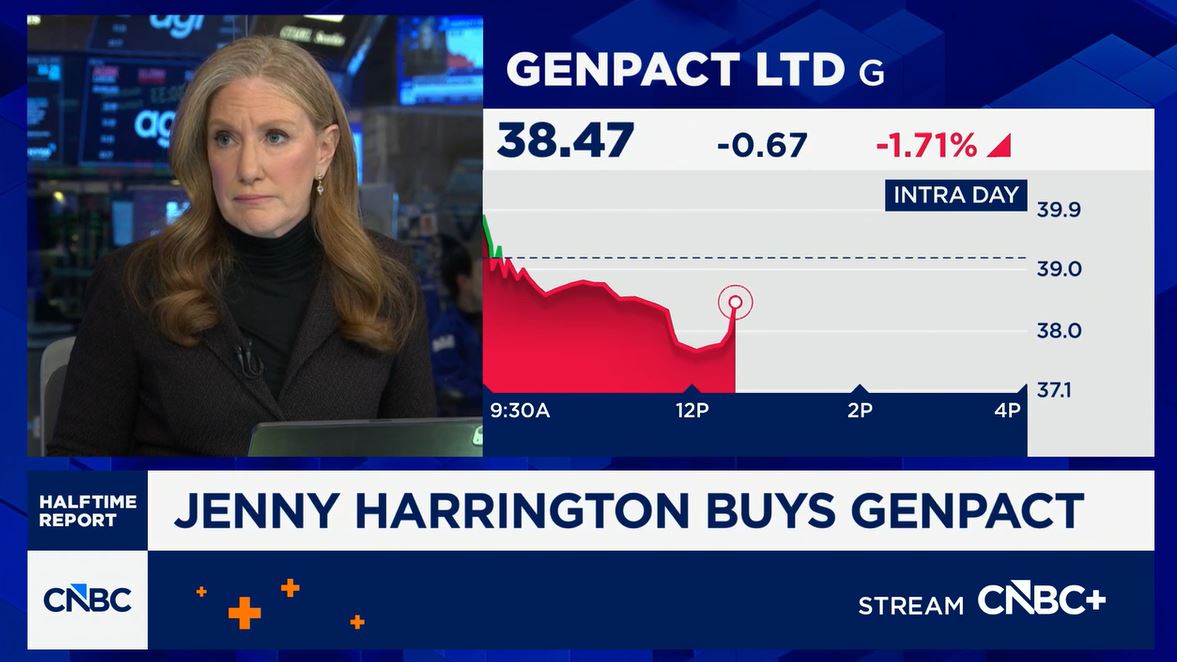
Jenny comes close to being the first to say in weeks that it’s a stock-picker’s market
In the category of Why Bother, Judge on Wednesday's (2/11) Halftime Report for some reason decided to challenge Jenny Harrington on her endless skepticism of the stock market (that she nevertheless fully invests in every day).
Judge asked Jenny about being less than excited about earnings and saying that once you "disaggregate" them, they don't look so great. "Why is the Dow at 50K and why is the equal weight hitting new (sic redundant) record highs every day if earnings outside of the Mag 7 are just kinda-" Judge asked.
Jenny cut in, "No, that is not what I said. I didn't say earnings outside of the Mag 7 are ho hum. I said once you look outside of the Mag 7, you can see a much different picture."
Jenny then said "K-shaped" in the 10th minute.
Judge insisted, "Earnings have blown past expectations. There's no other way to say it."
Jenny said, "This is why I beef against like, 'Hey, earnings are up a lot.' Because I think that just sends people straight back to the same playbook. Where I think that there needs to be more nuance. I think this is a year for active management."
(Translation: Jenny can't stand it that tech stocks, the good ones at least, generally go up. It's a great mindset ... for 2000-01.)
Judge said, "It's not the same playbook ... we've added pages to the playbook." Jenny added, "I don't think the market's great."
We got an ‘at the end of the day’
Joe Terranova was back on the Halftime Report Wednesday (2/11) for the 3rd straight day. (Apparently, he can't drive the volatility point home hard enough.) Joe even said Wednesday's jobs report "validates" what he said a day earlier, "bond market volatility is calm," though Wednesday had "a little bit of a rollover in crypto."
Kari Firestone said the market's "expensive," but one reason is because "there aren't as many stocks to buy."
Kari said earnings are "growing nicely but not great." Judge protested, "What do you mean? ... They're way exceeding expectations." Kari started to say it's "always" supposed to ... improve or something as Jenny cut in, "It's only great in aggregate."
Jenny added, "Once you start to disaggregate ... it's not as good a picture."
Brian Belski said "at the end of the day (snicker), uh, what the market's showing you is that other areas of the market are working, dividend growth, value, small cap."
Joe explained that "momentum can go to different places ... and what momentum is currently (sic redundant) doing, is it's pivoting more towards quality and more towards value."
Belski says Joe’s sale of NFLX means ‘we’re close to the bottom’
In the 2nd half of Wednesday's (2/11) Halftime Report, the panel took up what might be the most interesting stock in the market: NFLX. (This writer is long NFLX.)
Joe Terranova revealed he threw in the towel, saying he sold NFLX after being long since May 2024 at 66.
"I'm saving everyone in America that has a Netflix position; now it can finally go up," Joe cracked.
Joe said you don't want a great winning trade to "turn ultimately into a losing trade."
Judge said "Everybody knows why it's down" without revealing that reason. Joe admitted, "Yeah, it's gonna bounce, but what am I supposed to do? I'm long at 66."
Joe said, "I don't wanna sit here and say 'I bought it at 66 and I sold it at 64' after it went up to 115."
Kari Firestone opined that NFLX may not bounce back soon; "It can hang out down here for quite a while."
Brian Belski still owns NFLX. Judge explained that Belski tends to have a longer-term approach than Joe does.
Belski said of Joe's sale, "I love his move, because it just makes me feel better about my move ... I love how emotional he is about- selling it. That means we're close to the bottom."
Brian said he still owns WBD too. Belski said of NFLX, "I want to own this stock." That prompted Jenny Harrington to draw a greater distinction, saying, "I want to want to own this stock ... I have no idea how AI disrupts this business." Joe pointed out how he could be criticized for not selling at 95. (He also could've pointed out how he kept talking up NFLX and SPOT as a tandem well into the summer as they turned into massive dogs.)
Jenny warns that ‘nothing’s safe’ from AI (except for stocks she likes that are way overdone to the downside)
On Wednesday's (2/11) Halftime Report, Kari Firestone said she bought more APO, saying the sector got hit too hard.
Brian Belski opined, "The market is just kinda goin' down a checklist of where they can pick on, in terms of AI."
Jenny Harrington cautioned that "nothing's safe" from the AI and we don't know the impact yet on some industries.
But moments later, Jenny reported buying G. She said it's down because "there's this great fear that there is disruption from AI coming."
Belski sold MPWR (Judge never bothered to show a chart or graphic) and bought ALAB. Belski also bought PNFP and sold FCNCA.
Jenny finally sold JBLU because it's up "36%" this year and she doesn't see much more, now she can take the capital loss, and of course, tax losses seem to be more important on this show than portfolio gains.
Joe Terranova bought AAPL because there's a "similar pattern match to what existed in August," though he doesn't know if now will be the same "upside." He does see a "3-handle."
Joe called CDNS "undervalued" at 298.
Kari sold HQY and bought BSX. Joe trimmed the XBI. "It seems to be underperforming health care overall," Joe said.
HOOD was taking a tumble. Joe said the earnings report was "not diversified enough" and "too reliant on crypto."
Jenny's "a little worried" that expectations for CSCO are too high.
Santoli said, "It's a 50-50 market most days."
SPOT’s gain is so ‘strong,’ the stock is all the way back to the same price it was ... a week ago
Judge on Tuesday's (2/10) Halftime Report said SPOT is having a "great day." Maybe it was. (This writer is long SPOT.)
Until a day earlier, Judge hadn't noticed this stock for months, despite the fact it had crashed and burned for 6 months after a group of panelists including Joe Terranova, Bill Baruch and Josh Brown had pounded the table for it.
On the show Tuesday, Joe said quality has "never ever" been an issue for SPOT, rather, the "challenge" is the momentum. (Which is like saying, "The reason it's not gone up is because it hasn't gone up.") Joe somehow claimed, "The lift here, it's really strong, it's really important."
How come we never hear about a ‘soft landing’ anymore?
Judge mentioned "K-shaped" in the opening minute of Tuesday's (2/10) Halftime Report. Permabull Stephanie Link said the market's going higher and also said "K-shaped."
Joe Terranova admitted he keeps talking about elevated volatility, but there isn't elevated volatility in the bond market (Zzzzzzzz), which is "remarkably calm."
Josh Brown said we've got an "absurdly strong earnings picture."
Josh called the RSP (Zzzzzzzz) "the No. 1 chart we've been talking about on the show."
Josh impressively explained that "The 'R' in 'RSP' ... that comes from Rydex ... the only company that had an equal-weight index product, and I guess when Invesco bought it, they kept it, the 'R' there." (That practically falls under Fast Money Trade School that Guy Adami and Eric Bolling used to do.)
Joe’s still talking about the Oracle debt offering
Josh Brown on Tuesday's (2/10) Halftime Report said he bought some of his "favorite software names" on the pullback but he doubts there will be a V-shaped recovery because he thinks the market doesn't think all of them will make it.
Joe Terranova brought up "the Oracle debt offering" for the 2nd straight day.
Jim Lebenthal, who didn't have to deal with Weiss' hectoring on Tuesday, called a sell rating on QCOM "way too dramatic," but he doesn't think you have to "rush out and buy Qualcomm."
Joe said MU is high enough above the 50-day that it could still drop, but he takes the "other side" because of the fundamentals of memory.
Stephanie Link bought more SNPS.
What in the world is a HALO stock?
Josh Brown on Tuesday's (2/10) Halftime Report sold OTIS, a stock he had touted more than once; Judge wondered why given that industrials are doing so great. Josh said "the only reason I sold it is because there are too many other opportunities."
Josh was talking about "HALO" stocks; he said "HALO" means "Heavy Assets, Low Obsolescence," and it apparently has something to do with strong companies, but honestly, we had no idea what he was talking about.
Stephanie Link bought EL after its post-earnings pounding "presented an opportunity." (This writer is long EL.)
Judge said the EWZ is up 21% year to date. Stephanie said Brazil is a "power play" and a "very big beneficiary of AI." Joe Terranova talked up the EIS and EWY.
Joe said to "be a little bit careful here" with "somewhat parabolic" GILD. Stephanie is "a little nervous" about ZTS.
Josh said he thinks momentum continues with TOST results, but he continues to be "mystified" by the stock reaction.
Jim Lebenthal said at 116, he's not buying or selling WYNN.
Jim's Final Trade was ORCL, despite gains this week. Joe hung a $1,000 on GS.
SPOT somehow survived the JOET’s most recent rebalancing
This page has complained for weeks about how we haven't heard a word from Joe Terranova in months about SPOT, a stock that only 7-8 months ago he was regularly hailing. (This writer is long SPOT.)
So we were rather shocked to hear Judge bring it up in the 59th minute of Monday's (2/9) Halftime, a segment Judge called "The Setup," even though it was basically Final Trade time.
Joe admitted SPOT is a "falling knife." But then Joe got our Spider Sense going when he actually said it "barely survived the most recent, uh, momentum screen for the rebalance."
How in the world could this stock, in the last 6 months, pass anyone's momentum test???
We looked up the JOET's portfolio, and sure enough, SPOT is in there. (Good. Grief.)
Judge then decided to play trader, stating, "The thing about this is, AI-disrupted." Judge then tried to explain how you can go to "LLM" and put in "Give me the best playlist of these, that, whatever, now it's not the mechanism that actually play the music, but, I don't know, the stock reflects something that is reflective of what I just said."
Honestly, we have no idea what Judge is talking about, but if AI is pulling some kind of Napster 2.0, then that's a much bigger story than the 59th minute of a CNBC program.
Joe noted that the SPOT founder/CEO left the company a while ago, "and they haven't recovered from that."
In case you missed it, Jensen defends AI spending
Joe Terranova at the top of Monday's (2/9) Halftime Report mentioned a bunch of things working including equal-weight (Zzzzzzzz); Bryn Talkington said of the RSP, "let it run."
Steve Weiss said that when there's a correction, everybody says "oh that's healthy," but when the market surges like on Friday and Monday, "Nobody's saying, well that's unhealthy." Weiss concluded, "Valuations right now are too high."
Judge said Melius downgraded MSFT to hold. Weiss drew a comparison to Alphabet a year ago, which he said you can "justifiably" do.
Judge recapped how he asked Jensen on Friday about AI capex. (In replayed clips, Jensen defended it yet again.) Jim Lebenthal said he bought more ORCL on Monday morning. Jim explained, "It's been in a bad period because of this perception that O- that AI is a bubble." But Jim said that Jensen said "these tokens are profitable right now," and that Jensen said people knew that fiber optic spending in the late '90s "wasn't generating revenue."
Basically, when Jim says he’s not going to die on a hill for a stock (as he said a few months ago), he actually will
Back buying all the names he talks about all the time (whether they're good stocks or not) on the Halftime Report, Jim Lebenthal on Monday (2/9) found himself taking some exceptionally good questions — not from Judge, but fellow panelists.
Judge jabbed Jim for recently skiing in France, "winds just blowin' through your hair ... having your fondue" and deciding to buy more ADBE.
Jim said the show had "tremendous" conversations last week about software last week when he wasn't on, and Jim watches it when he's not on. Jim "totally agreed with all of us who were saying, 'This is overblown.'"
Jim added, "Adobe is not getting replaced anytime soon."
Steve Weiss cut in, "I disagree with that." Jim said, "This is what makes a market, and you can disagree with it, that's fine."
Judge then aired a clip of Brad Gerstner from Friday's Super Bowl set saying software names need to prove they're benefiting from AI, or expect lower multiples. Jim said he doubts getting ADBE under a 13 multiple. Jim insisted Brad's points are "already in the stock."
Weiss said there's a difference between MSFT, which makes operating systems, and ADBE and its "security software to protect your documents," and it would "not" be hard to replace what ADBE does. Weiss said, "Instead of paying a license fee for everybody sitting in your company, you could design that same security by using Claude or whatever, you're going to do."
Jim said "You're absolutely not ... because you're not gonna take the reputational risk that all of a sudden your document looks like it's written in sanskrit when you send it to an important client." Weiss said, "I use Docusign all the time."
Bryn Talkington said there's a "tremendous amount of opportunity" in software, but it won't be "V-shaped."
Joe Terranova said he agrees with Bryn, it's not an "all-clear moment" but it won't be V-shaped. Joe said Jim "made one mistake" in discussing ORCL; "you didn't mention last week's debt offering," which according to Joe gave investors "comfort" about the stock; "the CDS tightened on Oracle the most since April of 2021."
Judge may have been right, but bitcoin is more interesting than everyone’s Blue Owl midday trading analysis (including Barry Bannister’s suggestion of possible slide to $38,000 minutes later on Kelly’s The Exchange)
A curious little dispute took place on Monday's (2/9) Halftime Report when Judge pulled an end-around on Joe Terranova.
Bryn Talkington had said she bought more OTF, calling it "overdone." Steve Weiss praised Blue Owl because they "underwrite responsibly ... I've met some of these guys ... they're not taking chances."
Judge then asked the panel, "You guys wanna talk about bitcoin?" But then Judge said, gesturing toward the OTF chart that was still on the screen, "We can stay there for a minute, um, because this stock is moving, and, you know, maybe it's in part on Bryn's move."
Then Judge asked if Joe Terranova had a "last thought here as we look at ... Blue Owl." Which should've made it clear what Judge was talking about. But Joe went on to describe bitcoin. "It's deleveraging ... a lot of margin calls, and we saw a cascading effect of all of that. And ultimately it led to a print of 60,000 in bitcoin."
Joe then compared bitcoin to silver. Judge said, "You talkin' about bitcoin or you talkin' about this, what we're lookin' at on the screen."
Joe said, "You- you mentioned bitcoin. You said, 'Do you want to talk about bitcoin.' You did."
Steve Weiss said, "I'm with you, Scott."
Judge said, "OK. Let's talk about bitcoin. Because I started talking about bitcoin but then mentioned Blue Owl and the move and that's when we went back."
Joe protested, "I heard you say, 'Let's talk about bitcoin.'" Judge then ordered up a bitcoin chart and said Bryn bought more IBIT. Bryn said she bought Friday; "What was happening in crypto felt like a massive washout."
Judge quoted Bernstein as declaring, "The bitcoin bear case is the weakest in its history." Judge revealed, "I feel like it's the exact opposite."
Weiss said ADBE may be in the "too hard bucket" but bitcoin is in the "impossible bucket," because "nobody's been able to tell me what the intrinsic value is here. Nobody's able to tell me what the business use cases are. You can make something up like blockchain technology and security, but that's- that's b.s., we've seen so many of these, you know, bitcoin wallets stolen. ... You've seen some of the bitcoin holders, who incorrectly thought this was a store of value, move into gold."
Weiss said "there's no there there," but he thinks Bryn's right, "theoretically," bitcoin should bounce, but "You need a hundred thousand dollar, a hundred thousand Dow to see this go up."
Everything Weiss says about CLF is true (even as Jim claims he has an ‘edge’ in it)
Jim Lebenthal on Monday's (2/9) Halftime Report actually admitted buying more CLF, which wasn't having the greatest day.
Jim insisted, "You gotta look forward," and he made the usual argument (for years now) that steel prices are going up.
Joe Terranova asked Jim if he could ask him a question "on behalf of the viewer," always a nice gesture. The question was, "Where are the buyers coming in to accumulate" and what to do if it breaks the 200-day; Joe said that the stock was down 17%, "a big move in 1 day," and it's sitting at the 200-day.
Jim told Joe, "you're speaking like a trader" but there's "too much fundamental going on here" that "outweighs" what Joe is saying.
Steve Weiss rattled off Jim's Greatest Hits on this name, "I sold this stock in the 20s; you thought it was goin' to the 40s; you said it's not a commodity business, that, that, that they'll always generate mounds and mounds of free cash flow, and- and they haven't, so at what point do you say, you know what, 'I'm in love with this,' rather than I'm an investor in it."
Jim said he respects the question, but when he has a "fundamental thesis" or "edge" in a stock, when it goes down, he buys it. Jim said CLF has invested in acquisitions that have lifted sales from $2 billion to $20 billion.
This page thought entering playoffs that the Texans would win, 2nd straight bad Super Bowl call
Steve Weiss on Monday's (2/9) Halftime Report revealed he is trimming UBER. He said it's partnering with Waymo, but "partnering doesn't get you the same margins, so clearly margins will take a hit."
Weiss also trimmed NFLX. (This writer is long NFLX.)
Joe Terranova bought more GLW. Joe said it got a higher ranking in the JOET rebalance. (The same rebalance that found SPOT investable.)
CNBC's gorrrrjus MacKenzie Sigalos made what we think is her debut hosting ETF Edge.
Contessa Brewer reported on the brisk amount of gambling for the Super Bowl and how someone made $245,000 on the coin toss. Judge said, "Seahawks and the under was a, a very popular and lucrative bet ... people thought that that was a pretty good, if not sure bet going in." (Yes, and it paid off, but sometimes, those "very popular" bets are wrong.)
Contessa revealed, "I should say, we have a disclosure here: CNBC and Kalshi have a commercial relationship which includes customer acquisition and a minority investment."
Steve Weiss wondered, "Were there any bets on Bad Bunny having more ground yards than the Patriots." Judge said "we gotta go" and told Weiss, "I saw that somewhere else; you ripped that off."
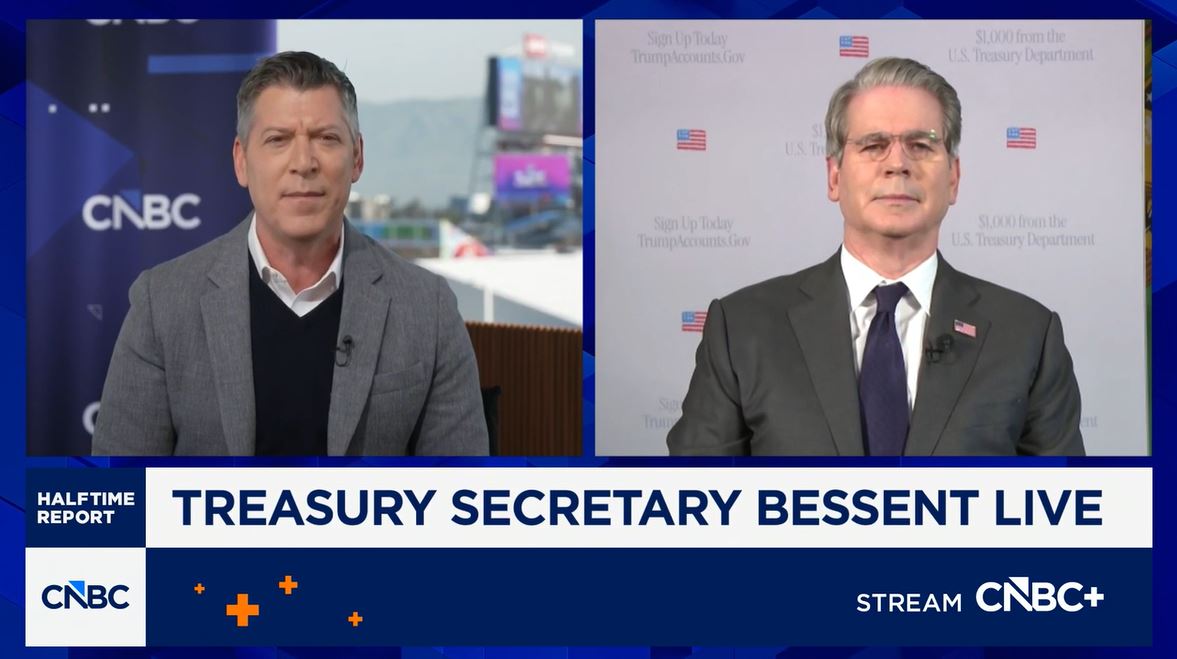
Treasury secretary doesn’t know about VSNT
Late into Friday's (2/6) Halftime Report in Santa Clara, Judge welcomed Scott Bessent, who wasn't in Santa Clara but said Trump Account signups are "going fantastic."
Scott said he wanted to give a "shout-out" to CNBC's "parent company (sic) (snicker), Comcast," saying senior management has been "very helpful." (Ah, a cable giant being "very helpful" to the administration.) Scott said the impact of the Trump Accounts on our "national psyche" may not be felt for even "60 years." That's a long time for gauging impact. ("Hey, didja hear what LBJ's up to??")
Judge asked Scott about the "alleged joke" Donald Trump made about "firing" (sic, joke was reportedly about "suing," not firing) Kevin Warsh if he doesn't cut rates, and Scott's response to Liz Warren in the chippy Senate hearing. Scott said Sen. Warren "seems to have no sense of humor" but "it was a joke" and "the president also made a joke about her not having reservations, so, we know what that's a reference to." Scott said Kevin brings "great credibility" to the Fed chair job.
Judge asked Scott if the Powell investigation should end. Scott punted to Jeanine Pirro but claimed senators reached a conclusion of "No crime, but probably guilty of incompetence." So we have a Treasury secretary labeling someone appointed by his own president as incompetent.
Bessent was not asked who is going to win the Super Bowl.
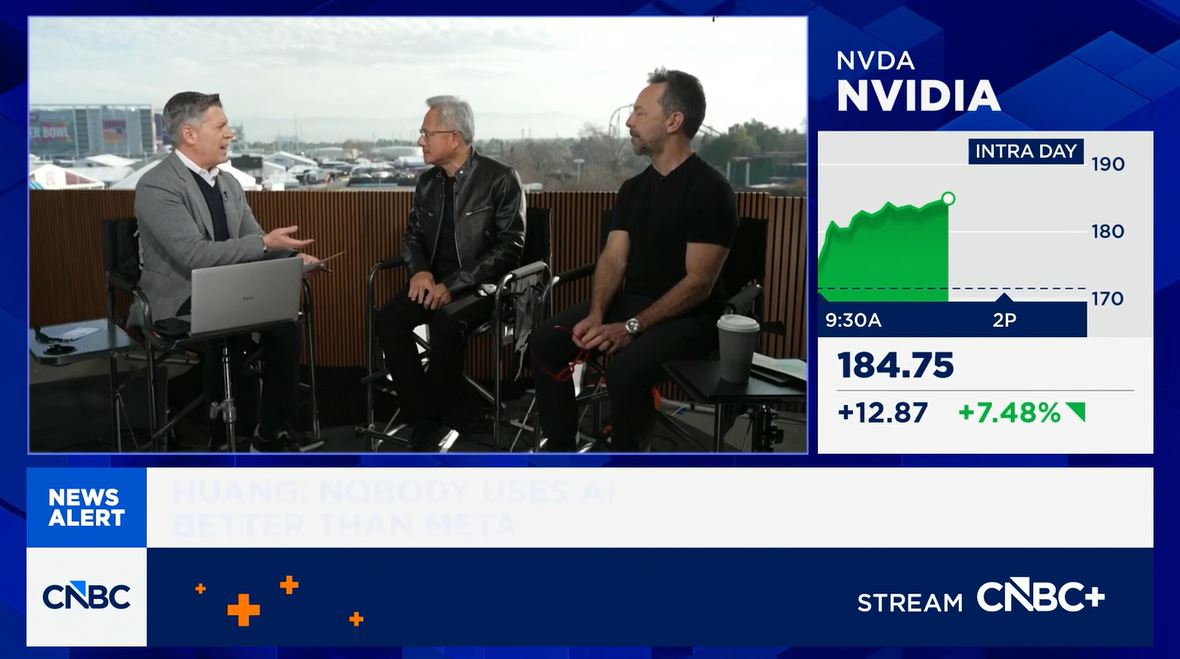
Jensen insists there’s no drama between him and OpenAI
Judge managed to land Treasury Secretary Scott Bessent for Friday's (2/6) Halftime Report.
And Bessent wasn't even the biggest get of the show.
That would be Jensen Huang. (Who admittedly isn't really "exclusive" these days given that he's giving speeches seemingly hourly and talked to Cramer a few days ago. But still.)
Judge just a day ago admitted, "We keep, you know, regurgitating the same conversation" about AI capex.
In fact, some folks think companies may actually be overdoing it.
But Jensen, who was in Santa Clara with Judge and Brad Gerstner, will tell you anything but and did so Friday.
"Demand is sky-high," the world's AI evangelist said. "Artificial intelligence is going to fundamentally change how we compute everything."
Jensen said that in the past year, we've seen AI "no longer hallucinating" but becoming "super useful."
Jensen said nobody's using AI better than META.
Brad Gerstner, who was also on hand for the entire show, likened AI spending to Jeff Bezos' spending on AWS.
Judge asked Jensen about investors with "PTSD" who are seeing "certain things" from "the last time tech went through this revolution and evolution." Jensen said "it's good to always reflect on history ... but history doesn't repeat."
Judge asked Brad if he's concerned about another DeepSeek; Brad praised Jensen for "putting forth an American agenda."
Judge asked Jensen if there's "really no drama" between him and OpenAI. Jensen insisted "there just isn't." Judge didn't ask Jensen to compare Seahawks defensive line with Patriots defensive line and whether AI has declared a winner in the game.
The Super Bowl is being broadcast by a Comcast property, which is probably why Judge is out there (even though VSNT is supposedly separate and able to license content to different media entities)
Friday's (2/6) Halftime Report was so chock-ful of A-list guests, the regular panelists (especially Steve Weiss) barely got more than a soundbite.
Brad Gerstner joined Judge in Santa Clara. Brad gushed about AI capex spending. Brad said there's a "fog of war" (snicker) whenever we have a "parabolic" rate of change in something or other.
Josh Brown said he's got "residual ice in the driveway" while Judge and Brad "will be at the game." Josh said he's not saying software has hit bottom, but he rattled off a bunch of extremely low RSIs, and if you were an "active seller" on Thursday without a margin call, "you're a donkey."
Malcolm Ethridge bought AMZN. Malcolm said that since COVID, "Retail investors are actively trading a lot more than they used to be."
Weiss said of AMZN, "The guidance was a little disappointing." He's not selling; it's not one of his "larger positions."
Brad Gerstner touted AI capex, saying, "I think for the next 3 years, this is like building the interstate highway system."
Eamon Javers reported on the video on Truth Social being taken down. Judge noted that the White House first claimed there was "fake outrage" about the video until it reached a "crescendo" and left the White House "no choice."
Josh mentioned the PLTU, which we'd never heard of; it sounds like he's not a big fan of it; "you really have to nail the timing." But Josh said this week can be great for longer-term investors who are seeing big drops in stocks they like.
Honestly, Judge talked to some football greats, but they didn’t talk much about either football or investing
The star guest of Thursday's (2/5) Halftime Report was Joe Montana, who joined Judge at CNBC's minuscule set in San Francisco.
"Joe Montana is scoring big in the field of venture capital," Judge proclaimed, but viewers didn't exactly get any tips on privately held startups that Joe finds promising.
Joe got into this, apparently, because of a a few teammates. "Harris Barton and Ronnie Lott knocked on my door and said, 'Hey, we want to start a fund of funds in venture,'" Joe recalled to Judge.
(Joe also mentioned selling his house and then having to drive 2 hours, sometimes 4 hours, to get around the area.)
Joe said in venture investing, it's about "people" and you're "betting on" the founders.
Judge asked if being on the cover of Worth (snicker) magazine is as good as being on the cover of SI. Joe said, "I see it in a different light." (Translation: The answer is "no.")
On the Super Bowl, Joe said "I like Seattle" and pointed to Sam Darnold and "what he's been through"; "I'm sure people in Minnesota are kickin' themselves for lettin' him go." (Well, depending on what happens Sunday, maybe they won't be.)
Joe made an interesting distinction between quarterbacks who look at their own bench where "they're telling him what to do," and if QBs can't read defenses and make decisions on their own, "by the time you get to the NFL, it's too late."
Another Super Bowl-winning QB, Joe Theismann, visited with Judge near the end of the show and talked about how stocks "fill the void" after football. Joe said AI is a "whole new era." He's been "bullish" on nuclear for a while. Joe likes OKLO and SMR, pointing to all the data centers in Virginia. As Joe mentioned, he's been on CNBC before, actually in the very early days of Fast Money, when Eric Bolling chided Joe for "averaging down."
Joe said SNOW is "a little expensive for me." In the Super Bowl, Joe said he likes Seattle, "very dominant" defensively and the team that's "best equipped to be able to throw the ball around."
A third guest in SF was Kenny Dichter of Real SLX partners (he used to be with Wheels Up), who joined Judge in between the two quarterbacks. (Maybe Kenny has been on more Worth magazine covers than Joe Montana has.) We don't really know what Real SLX does except that it apparently hosts events for elites at big sporting events, including a Rao's popup at the Ryder Cup that was apparently a really big eal, and now Kenny's got something going with the Super Bowl. Kenny praised V for being "quick" and "agile."
Joe, Bill and Josh all touted SPOT last year, not talking about it anymore
Judge helmed Thursday's (2/5) Halftime Report from CNBC's dinky San Francisco studio, where he would conduct interviews with a couple of NFL greats.
All the regular panelists were remote and got limited soundbites. Josh Brown described the selloff as, "This is not very complicated — these are some of the biggest winners over the last 3 years, where you're seeing the maximum amount of pain."
Josh said, "Pepsi and Coke look like they just discovered a cure for cancer," but he said those kinds of gains don't have "anything to do with fundamentals."
Even Judge admitted to Bryn Talkington, "We keep, you know, regurgitating the same conversation," about AI capex. (Yes. So why does Judge, who runs the show, keep regurgitating it.)
Bryn said Alphabet had an "amazing" call and said "the hedge funds just wanna take everything down," but you should be "choosy" and "opportunistic."
Joe Terranova, who was in that pandemic-era room with a whiteboard and numbers on the walls, said he mentioned "AI fatigue" a day earlier and doubled down on that.
In a bit of an understatement, Bill Baruch said the "larger environment" of the market is that "there is a wave of selling that's kinda- that's taking place."
Bill ditches bitcoin
Bill Baruch on Thursday's (2/5) Halftime Report said he sold IBIT and COIN, saying $75,000 had been "big support" for bitcoin.
Bill said COIN has gone "straight down" since that legislation didn't get passed in mid-January.
Josh Brown bought more TOST, which he stressed is an investment and not trading.
Joe Terranova said he likes KLAC, AMAT and LRCX; he thinks it's semis over software.
Bill trimmed MU, which Judge said went "parabolic." Bill said it's been a "double table-pounder" and had a "heckuva move." Of course, he only sold it from a "risk-management standpoint."
Booted from the internet
Regarding a stock that provoked conversation on the Halftime Report every time it's mentioned, Josh Brown said he did an "average up" in buying more UBER.
Josh said there's been a trend of the stock sliding on earnings based on autonomous questions, and "yesterday was the dumbest" selloff.
We get Josh's rationale, however, it wasn't really any different than what he always says. Josh said autonomous cars will eventually be "rolling toaster ovens" and all that will matter is the platform.
Bill Baruch said he trimmed UBER before earnings and this is a "good place" to buy more.
CNBC's Kate Rooney discussed the new Anthropic Opus whatever.
Bryn Talkington bought GEV, the stock Stephanie Link mentions on every show. As Bryn spoke, Josh was heard to say "I just got kicked off the internet."
Bryn made ZM her Final Trade, which Joe owns personally. Bill offered PLTR, saying there's big support at 120-130. Josh said KNSL and Joe said MRK.
‘Same place’ as Oct. 29
Wednesday's (2/4) Halftime Report was kind of more of the same, but guest host Frank Holland and crew, to their credit, put together a crisp show.
Joe Terranova opened by pointing out, "We're literally in the same place we were on October 29th. ... The volatility's kind of elevating."
Liz "ETF" Thomas said software is a "sentiment trade" with "a lot of indiscriminate selling going on." Even so, "I think some of the selling is just getting a little ahead of itself." Liz predicted churn for a "couple months."
Jenny Harrington asserted that "There are babies being thrown out with the bathwater and opportunities being created," though Jenny doesn't think ETFs are the way to play it. Jenny claimed, "I think there are companies out there that will go to zero," and there are others that are down 50% that will still have a "return."
The "zero" comment raised some eyebrows. Of course, in any given year, some publicly traded stocks are indeed going to zero. But those generally aren't the stocks mentioned on the show.
Jason Snipe said the current market is almost a "protracted Deepseek moment," and though he thinks software in general is kind of expensive, he thinks there could be "harmony" between software companies and AI.
Joe says people can have ‘fatigue’ with owning a stock
Joe Terranova on Wednesday's (2/4) Halftime Report blamed AMD's selloff on "fatigue," which is curious; evidently people grow tired of making money (but what about the "fatigue" in SPOT?).
Joe said what you do "depends on where you entered AMD." (Tip: Your cost basis has no bearing on whether the stock is going up or down.) (Second tip: If you are more concerned about taxes than whether your stock account goes up, you should probably switch to Treasurys and CDs.)
Joe said "uncline" (sic) (snicker) (we haven't heard that one before; that's a good one) and quickly corrected to "decline." (Joe doesn't seem inclined to talk about the "uncline" in SPOT since last summer.)
Bill Baruch, who wasn't on Wednesday's panel, joined remotely to say he trimmed GOOG and AMZN; it's "less of a conviction and more about risk management" (Zzzzzzzzzz) (Then why in the world did he have to dial in to the show).
Joe said LLY had a "spectacular quarter."
Jason Snipe said ABBV's slide is "a call on what's going on with Humira." Jason mentioned a number of products that are heard often in TV jingles around the time of the evening news.
Jenny gushed about how GSK and RGON and BMY "all are minting cash," even though the new GSK CEO makes Jenny a "tiny bit nervous."
Jenny: UBER selloff ‘dumb’
Guest host Frank Holland asked Jason Snipe on Wednesday's (2/4) Halftime Report about UBER sliding.
Jason said, "The big thing for me is, they continue to invest in autonomy," though there's a little concern about profitability and guidance. He claimed there will be "price appreciation" in the future after these investments "filter" through the company.
Jenny Harrington said "it's confusing to me that people don't appreciate this right now." Jenny said Wednesday's selloff is "dumb." Joe Terranova admitted, "I don't feel good about it," and the stock is "breaking down." Joe said the 12-month Street target is still "somewhere around" $102.90.
Joe bought GLW, though it's a "smaller position." Joe bought TKO even though it was removed from the JOET; it only "barely missed the cut."
Joe said XOM hit a 52-week high and asked Santoli about energy. Santoli said it's hard to tell how much is long-term belief or people just moving money around the market, but there's maybe a sense that there's a "floor in crude."
Liz "ETF" Thomas said materials are still "very underowned" and she's still "long, strong and bullish."
Joe said the WMT valuation is "extreme" and he would not "reach" here.
Jenny made the case for CSCO after giving a speech about the importance of when you buy a stock.
When is Joe going to talk about the anvil that is SPOT; on July 29 he said, ‘12 months from now, you’ll certainly be rewarded,’ it was actually over $600 then; where is this reward ... (a/k/a Bill Baruch actually touted it even more)
Most Halftime Report panelists correctly remain bullish even during rocky market times.
However, when the rockiness keeps happening off and on and panelists can barely contain how much they want to keep buying, it makes the conversation kinda stale.
Such was the case Tuesday (2/3), when Josh Brown opened saying it happens a couple times a year where popular trades get "absolutely nuked." He even quoted Taylor Swift lyrics.
Josh explained that "the ground zero is the application layer of the software stack."
Judge pointed to the struggles of the IGV. Joe Terranova said it's a "real theme" that doesn't go away this year. Then Judge said maybe people will decide it's "way overdone." Because within days and not hours, everyone will be buying again, until they sell it all off again.
Permabull Stephanie Link, who is never concerned about a market selloff, was talking up the PMI for the 2nd straight day. Stephanie touted cybersecurity.
Shannon Saccocia said "there's plenty of other places to go" besides tech for growth.
Judge asked Josh about TTAN being in the "eye of the storm" of the selling. Josh said the selling is just "indiscriminate" and "sector-wide."
Josh said things like commodities, which aren't replaced by AI, are "safer" right now.
In a really long-winded discussion about NVDA and others that persisted through the show, Judge questioned, "Is there growing friction between Nvidia and OpenAI?," then gave way to Kristina Partsinevelos for a report, then to Kate Rooney for more on Sam Altman (Zzzzzzzzzzzzzz) (#enuffalready).
Joe gave a speech about PLTR and said it would've been good to have a bigger pop Tuesday and said the JOET's had it since 16. Joe also touted ZM.
Josh bought DVN under the theory that money being drained from tech has to be going somewhere. Josh said the DVN "massive downtrend" since May 2022 is "over."
Stephanie sold MMM because she made 70%, so Judge would need to spend only "5 seconds on this."
Josh mocked Baird's JPM upgrade to neutral with a target of 280. "So they're bullish, but they think the stock's worth $50 less. So do I sell it and buy it back?" Josh said in the next couple of years, it's a "$500 stock," he'll "ignore" this call.
Josh mentioned that WMT joined the $1 trillion club.
For his Best Stocks list, Josh talked up TRGP, GWW and CTVA.
The JOET bought PHM. Stephanie Link said homebuilders are "minting money."
Judge did have a lengthy (by live TV standards) chat with Jim Stewart about DIS on Closing Bell. (See our home page.) Jim claimed it's a "solid" and "good" CEO choice basically because he's "personable" and because Bob is really willing to step down this time. (So why did he step down the last time.)
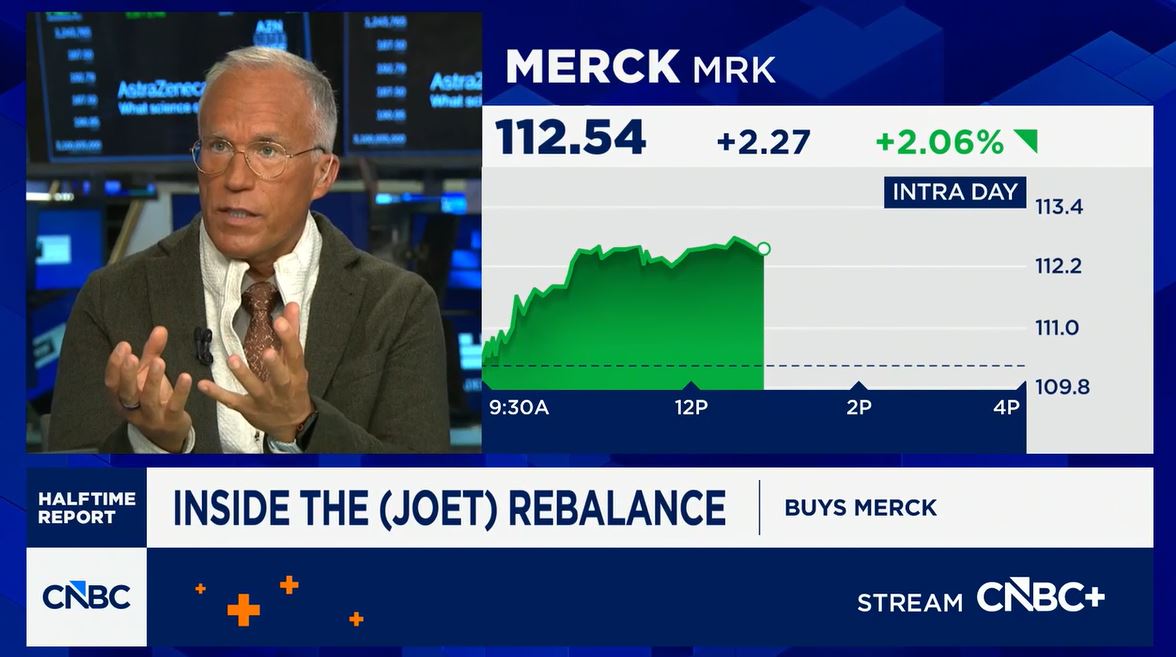
‘Majority of the gold trade is over’
Brian Belski on Monday's (2/2) Halftime Report made one of those comments that, 11 months from now, should figure into the Call of the Year or Bust of the Year conversations, asserting, "The majority of the gold trade is over." Belski suggested it typically underperforms after achieving 3 standard deviations of something or other.
Judge sort of buried the show's lede until the 25th minute (that's correct, minute, not "25th Hour," the Spike Lee movie), revealing that the JOET actually sold AMZN and META. Joe shrugged that "the rules are the rules."
Judge and Joe haggled over whether retail investors have finally infiltrated futures trading.
Judge asked Joe about APH being in the JOET forever. Joe said it's a "steady company." The JOET sold NFLX and DIS. (This writer is long NFLX.) Joe said NFLX's momentum "without question" has "broken down." (Gee, how could anyone ever figure that out.) (Are there charts of stocks online?) Belski though said of NFLX, "We're more inclined to buy more down here."
The JOET bought MRK, which Joe personally sold (so yet again, Joe spoke of the "uncomfortable position" he feels from owning something personally that's also in the ETF (Zzzzzzzzzz)).
There was a lengthy discussion including Kristina Partsinevelos and Kate Rooney about NVDA's financial "commitment" to other companies (Judge said that's his own word and not Nvidia's) or lack thereof.
Judge tried convincing Joe at the top of the show that market volatility (Zzzzzzzzzzz) may ease in February. "I don't think anyone should expect that," Joe countered.
Stephanie Link noted "the VIX is only 16."
We heard Judge mention "linear" (Zzzzzzzzzzz) (snicker).
Anastasia Amoroso said "I think we have the Fed on our side." (We can't wait to see how much more handsome the new chair will be than the current one at the Federal Reserve press conference.)
Stephanie Link bought SNPS.
Judge said Belski was wearing a "Snuggie" under his jacket and asked Brian if he's warm enough.